
How Air & Ball Temperature Affects Your Golf Ball’s Flight
This post contains affiliate links. As an Amazon Associate, we earn from qualifying purchases.
This post contains affiliate links. As an Amazon Associate, we earn from qualifying purchases.
Temperature affects golf ball flight through two primary physical forces: air density and ball resiliency. Colder air is denser, increasing drag and reducing carry distance by roughly two yards for every 10°F drop. A cold golf ball also loses resiliency, reducing its coefficient of restitution (COR) and costing an additional 2–4 yards of ball speed. The optimal temperature for maximum distance and feel is between 59°F and 95°F.
The air-density penalty is the main driver, but the ball’s own temperature matters just as much on a cold morning. That’s where most weekend players get caught—they layer up but leave the balls in the trunk.
What follows: the exact yardage penalties from peer-reviewed data, the legal trick for keeping balls warm, why humidity actually helps distance, and how to rebuild your club selection for any forecast. By the end, you’ll stop guessing and start calculating.
Key Takeaways
- Expect to lose about two yards of carry for every 10°F drop in temperature, purely from increased air density.
- A ball stored below 50°F loses resiliency, cutting ball speed by 1–2 mph and adding another 2–4 yards of lost distance.
- The official R&A and USGA equipment test standard is 75°F—that’s the baseline all ball performance is measured against.
- Humid air is less dense than dry air, offering a slight distance boost unless rain or dew adds surface drag.
- A 10 mph headwind hurts 3x more than a 10 mph tailwind helps due to amplified lift and drag on a spinning ball.
Temperature Effects: The Numbers You Need to Know
Forget vague estimates. The relationship between temperature and golf ball distance is quantified. Aerodynamic research from the USGA Equipment Standards group, confirmed by millions of shots in the Trackman dataset, establishes a reliable rule: a golf ball travels approximately two yards farther for every 10°F increase in temperature.
This is the 2-yard rule. It’s driven by air density, which controls drag. The standard reference air density is 1.225 kg/m³ at 59°F. At 40°F, density rises to about 1.29 kg/m³. At 90°F, it falls to roughly 1.16 kg/m³. That’s a 10% swing.
On a 250-yard drive, that 10% density change translates to 8–12 yards of carry difference between a cold morning and a warm afternoon. The Titleist Performance Institute has measured this effect across ball models; the density-driven change is consistent.
Where this goes sideways: Assuming the air is the only variable. A cold ball and cold muscles compound the penalty. Add a 15 mph headwind and that 250-yard drive can become a 210-yard reality.
The Cold Ball Penalty
Air density is only half the story. The golf ball itself performs worse when cold. Modern cores are synthetic rubber, typically polybutadiene. Like any polymer, it gets stiffer as temperature drops.
This stiffness reduces the ball’s coefficient of restitution (COR)—its ability to spring off the clubface. Independent testing cited in USGA validation protocols shows a ball stored at 40°F has a measurably lower COR than one at 75°F.
In practical terms, a cold ball compresses less efficiently. It comes off the face 1–2 mph slower. That alone costs 2–4 yards of carry on a driver. Combine this with the air-density penalty, and a golfer playing in 40°F weather with a cold ball loses 12–15 total yards compared to an 80°F round.
This is the physics behind the old caddie trick. Keeping balls in a warm pocket preserves COR. Rule 4.2 permits warming a ball by any method between holes, and you may substitute balls between holes. Rotating two balls from your pocket is legal and effective.
The Optimal Temperature Window
Manufacturers design balls to perform within a specific thermal range. According to Acushnet Company’s US Patent 7872087, the “optimum temperature for maximum driving distance and a ‘soft’ feel is about 59°F to about 95°F.”
This isn’t a marketing claim. It’s a specification for the polymer chemistry in Titleist balls. The patent describes compositions aimed at limiting COR change to 5% or less with a 15°F temperature drop. The governing bodies’ test standard reinforces this: the R&A and USGA Overall Distance Standard uses 75°F as its baseline for all equipment conformity testing.
| Condition | Air Density | Effect on 250-yd Drive | Primary Cause |
|---|---|---|---|
| 40°F / 4°C | ~1.29 kg/m³ | -8 to -12 yards carry | High drag (dense air) |
| 75°F / 24°C | ~1.225 kg/m³ | Baseline (no adjustment) | R&A/USGA test standard |
| 90°F / 32°C | ~1.16 kg/m³ | +4 to +6 yards carry | Low drag (thin air) |
| 40°F + Cold Ball | N/A | -12 to -15 yards total | Drag + reduced COR |
How Humidity and Wind Change the Equation
Temperature doesn’t work in isolation. Humidity and wind modify the air-density effect, sometimes in counterintuitive ways.
The Humidity Myth: It Actually Helps
Most golfers feel humid air is heavy. The physics says the opposite. Dry air is mostly nitrogen (molecular weight 28) and oxygen (weight 32). Water vapor (H₂O) has a molecular weight of 18.
When humidity rises, lighter water molecules displace heavier air molecules. The number of molecules per volume stays roughly the same, but the average weight drops. Lower mass per volume means lower density.
At 90°F with 100% humidity, air density is about 1% lower than at 0% humidity. On a 250-yard drive, that’s a 1–3 yard gain. It’s small, but real.
The complication is surface moisture. Rain or dew on the ball disrupts the dimple pattern’s boundary layer. This can increase drag by 5–10%, costing 3–8 yards. So, humid but dry air helps. Wet conditions hurt.
Wind Physics: Why Headwinds Are Brutal
Wind interacts with a spinning ball asymmetrically. A driver shot has backspin, which creates lift via the Magnus effect. A headwind increases the ball’s speed relative to the air, amplifying both drag and lift.
The ball balloons, stalls, and drops steeply. Trackman data confirms a 10 mph headwind reduces carry by 15–17 yards on a 250-yard drive. A 20 mph headwind can cost 30–37 yards.
A tailwind decreases relative speed, reducing drag and lift. The ball flies lower and gains distance, but less than the headwind takes away. A 10 mph tailwind adds only 5–10 yards.
This asymmetry dictates strategy. Respect headwinds more than you reward tailwinds. Into the wind, club up and make a controlled 75% swing to reduce spin loft. Take more club than you think.
Combining Factors: Real-World Adjustments
On the course, conditions stack. You need a method for adding up the penalties and bonuses.
Let’s walk through a common scenario: a 40°F morning at sea level with a 15 mph headwind.
- Temperature Penalty (40°F vs. 75°F): -8 to -12 yards.
- Cold Ball Penalty: -2 to -4 yards.
- 15 mph Headwind: -22 to -26 yards (scaled from Trackman data).
- Potential Wet Ground (no roll): -10 to -20 yards of total distance.
Total Driver Impact: Your 250-yard baseline drive now carries 200–210 yards and may roll only 5 yards. That’s a 40–50 yard loss. You’re hitting a 3-wood to reach a typical drive distance.
The adjustment isn’t just for driver. Every club in the bag is affected proportionally. Your 150-yard 7-iron becomes a 130-yard club. That’s a two-club difference.
Easy to miss: Altitude overpowers temperature. Playing at 6,000 feet in 40°F weather, you’ll still hit the ball farther than at sea level in 80°F calm. The effects of altitude on air density are the single largest environmental variable.
A Practical Adjustment Framework
Don’t memorize charts. Build a simple pre-round routine.
- Check the temperature. Apply the 2-yard rule per 10°F deviation from 75°F. 50°F? That’s -5 yards.
- Check wind direction and speed on each hole. A headwind costs triple its tailwind benefit.
- Warm your balls. Keep two in a pocket. Rotate them every hole to maintain core temperature.
- Club selection rule: Add one club for every 15°F below 75°F. Add two more clubs for a 10+ mph headwind.
- Forget feel. On a cold, windy day, your normal “smooth” 7-iron swing produces a 5-iron distance. Swing the 5-iron.
This framework turns weather from an obstacle into a calculable part of your strategy. It’s the difference between flying a green by 20 yards and sticking an approach.
Golf Ball Selection and Temperature
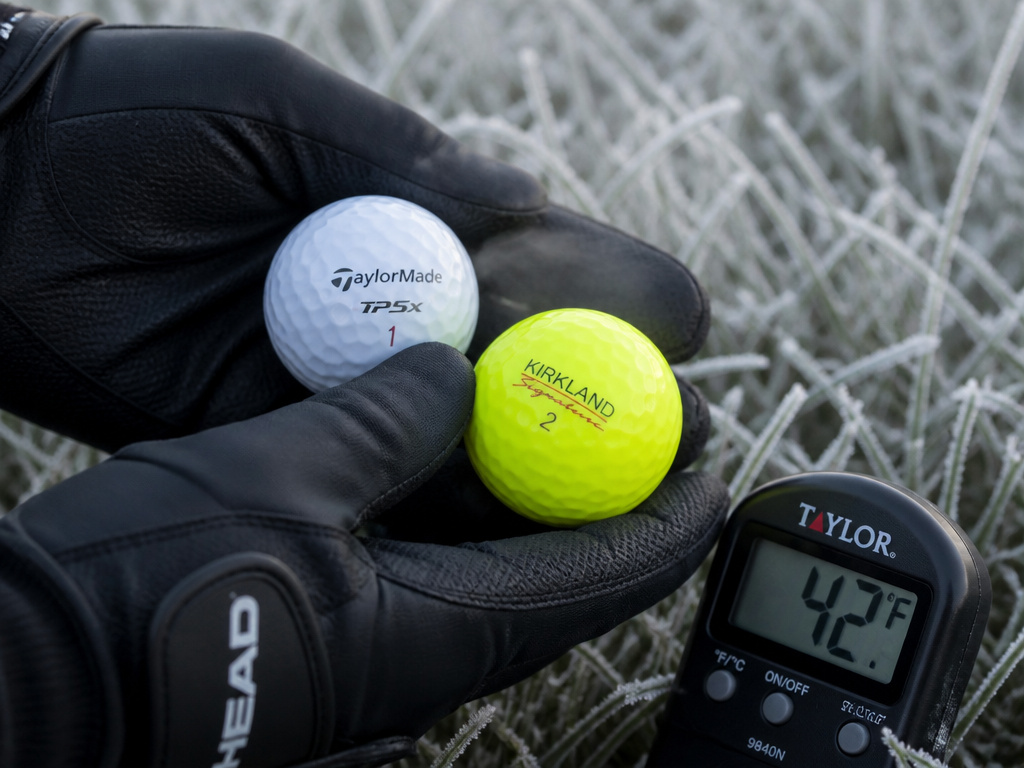
Should you switch balls in the cold? Titleist’s official advice says not to chase compression. Modern balls aren’t sold in different compressions like old wound balls; switching means changing models entirely. They recommend using room-temperature balls to make compression a “non-issue.”
That’s the correct first step. If your gamer ball is a Titleist Pro V1, warming it is more effective than switching to a lower-compression model you don’t know.
However, if you consistently play in sub-50°F weather, a lower-compression ball can help. Softer cores retain a higher percentage of their COR when cold. Models like the Callaway Supersoft or the Srixon Soft Feel are designed for moderate swing speeds and can be more forgiving in the cold.
The golf ball construction matters. Two-piece Surlyn-covered balls are often firmer. Multi-layer urethane balls like the TaylorMade TP5 or the Bridgestone Tour B XS have softer cores beneath firmer mantles, which can help maintain feel.
| Ball Model | Construction | Cold Weather Consideration |
|---|---|---|
| Titleist Pro V1 | 3-piece Urethane | Excellent all-rounder; keep it warm. |
| Callaway Supersoft | 2-piece Surlyn | Low compression helps in cold; less spin. |
| Srixon Z-Star | 3-piece Urethane | Softer core than some competitors; good feel. |
| TaylorMade Distance+ | 2-piece Ionomer | Very low compression; designed for distance in all temps. |
Don’t overthink it. Warmth trumps model. But if you’re buying balls for a winter golf trip, lean toward the lower-compression end of your preferred brand’s lineup.
Frequently Asked Questions
Does a golf ball go farther in hot or cold weather?
Golf ball goes farther in hot weather. Warm air is less dense, reducing drag. A warm ball also has a higher coefficient of restitution, transferring energy from the clubface more efficiently. The combined effect can add 10+ yards to a drive on a 90°F day versus a 40°F day.
How much distance do you lose per 10 degrees?
You lose about two yards of carry distance per 10°F drop in temperature, based on the air-density change. This is the standard 2-yard rule used by the USGA and Trackman. This applies to every club in your bag proportionally.
What is the best temperature for golf ball distance?
The best temperature range for maximum distance and feel is between 59°F and 95°F, according to Acushnet Company’s patent on golf ball compositions. The R&A and USGA use 75°F as the standard testing temperature for all golf ball performance specifications.
Why does a cold golf ball not go as far?
Cold golf ball doesn’t go as far for two reasons. First, the cold air is denser, creating more drag. Second, the ball’s core material stiffens, reducing its coefficient of restitution (COR). This means it compresses less at impact, resulting in lower ball speed and less energy transfer from the club.
Do professional golfers change balls for cold weather?
Most professionals do not change their ball model for cold weather. They rely on keeping multiple balls at room temperature and rotating them during the round to maintain consistent performance. They adjust their club selection and expectations for the reduced distance instead.
Before You Go
Temperature isn’t just something you dress for. It’s a core variable in your distance equation, as concrete as your swing speed. The 2-yard rule gives you a starting point. The cold-ball penalty explains why even perfect contact falls short on a frosty morning.
The fix is straightforward. Check the forecast. Apply the yardage math—one club for every 15 degrees below 75, two more for a headwind. Keep your next ball in your pocket. That’s the entire adjustment.
Advanced players integrate this with other principles of ball flight. They know a headwind requires less loft, that humidity offers a tiny boost, and that altitude trumps everything. This turns weather from a nuisance into a layer of strategy you can actually use.
Your driver doesn’t know it’s cold. Your 7-iron doesn’t feel the wind. But you can know, and you can feel it for them. That’s how you shoot the same score in October as you do in July.
