
How the PGA Tour Works | The Changes That Reshape Access
This post contains affiliate links. As an Amazon Associate, we earn from qualifying purchases.
The PGA Tour works as a season-long meritocracy where players earn status and tournament access through the FedExCup points race. For the 2026 season, key changes tighten access: full-field event maximums drop to 144 players, with many fields set at 120; exempt status now requires a top-100 FedExCup finish (not top-125); and the path to the lucrative Signature Events runs through the Aon Next 10 and Aon Swing 5 rankings.
That shift from a 125-player safety net to a top-100 cutoff is the single biggest change for players fighting to keep their cards. It turns what was a comfortable buffer into a knife-edge fight over the final FedExCup Fall events.
What follows is a breakdown of the three-tiered competition: the FedExCup regular season that builds your resume, the Priority Ranking that dictates your weekly schedule, and the playoff and fall series where next year’s status is won or lost. By the end, you’ll read a tournament field list and know exactly why each player is there.
Key Takeaways
- The FedExCup points list is everything, it determines exempt status, Priority Ranking order, and qualification for the Playoffs and Signature Events.
- For 2026, exempt status is guaranteed only to the top 100 finishers on the prior season’s FedExCup list, a tightening from the historical top-125 rule.
- Signature Events are eight limited-field tournaments with $20 million purses; access is primarily for the prior season’s top 50, plus hot players via the Aon Next 10 and Aon Swing 5.
- The FedExCup Playoffs cut from 70 to 50 to 30 players, with quadruple points on offer, culminating in a 30-man, even-par start at the TOUR Championship.
- Alternate paths to the PGA Tour exist through Korn Ferry Tour promotion, Q-School, and DP World Tour rankings, but all funnel into the same FedExCup points system.
The FedExCup: The Season-Long Meritocracy
The entire PGA Tour ecosystem runs on FedExCup points. Think of them as a season-long currency. Every finish in an official event earns points, with more awarded for better finishes and for winning stronger fields.
The FedExCup is a season-long points competition offering nearly $100 million in Bonus Money and culminating with the FedExCup Playoffs. Players vie to become the FedExCup Champion, which distinguishes the one player who not only performs well during the FedExCup Regular Season, but also excels through the pressure of the Playoffs.
This isn’t just about one big check. Your year-end points total locks in your status for the following season. The 2026 change is stark: only the top 100 on the final FedExCup Points List get full exempt status. Finishing 101st now means conditional status, a significant demotion in access.
Points are weighted by event prestige. A win at a major or THE PLAYERS Championship nets 750 points. A win at one of the eight Signature Events is worth 700 points. Standard full-field event wins pay 500 points. This tiered system ensures the best players are continually pushed to compete against each other.
| Event Type | Winner’s Points | Field Size (Typical) | Cut? |
|---|---|---|---|
| Major / THE PLAYERS | 750 | 120-156 | Yes |
| Signature Event | 700 | ~72-80 | Varies |
| Full-Field Event | 500 | 120, 132, or 144 | Yes |
| Additional Event | 300 | 120-144 | Yes |
| FedExCup Playoffs (1st 2 events) | 750 | 70, then 50 | No |
The points you accumulate determine your spot on the Priority Ranking, the master list used to fill every tournament field each week. Higher points mean higher priority, which means you get into more events.
Player Status & The Priority Ranking: Your Place in Line
The Priority Ranking is the weekly pecking order. Tournament fields are filled by going down this list, category by category, until all spots are taken. If you’re in a low category for a popular event, you might not get in.
For 2026, the hierarchy has been reshuffled. The most notable change is the creation of three distinct conditional status bands for players finishing between 101st and 150th.
- Category 1 (101-110 on prior FedExCup): Not subject to mid-season reshuffle. These players have the first shot at any open spots in full-field events.
- Category 2 (111-125): Subject to one mid-season reshuffle based on current-year points.
- Category 3 (126-150): Subject to reshuffle and get the last look at open spots.
This structure makes the fight for 101st versus 111st meaningful. A five-spot jump at the end of the FedExCup Fall can mean the difference between a reliable schedule and a waiting game.
Where this goes sideways: Players outside the top 100 who don’t grasp their specific conditional category. A guy at 108th gets into most events he wants; a guy at 112th might miss 3-4 before the first reshuffle, killing his momentum before it starts.
Other key Priority Ranking categories include winners from the current season, the top finishers from the Korn Ferry Tour, and the top five graduates from PGA Tour Q-School. This is the most direct, if grueling, path to a Tour card, four stages of qualifying in the fall.
Signature Events: The High-Stakes Invitationals
Eight times a season, the Tour stages Signature Events. These are the tournaments with the $20 million purses, the 700-point wins, and fields that are a who’s-who of current form. Forget “invitational” in the old sense, access is earned through a strict set of performance gates.
The core field is the top 50 players from the previous season’s FedExCup standings. If you qualified for the BMW Championship last year, you’re in all eight Signature Events this year. The remaining ~20-30 spots are dynamic, filled by two revolving doors: the Aon Next 10 and the Aon Swing 5.
- Aon Next 10: The top 10 players in the current season’s FedExCup standings who are not already exempt via the top-50 category. This rewards season-long consistency from rising players.
- Aon Swing 5: The top five FedExCup points earners in the tournaments held between Signature Events. This is the hot-hand clause, win or contend in a regular event, and you’re suddenly in the next big one.
Three of these events. The Genesis Invitational, Arnold Palmer Invitational, and the Memorial, have a cut to the top 50 and ties. The other five are no-cut events. The goal is clear: concentrate wealth and points among the proven best, while leaving just enough mobility for the next star to crash the party.
The FedExCup Playoffs & Fall: The Final Audition

The regular season builds the resume. The Playoffs and Fall determine the final paycheck and next year’s job security.
After the Wyndham Championship, the top 70 players on the FedExCup points list advance to the FedExCup Playoffs. The points reset, but they carry over, and the stakes are quadrupled. The first two Playoffs events award 750 points to the winner, matching a major.
The fields shrink under pressure: 70 at the FedEx St. Jude Championship, 50 at the BMW Championship, 30 at the TOUR Championship. If a qualified player withdraws, the field shortens. No alternates.
In the event an eligible player is unable or chooses not to play, the field will be shortened and no alternates will be added.
Making the TOUR Championship comes with a huge bonus: a two-year exemption on Tour. The FedExCup champion gets a five-year exemption. But for those outside the top 30, the battle simply moves to the FedExCup Fall.
This eight-tournament series is where the final top-100 status is decided. Players ranked 51st and beyond keep their points and compete for more. Nos. 51-60 have already locked up top-100 status but are playing for a spot in the following season’s first two Signature Events via the Aon Next 10. For everyone else, it’s a frantic scramble for points. The difference between 98th and 102nd on the final Fall list is the difference between a full card and a conditional one.
Alternative Pathways to the Tour
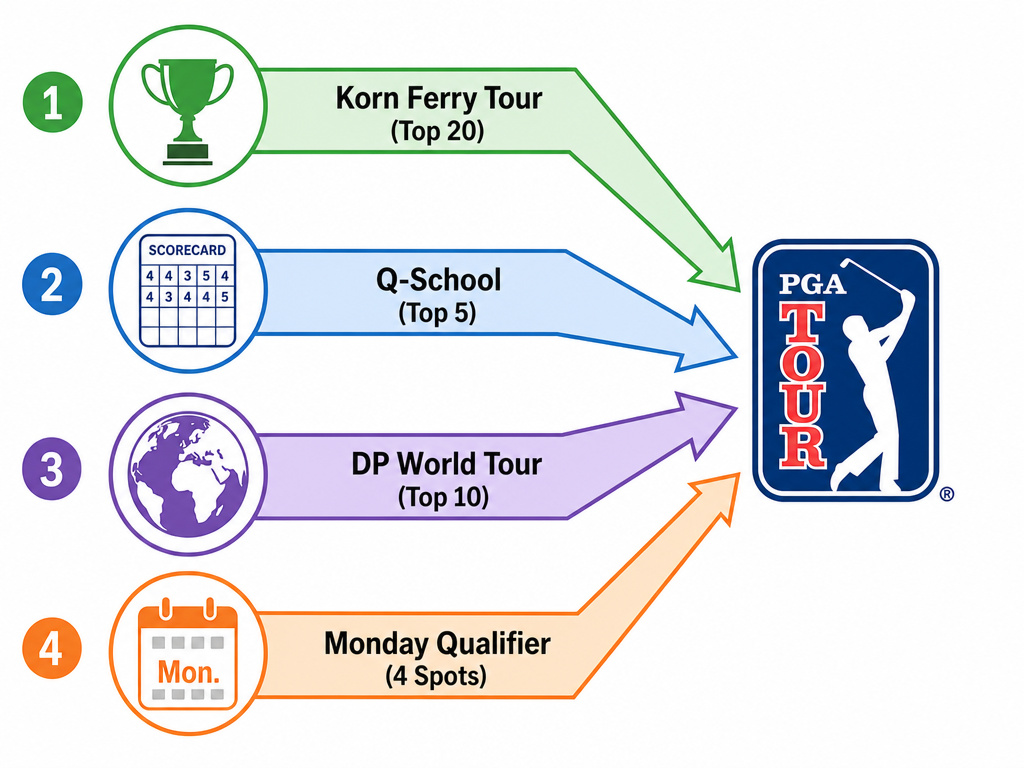
The FedExCup grind isn’t the only way in. The Tour’s ecosystem has deliberate feeder routes.
The most reliable is the Korn Ferry Tour. The top 20 finishers on its season-long points list graduate with PGA Tour cards. It’s a year-long audition on golf’s toughest minor league. Players can also qualify for the PGA Tour via Q-School, where the top five finishers at Final Stage earn cards directly, a return to the classic, high-pressure format.
There’s also an international route. Ten PGA Tour cards are awarded to the leading players on the DP World Tour’s Race to Dubai rankings who aren’t already exempt. This formalizes the global talent pipeline.
Finally, there’s the Monday qualifier. A handful of events offer four spots via an 18-hole shootout on the Monday of tournament week. The odds are lottery-ticket long, but it’s a storybook path that still exists. Corey Conners won the 2019 Valero Texas Open as a Monday qualifier, the last player to do it.
Field Sizes & Eligibility: The 2026 Squeeze
One of the biggest under-the-radar changes for 2026 is the reduction in field sizes for full-field events. The maximum is now 144 players, down from 156. More significantly, many tournaments will field only 120 or 132 players due to “circumstances such as limited daylight.”
This has a cascading effect. Fewer spots mean higher Priority Ranking categories get locked in earlier, leaving players with conditional status on the outside looking in more often. It also affects Monday qualifiers: events with 120-player fields will have zero open qualifying spots. Events with 132 players get two spots. Only events with the full 144 players keep the traditional four spots.
| Field Size | Open Qualifying Spots (2026) | Example Events |
|---|---|---|
| 120 players | 0 | THE PLAYERS Championship, Sony Open in Hawaii |
| 132 players | 2 | Varies by daylight/travel |
| 144 players | 4 | Majority of Full-Field Events |
This puts a premium on securing exempt status. The margin for error has vanished.
Frequently Asked Questions
What is the difference between the PGA Tour and the FedExCup?
The PGA Tour is the organizing body and the schedule of tournaments. The FedExCup is the season-long points competition that runs on the PGA Tour, determining player status, playoff qualification, and the annual champion. You play in PGA Tour events to earn FedExCup points.
How do you qualify for the PGA Tour?
The primary way is to finish in the top 100 of the prior season’s FedExCup Points List. Other ways include graduating from the Korn Ferry Tour (top 20), finishing in the top five at Q-School, or being among the top DP World Tour players eligible for cards. Winning a PGA Tour event also grants immediate status and a two-year exemption.
What are Signature Events on the PGA Tour?
Signature Events are eight limited-field tournaments with elevated purses ($20 million) and FedExCup points (700 to win). Fields are primarily for the prior season’s top 50 FedExCup finishers, with additional spots for current-season top performers (Aon Next 10) and hot players from recent events (Aon Swing 5).
How does the FedExCup Playoffs format work?
The Playoffs include three events for the top 70 FedExCup finishers. The field drops to 50 after the first event and 30 after the second. The first two events award 750 points to the winner. The finale, the TOUR Championship, starts all 30 players at even par in a 72-hole stroke-play event; the lowest score wins the FedExCup.
What is the purpose of the FedExCup Fall?
The FedExCup Fall finalizes the top 100 in FedExCup points, which grants exempt status for the following season. Players ranked 51st and beyond after the Playoffs carry their points forward and compete in eight fall events to improve their standing. It’s the final chance to secure or improve playing privileges.
The Bottom Line
The PGA Tour’s engine is the FedExCup points list. Every shot, every finish, changes a player’s standing in a live, season-long competition for status, access, and wealth. The 2026 changes, smaller fields, a higher exempt-status bar, have made the system more volatile and the fight for survival more intense.
For a fan, this means the storylines extend beyond who wins on Sunday. The battle for 100th place in the Fall can be as compelling as the battle for 1st in the Playoffs. It’s a relentless meritocracy. Play well, and the rewards. Signature Events, Playoff glory, job security, are immense. Stumble, and the path back is narrower than ever. That tension, between opportunity and oblivion, is what makes the Tour work.
