
What Is the Korn Ferry Tour & How It Leads to the PGA Tour
This post contains affiliate links. As an Amazon Associate, we earn from qualifying purchases.
This post contains affiliate links. As an Amazon Associate, we earn from qualifying purchases.
The Korn Ferry Tour is the PGA Tour’s official developmental circuit, where professional golfers compete in a season-long points race to earn one of 20 PGA Tour cards for the following season. The top finishers on the Korn Ferry Tour Points List secure membership, with additional pathways like the “Three-Victory Promotion” and the Korn Ferry Tour Finals series providing other routes to the top level.
This structure is designed to harden players for the travel, pressure, and scoring demands of the main tour. It’s a full-season audition, not a one-week lottery.
What follows is a breakdown of its history, the exact mechanics of the points system, the critical differences between the regular season and the Finals, and the other rules, like the battlefield promotion, that shape this proving ground.
Key Takeaways
- The number of PGA Tour cards awarded has shifted over time, settling at 20 for the 2025 season after a brief experiment with 30.
- Earning a card hinges entirely on the Korn Ferry Tour Points List, with 500 points for a regular-season win and 600 for a Finals win.
- A “Three-Victory Promotion” grants an immediate PGA Tour card, a feat achieved only 13 times in the tour’s history.
- Finishing between 21st and 60th on the Points List doesn’t mean going backwards; those players retain full Korn Ferry Tour status and get a pass to the final stage of Q-School.
- The tour’s format, 72-hole events with a 36-hole cut, mirrors the PGA Tour exactly, which is the whole point.
History and Evolution: From 5 Cards to 20
The tour began in 1990 as the Ben Hogan Tour, a project funded by the Ben Hogan Golf Company. The initial goal was straightforward: create a clear path. That first season, only five cards were awarded.
The name changed with the sponsors. Nike Tour, Buy.com Tour, Nationwide Tour, Web.com Tour, before Korn Ferry took over in 2019. More importantly, the number of cards grew as the tour proved its value. It went from 5 to 10, then 15, then 20 in 2003. A jump to 25 cards happened in 2007, and a recent two-year experiment saw 30 cards awarded in 2023 and 2024.
For the 2025 season, the number has returned to 20. This isn’t a reduction in opportunity but a recalibration. The tour’s purpose is to identify the most consistent performers ready for the next step, not just to maximize the number of graduates.
The Korn Ferry Tour was established in 1990 by the PGA Tour, with five PGA Tour cards awarded via the season-long standings. The circuit has been known as the Ben Hogan Tour, Nike Tour, Buy.com Tour, Nationwide Tour, and Web.com Tour before its current sponsorship.
This constant evolution shows the PGA Tour refining its farm system. The current model, with its intense focus on the Points List and a streamlined Finals series, is the latest iteration of that process. Understanding this history frames why the qualification pathways are so structured today.
The Korn Ferry Tour Points List: How Cards Are Earned
Forget money. The entire season revolves around the Korn Ferry Tour Points List. Every player who makes the 36-hole cut earns points, with the amounts dictated by a standardized table.
The system is brutally simple. A regular-season tournament win nets 500 points. A solo second place gets 300. The points scale down through every finishing position. If players tie, the points for the tied positions are added together and divided equally. This granularity rewards week-in, week-out performance, not just occasional brilliance.
The season culminates at the Korn Ferry Tour Championship. When the final putt drops, the top 20 players on the cumulative Points List are handed PGA Tour membership for the next season. It’s a straightforward exchange: points for a card.
| Points List Finish | Prize |
|---|---|
| 1–20 | PGA Tour card for next season |
| 21–60 | Full Korn Ferry Tour status + exemption to Final Stage of Q-School |
| 61–75 | Full Korn Ferry Tour status + exemption to Second Stage of Q-School |
| 76–100 | Conditional Korn Ferry Tour status + exemption to earlier Q-School stages |
But the Points List does more than just hand out cards. It also sets the Priority Ranking for field entries each week and determines who gets into the season-ending Korn Ferry Tour Finals. It’s the single most important number attached to every player’s name from January to October.
I’ve seen players get fixated on chasing a win every week. The Points List structure shows why that’s a mistake. A string of top-10 finishes often builds a more stable path to the top 20 than a single win followed by missed cuts. Consistency is the currency here.
The Korn Ferry Tour Finals: A Second Chance, Redefined
From 2013 to 2022, the Korn Ferry Tour Finals were a separate series mixing Korn Ferry Tour standouts with PGA Tour players fighting to keep their cards. That changed in 2023.
Now, the Finals are an exclusive, four-event series only for the top players on the Korn Ferry Tour Points List. The first event starts with 156 players. After each tournament, the field shrinks based on the cumulative Points List: to 132, then 100, and finally just 60 players for the Korn Ferry Tour Championship.
The four-event Korn Ferry Tour Finals, reimagined in 2023, comprises only the top players on the season-long Korn Ferry Tour Points List. The field reduces from 156 to 60 players, with no input from the PGA Tour’s FedExCup standings.
The stakes are amplified. A Finals event win is worth 600 points, and every position pays out more than its regular-season equivalent. This allows for dramatic, late-season moves. A player sitting 25th after the regular season can play their way into the top 20 during the Finals. Conversely, someone at 15th can play their way out.
The Finals are a pressure cooker designed to mimic the intensity of the PGA Tour’s FedEx Cup playoffs. It’s the final exam, and the grading is public.
Other Pathways to the PGA Tour

The Points List is the main highway, but there are two notable side roads.
First, the legendary “Three-Victory Promotion.” Win three Korn Ferry Tour events in a single season, and you get an immediate promotion to the PGA Tour, effective the following week. It’s a “battlefield promotion” that has only happened 13 times since the rule was introduced. Jason Gore did it in 2005. Matt McCarty was the most recent, in 2024.
It’s a rare feat because winning once on any professional tour is hard. Winning three times in a season against the same hungry competition is a different level of dominance. This rule exists to fast-track those truly exceptional performers.
Second, there’s PGA Tour Q-School presented by Korn Ferry. While the Korn Ferry Tour is now the primary path, Q-School still offers a direct ticket. However, the ticket is to the Korn Ferry Tour, not the PGA Tour. The top finishers at Q-School’s final stage earn Korn Ferry Tour membership, where they must then climb the Points List. It’s a backdoor, but it still leads to the same grueling season-long grind.
Tournament Structure and Eligibility
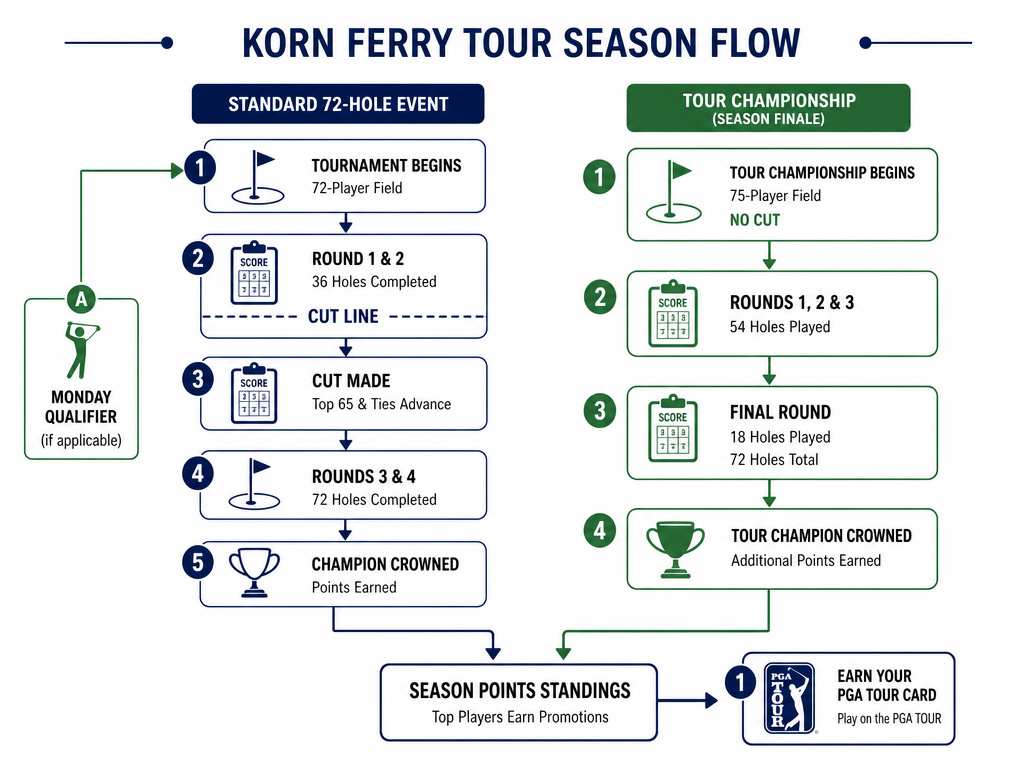
A standard Korn Ferry Tour event looks exactly like a PGA Tour event: 144 or 156 players, 72 holes of stroke play, with a cut after 36 holes for the top 65 and ties. The familiarity is intentional.
Most fields are filled via the season’s Priority Ranking. But every week, eight spots are available through Monday Open Qualifying. An 18-hole shootout, often across two courses, gives anyone with the game a chance to play their way in. If a Monday qualifier goes on to win the tournament, they earn full Korn Ferry Tour status for the rest of the season. It’s a high-risk, high-reward shot that has produced 24 champions through 2024.
The season finale, the Korn Ferry Tour Championship, breaks the mold slightly. It has a maximum field of 75 players and features no cut. By that point, the field has been whittled down to the best of the best, and every shot directly decides who gets a career-changing card.
Why It Matters: The Proving Ground
Tiger Woods, who never played on the circuit, summed up its value. He said a full season there “hardens the guys” and teaches them the professional lifestyle, the travel, the weekly pressure, the need to be aggressive. It prepares them to make birdies when they reach the PGA Tour.
The alumni list is the proof. Scottie Scheffler, Justin Thomas, Xander Schauffele, and Will Zalatoris all honed their games here. The tour doesn’t just test golf skill; it tests resilience. The player who finishes number one on the Points List doesn’t just get a card. They earn an exemption into the following year’s Players Championship and U.S. Open, a massive head start.
For fans, it’s a chance to see the next generation of stars before they become household names. The swings are just as good, the pressure is just as real, and the stories are often more dramatic because the stakes are so personal. It’s high-level golf where every putt has a tangible cost.
Frequently Asked Questions
How many PGA Tour cards does the Korn Ferry Tour give out?
For the 2025 season, 20 PGA Tour cards are awarded to the top finishers on the season-long Korn Ferry Tour Points List. This number was 30 in 2023 and 2024 but has been adjusted back to 20.
What is the “Three-Victory Promotion”?
If a player wins three Korn Ferry Tour events in a single season, they receive an immediate promotion to the PGA Tour for the remainder of that season and the following season. This has happened only 13 times in the tour’s history.
Can you get a PGA Tour card through Q-School?
Yes, but not directly. PGA Tour Q-School now grants membership to the Korn Ferry Tour. The top finishers at the final stage earn Korn Ferry Tour status, and from there they must finish in the top 20 of the Points List to earn a PGA Tour card.
What’s the difference between the regular season and the Finals?
The regular season comprises most tournaments and uses a 500-points-for-a-win scale. The Korn Ferry Tour Finals is a four-event series at season’s end for the top Points List players, using a 600-points-for-a-win scale to finalize the top 20. Since 2023, only Korn Ferry Tour players are eligible.
Who holds the record for most Korn Ferry Tour wins?
Jason Gore holds the record with 7 career victories on the Korn Ferry Tour. He is also one of the players to earn the Three-Victory Promotion, which he did in 2005.
The Bottom Line
The Korn Ferry Tour is a filter. It takes hundreds of talented professionals and, over a grinding season, identifies the 20 most ready for the main PGA Tour. The system, with its focus on cumulative points, a high-stakes Finals series, and rare instant promotions, is built to reward consistency and mental toughness above all else.
If you want to understand the future of the PGA Tour, watch the Korn Ferry Tour. The games are the same, but the pressure is distilled. Every shot carries the weight of a dream, and the math never lies. By the time a player like Scottie Scheffler or Sungjae Im arrives on the big stage, they’ve already passed the hardest test in golf.
