
Nelly Korda and Modern Women’s Golf: Redefining the Game
This post contains affiliate links. As an Amazon Associate, we earn from qualifying purchases.
Nelly Korda and modern women’s golf represent a shift toward precision, consistency, and strategic depth, moving the conversation past raw distance. The LPGA Tour, with Korda as its current standard-bearer, demonstrates that winning at the highest level is built on elite iron play, course management, and mental resilience, a model that is often more instructional for the average golfer than the power-focused game on display elsewhere.
Let’s be clear about this. The dominance is about hitting it better, more often, under the highest pressure, not farther than everyone else. Korda’s game, and the tour she leads, strips golf back to its core competencies: finding fairways, attacking pins from precise distances, and making putts when they matter.This focus on repeatable, high-percentage shots is what separates contenders from champions.
What follows is a look at the engine of this modern era. We’ll break down the technical blueprint Korda follows, the mental overhaul that followed a winless season, and why the style of play you see every week on the LPGA Tour might be the best model for your own game.
Key Takeaways
- Modern women’s golf, led by Nelly Korda, prioritizes precision and consistency over pure distance, offering a more relatable and technically instructive model for amateur players.
- Korda’s success is built on a specific maturation: managing expectations, embracing a conservative strategy with a lead, and silencing external noise, a mental shift detailed in post-round interviews.
- The LPGA Tour provides the best pure ball-striking showcase in professional golf, with a focus on greens in regulation and scrambling that highlights shot-making artistry.
- Korda’s current run, four wins in eight starts in 2026, places her in rare historical company, challenging records set by legends like Annika Sörenstam and Pat Bradley.
- For golfers looking to improve, studying the course management and tempo of top LPGA players can yield faster results than trying to mimic the extreme power game of the PGA Tour.
What Defines Modern Women’s Golf?
The modern game on the LPGA Tour is a different sport altogether from the men’s game, built on a different set of constraints and, therefore, a different set of elite skills. Where the PGA Tour can sometimes be a contest of who can overpower a course, the LPGA is a contest of who can outthink it.
The average driving distance is lower, yes. But that fact forces a reliance on superior long-iron play, more precise wedge distances, and a scrambling percentage that would make most weekend players’ heads spin. The greens are just as fast, the rough just as thick, and the pressure just as immense. The winning scores are often just as low, achieved through a meticulous, error-minimizing style.
The LPGA Tour is the best pure ball-striking tour in the world. You watch players like Korda, Lydia Ko, or Jin Young Ko, and you see a level of repetitive, clean iron contact that is the absolute foundation of good golf. It’s not about flash; it’s about a consistent, grooved move that holds up for 72 holes.
This environment rewards patience and punishes recklessness. A player can’t simply bomb a driver over trouble; she has to plot her way around it. This results in a brand of golf that is deeply strategic and immensely satisfying to watch for anyone who understands the difficulty of hitting a 4-iron to a tucked pin. It’s a game of chess, not checkers.
The Korda Blueprint: Precision Over Power
Nelly Korda’s swing is a study in efficient, athletic motion. It’s powerful, but not in a brutish way. The power is harnessed, a coil and release that generates speed while maintaining a startlingly stable base. You hear the strike before you see the ball flight: a crisp, solid click that signals center-face contact. The ball doesn’t balloon or spin wildly; it takes off on a penetrating, controlled trajectory.
Her statistical dominance tells the story of a precision model. In her 2026 Chevron Championship win, she led the field in greens in regulation. At the U.S. Women’s Open, it was her scrambling, getting up and down from around the greens, that saved her when her “B game” showed up. This one-two punch is the hallmark of a complete player: hit the green when you’re supposed to, and save par almost every time you miss.
Why does this matter for you? Because the mechanics that create this consistency are more accessible than you think. They are built on balance, sequence, and timing, things every golfer can work on, rather than on extreme flexibility or supernatural strength.
| Korda’s Winning Tool | The Specific Skill | Why Amateurs Should Watch |
|---|---|---|
| Iron Play | Greens in Regulation | Demonstrates the value of a repeatable, balanced swing over trying to add yards. |
| Short Game | Scrambling Percentage | Shows that scoring is saved from 50 yards and in, not from 300 yards off the tee. |
| Course Management | Bogey Avoidance | Highlights the decision to play to the fat of the green under pressure, not at every pin. |
| Mental Game | Final Group Appearances | Underlines the ability to handle contention repeatedly, a skill built on routine. |
I’ve worked with multiple players who hit their irons pure but can’t drive, a common edge case where different mechanics are at play. We often end up watching LPGA Tour highlights, not PGA Tour bombs. The takeaway is always the same: look at the tempo, look at the finish. The swing is controlled, not maxed out. That control is what lets Korda hit that 50-degree wedge to inches on the 13th at Memorial Park with a five-shot lead, the shot that sealed her win.She had the discipline to play safe, then the precision to execute a scoring shot when she chose to be aggressive.
The Mental Rebuild: From Winless to World Beater

Korda’s 2025 season is the critical chapter most highlight reels skip. She went winless. The stats were still good, sometimes better than her seven-win 2024 season. But the trophies stopped coming. The frustration, by her own admission, became paralyzing. She over-analyzed every shot. The noise from outside grew louder.
The comeback wasn’t about a swing change. It was a mindset change. She and caddie Jason McDede built what she calls her “bubble”, a focus on controllable processes over uncontrollable outcomes. This shift is documented in her own words in a Golfweek tournament results recap, where she spoke about the maturity gained from that struggle.
“I told myself I don’t ever want to feel like that on a golf course,” Korda said of her 2025 mentality. The solution was a conscious return to simplicity: play smart, accept bad breaks, and just hit the shot in front of you.
You see this maturity in how she wins now. At the Chevron, she led for the final 57 holes. With a big lead, she fought the instinct to attack and instead played conservatively, aiming for the middle of greens. It felt uncomfortable. “That’s not Nelly golf,” she said. But it was winning golf. She managed the course and her emotions, a skill that separates great players from legendary ones. This psychological framework, moving from frustration to acceptance, is the single biggest lesson any competitive golfer can take from her story.
Historical Context: Where Korda’s Run Stands
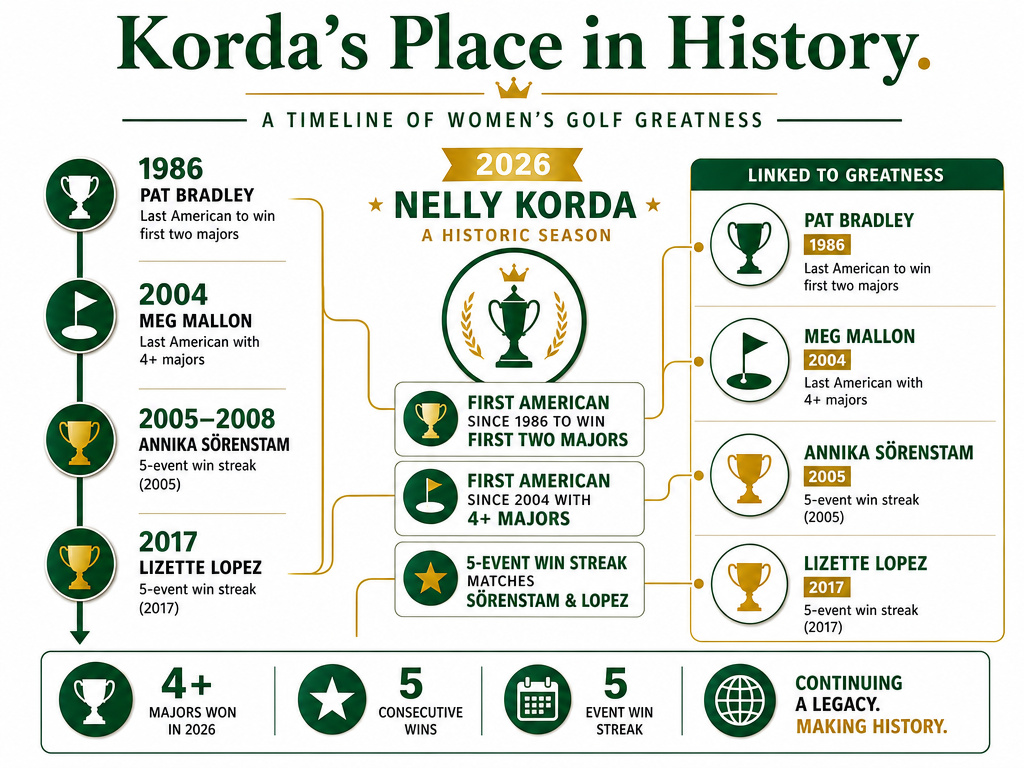
To understand the weight of Korda’s current dominance, you have to place it on the timeline of women’s golf. Her achievements in 2026 aren’t just winning; they’re historic winning.
She became the first American woman to win the first two majors of a season since Pat Bradley in 1986. With her fourth major title at the U.S. Women’s Open, she became the first American to reach four majors since Meg Mallon in 2004. The names she’s joining. Bradley, Mallon, Patty Berg, Mickey Wright, are etched in the foundation of the sport. Her TIME100 Sports profile explicitly notes that only Annika Sörenstam has matched the sustained excellence of starting a season with six consecutive top-two finishes.
The historical parallels are deliberate. Korda’s five-event winning streak in 2024 matched Sörenstam and Nancy Lopez. Her current pace invites comparisons to Inbee Park’s 2013 season, where Park captured the first two legs of the calendar Grand Slam. Korda now sits just two points shy of the LPGA Hall of Fame, a threshold no American has crossed since Juli Inkster in 1999.
This context matters because it shifts the conversation from “great player on a hot streak” to “generational talent reshaping the record books.” It’s a level of sustained performance that defines eras.
A Model for Every Golfer
So what can the weekend player actually take from this? The obsession with distance in amateur golf is a trap. Buying a new driver to fix a slice is like repainting your mailbox to fix a leaky roof. The core issue remains.
The modern women’s game, and Korda’s example, provides a better blueprint. Here’s a practical list of where to shift your focus:
- Practice Your 100-Yard Shot. Know your exact swing for a 100-yard wedge. This is the most common approach distance for LPGA pros and should be for you. Groove it.
- Track Greens in Regulation, Not Driving Distance. Did you hit the green with your approach shot? That’s a better measure of a successful round than how far you drove it into the trees.
- Develop a “Bubble” Routine. Before a shot, have a simple, repeatable routine. It’s not about mechanics; it’s about resetting your focus and blocking out the last hole. This is the amateur version of Korda’s Post-It notes.
- Play More, Range Less. The strategic decisions, club selection, risk assessment, recovery shots, are learned on the course. Beating balls on the range teaches you to hit balls on the range.
This philosophy extends to your equipment choices. Instead of chasing the lowest-spinning driver, most amateurs would see more benefit from a fitting that adjusts for loft, lie angle, and shaft flex.com/best-golf-clubs-for-women/) that promote consistency, or investing in a golf bag for women that comfortably carries the tools you actually use. The best players in the world prioritize precision and comfort; your gear should do the same.
Frequently Asked Questions
How many majors has Nelly Korda won?
Nelly Korda has won four major championships: the 2021 PGA Championship, the 2024 Chevron Championship, and the 2026 Chevron Championship and U.S. Women’s Open. Her victory at Riviera Country Club in 2026 was her first U.S. Women’s Open title.
What is Nelly Korda’s world ranking?
As of her 2026 Chevron Championship win, Nelly Korda reclaimed the World No. 1 spot in the Rolex Women’s World Golf Rankings. She had previously held the top ranking during her dominant 2024 season before relinquishing it to Jeeno Thitikul in the summer of 2025.
Why is the LPGA Tour a good model for amateur golfers?
The LPGA Tour emphasizes precision, course management, and consistency over extreme power. The average course length and player strength are closer to those of skilled amateur men and women, making the strategies and club selections used by pros more directly applicable. Watching how they navigate a course teaches more about scoring than watching players who can carry hazards amateurs cannot.
Is Nelly Korda in the LPGA Hall of Fame?
She is on the doorstep of the LPGA Hall of Fame. It uses a points system, and Korda’s four major victories and 17 total LPGA wins have her just two points shy of qualification.Her next win will almost certainly secure her induction.
What was significant about Korda’s 2025 season?
Korda’s 2025 season was significant because she went winless on tour despite strong statistical performance. This period of frustration directly led to the mental and strategic overhaul that fueled her historic 2026 comeback, teaching a powerful lesson about resilience and the importance of process over results.
The Bottom Line
Nelly Korda and the modern era of women’s golf offer a masterclass in the sport’s timeless principles. It’s a reminder that golf, at its best, is a game of precision, patience, and nerve. The pursuit of power has its place, but it should never come at the cost of a repeatable swing or a clear mind.
For your own game, this means a shift in perspective. Study the history of women’s golf to see how the foundation was built, then watch the current tour to see how it’s executed. Pay for a lesson on your wedge game before you pay for a new driver. Value the round where you hit 10 fairways and 12 greens over the round where you hit one 280-yard drive.
Korda’s run will eventually cool. Records will be contextualized by the AP News major title report and future seasons. But the model she represents, the precision model, is the enduring takeaway. It’s the most reliable path to better scores, whether you’re playing for a major or a personal best. Strip it back. Hit it solid. Repeat. That’s it.
