
Understanding Golf Club Set Composition: A Complete Guide
This post contains affiliate links. As an Amazon Associate, we earn from qualifying purchases.
This post contains affiliate links. As an Amazon Associate, we earn from qualifying purchases.
A golf club set composition is the specific mix of clubs in your bag, governed by a 14-club maximum rule but typically built with 8-12 clubs for beginners. A standard modern set includes a driver, one or two fairway woods, hybrids replacing long irons, mid-to-short irons (6-9), a pitching wedge, a sand wedge, and a putter. The exact clubs and their lofts are precisely gapped to cover every distance on the course.
That 14-club limit is a hard ceiling, not a target. Most new players are better served by an 8-10 club setup, a driver, fairway wood, hybrid, a few irons, a wedge, and a putter. Trying to manage 14 clubs before you have consistent swing mechanics adds complexity, not capability.
What follows is a breakdown of the standard composition, the official rules that shape it, and the specific club-by-club specs from real sets like the Callaway XR. You’ll see why hybrids have replaced long irons, how loft gapping works, and where you might add a club as your game improves.
Key Takeaways
- The USGA’s 14-club maximum is strict, but most beginner sets contain only 8-12 clubs for simplicity and lower cost.
- A modern standard set swaps difficult 3, 4, and 5-irons for easier-to-hit hybrids, which have wood-like heads on iron-length shafts.
- Loft gapping, the consistent difference in angle between clubs, is critical. A well-composed set like the Callaway XR has gaps of 3-6 degrees between each iron and wedge.
- Club length and shaft flex are the two most important fitting specs in a complete set. Getting these wrong for your height and swing speed makes every club harder to use.
- You can damage a club during a round and still use it. The rules distinguish between normal wear (acceptable) and damage from abuse (which may disqualify the club).
What Clubs Are in a Standard Golf Set?
A standard, full set built to the 14-club limit contains a driver, fairway woods, hybrids, irons, wedges, and a putter. The modern trend is to replace the hardest-to-hit long irons with hybrids, resulting in a bag that looks like this: Driver, 3-wood, 5-wood, 4-hybrid, 5-hybrid, 6-iron through 9-iron, pitching wedge (PW), gap wedge (GW), sand wedge (SW), and putter.
The driver is your longest club, with the lowest loft (typically 9-12 degrees) and the largest head, designed exclusively for distance off the tee. Fairway woods, like the 3-wood and 5-wood, are for long shots from the fairway or tee when you need more control than a driver offers. Hybrids are the crossover solution. They blend the forgiving, low-center-of-gravity head of a fairway wood with the shorter shaft and swing feel of an iron, making them far easier to launch than a 3 or 4-iron.
The part nobody mentions: A standard 4-iron has about 21 degrees of loft. A standard 4-hybrid also has about 21 degrees of loft. They’re designed to travel the same distance, the hybrid just does it with a higher, softer landing and much more margin for error on mishits. That’s why they’ve become the default.
Irons from 6 through 9 are your scoring clubs for approach shots. Wedges, pitching, gap, sand, handle the high, soft shots within 120 yards. The putter is the most used club in the bag. Every major manufacturer’s complete sets follow this general framework, varying only the number of clubs at each stage.
The 14-Club Rule and What It Really Means
The USGA and R&A Equipment Rules state you cannot carry more than 14 clubs during a stipulated round. Carrying a 15th club incurs a penalty, two strokes per hole in stroke play, with a maximum of four strokes per round. There is no minimum number. You could putt with your driver all day if you wanted, though you wouldn’t score well.
This rule exists to preserve skill as the deciding factor in the game. It prevents a player from carrying a specialized club for every conceivable lie and shot shape. You must choose your tools wisely.
For beginners, this rule is liberating, not restrictive. You do not need to find 14 clubs. In fact, Callaway’s own buying guide explicitly advises, “Most beginners need 8–10 clubs, not 14.” A smaller set is cheaper, lighter to carry, and reduces decision paralysis on the course. You can build a highly effective beginner starter set with just a driver, 3-wood, 5-hybrid, 7-iron, 9-iron, sand wedge, and putter.
| Skill Level | Recommended # of Clubs | Typical Makeup |
|---|---|---|
| Beginner | 8–10 | Driver, 3W, 1-2 Hybrids, 6/7/8/9 Irons, PW or SW, Putter |
| Intermediate | 10–13 | Driver, 3W, 5W, 2-3 Hybrids, 5/6/7/8/9 Irons, PW, SW, Putter |
| Advanced | 14 (Max) | Driver, 3W, 5W, 3H, 4H, 5-PW Irons, GW, SW, LW, Putter |
Breaking Down a Real Set: The Callaway XR Spec Sheet
Looking at a real product spec sheet cuts through the theory. The Callaway Men’s XR 13-Piece Complete Set includes 12 clubs, headcovers, and a stand bag. Here is its exact composition and the manufacturer-listed specs for each club.
This table is taken directly from Callaway’s official product specifications. Notice the precise progression in loft and length, which creates consistent loft gapping.
| Club | Loft | Standard Length | Lie Angle |
|---|---|---|---|
| Driver | 10.5° | 45.50″ | 59.0° |
| 3-wood | 16.5° | 43.00″ | 60.0° |
| 4 Hybrid | 21° | 40.00″ | 61.0° |
| 5 Hybrid | 25° | 39.50″ | 61.0° |
| 6-iron | 26° | 37.625″ | 62.0° |
| 7-iron | 30° | 37.00″ | 62.5° |
| 8-iron | 34.5° | 36.50″ | 63.0° |
| 9-iron | 39° | 36.00″ | 63.5° |
| PW | 44° | 35.50″ | 64.0° |
| AW | 50° | 35.25″ | 64.0° |
| SW | 55° | 35.25″ | 64.0° |
| Putter | 3° | 35.00″ | 70.0° |
The set uses hybrids to cover the 21-25 degree loft range (traditional 3 and 4-irons), then transitions to irons starting at the 6-iron (26 degrees). The wedge setup. Pitching (44°), Approach (50°), Sand (55°), provides three distinct tools for short-game shots. This is a classic example of a modern, game-improvement complete golf club sets composition.
Woods, Hybrids, Irons, Wedges, Putter: The Role of Each
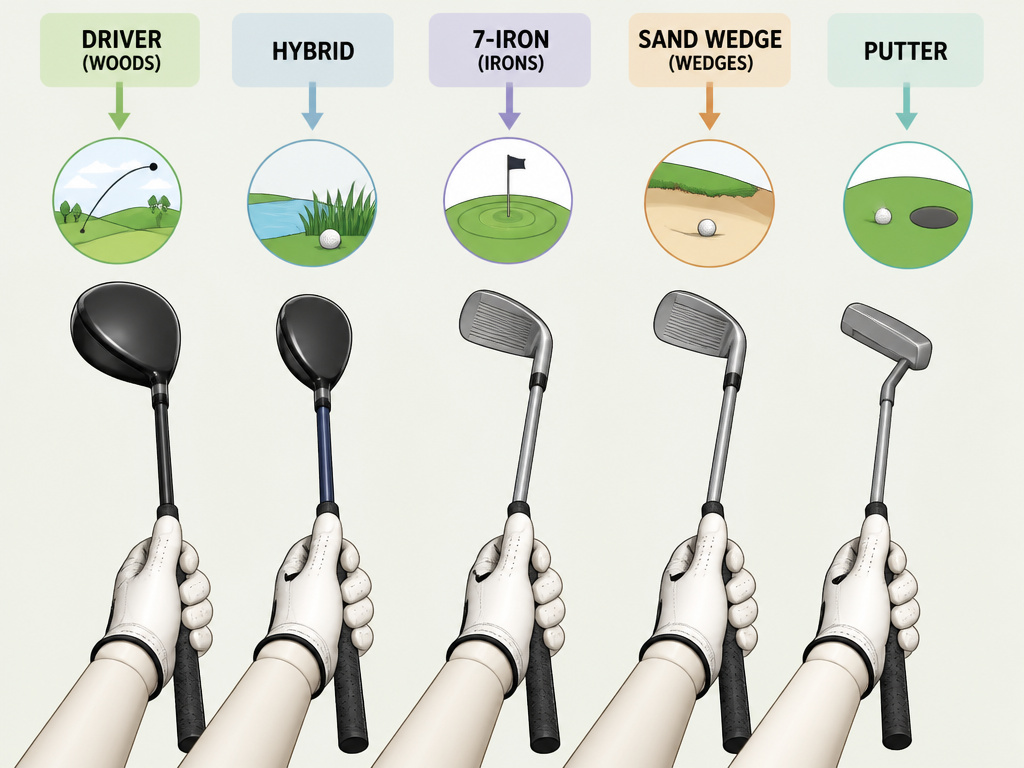 Each club type has a specific job based on its design. Using the right tool for the shot is half the battle.
Woods are for maximum distance. The driver is for the tee box on par-4s and par-5s. Fairway woods (3-wood, 5-wood) are for long shots from the fairway or when you need a accurate tee shot on a tight hole.
Hybrids are your rescue tools. Use them for long approach shots, hitting out of light rough, or any time you need a high, soft landing from a distance where you’d struggle with a long iron. They are the most forgiving clubs in the bag for most amateur players.
Irons are for control and precision. The mid-irons (6, 7, 8) are often called “scoring irons” because they’re used for approach shots into greens. The short irons (9, PW) are for shorter approaches and chipping.
A conforming club that gets damaged during a round (outside of abuse) can still be used for the rest of that round. The USGA rules treat it as conforming for the day’s play. But a club that was non-conforming when new can never become legal through wear.
Wedges are for finesse. The pitching wedge is for full swings from 100-130 yards. The sand wedge is for bunker shots and high-loft pitches around the green. Many players add a gap wedge (between PW and SW) and a lob wedge (58-60 degrees) for more short-game options as they improve.
The Putter is for the green. Its only job is to roll the ball smoothly into the hole. More strokes are taken with the putter than any other club.
How Many Clubs Do You Actually Need to Start?
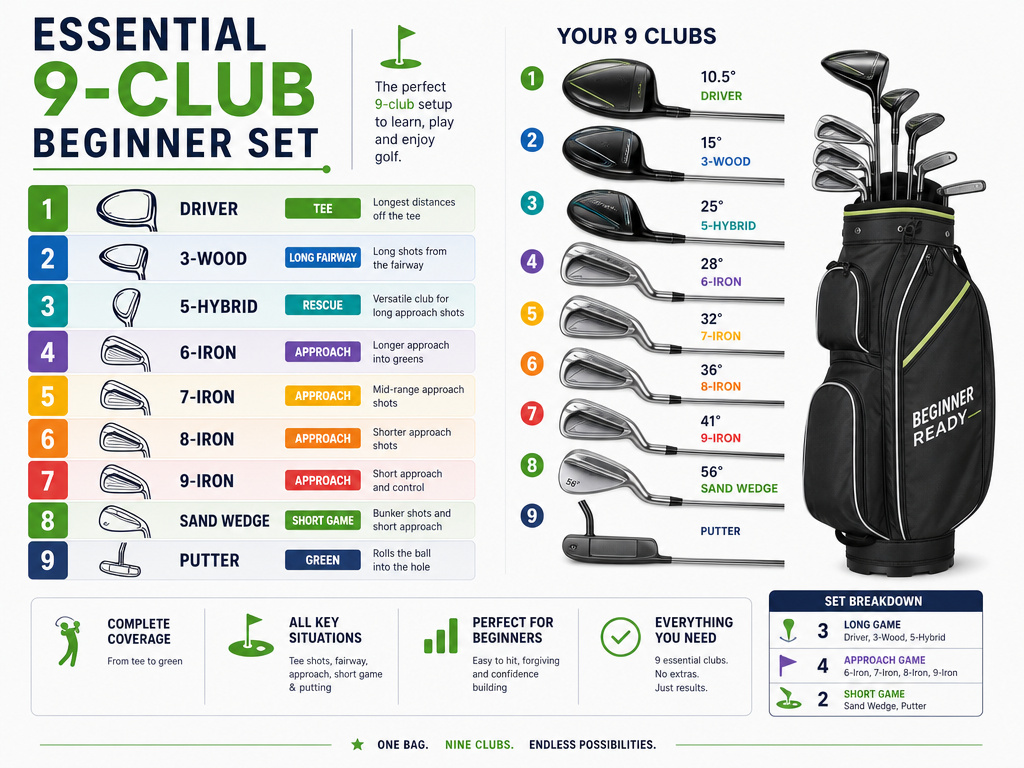 You need enough clubs to cover the basic distances without overlap, but not so many that you’re overwhelmed. For an absolute beginner, a 9-club set is more than enough. A great beginner golf club sets like the Callaway Strata 12-Piece provides this perfectly.
Here is a functional 9-club beginner composition: 1. Driver 2. 3-wood 3. 5-hybrid 4. 6-iron 5. 7-iron 6. 8-iron 7. 9-iron 8. Sand Wedge 9. Putter
This setup gives you a club for the tee (Driver), a club for long fairway shots (3-wood), an easy-to-hit rescue club (5-hybrid), a progression of irons for 150-100 yard approaches (6-9 iron), a wedge for sand and short chips (SW), and your putter. You can play any course in the world with these nine clubs and not be at a strategic disadvantage as a newcomer.
The impulse to fill the bag to 14 clubs immediately is a mistake. It’s better to master this smaller arsenal, learn the distances you hit each club, and then add pieces, like a 5-wood, a gap wedge, or an additional hybrid, as your game demands them. This is the smart path from a beginner sets for men or beginner sets for women to an intermediate golf club sets.
The Two Specs That Matter Most: Length & Shaft Flex
Club composition is about which clubs, but performance is dictated by how those clubs are built for you. The two non-negotiable fitting specs in any set are length and shaft flex.
Club Length is determined by your height and wrist-to-floor measurement. Standard men’s length is for someone around 5’9″ to 6’0″. If you are significantly taller or shorter, you may need a “Long” or “Short” set. Using clubs that are too long forces you to stand too upright, causing heel strikes. Clubs that are too short make you hunch over, leading to toe strikes.
Shaft Flex matches your swing speed. A shaft that is too stiff won’t load properly, robbing you of distance and feeling boardy. A shaft that is too whippy can cause erratic dispersion and a loss of control. Most complete sets offer options: * Ladies (L) Flex: For very slow swing speeds. * Senior (A) Flex: For moderate swing speeds. * Regular (R) Flex: For average male swing speeds (85-95 mph with driver). * Stiff (S) Flex: For above-average swing speeds (95-105 mph).
Where this goes sideways: Choosing a stiff flex because it “sounds” more professional when your swing speed is only 80 mph. The club can’t load, your shots fly low and short, and you’ll fight a slice because the face can’t square up. Play the flex that matches your measured speed, not your ego.
Getting these two specs right is more important than any other technology in the clubhead. A correctly fitted regular-flex set will always outperform a poorly fitted stiff-flex set. This is why many golf club sets for seniors come standard with senior flex and sometimes shorter lengths.
Composition Differences: Men’s, Women’s, Junior, Lefty
The core composition principles are universal, but the execution differs for different players.
Men’s Sets like the Callaway XR or Mavrik use standard men’s lengths, heavier overall club weights, and grips with a larger diameter. The lofts are often slightly stronger (lower numbered) to optimize for typical male swing speeds and launch angles.
Women’s Sets, such as the Callaway REVA, are not just pink versions of men’s clubs. They have specific design features: * Lighter overall club weight and swing weight. * Shorter standard lengths (typically -1 inch). * Higher lofted drivers (12-14 degrees) to help get the ball airborne. * Thinner grip diameters to suit smaller hands. * Softer shaft flexes (Ladies or Senior).
Junior Sets are sized by height, not age. A quality set like the Callaway XJ will have ultra-lightweight components, very flexible shafts, and smaller clubheads. They are scaled-down properly, not just cut-down adult clubs.
Left-Handed Sets have the same technical specs as right-handed sets, but the clubheads are mirrored. The challenge is that manufacturers produce far fewer LH models, so the selection of complete left-handed golf club sets is more limited. The composition within those sets, however, follows the same modern hybrid-inclusive blueprint.
When to Upgrade or Change Your Set’s Composition
Your first complete set is designed to last for several seasons. You’ll know it’s time to tweak the composition or upgrade entirely when you encounter consistent, specific problems that your current clubs can’t solve.
Change your composition when: * You Have a Persistent Distance Gap: You consistently hit your 5-hybrid 180 yards and your 6-iron 150 yards, leaving a 30-yard hole. This is solved by adding a club with a loft in between, like a 6-hybrid or a stronger-lofted 5-iron. * Your Short Game Lacks Options: You keep facing 40-yard shots where a full sand wedge is too much and a chip with a pitching wedge is too little. Adding a gap wedge (around 50-52 degrees) fills this crucial yardage. * Your Swing Speed Changes Significantly: If you get stronger and faster, your regular flex shafts may feel too soft and uncontrollable. This is a sign to move into a sets for intermediate players with stiffer shafts.
Consider a full upgrade when: * The technology is visibly outdated (e.g., deep-faced titanium woods vs. Modern low-CG heads). * You’ve consistently lowered your handicap and need less forgiveness and more workability. * The clubs are physically worn out, deep grooves are rounded, faces are scratched, shafts have lost their integrity.
You don’t need to replace all 14 clubs at once. Many golfers upgrade their driver first, then their wedges, then their irons. Your putter might stay in the bag for a decade.
Frequently Asked Questions
What is the most common golf club set composition?
The most common modern composition is a 12-club set: Driver, 3-wood, 5-wood, 4-hybrid, 5-hybrid, 6, 7, 8, 9 irons, pitching wedge, sand wedge, and putter. This setup replaces difficult long irons with hybrids and provides coverage for every common distance.
Can I carry 2 putters in my bag?
Yes, you can carry two putters, as long as your total club count does not exceed 14. However, it’s an inefficient use of a slot. The space is better used by a wedge or hybrid that covers a distance gap you actually have.
Do I need both a 3-wood and a 5-wood?
Not necessarily. Many beginners and intermediates do fine with just a 3-wood. A 5-wood flies higher and lands softer, which is helpful for long approach shots into greens. If you struggle to hit your 3-wood off the fairway, a 5-wood can be a more reliable alternative. Test both to see if the distance gap between your 3-wood and your longest hybrid justifies carrying both.
What club should I add first as a beginner?
Add a gap wedge (50-52 degrees). It fills the critical distance between your pitching wedge and sand wedge (usually about 20-30 yards) and is incredibly versatile for half-swing shots around the green. It’s the single most impactful addition to a beginner’s bag.
Are older golf club sets still good?
Older sets can be perfectly good if they are in good condition and fit you reasonably well. Technology improvements in the last 5-7 years have been incremental, not revolutionary. The main drawbacks of older sets are worn grooves (which reduce spin and control) and potentially outdated shaft technology. If the grips are fresh and you hit them well, an older set is a fine and cost-effective way to play.
The Bottom Line
A golf club set composition isn’t about collecting 14 different tools. It’s about building a concise toolkit of 8-12 clubs that reliably cover the distances you face, with a heavy emphasis on forgiveness. Start with a quality best starter sets that matches your height and swing speed. Learn those clubs intimately.
Then, let your own game, the specific yardage gaps you discover and the shots you repeatedly need, dictate what you add next. The rules give you 14 slots, but wisdom often uses far fewer.
