
Your Guide to Wedge Bounce and Grind Explained Simply
This post contains affiliate links. As an Amazon Associate, we earn from qualifying purchases.
This post contains affiliate links. As an Amazon Associate, we earn from qualifying purchases.
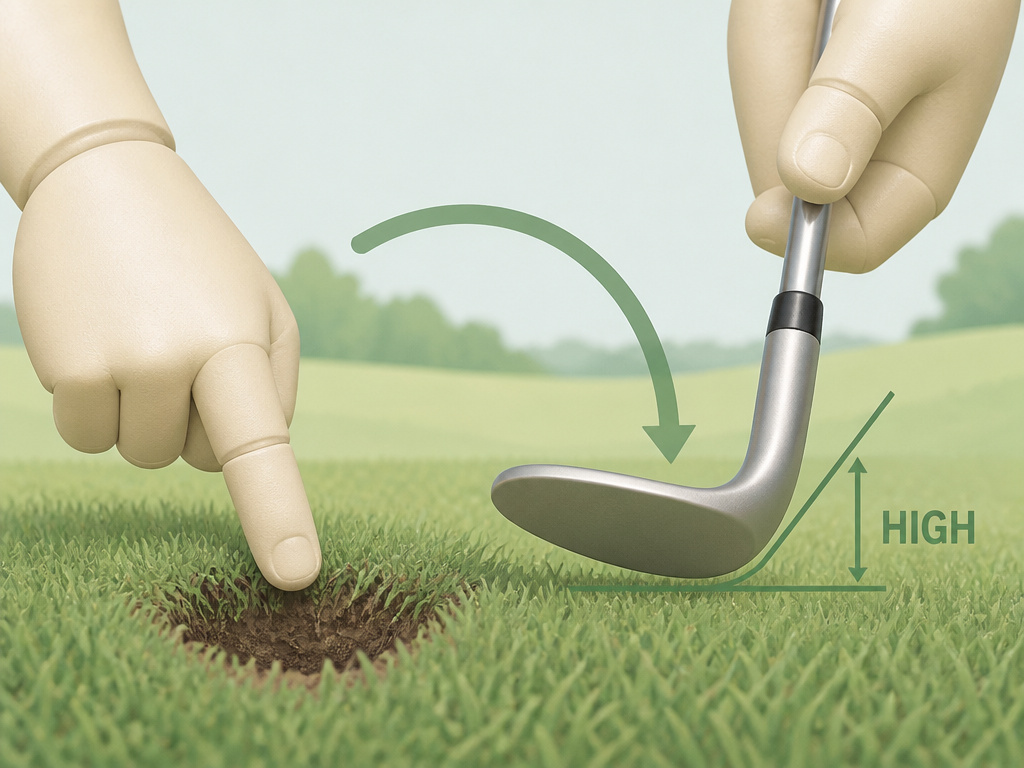
Wedge bounce is the angle between the leading edge and the lowest point of the sole, which makes the club skip or glide through turf instead of digging. Wedge grind is the shaping of that sole by removing material, which changes how the club sits and interacts with the ground when you open or close the face. Getting both right stops thin and fat shots.
Most players look at the loft stamped on the bottom. The real conversation happens below that number, in the shape of the metal that actually touches the ground. A wedge isn’t just a lofted iron. It’s a specialized tool for navigating dirt, grass, and sand, and its sole design dictates whether it works for you or against you.
What follows breaks down bounce and grind without the marketing fluff. You’ll get the mechanical definitions, the specific conditions each spec is built for, and the step-by-step process to match them to your swing and your home course. By the end, you’ll read a wedge’s specs like a fitter does.
Key Takeaways
- Effective Bounce matters more than the stamped angle. The sole’s width and shape change how the bounce actually plays, a point professional fitters at Engineered Golf emphasize.
- A bounce mismatch creates a predictable miss. Too much bounce on firm turf causes thin shots; too little bounce in soft conditions leads to digging and fat shots.
- Pick grind before bounce. The grind (like Vokey’s M or F) determines how the wedge behaves when you manipulate the face. Bounce fine-tunes that interaction.
- Different wedges in your bag need different specs. A 50-degree gap wedge for full swings often needs mid-bounce, while a 60-degree lob wedge for flop shots usually needs low bounce.
- If you swap wedges twice based on bounce and see no improvement, the issue isn’t bounce alone. That’s the concrete threshold to book a professional fitting.
Bounce vs. Grind: The Core Difference
Forget which one is more important for a second. You need to know what each part does.
Bounce is the measurable angle built into the clubhead. Grind is the intentional shaping of the sole that modifies how that bounce angle performs. Think of bounce as the engine and grind as the transmission.
Bounce is a geometric fact. It’s the angle created between the leading edge and the trailing edge when the sole rests flat. A higher number, like 12 degrees, means the leading edge sits higher off the ground at address. This angle acts like a ski, promoting glide. A lower number, like 6 degrees, lets the leading edge sit closer to the ground, which is better for clean contact on firm surfaces.
Grind is a customization. Manufacturers remove material from the heel, toe, or trailing edge of the sole. This changes the effective playing surface. A grind can let you open the clubface without the leading edge rising sky-high, or it can concentrate the sole’s contact point for more stability on square-faced shots.
If you only remember one thing: bounce prevents digging. Grind enables creativity.
Why “Effective Bounce” Is the Real Metric
The number stamped on your wedge is a starting point, not the final answer.
Common mistake: Choosing a wedge based solely on its stamped bounce angle. The sole’s width and where it contacts the ground change the playing characteristic completely.
A clubfitter at Engineered Golf states that Effective Bounce is the real consideration for how a wedge interacts with the ground. A wedge with a narrow sole and a 10-degree stamp can play with less effective bounce than a wide-soled wedge with 8 degrees. The width of the sole spreads the impact force. This is why two wedges with the same loft and stamped bounce can feel completely different from the turf.
| Sole Characteristic | Effect on Play | Best For |
|---|---|---|
| Wide, full sole | Increases effective bounce, more forgiveness | Soft conditions, bunkers, diggers |
| Narrow, relieved sole | Decreases effective bounce, more versatility | Firm conditions, tight lies, sweepers |
| Heel/toe grind | Allows face to open without lifting leading edge | Players who manipulate face for flop shots |
This is the first layer most off-the-rack buyers miss. You’re not just buying a bounce angle. You’re buying a sole shape that delivers that bounce.
How Bounce Works: Your Swing Meets the Ground
Bounce categories align with swing types and course conditions. Get this match wrong, and your wedge game never feels consistent.
Low Bounce (4–6 degrees) is for sweepers and firm turf. If you take shallow divots or pick the ball cleanly off tight lies, low bounce keeps the leading edge low. It’s essential for hardpan, tight fairways, and coarse sand. The risk? In soft conditions, it acts like a shovel and digs to China.
Mid Bounce (7–10 degrees) is the versatile workhorse. It handles a neutral attack angle and mixed conditions. If you’re unsure, start here. It offers forgiveness for slight misses while still working from decent lies.
High Bounce (10+ degrees) is for diggers and soft conditions. If your divots are deep and your home course is lush or wet, high bounce skips the club through the turf. It’s a bunker savior in fluffy sand. On hard ground, it’s a skull-shot machine, the sole hits first and bounces the leading edge into the ball’s equator.
The Failure Mode You Can Diagnose Yourself
Your most common miss tells the story.
Where this goes sideways: Consistently thin wedge shots, even from decent lies. This usually means too much bounce for your swing or the turf. The sole contacts the ground early and bounces the leading edge up into the ball.
The fix is to drop down one bounce level. If you’re using a 12-degree sand wedge and thinning everything, try an 8-degree version. The opposite problem, constant fat shots, points to too little bounce digging in.
How Grind Works: Shaping for Shotmaking
Grinds are often designated by a letter (Vokey’s M, Titleist’s F, Callaway’s C). Each letter represents a specific sole shape designed for a type of interaction.
The F Grind (Full) is the safe, stable choice. It has a full sole with minimal relief. It’s designed for players who keep the face square and want forgiveness on full swings and basic pitches. Think of it as the utility wedge.
The M Grind (Versatile) is Bob Vokey’s favorite and the most popular. It has moderate heel and toe relief. This lets you open the face for higher shots without the sole digging, while still providing enough bounce for square-faced stability. It’s the go-to for players who like options.
The L Grind (Low Bounce) is for artists and firm conditions. It’s a narrow, crescent-shaped sole with significant relief. It sits very low to the ground, offering minimal bounce for maximum creativity from tight lies. It’s unforgiving if your strike is off.
The D Grind (High Bounce) is for diggers who still want versatility. It has a wider sole with a crescent shape, providing high bounce to prevent digging but with enough relief to allow some face manipulation. It’s built for soft conditions and steep swings.
| Grind Type | Key Feature | Ideal Player Profile |
|---|---|---|
| F Grind (Full) | Wide sole, maximum stability | Square-face player, prefers forgiveness, plays in softer conditions |
| M Grind (Versatile) | Heel & toe relief, balanced | Creative player, opens the face, needs all-around performance |
| L Grind (Low) | Narrow, heavily relieved sole | Advanced player, firm turf specialist, executes flop shots |
| D Grind (High) | Wide sole with relief for openness | Digger with a steep attack angle who plays from soft turf and sand |
Your grind choice answers one question: how much do you manipulate the clubface around the greens? If the answer is “never,” a full sole grind is fine. If you open the face regularly, you need a grind with relief.
How to Choose Your Bounce and Grind
 This is a step-by-step filter. Follow it in order.
- Analyze Your Conditions. Is your home course firm and fast (links-style) or soft and lush (parkland)? Firm conditions demand lower bounce; soft conditions demand higher bounce. This is your first filter.
- Analyze Your Divot. Go to the range and hit ten wedge shots. Are your divots deep trenches or barely-there scrapes? Deep divots need higher bounce; shallow sweeps need lower bounce. Neutral divots point to mid-bounce.
- Pick Your Grind First. Decide how you use your wedges. For full swings and square faces, choose a full sole grind (F, S). For creativity and open faces, choose a versatile grind (M, C). This determines the sole’s shape.
- Fine-Tune with Bounce. Within your chosen grind category, select the bounce angle that matches your divot and conditions from steps 1 and 2. This dials in the turf interaction.
- Test on Real Grass. Never decide on a mat. Mats hide digging. Hit shots from real fairway grass, rough, and a practice bunker if possible. Does the club glide or dig? Skid or stick?
- Differentiate Your Set. Your wedges shouldn’t be identical. A 50-degree gap wedge for full swings benefits from mid-bounce (8-10 degrees). A 60-degree lob wedge for flop shots needs low bounce (4-6 degrees). Using high bounce on a lob wedge for tight lies is a guaranteed way to blade the ball.
When to Stop Guessing and Get Fit
There’s a clear line between self-diagnosis and needing a professional.
If you test two different bounce options, one lower, one higher, and still can’t make consistent contact, the problem isn’t bounce alone. That’s your signal to visit a fitter with a launch monitor.
A good fitter will measure your attack angle, dynamic loft, and lie angle at impact. They’ll match you with the correct grind, bounce, and even shaft. Swapping heads based on a stamped number has limits. After two failed swaps, you’ve reached them.
A Quick Guide to Major Brand Grinds
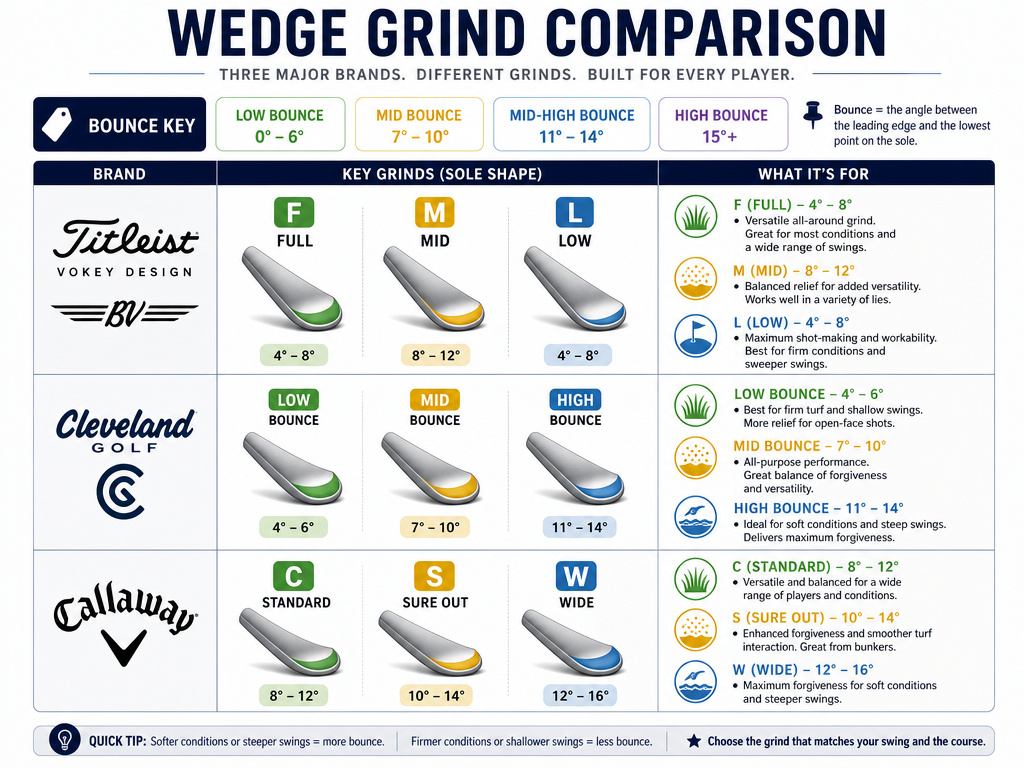 Each manufacturer has its own naming system, but the principles translate.
- Titleist Vokey: The benchmark. F Grind (full), M Grind (versatile), L Grind (low), D Grind (high). The Vokey SM11 lineup offers these core options plus specialty lob wedge grinds.
- Cleveland: Uses a simple three-grind system: LOW (4-6°), MID (7-9°), and HIGH (10+°). Their RTX wedges pair these with sole shapes like “Full” and “Heel/Toe” for similar versatility.
- Callaway: Key grinds include C (versatile, all-around), S (similar to Vokey M, with heel relief), and W (wide sole for high bounce). The Callaway Jaws series leans on the C and S grinds for most players.
For the average golfer building a first proper wedge set, a Vokey M Grind or a Callaway C Grind in a mid-bounce configuration is the most reliable starting point. It offers the blend of forgiveness and creativity that most games need.
Frequently Asked Questions
Can I have different bounce angles in my wedges?
Absolutely. You should. Your gap wedge and lob wedge perform different jobs. A mid-bounce gap wedge (50-52°) is perfect for full swings. A low-bounce lob wedge (58-60°) is essential for open-faced shots from tight lies. Matching the bounce to the club’s purpose is a hallmark of a well-built short game.
Is more bounce better for bunkers?
Generally, yes. High bounce (10-14 degrees) helps the club glide through sand instead of digging. It literally “bounces” the leading edge up to slide under the ball. However, in firm, wet, or very shallow bunkers, lower bounce can sometimes provide cleaner contact. For most standard, fluffy bunkers, higher bounce is more forgiving.
Can a grind be changed after purchase?
Technically, yes, but it’s a job for a professional clubfitter with a grinding wheel. They can remove material to add relief, effectively creating a custom grind. However, you cannot add material back. It’s far easier and safer to select the correct grind when you buy the wedge.
Do I need a special grind if I don’t open the clubface?
No. If you play almost all your wedge shots with a square face, a full sole grind (like Vokey’s F Grind or Cleveland’s Full sole) is ideal. It provides the most stability and forgiveness. You pay for versatility you won’t use with a more relieved grind.
How does loft affect bounce and grind choice?
Loft and bounce are independent specs, but your intended use for a specific loft dictates your choice. You choose the loft you need for distance gapping. Then, you choose the bounce and grind that suit how you’ll use that loft. A high-loft wedge (60°) used around greens needs different specs than a lower-loft wedge (50°) used for full approaches.
Before You Go
Wedge bounce and grind aren’t just jargon. They’re the functional specs that connect your swing to the ground. Ignore them, and you’re fighting the design of the club. Understand them, and you unlock consistency.
Start with your conditions and your divot. Let those point you to a bounce range. Then, be honest about your shot-making: do you manipulate the face? Your answer selects the grind. Finally, test the combination on real grass, not a mat. The right wedge should feel like it’s working with the turf, not against it. If you hit that point after two tries, stop. If you don’t, that’s what fitters are for. Your short game shouldn’t be a mystery.
