
Essential Golf Accessories Every Golfer Should Own & Use
This post contains affiliate links. As an Amazon Associate, we earn from qualifying purchases.
This post contains affiliate links. As an Amazon Associate, we earn from qualifying purchases.
Essential golf accessories for every golfer are a pitch mark repair tool, a quality towel, a well-fitted glove, and legal distance-measuring tech like a GPS watch or laser rangefinder. These four items directly impact course care, grip security, club performance, and smart decision-making without breaking any R&A equipment rule 4. Everything else is comfort or clutter.
That “legal” clause is the line between a useful kit and a rulebook violation. The governing bodies draw it clearly: your gear must not eliminate the need for skill or judgment. A device that gives you a number is fine. One that suggests a club or calculates wind is not for competition.
What follows is a breakdown of those four essentials, why they work, what happens without them, and a clear look at the optional extras. The goal is a lighter bag and faster decisions, not a collection of every gadget ever marketed.
Key Takeaways
- A pitch mark repair tool is a non-negotiable piece of course etiquette; unrepaired marks take weeks to heal and ruin putting lines for everyone behind you.
- A dedicated golf towel is more critical than a brush; wet grips cause mis-hits, and clean clubface grooves add 10-15 yards of consistent spin on approach shots.
- Always check local competition rules before using any Distance Measuring Device (DMD); features like slope compensation or club recommendation are illegal under standard Rules of Golf player’s equipment guidelines.
- Avoid bag organizers and redundant tech; they add dead weight and complicate your routine without improving a single shot.
- For electric trolleys like the Motocaddy M3 GPS, the 10-minute auto safety cut-off is a feature, not a fault, it prevents motor burnout if you forget to turn it off.
The 4 Non-Negotiable Essentials (And Why They’re Non-Negotiable)
Your bag already has 14 clubs. These four accessories support them. Skip one, and something tangible breaks, your score, the course, or the rules.
1. The Pitch Mark Repair Tool: It’s Not a Suggestion
This is the smallest item with the biggest ethical weight. A ball landing on the green leaves a depression, a pitch mark. Repair it correctly with the twin-pronged tool, and the grass recovers overnight.
Common mistake: Using a tee or just stomping the mark flat. This shears the roots. The spot turns brown and dies within days, leaving a scar for the rest of the season.
The correct method is simple. Insert the prongs at the edges of the depression, not the center. Gently push the turf toward the middle. Do not lift. Then, tap down with your putter. The entire process takes eight seconds. Your playing partners notice if you skip it.
2. The Golf Towel: Your Most Used Piece of Gear
A quality golf towel does two jobs nothing else can. It keeps your grips dry, and it cleans your clubfaces. A wet grip shifts in your hand during the swing, opening the clubface. The result is a block or a slice, every time.
A clean clubface is about spin, not vanity. Dirt packed into the grooves turns a sharp, biting wedge shot into a knuckleball that skids over the green. Wipe the face after every shot. A damp corner of the towel is all you need.
Hook it to your bag with a simple clip. Dark colors hide dirt. Carry a second, smaller towel for your hands if you play in humid climates. This single item replaces about half the gadgets in a typical curated list of essential gear.
3. The Golf Glove: Grip Security, Not Fashion
A glove is not about blisters. It’s about consistent pressure. A well-fitted leather glove creates a unified bond between your hand and the rubber grip. Without it, your lead hand must squeeze tighter to prevent slippage. That tension travels up your arm, locking your wrists and killing clubhead speed.
You need one glove. It goes on your lead hand (right hand for lefties). It should fit snugly without restricting knuckle movement. When the palm wears thin or the closure loses its stick, replace it. Playing with a worn-out glove is like playing with a worn-out grip, you’re adding variability where none should exist.
4. Legal Distance Measurement: GPS vs. Laser
Knowing the number is a skill. Pacing it off or guessing is a waste of energy. A legal Distance Measuring Device (DMD) gives you the number so you can exercise judgment.
| Device Type | Best For | The Critical Rule Check |
|---|---|---|
| GPS Watch / Handheld | Speed, overall course management. | Must be set to “competition mode” to disable prohibited features like plays-like distance (slope). |
| Laser Rangefinder | Pinpoint accuracy, targeting specific hazards. | Must NOT have “slope compensation” enabled or any club-suggestion technology. |
Where this goes sideways: Assuming your device’s “slope” feature is always okay. Under the standard R&A equipment compliance guide, any feature that accounts for elevation change is non-conforming for competition. You must disable it or use a model without it.
For most recreational players, a basic GPS watch is the simplest path. It gives front, middle, and back distances automatically. A laser, like a Bushnell model, is more precise but requires a steady hand. Both are legitimate essential golf tools when used within the rules.
The Tech That’s Actually Legal (And the Pitfalls)
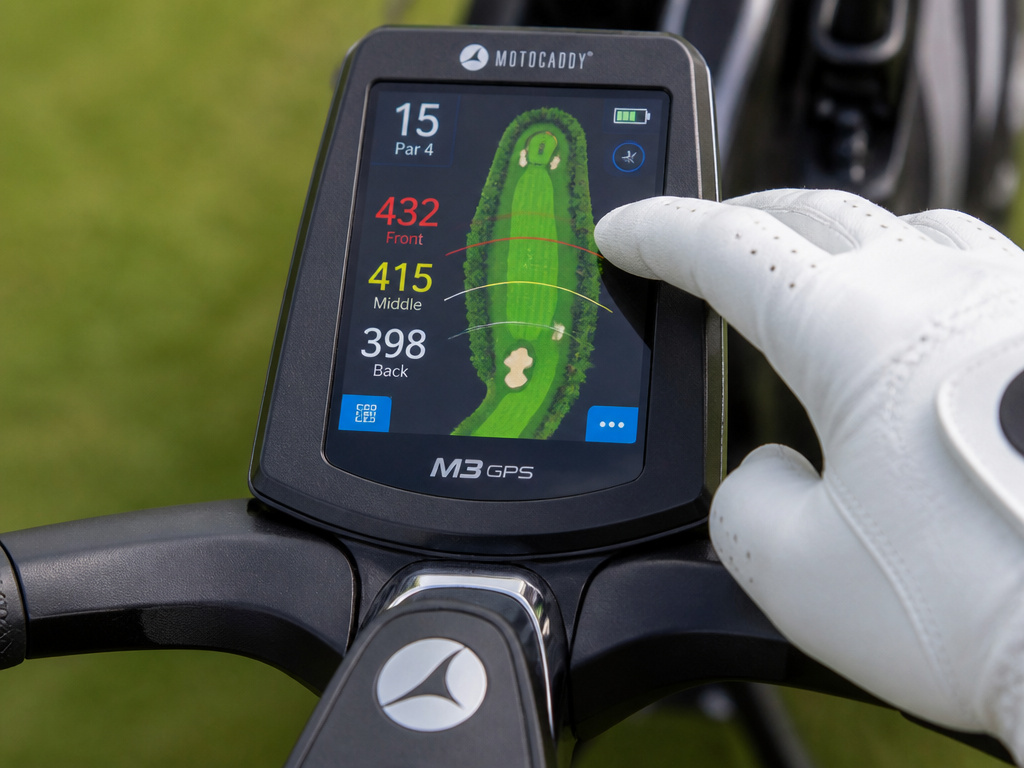 The line between a helpful device and an illegal aid is defined by one principle: does it replace a skill? Measuring distance is a fact-finding mission. Interpreting that distance and selecting a club is the skill.
Electric trolleys like the Motocaddy M3 GPS walk this line. Their GPS provides hole maps and distances, which is legal. However, their manuals explicitly warn that “DMD features are legal to use when local USGA and R&A rule 4.3 is in effect.” The responsibility is on you to check before a tournament.
These trolleys also come with safety features that owners often mistake for faults. The 10-minute automatic motor cut-off is designed to prevent battery drain and motor damage if you walk away. It’s a protection, not a defect.
Advanced launch monitors, like the Foresight Sports ForeCaddy, exist in a practice-only space. They provide ball-flight data that is illegal for use during a round because it “artificially eliminates… The need for a skill or judgment.” Using one on the course would be a clear violation. They are fantastic for range work, but they stay in the bag when you tee off.
The “Nice to Have” Extras (Not Essentials)
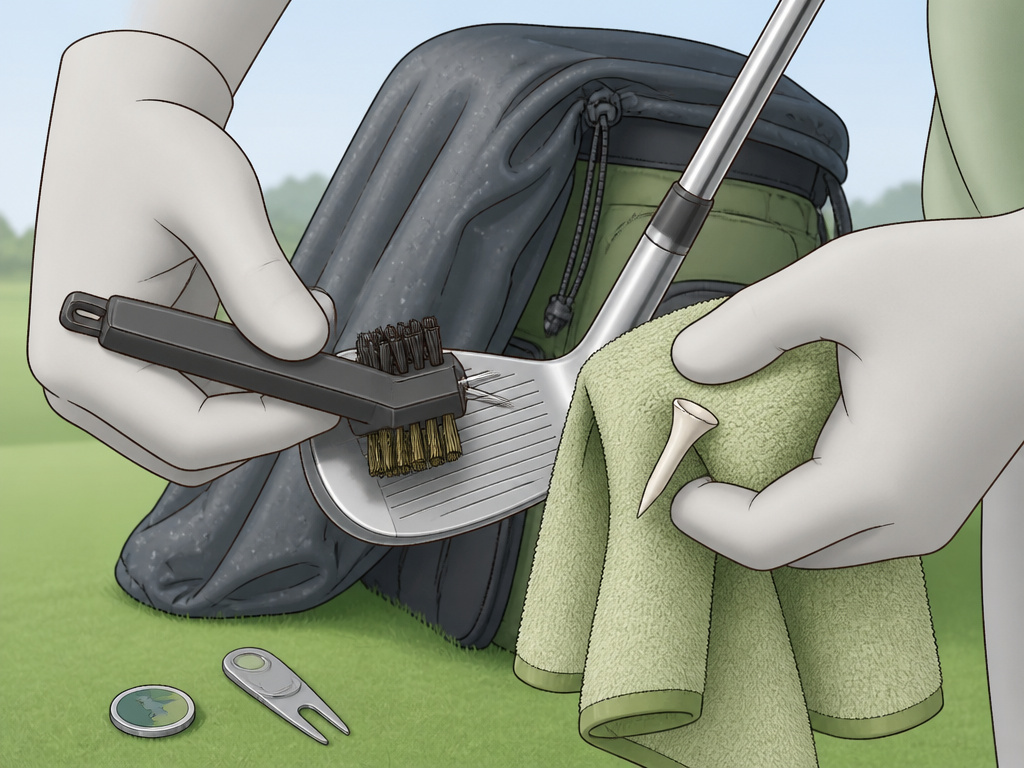 This is where most bags gain dead weight. An accessory is “nice to have” if it makes a real task slightly more convenient, not if it invents a problem to solve.
A club cleaning brush is the classic example. A towel cleans the face. For stubborn dirt in the grooves, a tee works perfectly. A brush is marginally faster, but it’s not essential. If you want one, get a simple, compact model, not a giant tool with a spike.
Personal ball markers and divot tool combinations are convenient. They speed up your routine on the green. They are not, however, required. A coin works as a marker. Your repair tool is already in your pocket.
A waterproof bag cover is climate-dependent. If you frequently play in rain, it’s a sanity-saver. If you don’t, it’s just nylon taking up space. Judge by your local weather, not a generic checklist.
The category of true clutter includes bag organizers with fourteen separate tubes, electronic swing trainers that beep at you, and any gadget that duplicates your phone or rangefinder. Every extra ounce in your bag is an ounce you carry for four hours. Be ruthless.
What to Skip Entirely: The Hype Gear
Some products are solutions in search of a problem. They add cost, weight, and complexity without improving a shot.
- Elaborate Bag Organizers: Your bag has pockets. Use them. A separate organizer adds bulk and makes it harder to find things.
- Non-Conforming Training Aids: Any device designed to be used during a round to guide alignment, swing path, or posture is illegal. Using one risks disqualification. Keep training aids for the practice area.
- Redundant Technology: You do not need a laser rangefinder and a GPS watch and a GPS app on your phone. Pick one source of truth for distances. Multiple devices lead to conflicting numbers and paralysis.
The test is simple. If you didn’t have the item last season, did you genuinely miss it? Did your score suffer? If the answer is no, it’s hype. Focus your budget and bag space on the four essentials that actually matter.
Building Your Personalized Kit
Start with the four non-negotiables. Buy a good towel, a repair tool, a glove that fits, and a legal distance device. That’s your foundation.
Then, and only then, consider the conditions you actually play in. This is where you add your “nice to haves.”
| If you often… | Then add… | Why it fits |
|---|---|---|
| Play in wet climates | A second towel, waterproof gloves | Dry grips are non-negotiable; this is just redundancy. |
| Walk the course | A push cart or electric trolley | Preserves energy for your swing. Consider push cart accessories like a drink holder. |
| Practice putting seriously | A putting alignment mirror | Used only on the practice green, it builds a repeatable setup. |
| Travel with your clubs | A sturdy travel cover | Protection is insurance, not an everyday accessory. |
Notice that “buy a new driver” isn’t on the list. The fastest way to lower your scores isn’t more gear, it’s maintaining the gear you have. Clean grips, sharp grooves, and fresh gloves have a higher return on investment than any magic gadget.
Frequently Asked Questions
What is the most forgotten golf accessory?
The pitch mark repair tool. Players remember tees and balls, but they leave the repair tool in the car or at home. It’s the one item that has zero benefit to you personally, its entire purpose is to care for the course for the players behind you. That’s why it’s the truest test of a considerate golfer.
Are rangefinders with slope legal?
Rangefinders with slope compensation are not legal under the standard Rules of Golf for any competition that follows R&A or USGA rules. The slope feature adjusts the distance based on elevation, which is considered replacing the player’s judgment. Many models have a “tournament mode” to disable slope. Always assume slope is illegal unless the local committee specifically allows it.
How many golf towels do I need?
You need one main towel hooked to your bag. If you play in consistently rainy or humid conditions, carry a second, smaller towel in a plastic bag to keep it dry. The dry towel is for your grips; the damp one is for cleaning clubs. Two is the practical maximum.
Is a golf brush necessary?
No. A golf brush is not necessary. A damp towel cleans clubfaces effectively for 95% of shots. For packed dirt in grooves, a golf tee is a perfect tool to scrape it out. A brush is a minor convenience, not an essential. It belongs in the “nice to have” category if you dislike using a tee.
Can I use my phone as a GPS?
Yes, you can use your phone as a GPS device, provided the app only provides distance information and no other prohibited features (like club recommendations, slope, or wind calculation). However, you must also comply with any local club rules regarding phone use on the course, which often prohibit phone calls or require silent modes.
Before You Go
Forget the twenty-item checklists. Your essential kit is tiny: a tool for the green, a towel for your clubs, a glove for your grip, and a legal device for your decisions. Everything beyond that is either for specific conditions or for comfort.
Spend your money on quality within those four categories first. A durable towel outlasts five cheap ones. A comfortable glove you’ll actually wear is worth the premium. Then, if you walk, look at a trolley. If you travel, get a good cover. Build out from the core, don’t clutter from the edges. A lighter bag is a faster round, and a simpler routine is a clearer head. That’s the real advantage no gadget can give you.
