
Tracing the Major Phases in the Evolution of Golf Clubs
This post contains affiliate links. As an Amazon Associate, we earn from qualifying purchases.
This post contains affiliate links. As an Amazon Associate, we earn from qualifying purchases.
The evolution of golf clubs through history isn’t a story of steady improvement. It’s a story of collisions, between new materials and ancient rules, between wild experiments and governing bodies, and between the ball and the club that has to hit it. Each time the ball changed, the clubs that worked before shattered.
Strip it back. The clubs in your bag today are the survivors of a fight that started over 500 years ago. The fight is about one thing: how to make a small, hard object go a predictable distance with a stick in your hands. Every revolution, hickory, steel, perimeter weighting, titanium, killed the technology that came before it because the old tools literally could not survive hitting the new ball.
The real shift happened when golf stopped being a craft and became an engineering problem. A 17th-century clubmaker worked by eye and feel. A 21st-century designer works with CAD software, finite element analysis, and a rulebook that limits clubhead volume to 460cc and Characteristic Time (CT) to 239 ± 18 µs. The journey between those two points is where the game was reinvented.
Key Takeaways
- The golf ball drove every major change; hard gutta-percha balls in 1848 broke the wooden long-noses, forcing the shift to hickory and iron.
- Rules didn’t just limit technology; they created the modern game by standardizing club length (max 48 inches), head size (max 460cc), and face flexibility (CT limit).
- The 20th century had two separate revolutions: perimeter weighting (1960s) which forgave mishits, and metal woods (1980s/90s) which prioritized power and distance.
- Today’s 7-iron has the loft and length of a 1970s 5-iron; this “strengthening” of lofts accounts for most of the perceived distance gains in modern irons.
- A conforming club damaged during a round is still legal for that round, but if a field test shows a CT over 257 µs, it’s deemed non-conforming and can’t be used again.
The First True Pro (And the Ball That Betrayed Him)
The story starts with a man who wasn’t a golfer. Hugh Philp was a furniture maker in St. Andrews who started repairing clubs as a side hustle around 1812. By 1819, the Society of Golfers (the future R&A) made him their official clubmaker. His world was wood, apple, beech, hazel, shaped by hand into clubs called long-noses and spoons. They were designed for one specific object: the feathery ball.
A feathery was a hand-stitched leather pouch stuffed with boiled goose feathers. It was expensive, fragile, and soft. Philp’s long-nose drivers, with their slender heads and flexible shafts, were perfect for compressing it. Then a divinity student ruined everything. In 1848, Robert Adams Patterson molded a ball from a strange latex called gutta-percha. It was hard, cheap, and flew 30 yards farther. Within five years, the feathery was dead. The long-noses, engineered for a soft ball, started splintering on impact with the hard rubber. Philp’s entire craft was obsolete.
Where this goes sideways: Assuming old clubs just wore out. The gutta-percha ball didn’t just go further; it acted like a hammer on the thin wooden club faces. A well-made long-nose might survive a season hitting the new ball, where it had lasted a gentleman player for years with featheries.
This collision forced the first material revolution: hickory. American hickory shafts, imported in straight-grained billets, were stronger and more consistent than the native ash or hazel. They could handle the gutta-percha. Iron heads became more common for approach shots. This era also gave us the bizarre named clubs, brassie, mashie, niblick, that were essentially the first numbered set system, each tooled for a specific job with the new ball.
The Steel Shock: When Physics Overruled Tradition
Hickory had a fatal flaw: it was organic. The grain dictated stiffness. Two clubs from the same set could twist differently at impact. Then came steel. The USGA legalized steel shafts in April 1924. The R&A, citing tradition, held out. The argument ended in September 1929 when the Prince of Wales played a round at St. Andrews with steel-shafted clubs. The R&A could not disqualify the heir to the throne. They changed the rule.
The impact was immediate. Steel shafts were consistent. Engineers could now design a shaft’s flex profile instead of hoping a piece of wood would behave. Billy Burke won the 1931 U.S. Open with them, the first major winner to do so. By the early 1940s, hickory was gone from professional golf. This wasn’t just an upgrade. It was the end of an artisanal craft and the beginning of mass manufacturing. The club was now a predictable mechanical object.
| Era | Dominant Material | Key Limitation | What Killed It |
|---|---|---|---|
| Long-Nose (pre-1848) | Native Hardwoods (Apple, Beech) | Could not survive hard gutta-percha ball | The gutta-percha ball (1848) |
| Hickory (1848-1929) | American Hickory Shafts, Forged Iron Heads | Inconsistent stiffness due to natural grain | Consistent, engineerable steel shafts (1924-29) |
| Classic Steel (1930s-1970s) | Steel Shafts, Persimmon/Plywood Heads | Small sweet spot, low forgiveness | Perimeter weighting & metal woods |
| Modern (1980s-Present) | Graphite Shafts, Titanium/Composite Heads | Constrained by volume (460cc) & CT (239µs) limits | Rules have capped the next revolution |
The feel changed, too. A hickory shaft had a soft, whippy kick. A steel shaft was a taut, solid rod. Players lost the ability to “work” the ball with their hands through the grain; they gained the ability to rely on the same swing producing the same result every time. That trade-off, artistic feel for mechanical consistency, defines the modern game.
The R&A/USGA Equipment Rulebook: What Actually Changed
Once clubs became engineered objects, the governing bodies had to write the spec sheet. The history of golf equipment rules is a series of reactions to what manufacturers invented. It’s not a plan; it’s a containment strategy.
The rulebook’s spine is the Equipment Rules published jointly by the R&A and USGA. This document is the source for every limit that defines a modern club. Let’s be clear about this: the 48-inch maximum shaft length (except for putters) introduced in 2004 didn’t come from nowhere. It was a response to manufacturers pushing longer and longer drivers, chasing greater power and distance. The rule stopped that arms race.
“The overall length of a club must be at least 18 inches (0.457m) and, except for putters, must not exceed 48 inches (1.219m).” . The R&A/USGA Equipment Rules (2024)
The same year, 2004, saw the 460cc volume limit for clubheads, plus a 10cc tolerance. That’s why every modern driver looks about the same size. The engineers had maxed out the space they were allowed to work with. Before that, in 1998, the USGA set a COR (Coefficient of Restitution) limit of 0.822, which the R&A matched in 2003 with a CT (Characteristic Time) limit of 239 ± 18 µs. These are different ways of measuring the same thing: how springy the clubface can be. A hotter face means more ball speed, more distance. The limit capped it.
What does the ball flight tell us? These rules didn’t stifle innovation; they channeled it. When you can’t make the face hotter or the head bigger, you pour genius into weight distribution, aerodynamics, and adjustable hosels. The modern driver is a masterpiece of working within a very strict box.
The Two Revolutions Inside Your Modern Bag
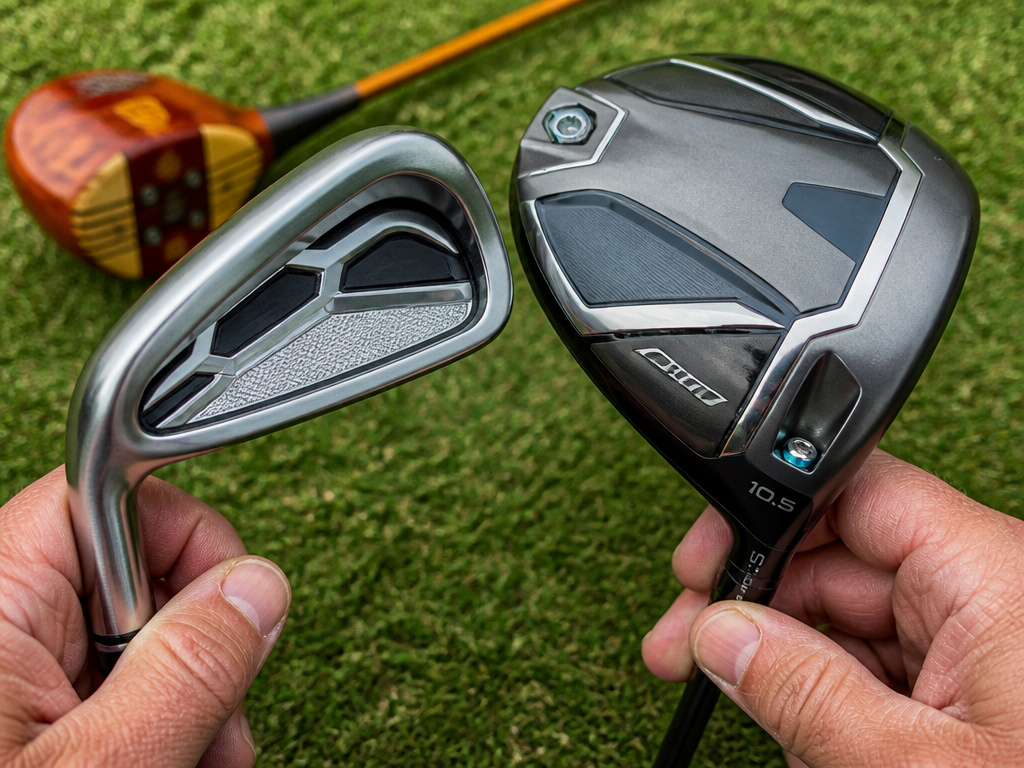
Look at your irons and your driver. They are products of two separate 20th-century revolutions that happened decades apart.
Revolution One: Perimeter Weighting (1960s). For centuries, clubhead weight was concentrated behind the sweet spot. Hit it there, and the ball flew well. Miss it, and the club twisted in your hands, producing a weak, off-line shot. Then Karsten Solheim (founder of Ping) and others pioneered the cavity-back iron. They hollowed out the back and pushed weight to the heel and toe. This increased the club’s moment of inertia (MOI). On a mishit, the clubhead resisted twisting. The result was forgiveness. Mishits still got airborne and went somewhere near the target. This opened the game to millions of average players.
Revolution Two: Metal Woods (1980s/90s). Persimmon wood drivers were beautiful, but they had a sweet spot the size of a dime. In 1979, TaylorMade released the first metalwood. Then, in 1991, Callaway’s Big Bertha landed like a bomb. Its oversized stainless steel head offered a massive sweet spot and more power. Titanium soon replaced steel, allowing even larger, lighter heads. The last persimmon driver on tour was used in 2001. Metal woods prioritized pure distance and consistency over the nuanced “workability” of wood.
Easy to miss: The modern hybrid is the direct descendant of both revolutions. It replaces a hard-to-hit long iron (forgiveness via perimeter weighting) with a club shaped like a small fairway wood (distance via metalwood design). It’s the perfect fusion of the two big ideas.
These shifts changed the sound of the game. A pure strike with a persimmon driver made a solid, muted thwock. A titanium driver makes a loud, high-pitched crack. That’s the sound of different materials transferring energy. One isn’t better; they’re the acoustic signatures of their respective eras.
Why Your 7-Iron is Really a 5-Iron (And That’s Okay)
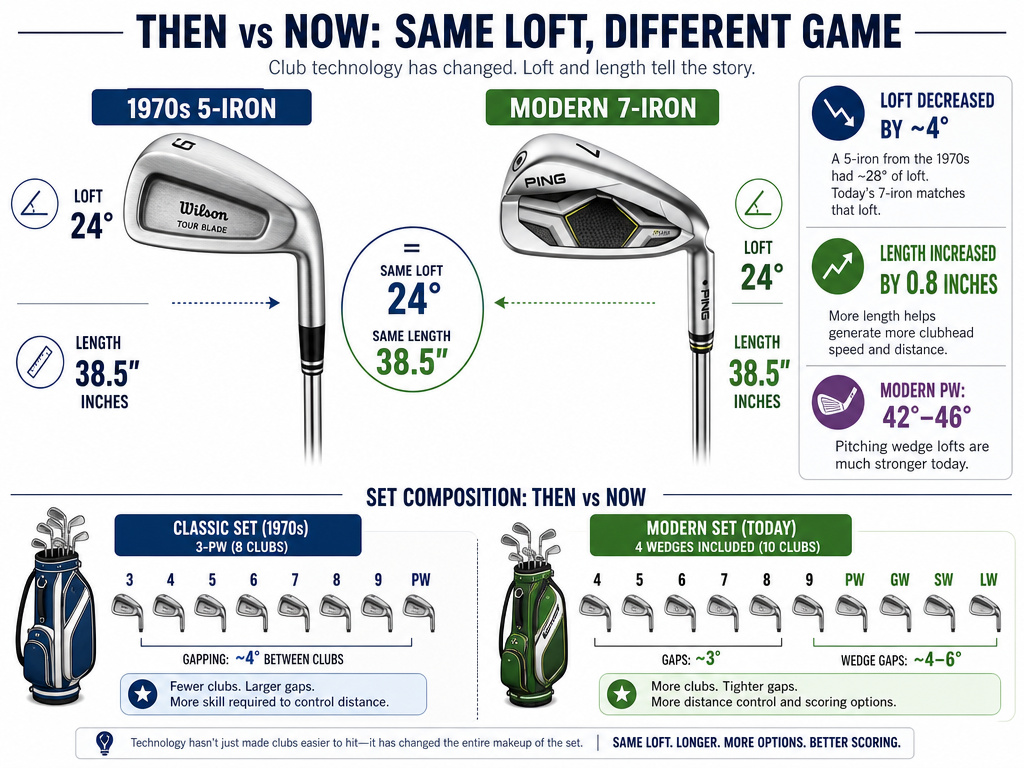
You’ve probably heard that modern irons are “stronger lofted.” That’s true, but it undersells the total change. Today’s 7-iron has the loft of a 1970s 5-iron and the shaft length of a 1970s 5-iron. It’s not just a numbering trick; it’s a complete re-specification of the set.
According to an R&A research report, over the last 40 years, the average iron’s loft has decreased by about 4 degrees and its length has increased by about 0.8 inches. That means today’s 7-iron is about one and a half to two clubs stronger than its 1970s counterpart. Ben Hogan hit a 1-iron 200 yards at Merion in 1950. In 2013, Justin Rose hit a 4-iron from a similar spot at Merion. The club difference is directly accounted for by these spec changes.
Why did this happen? It’s a marketing-driven arms race tied to the promise of more distance. But here’s the truth nobody sells: it also changes your gapping. If your 7-iron goes as far as an old 5-iron, you need more clubs at the bottom of your bag (gap wedges, specialty wedges) to cover the short shots. The modern 14-club limit forces choices that didn’t exist 50 years ago.
- The average loft of a modern pitching wedge is now between 42-46 degrees.
- This has created the “wedge gap,” filled by the 50-52 degree gap wedge.
- Many players now carry four wedges (PW, GW, SW, LW) to cover 120 yards and in.
This is where the rubber meets the road. The evolution of clubs isn’t abstract history; it’s why your set makeup looks the way it does. For amateurs, understanding this is more useful than chasing the latest driver model. Good golf should feel less complicated the more you understand it, and knowing your real distances with each iron is the foundation.
Frequently Asked Questions
How have golf club rules evolved?
The rules have evolved from a single sentence in 1908 banning “mechanical contrivances, such as springs” to a detailed technical rulebook limiting size, length, and face flexibility. Key milestones include the legalization of steel shafts (1924-29), the 14-club limit (1938-39), and the introduction of the CT limit for drivers (2003) and the 460cc volume limit (2004). Each change was a reaction to manufacturing innovations that threatened to alter the game’s skill balance.
What is the most significant change in golf club history?
The shift from hickory to steel shafts (1924-29) is the most significant. It marked the end of golf as a purely craft-based, organic pursuit and the beginning of it as an engineered, mass-produced sport. Steel’s consistency allowed for standardized sets, repeatable swings, and the modern concept of club fitting. It made the game more accessible and fundamentally changed the feel and physics of the swing.
When did drivers stop being made of wood?
Drivers stopped being made of wood at the professional level in the late 1990s. While metal woods were introduced in 1979, persimmon drivers persisted on tour for another two decades due to player preference for their feel and control. The last persimmon driver used in a PGA Tour event is believed to have been in 2001. The shift was driven by the superior forgiveness and distance of oversized metal heads, notably after the 1991 release of the Callaway Big Bertha.
Why are modern golf clubs more forgiving?
Modern clubs are more forgiving primarily due to perimeter weighting, a design principle that moves weight from the center of the clubhead to its edges (heel and toe). This increases the club’s moment of inertia (MOI), causing it to resist twisting on off-center hits. The result is that mishits lose less distance and deviate less from the target line. This technology, pioneered in irons in the 1960s and applied to metal woods later, has made the game easier for average players.
How has club technology affected scoring?
Club technology has significantly lowered scores for average amateurs by making mishits less penal. Perimeter-weighted irons and large-headed drivers keep bad shots in play. However, for elite professionals, the effect is more debated. While modern equipment provides more consistency, the governing bodies’ strict limits on factors like CT (Characteristic Time) have prevented a runaway distance explosion at the highest level. Scoring averages on tour have dropped, but course lengthening and improved conditioning have been used to maintain the challenge.
Before You Go
One rule most guides skip: if you’re using a set of clubs more than 15 years old, your 7-iron is likely two clubs weaker than a new one. Before you buy the latest model chasing distance, grab your 7-iron and a modern demo 7-iron at a range. You’ll likely see a 10-15 yard gap. That’s the evolution of golf clubs, measured in real grass.
The history isn’t about things getting shinier. It’s about a slow, forced march from art to science, from the workshop of Hugh Philp to the CAD screen of a Callaway engineer. Every club in your bag is a compromise between what physics allows and what the rulebook permits. I’ve learned that on the weekend rounds where I first got hooked. Better golf comes from understanding that compromise, not fighting it. The next time you hear that distinctive crack of a driver, listen for the echo of a hickory shaft snapping on a gutta-percha ball 170 years ago. It’s the same conversation, just louder.
