
Unlock Golf Accessibility and Inclusion With the 48-Inch Rule
This post contains affiliate links. As an Amazon Associate, we earn from qualifying purchases.
This post contains affiliate links. As an Amazon Associate, we earn from qualifying purchases.
Golf accessibility and inclusion means building courses and crafting policies so anyone, regardless of mobility or disability, can play. It’s governed by two frameworks: the built-environment rules from the U.S. Access Board (like the 48-inch minimum path width) and the playing rules from the USGA, specifically Rule 25, which since 2023 automatically applies modified rules for eligible players. The goal isn’t a separate game, it’s removing barriers so the same game is open to all.
That 48-inch number is where theory meets dirt. It’s the minimum clear width for a golf car passage, and it’s not a suggestion. It’s printed in the federal standards because that’s the space a single-rider adaptive vehicle needs to navigate a path, enter a weather shelter, or reach a practice green. Get it wrong, and you haven’t built an accessible route; you’ve built a decoration.
What follows is the map course owners, pros, and players need. We’ll walk through the two-track legal system (the course and the rules), the adaptive equipment that bridges the gap, and the straightforward policies that turn compliance into genuine welcome. By the end, you’ll be able to read any course’s layout and spot where accessibility is built-in or bolted-on.
Key Takeaways
- Since January 1, 2023, the USGA’s Rule 25 applies automatically in all play for eligible players with disabilities, ending the need for committees to adopt it as a Local Rule.
- The 48-inch minimum width for accessible routes and golf car passages is a federal standard (ADA Chapter 10); it jumps to 60 inches if handrails are present.
- Where man-made barriers like curbs line a path, openings at least 60 inches wide must occur every 75 yards to allow access to the fairway.
- ANSI/RESNA ASE-2 is the safety and performance standard for adaptive golf cars; look for it when evaluating equipment like the SoloRider or ParaGolfer.
- True inclusion requires a written accessibility policy that welcomes golfers with disabilities and outlines reasonable modifications, not just physical compliance.
The Two-Track System: Accessible Routes vs. Golf Car Passages
Most people think “accessible golf course” and picture ramps. That’s part of it, but the federal rules acknowledge a golf course isn’t a building. The ball lands where it lands, and requiring a paved path to every possible spot is impossible. So the guidelines created a two-track system.
The first track is the standard accessible route. Outside the boundary of the course, think from the parking lot to the clubhouse or the bag drop, this follows typical ADA rules. But once you cross onto the playing area, the second track takes over: the golf car passage.
A golf car passage is a continuous passage on which a motorized golf car can operate. It must be a minimum of 48 inches wide, but it doesn’t necessarily need a paved surface; it can be a firm part of the fairway or path.
This is the critical swap. It means access can be provided through maintained turf and existing paths, as long as they are firm, stable, and meet the width requirement. The U.S. Access Board golf course guide explicitly allows this substitution within the course boundary. The goal is functional access, not cosmetic compliance.
Where does the 60-inch rule come in? Two places. First, if an accessible route (not a passage) has handrails, the width must be 60 inches minimum to get a car through. Second, and this is the one crews miss: where curbs or barriers prevent cars from entering a fairway, you must provide a 60-inch-wide opening at least every 75 yards. Miss that interval, and a player is trapped on the path.
| Feature | Standard Accessible Route | Golf Car Passage |
|---|---|---|
| Typical Location | Outside course boundary (parking, clubhouse) | Within course boundary (fairways, paths to greens) |
| Minimum Width | 36 inches (increases to 48-60 inches for specific golf elements) | 48 inches |
| Surface Requirement | Firm, stable, slip-resistant | Must support a golf car; can be turf |
| Key Purpose | General ADA compliance | Functional access to the game |
Rule 25: How the Rules of Golf Adapted
For years, players with disabilities needed tournament committees to explicitly adopt the “Modified Rules.” If they didn’t, you were stuck with the standard rules, which could be impossible to follow. That changed on January 1, 2023.
Rule 25 of the Rules of Golf now automatically applies in all competitions and general play for eligible players. It’s not a request, it’s the rule. This covers four categories of disability: players who are blind or have vision impairment, amputees, players who use assistive mobility devices, and players with intellectual disabilities.
The committee’s job shifts from deciding if the rules apply to determining eligibility under those categories. They can ask for evidence, a medical certificate, a pass from an organization like EDGA, but the modification is guaranteed. This is a massive shift from goodwill to guarantee.
Common mistake: Thinking Rule 25 covers all disabilities. It doesn’t. Players with other conditions (e.g., neurological, orthopedic, deafness) play under the standard rules, as no specific modifications have been deemed necessary yet. Their access is handled through course setup and policy, not rule changes.
Rule 25 is a playing rule. It doesn’t override a course’s safety decisions or cart policies. A committee can still restrict cart use due to wet conditions for all players. It makes certain that if carts are allowed, a player using an adaptive device is not disqualified for an action like touching the sand with their wheelchair during a bunker shot.
Adaptive Equipment That Actually Works
You can have the perfect accessible route, but if a player can’t swing a club, it’s a dead end. This is where adaptive equipment bridges the gap. I’m not talking about gimmicks. I mean tools that restore the fundamental physical relationship between the player and the swing.
The gold standard for single-rider vehicles are machines like the SoloRider and the ParaGolfer. These aren’t glorified scooters. They are engineered to lift and support a player into a standing or seated playing position, navigate slopes, and minimize turf damage. Their design and safety are governed by the ANSI adaptive golf car standard (ANSI/RESNA ASE-2), which covers everything from stability tests to battery safety.
For clubs, adaptation often starts much simpler than a full custom set. A player with limited grip strength doesn’t necessarily need $3,000 irons. They might just need a set of best arthritic golf grips. These jumbo, soft-compound grips reduce tension and vibration. It’s a $15 fix that does more than a fitting for a club they can’t hold.
Here’s my stance, forged from watching this space: we over-engineer the expensive solution and under-value the simple one. Before chasing a full bag of custom clubs, exhaust the basics: * Grip modifications (size, material, texture) * Club length and lie adjustments * Seated or supported stance mechanics * Ball position aids
A fundamentally sound, repeatable motion built within a player’s physical reality works with almost any decent club. Start there. The ADA accessible golf courses guide covers the built environment, but the swing adaptation is a collaboration between player, coach, and sometimes a physical therapist.
Building an Inclusive Policy (Beyond the Law)
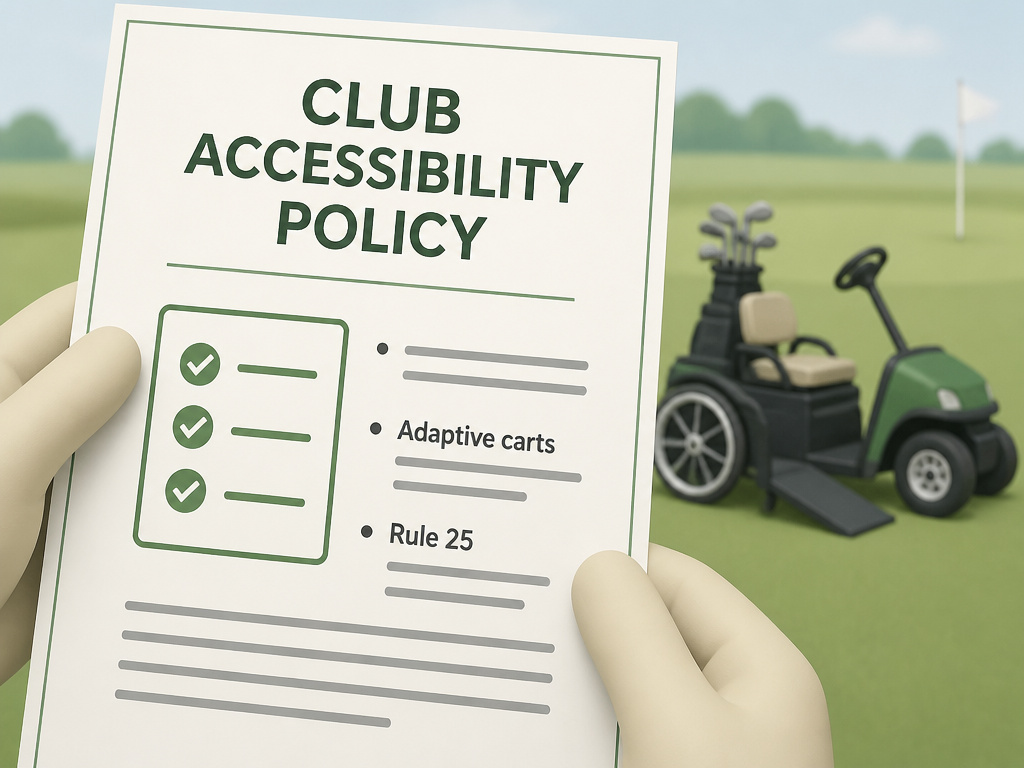 The law sets the floor. The National Alliance for Accessible Golf toolkit is blunt: you should have a written accessibility policy. Not a secret binder, but a visible statement.
This policy does two things. First, it tells staff what to do. It spells out that reasonable modifications are allowed, maybe a player uses their own adaptive cart, or needs a spot in the shade to manage a condition. Second, and more importantly, it tells the golfer with a disability, “You are expected here.”
A weak policy is just a legal disclaimer. A strong policy reads like an invitation. It should cover: 1. A Welcome Statement: “We welcome golfers with disabilities.” 2. Cart & Equipment Policy: Clarify use of personal adaptive carts, rental availability, and any trail fees (which must match fees for standard personal carts). 3. Communication: Who to contact to arrange accommodations (pro shop, head pro). 4. Course Access: Reference key accessible features (accessible restrooms, routes to first tee). 5. Rule 25 Acknowledgment: State that the club follows USGA Rule 25 for eligible players.
Without this, you’re relying on the discretion of a 17-year-old starter. That’s how you get inconsistent, awkward experiences that feel like charity, not golf.
The Fairness Debate: Carts and Competition
 This is the elephant on the fairway. Does using a cart provide an unfair physical advantage in competition? The competitive golf event transportation study from St Andrews University tackled this directly. Its scoping review concluded it is “biologically plausible and likely” that carts offer a performance advantage in some circumstances by reducing fatigue.
Let’s be clear about this. The advantage isn’t in the swing. It’s in energy conservation over 18 holes, especially in heat or on hilly terrain. This is a real debate at the elite amateur and professional level.
For the vast majority of play, however, this debate is a distraction. The inclusion benefit vastly outweighs a theoretical advantage in a club championship. For players with disabilities, the cart isn’t an advantage; it’s the only way to play. The governing bodies have rightly separated the right to access from the fine print of elite competition. Local committees can still set cart policies for all players based on conditions; they just can’t discriminate.
The Pro’s Role: Simplifying the Adaptive Swing
This is where my experience as an instructor hits the road. I’ve worked with left-handed players trying to learn from right-handed instruction. The mental translation required is immense, every “right side” cue becomes a “left side” action. It’s an edge case that requires rebuilding the instruction from the ground up.
Teaching adaptive golf is the same principle, magnified. You strip it back. You abandon the complex “positions” that dominate modern instruction. What does the ball flight tell us? We build a simple, repeatable motion pattern that works within the player’s physical constraints, whether they’re seated, standing with support, or have limited range of motion.
My strong opinion? Most golf gadgets and data paralysis hurt more than they help here. The focus is on feel, on rhythm, on one key that produces a clean strike. It’s about practical routines, not chasing the latest tip. Good golf should feel less complicated the more you understand it, and that’s doubly true here.
Often, the best equipment aid isn’t a club. It’s a best ankle brace for golf that provides stability for a player with drop-foot, or arch support golf shoes that let them ground their feet properly. These are the unsexy, essential tools of access.
Frequently Asked Questions
What is the minimum width for an accessible golf cart path?
The minimum clear width for a golf car passage on the course is 48 inches. For an accessible route serving specific elements like teeing grounds or weather shelters, the minimum is also 48 inches, widening to 60 inches if handrails are present. These are federal standards outlined in the ADA Chapter 10 guidelines.
Does a private golf club have to follow ADA accessibility rules?
It depends on the club’s public access. If the club is truly private and never hosts non-member events open to the public, it may be exempt from Title III of the ADA. However, most private clubs host weddings, outings, or allow guest play, which can trigger “public accommodation” status and require compliance. It’s a complex legal area; clubs should consult an attorney.
Can a golf course charge a fee for a player using their own adaptive cart?
Yes, but only if they charge a standard “trail fee” for any player bringing their own golf cart. The fee must be identical. If the course is normally “walking only,” they must allow the adaptive cart as a reasonable modification and likely cannot charge a fee, as the player has no walking alternative.
What’s the difference between the ADA and USGA Rule 25?
The ADA (Americans with Disabilities Act) governs the built environment, the physical course, paths, facilities, and policies. The USGA’s Rule 25 governs the rules of play during a round. The ADA gets you onto the course; Rule 25 defines how you play the game once you’re there. They are separate but complementary frameworks.
Before You Go
Golf accessibility and inclusion isn’t a charity project. It’s a recognition that the game is richer when more people can play it. The frameworks are now clear: the 48-inch path, the automatic Rule 25, the ANSI standard for equipment.
The work is in the execution. It’s the superintendent measuring the width of a bridge on the 12th hole. It’s the pro shop manager printing the accessibility policy and posting it next to the tee time sheet. It’s the instructor ditching the perfect backswing model and finding the one move that gets this player, today, to make solid contact.
One rule most guides skip: if your course’s “accessible” tee box is only reachable by a 1:8 slope, it’s not accessible. The maximum allowable slope is 1:12 (8.33%). Check that first. Everything above assumes the basics are right, a truly barrier-free course is faster to build correctly than to retrofit after a complaint.
