
Golf for Seniors Complete Guide | Play Longer & Stronger
This post contains affiliate links. As an Amazon Associate, we earn from qualifying purchases.
This post contains affiliate links. As an Amazon Associate, we earn from qualifying purchases.
A complete guide to golf for seniors is built on three pillars: a shorter, more efficient swing adapted to your current flexibility; equipment specifically fitted to your present swing speed (think senior flex shafts, 12+ degree drivers, and graphite irons); and a strategic shift in course management that prioritizes consistency over distance. The goal isn’t to reclaim your 30-year-old game, but to build a reliable, enjoyable one with the body you have today.
Let’s be clear about this. The difference between struggling and thriving after 60 is matching your mechanics and your gear to the numbers you actually produce now, not the ones you remember. Research shows swing speed drops 1-2 mph each year after 50.That decade-long slide changes everything about which shaft you need and what loft gets the ball in the air.
What follows is a system, not a list of tips. We’ll walk through the swing adjustments that protect your back, the equipment specs that add yards without effort, and the on-course strategy that turns experience into your biggest weapon. By the end, you’ll have a clear map for your next round—and your next decade of play.
Key Takeaways
- Swing shorter, not harder. A three-quarter backswing with a focus on tempo and connection produces more consistent contact and less strain than forcing a full turn your spine can’t safely deliver. Your shaft flex is essential.** If your driver swing speed is under 85 mph, you need a senior flex (A/L) shaft. Playing anything stiffer actively costs you distance and increases joint strain.
- Loft is your friend. A 12 to 14-degree driver is not a concession; it’s physics. The extra loft compensates for lower swing speed and creates the launch angle needed for carry.
- Warm up your body before your swing. A 5-minute mobility routine targeting the hips, thoracic spine, and shoulders can prevent the majority of senior golf injuries, which occur on “cold” first swings.
- Move up a tee box before you think you have to. Playing from the appropriate yardage preserves the strategic challenge of the game and makes it more enjoyable, not easier.
The Foundation: How Age Changes Your Swing (And What to Do)
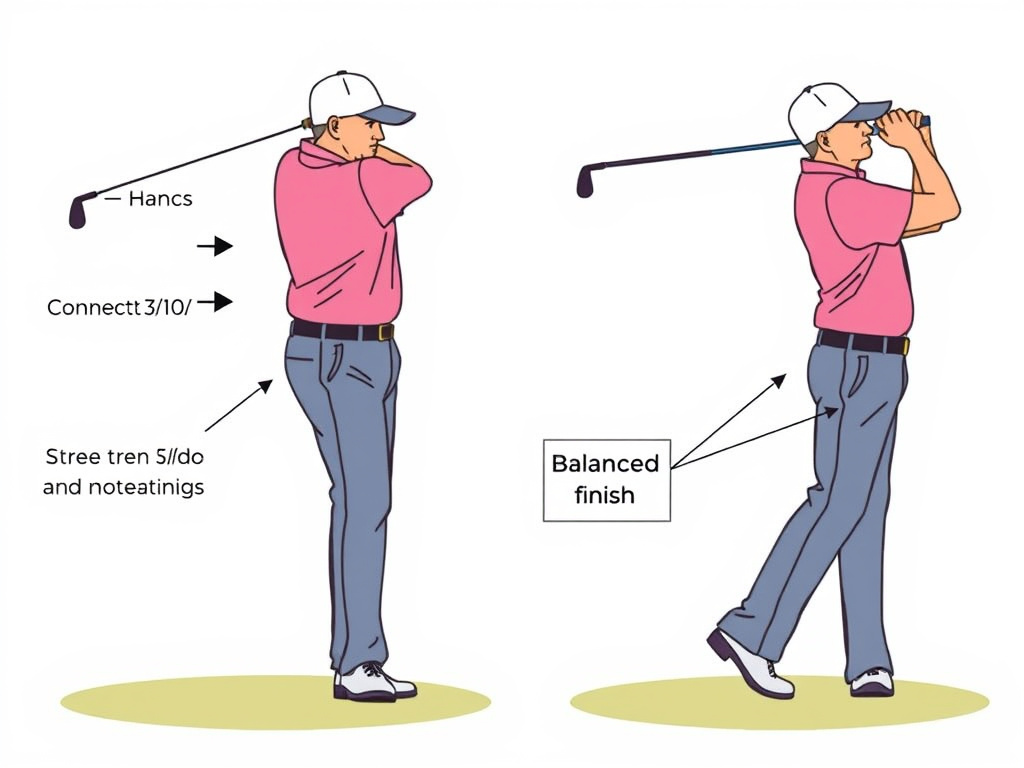
Your swing hasn’t gotten worse. Its operating environment has changed. Connective tissue stiffens, rotational range decreases, and the muscles that once powered a full coil now favor efficiency. Trying to replicate your old backswing is the fastest route to back pain and inconsistency.
The Senior Swing: Shorter, Smoother, Connected
The best golf swing for seniors is a different shape altogether, not a full swing with less speed.
A three-quarter backswing with an emphasis on sequencing, tempo, and connection produces more consistent contact and often more distance than an overextended full swing. The arms stay linked to the torso, grip pressure stays light, and the transition is gradual.
Forget the top-of-the-backswing position you see on TV. Your finish position is a better target. Here’s the adjustment sequence:
- Grip Pressure: Lighten Up. This is the first fix. Grip pressure should be a 3 or 4 on a scale of 10. White knuckles create tension that locks up the wrists, elbows, and shoulders, killing speed and feel. A lighter grip alone can add 3-5 mph of clubhead speed.
- The Knee Key. The most common mechanical mistake is forcing hip rotation that isn’t there anymore. The fix is in your knees. At address, flare both feet outward about 20 degrees. As you swing back, let your trail knee straighten slightly while your lead knee flexes inward. This coordinated movement gives your hips and shoulders room to turn without forcing your lower back to compensate.
- Tempo is Everything. A smooth, repeatable rhythm is your superpower. Use a simple 3:1 count: “one-two-three” on the backswing, “one” on the downswing. A slower overall tempo (around 1.5 to 2 seconds for the whole swing) suits senior mechanics perfectly.
| Old Swing Thought | New Senior Adjustment | Physical Reason |
|---|---|---|
| “Make a full shoulder turn” | “Make a connected, three-quarter turn” | Protects the lumbar spine; uses available thoracic rotation. |
| “Power from the hips” | “Let the knees unlock the turn” | Accommodates reduced hip mobility; reduces lower-back load. |
| “Swing aggressively” | “Swing with smooth tempo” | Promotes consistency; reduces injury risk from jerky movements. |
Where this goes sideways: Ignoring pain to “work through” a stiff back. A sharp twinge on your downswing is a structural warning, not a stamina test. Stop, walk it off, and shorten your swing further for the rest of the round. Pushing through it is how you end up sidelined for months.
Your Body First: Warm-Up and Maintenance
The dirty secret of senior golf injuries? They usually happen on the first few holes, when cold muscles are asked to make an aggressive rotational move. A dynamic warm-up that includes movements like leg swings and torso rotations isn’t optional; it’s your most important pre-shot routine.
I favor straightforward routines players can actually stick with. This one takes five minutes in the parking lot:
- Pelvic Rotations (90 seconds): Stand, hands on hips. Slowly rotate your pelvis in a circle, like stirring a pot with your belt buckle. 10 circles each direction. This wakes up the lumbar spine and hips without load.
- Open Books (90 seconds): Lie on your side, knees stacked and bent. Extend your top arm and rotate your upper body open, looking behind you. Hold for 3 seconds. Do 8 per side. This mobilizes the thoracic spine—the part of your back that should do the rotating.
- Arm Circles with a Club (60 seconds): Hold a club horizontally at both ends. Make slow, wide circles forward and back, then hold it overhead for gentle side stretches.
Do this before every single round. It’s not a fitness program; it’s injury insurance. The research is clear: seniors with higher physical capacity, including flexibility, not only play more often but also post better scores. A study in the International Journal of Golf Science found that healthy senior golfers reported significantly greater flexibility and different playing habits than those with age-related conditions.
The 3 Non-Negotiable Equipment Changes
This is the part nobody sells: your beloved clubs from 2005 are likely fighting you. Equipment technology hasn’t just gotten “newer”—it’s been refined to solve the exact problems senior golfers face. Updating your gear is the single fastest way to gain yards and reduce fatigue.
1. The Right Shaft: Flex and Weight
Your shaft flex is the engine of your club. If it’s mismatched to your swing speed, nothing else works.
- The Speed Test: Get your current driver swing speed measured. Most big-box stores will do this for free.
- The Rule: Below 85 mph, you need a senior flex shaft (often marked “A” for Amateur or “L” for Light). Between 85-95 mph, a regular flex is correct. The old “stiff” flex from your faster days now acts like a board, failing to load and unload properly, costing you launch and distance.
- The Weight: Senior-specific graphite driver shafts weigh 45-55 grams (standard is 55-70g). This lighter total club weight (aim for 275-290 grams) can increase clubhead speed by 2-5 mph. That’s 5-15 extra yards, just from the scale.
For irons, the move to graphite is even more critical. A typical graphite iron shaft weighs 55-80 grams, compared to 105-130 grams for steel. That 30-40 gram savings per club reduces strain on joints by 15-20% per impact, according to research cited by GOLFTEC. Over 100 shots a round, that’s a massive reduction in cumulative fatigue. When choosing senior golf irons, the shaft material is your first filter.
2. Launch and Loft: Your Driver Makeover
Higher loft equals more distance for slower swing speeds. This is physics, not opinion.
If your driver swing speed is under 90 mph, a 12-degree driver will almost certainly outperform a 9.5-degree driver. The additional loft generates the necessary launch angle and spin to maximize carry.
The ideal launch angle for seniors is 13 to 17 degrees, with a spin rate between 2500 and 3200 RPM. You cannot hit those numbers with an 8.5-degree head at 82 mph. Look for drivers offering 10.5, 12, or even 13.5-degree loft options. Models like the Cleveland Launcher XL 2 are built around this high-launch principle. This is the most important upgrade for your golf woods for seniors.
3. The Bag Makeover: Hybrids, Balls, and Grips
The final touches complete the system.
- Replace Long Irons with Hybrids. This is non-negotiable. A 4-hybrid is easier to launch, more forgiving, and goes the same distance as a 4-iron for almost every senior. Start by swapping your 3- and 4-iron. Many should also replace the 5-iron. Explore the best hybrid clubs for seniors to fill these gaps.
- Use a Low-Compression Ball. Golf balls with a compression rating of 50-70 (like many Callaway Supersoft or Titleist TruFeel models) compress more easily at slower swing speeds, transferring energy more efficiently for more distance. Don’t play a Pro V1x designed for 110 mph swing speed. Match your golf balls for seniors to your reality.
- Regrip to Reduce Stress. Old, hard grips force you to squeeze tighter. New, midsize or undersize grips can ease arthritic hand stress. A grip like the Golf Pride MCC Plus4 has a softer lower hand to reduce tension. Regrip every 40-60 rounds. It’s the cheapest performance boost in golf.
| Club Type | Senior-Optimized Spec | Reason & Effect |
|---|---|---|
| Driver | 12-14° loft, Senior (A/L) Flex, ~50g graphite shaft | Maximizes launch angle for carry; increases swing speed 2-5 mph. |
| Irons | Graphite shafts (55-80g), stronger lofts, game-improvement heads | Reduces joint strain by 15-20%; improves launch; increases forgiveness. |
| Long Irons (3-5) | Replace with matching hybrids | Easier launch, higher flight, more forgiveness on off-center hits. |
| Putter | Mid-mallet head with alignment aids | Increases stability and reduces twisting on off-center strikes. |
For many, the simplest path is a complete senior golf set. Sets like the Callaway Strata or Wilson Profile SGI are engineered as a system—the driver loft, shaft flexes, and hybrid inclusion are all pre-optimized for moderate swing speeds. It removes the guesswork.
Strategy and Course Management: Play Smarter Golf
Your decades of experience are a tangible advantage. It’s time to wield them deliberately. Good golf should feel less complicated the more you understand it, and course strategy is where that understanding pays off.
The Tee Box Decision
This is my strongest opinion: you should move up to the next tee box before you feel you have to. Stubbornly playing from the same 6,500-yard tees turns every par 4 into a driver and a long hybrid, eliminating any chance at hitting a green in regulation. From the appropriate tees, the course’s original strategic challenges—risk/reward, angles, club selection—come back into play. The game becomes fun again, not a grueling test of survival.
The 100-Yard In Focus
Through trial and error, I learned that most practice time should be spent inside 100 yards. This rule has saved countless strokes for the players I coach. Distance fades with age, but precision and touch can sharpen.
- Master 3-4 Chip Shots: Have a standard bump-and-run, a lofted pitch, and a greenside bunker shot you can trust.
- Own the 50-Yard Wedge: This scoring shot is often neglected. Find a comfortable, half-swing wedge motion that produces a consistent carry distance.
- Practice Putting with Purpose: Don’t just hit 20-footers. Lag putting to reduce three-putts and making every 3-footer are the skills that lower scores. Investing in the right golf wedges for seniors can make this practice far more effective.
Your goal is to turn two shots into one shot as often as possible from inside scoring range. That’s how you beat longer hitters.
Fitness for Longevity
Supplementary fitness is about maintaining the mobility and stability your swing requires. A simple routine done consistently beats an intense one you abandon.
- Flexibility: Daily torso rotations, hamstring stretches, and the “open book” drill maintain rotational range.
- Core & Legs: Light strength work for your core, glutes, and legs supports a stable swing and powerful weight transfer. Bodyweight squats and planks are sufficient.
- Stability: Single-leg balances and rotational exercises with light resistance bands build the foundation for an athletic stance.
Consistent, light work is the key. Even 15 minutes, three times a week, pays enormous dividends in how you feel on the 18th tee. For a structured plan, look into specific golf exercises for seniors.
Frequently Asked Questions
What is the single most important equipment change for a senior golfer?
Switching to the correct shaft flex. If your driver swing speed is below 85 mph, you must use a senior flex shaft. Playing a shaft that’s too stiff is the primary cause of lost distance, low ball flight, and unnecessary joint strain. It’s the foundation everything else is built on.
Can senior golfers really add distance?
Yes, but not by swinging harder. Most seniors leave 15-30 yards on the table through inefficient mechanics and mismatched equipment. By optimizing your swing tempo, using lighter senior-flex equipment, and choosing a high-loft driver, you can maximize the distance your current swing speed produces. A player with 75 mph speed can still achieve 180-190 yards of carry with the right setup.
How often should senior golfers practice?
Frequency trumps duration. Practicing for 30 minutes, 3-4 times a week is far better than a single 3-hour marathon session. Focus your time on short game (putting and chipping) and hitting shots with a specific target in mind. Range sessions should replicate course conditions, not just mindlessly beating balls.
Are complete golf club sets a good option for seniors?
Absolutely. For many seniors, a complete senior golf set is the smartest choice. Brands like Callaway and Wilson design these sets as integrated systems, with senior-appropriate shafts, lofts, and hybrid inclusions already optimized. It eliminates the complexity and cost of piecing together a bag club-by-club.
What should a senior golfer look for in golf shoes?
Stability and comfort are paramount. Look for shoes with ample cushioning, good arch support, and a wide toe box. Spikeless shoes are often lighter and more comfortable for walking, but ensure the sole has enough grip for your typical course conditions. Don’t underestimate the importance of proper golf shoes for seniors in maintaining balance and energy throughout the round.
Before You Go
Strip it back. The path to better senior golf is built on three honest assessments: the swing your body can safely make today, the equipment that matches your current numbers, and the course strategy that plays to your enduring strengths.
Start with one thing. Get your swing speed measured. Try a three-quarter backswing for nine holes. Move up one tee box next weekend. This isn’t about lowering your standards; it’s about raising your enjoyment. The game you love is still there. It just might look a little different from a few yards forward, with a lighter club in your hands, and without the ache in your back on the drive home. That’s a win worth playing for.
