
Golf in South Africa & Middle East | Sustainable Touring Guide
This post contains affiliate links. As an Amazon Associate, we earn from qualifying purchases.
This post contains affiliate links. As an Amazon Associate, we earn from qualifying purchases.
Golf in South Africa and the Middle East delivers championship layouts designed by icons like Nicklaus and Player, set in landscapes from Kruger Park borders to Red Sea coastlines, with a growing emphasis on sustainability certified by bodies like the GEO Foundation. Booking requires planning: secure top private courses like Leopard Creek 4-6 weeks in advance, bring a handicap certificate, and respect local dress codes that favor collared shirts and tailored shorts.
Forget the postcard. The real story here isn’t just another pretty course. It’s how these regions have turned environmental necessity into a competitive advantage, with water stewardship and ecosystem plans that are now baked into their international marketing. That shift changes what you’re actually paying for when you book a round.
What follows is a breakdown of the must-play courses, the concrete steps to get on them, and the one economic stat from a 2024 report that explains why your green fee matters more than you think.
Key Takeaways
- Sustainability is a selling point. Courses in Saudi Arabia are pursuing GEO Foundation certifications, and South African tours actively market their environmental stewardship as part of the luxury experience.
- Book further out than you think. For championship courses, especially private ones like Leopard Creek, secure your tee time 4-6 weeks in advance during peak season. Public courses are more flexible, but a week’s notice is still wise.
- The economic impact is real. In 2024, over 4.2 million rounds were played in South Africa, and golf tourism generates spending that is two to three times higher than that of the average leisure tourist.
- Embrace the walking culture. Many premier courses, including the Gary Player Country Club, are walking-only. This isn’t a limitation; it’s part of the designed experience and pace.
- Local knowledge isn’t optional. Caddies aren’t just a luxury in South Africa; at courses like Durban Country Club, their read on the greens and wind is the difference between a score in the 70s and a frustrating day.
The Sustainability Angle Most Visitors Overlook
Most travelers see a stunning desert or coastal landscape and think, “What a beautiful place for a course.” What they miss is the immense operational effort happening just under the surface to keep it that way. This isn’t greenwashing. It’s a direct response to the environmental pressures of building in arid or sensitive coastal zones.
In November 2022, Golf Saudi announced that Dirab Golf & Country Club, Riyadh Golf Club, Royal Greens Golf & Country Club, and Safaa Golf Club had achieved GEO Foundation certification. The certification isn’t a finish line; it commits each club to a three-year plan of continual improvement in water use, energy, and ecosystem support.
That commitment shows up in specifics. Shura Links Golf in Saudi Arabia uses Platinum TE Paspalum grass, a salt-tolerant turf that drastically reduces freshwater demand. Their entire pitch is built on “regenerative tourism.” In South Africa, the Legend Golf & Safari Resort weaves its course through existing grasslands and bush, with a design philosophy that minimizes earth-moving. It’s a different calculus. In these regions, a course that isn’t actively managing its environmental footprint isn’t just being irresponsible; it’s risking its own long-term viability.
This matters for you, the golfer, in two ways. First, the conditioning can be superb because the grass is specifically chosen for the climate. That paspalum at Shura Links or Al Zorah Golf Club in the UAE provides a consistent, firm playing surface you won’t find on a struggling, over-watered bentgrass lawn. Second, it reframes the value. You’re not just buying a round; you’re indirectly supporting an operation that has to account for every drop of water. That’s a level of scrutiny many older, water-rich courses never face.
How to Book a Tee Time in South Africa and the Middle East
The process is straightforward, but the timelines and requirements catch many first-timers off guard. It breaks down into a clear hierarchy based on the course type.
Let’s be clear about this: expecting to walk onto a top-tier course like Leopard Creek or The Els Club Dubai is a fantasy. These places operate on a different schedule. Your strategy changes based on the club’s status.
| Course Type | Peak Season Lead Time | Off-Season Lead Time | Key Requirement |
|---|---|---|---|
| Championship / Private (e.g., Leopard Creek) | 4–6 weeks (up to 6 months) | 2–3 weeks | Handicap certificate (often 24 or better), often booked via tour operator |
| Resort Courses (e.g., Arabella, Steenberg) | 3–4 weeks | 1–2 weeks | Handicap may be required, direct booking usually possible |
| Public Courses (e.g., Milnerton) | 1–2 weeks | 3–7 days | Generally open, less strict on handicap |
| Municipal Courses | 1 week | 2–3 days | Most accessible, budget-friendly |
Common mistake: Assuming “book online” means instant access everywhere. For the premium private tracks, the online booking system often just directs you to contact a tour operator or the pro shop directly. Email is your best bet for groups of eight or more, but expect a 24- to 48-hour response time.
Your checklist before you even start looking: 1. A valid handicap certificate. Digital is fine. The 24-index ceiling is real for most championship courses. 2. Your passport details. You’ll need them at check-in. 3. A collared shirt, tailored shorts or trousers, and golf shoes (soft spikes). Denim, t-shirts, cargo shorts, and gym wear are universally prohibited. The dress code at places like Steyn City is explicitly detailed and enforced. 4. A credit card for the deposit. Most bookings, especially advance ones, will require it.
If this sounds like a lot of admin, that’s because it is. For a multi-course trip, using a specialist tour operator adds a 10–20% premium but strips away all the friction. They have the existing relationships with private clubs and can bundle your rounds, accommodation, and even caddies into one smooth itinerary.
Must-Play Courses and What Makes Them Unique
You could spend a lifetime exploring the fairways here. These five courses illustrate the range, from tournament hosts to conceptual marvels.
The Els Club Dubai: A Desert Links
Ernie Els didn’t just build another desert course. He built a “desert links,” importing concepts from UK links courses into the sand. The result is a 7,538-yard layout where the challenge comes from strategic bunkering (inspired by Royal Melbourne), wide, rolling fairways, and the wind. They offer a thoughtful tee selection system based on your average score, not just your ego. It’s a course that rewards course management over pure power.
Gary Player Country Club, South Africa
This is the walking-only host of the Nedbank Golf Challenge. The 5km running trail that borders the course hints at its place within the larger Sun City resort. It’s a big, brawny parkland test designed by the Black Knight himself. The condition is always tournament-ready, and the history is palpable. You feel the prestige. Just remember: no carts are available, so your legs are part of the challenge.
Legend Golf & Safari Resort Signature Course, South Africa
Here’s the concept: 18 holes, each designed by a different major champion (Sergio Garcia, Retief Goosen, Justin Rose, etc.). It’s billed as the longest course in Africa, playable from 6,534 meters for daily play but extendable to a brutal 7,748 meters for tournaments. It’s a fascinating, if occasionally disjointed, experience where you jump from one designer’s brain to another’s every hole. The setting, amidst the Waterberg mountains, is pure drama.
Shura Links Golf, Saudi Arabia
As a flagship of Saudi Vision 2030, Shura Links represents the new breed. A Brian Curley-designed links where the Arabian desert meets the Red Sea. The wind is a constant factor, the views are all ocean and dunes, and the technology is forefront—their academy uses Trackman radar systems. It’s built for “regenerative tourism,” appealing explicitly to golfers from Europe and the US seeking perfect winter weather without the Mediterranean crowds.
Steyn City Golf Course, South Africa
Another Nicklaus design, this 90-hectare course is about 1.5 times the size of an average layout. It’s a big, modern parkland course with 75 bunkers and extensive water features. It feels expansive and meticulously maintained. The club has been voted tops in categories like halfway house and service, indicating an experience that focuses as much on off-course comfort as on-course challenge. It’s a cart-only course, and they enforce a strict 4-hour, 40-minute pace of play.
The Economic Engine Behind the Greens
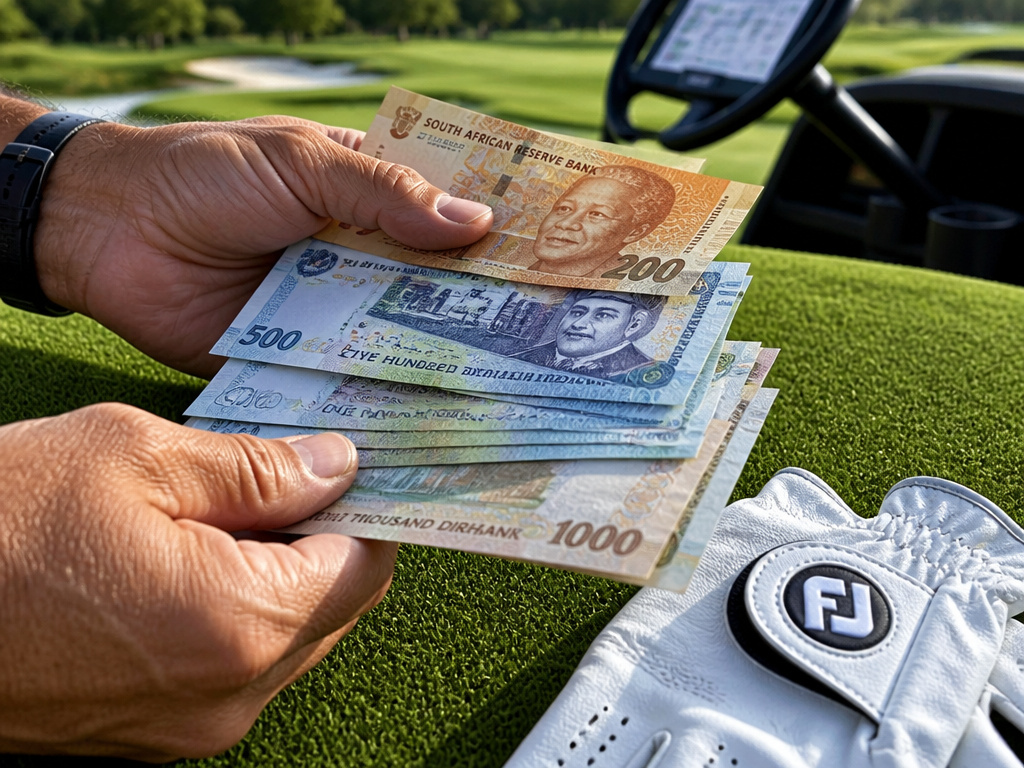 Strip it back. Why are these regions investing so heavily in golf? Because the numbers work. Golf tourism isn’t just a niche; it’s a high-value economic driver.
A 2024 report by Handicaps Network Africa (HNA) counted 4.2 million rounds played in South Africa alone. That’s over 11,500 rounds a day providing steady employment in maintenance, hospitality, and coaching. But the real multiplier is the international visitor.
Golf tourists spend two to three times more per day than the average leisure tourist. They stay longer, travel in groups, and are more likely to return. The 2025 World Golf Awards named South Africa Africa’s Best Golf Destination, a title that directly feeds this cycle.
The tournament effect is also quantifiable. The inaugural LIV Golf South Africa event attracted over 100,000 spectators and generated an estimated R800 million in economic impact. Even the venerable Investec South African Open sold out its 2026 edition at Stellenbosch Golf Club with 41,000 spectators. This global broadcast coverage acts as a sustained advertisement for the country’s courses.
This economic reality shapes your experience. The investment in course conditioning, the quality of the golf academy facilities, the prevalence of GPS-equipped carts—these are the tangible results of a market that sees golf as a worthwhile investment. It’s a mature ecosystem, not a hobby.
Caddies, Cart Policies, and Local Etiquette
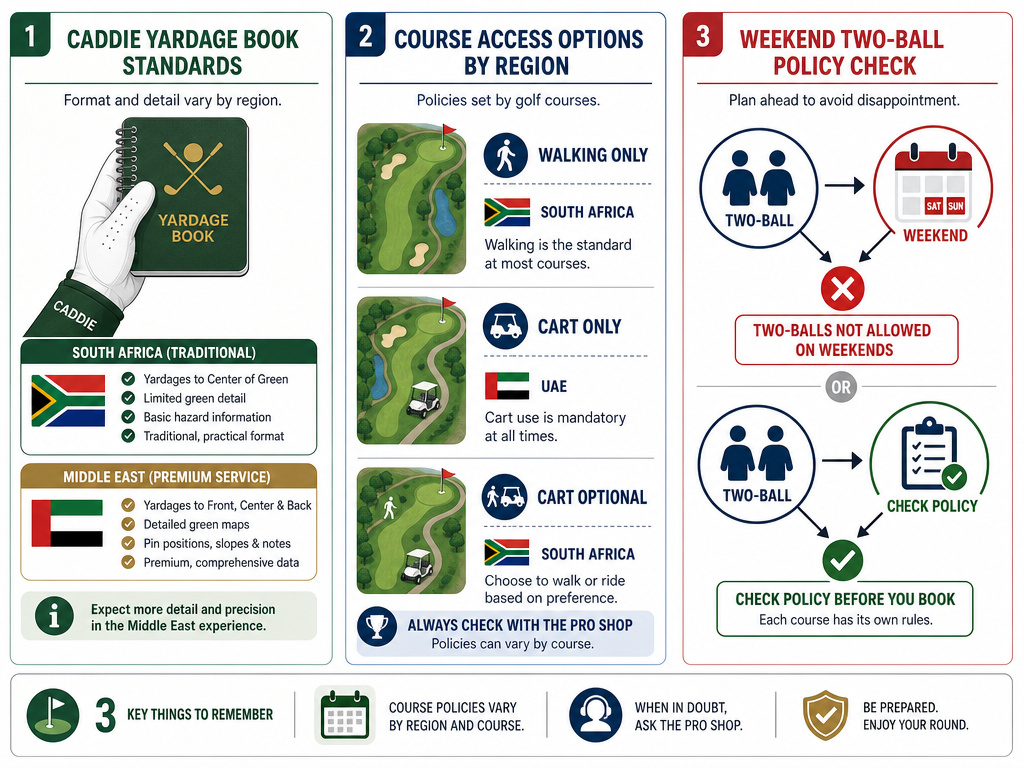 Navigating the local customs is part of the adventure. Getting it wrong can add unnecessary stress to your round.
Caddies: Optional, But Highly Recommended
In South Africa, caddies are woven into the fabric of the game. They cost between R250 and R500 plus a tip. At a course like Durban Country Club or Leopard Creek, they are almost essential for their local knowledge of the greens and wind patterns. In the Middle East, caddies are less traditional but are offered at premium clubs like Al Zorah as part of a high-service, concierge-style experience.
To Cart or to Walk?
Policies vary dramatically: * Walking Only: Gary Player Country Club is strictly walking. They don’t offer carts at all. * Cart Only: Steyn City mandates carts. Their pace-of-play policy (4h:40m for 18 holes) is built around cart use. * Cart Optional: Most other resort and public courses offer the choice. In the desert heat of the UAE or Saudi Arabia, a cart is often a wise investment in your own comfort.
The Two-Ball Rule
Here’s a quirk many internationals stumble over. In South Africa, the long-standing international norm that a twosome has precedence over foursomes is often reversed. Many clubs restrict or even forbid two-balls from playing, especially on weekends. Don’t expect to breeze through as a pair. Always check the club’s policy when you book.
Frequently Asked Questions
What is the number one ranked course in South Africa?
That’s Leopard Creek Country Club, which borders the Kruger National Park. Access is exclusive to members, their guests, and guests of specific partner lodges. For most travelers, booking requires going through a qualified tour operator.
Do I need a handicap to play in South Africa or the Middle East?
For the championship and most resort courses, yes. A maximum handicap of 24 is a common requirement, and you must present a valid certificate at check-in. Public and municipal courses are more relaxed.
What is the best time of year to go?
For South Africa, April offers near-perfect weather nationwide with lower crowds. September is a close second. For the Middle East, the winter months from November to March provide the most comfortable playing conditions, escaping the intense summer heat.
Can I realistically combine a golf trip with a safari?
Absolutely. It’s South Africa’s signature offering. Leopard Creek borders Kruger, the Gary Player Country Club is next to Pilanesberg National Park, and many lodges sell combined packages. Even Skukuza Golf Club is inside Kruger Park itself.
How does the cost compare to golf in the US or Europe?
South Africa is consistently 40–60% cheaper for equivalent premium golf. A round at a top-tier course might cost between R2,500 and R6,300, which translates to roughly $130–$330 USD. The Middle Eastern premium courses are priced closer to European luxury resort levels.
Before You Go
Look past the yardage books and the designer names. The compelling story of golf in South Africa and the Middle East is about adaptation—adapting famous design templates to desert and coastal landscapes, adapting business models to prioritize environmental sustainability, and adapting to serve a global tourist who demands both luxury and authenticity.
Your takeaway shouldn’t be a list of courses. It should be a decision framework. First, identify the experience you want: is it the walking, tournament-grade test of a Gary Player course, or the high-tech, coastal challenge of a Shura Links? Second, work backward from that choice to the logistics. That private course dream requires a tour operator and a handicap certificate; that desert links round needs a cart booked in advance and a collared shirt in your bag. Finally, recognize that your green fee is voting for a particular model of the game. In these regions, that model increasingly includes water stewardship and certified sustainability.
That’s it. Pick your challenge, do the paperwork, and go see how the other half of the golfing world plays.
