
How to Book a Tee Time Abroad With Reliable Booking Systems
This post contains affiliate links. As an Amazon Associate, we earn from qualifying purchases.
This post contains affiliate links. As an Amazon Associate, we earn from qualifying purchases.
To book a tee time abroad, you must match your destination to one of two booking systems: the Western platform model (real-time, credit card, English) or the Japanese/Asian model where a local address and phone number are required for registration, making assisted booking the only practical route for foreign visitors. The harder the course, the longer its advance booking window, think months to years, not weeks.
If you assume every course works like your local muni, the first click on a foreign website will stop you cold. The difference isn’t language. It’s architecture.
Some courses publish live inventory you can grab instantly. Others, including most of Japan’s best tracks, hide behind a registration wall built for locals. You don’t need to speak Japanese; you need a strategy that bypasses the wall entirely. The rest of this guide walks that line: what you click, what you avoid, and the one document that can turn you away at the first tee even with a confirmed time.
What follows: the two booking architectures, the handicap rule that overrules your credit card, and the surprising logic behind picking your first foreign tee time.
Key Takeaways
- Two systems exist: Western platforms (Leading Courses, Golfscape) show real-time availability; Japanese systems (Rakuten GORA) require local registration, making assisted booking essential. Handicap certificates are required: Courses like Muirfield, Monte Rei, and many premium links will refuse play without a valid CONGU or equivalent certificate presented at check-in.
- Booking windows vary wildly: Pebble Beach opens to resort guests 18 months out; St Andrews uses an advance lottery and a two-day ballot; most public courses release times 2-12 months ahead.
- In Japan, the “plan” is the product: The tee time price bundles lunch, cart, caddie, and club rental. Booking solely on price gets you a bare-bones round with hours of dead time between nines.
- Use a specialist for complex trips: For multi-course itineraries, especially in Scotland, Ireland, or Japan, a golf travel agent accesses blocked inventory and handles logistics you cannot replicate alone.
The Two Main Booking Systems (And Why You Need to Know)
You face one of two paths. Get it right, you’re confirmed before you book the flight. Get it wrong, you’re on the phone with a course receptionist who doesn’t open emails in English.
System 1: The Platform Model (Europe, Americas, South Africa, Australia)
This is what most travelers expect. A site like Leading Courses or Golfscape acts as a middleman, connecting you to a course’s live tee sheet. You pick a date, see available slots, pay by card, and get an instant confirmation.
Leading Courses distinguishes between three types: direct bookable (real-time connection, instant confirmation), bookable on request (team confirms after payment), and reservable (pay a fee, pay green fee on arrival). Your booking includes their Best Price Guarantee, free cancellation within the window, and options to add a buggy or rental clubs.
The experience is clean. The sites are in English. The green fee you see is what you pay. This system covers most of the Algarve, Costa del Sol, Scotland’s resort courses, South Africa’s Fancourt, and Bandon Dunes. It works because the platform has a commercial agreement with the course.
System 2: The Local Registration Wall (Japan, South Korea, parts of Asia)
Here, the blocker is identity, not language. In Japan, the dominant platform is Rakuten GORA.To even see availability, you must register with a Japanese address and a Japanese mobile phone number.
Browser translation doesn’t solve this. You cannot fake a phone number the system texts a verification code to. This isn’t an oversight; it’s a system built for the domestic market.
The practical route is assisted booking through a service like Nomae Golf. You find the course and date you want in English, submit a request, and their team, with a local presence, makes the reservation on your behalf. You pay them a fee, they handle the Japanese side, and you get a confirmation in English. It’s the only way for most foreign visitors to access premium Japanese courses without a personal local contact.
Check Handicap Restrictions First (It’s Not a Suggestion)

Your handicap isn’t just a number. At certain clubs, it’s a visa. Show up without the right paperwork, and your booked, paid-for tee time means nothing.
The Requirement: Many top-tier courses, especially in the UK, Ireland, and Portugal, enforce handicap limits to maintain pace of play and course preservation. They don’t trust your word. They require a physical certificate from a recognized body. CONGU (UK & Ireland), USGA, or EGA (Europe).
- Muirfield: Maximum CONGU handicap of 18 for men, 24 for women.
- Monte Rei (Algarve): Often requires a handicap certificate, especially for morning tee times.
- Royal County Down & Royal Portrush: While not always strictly enforced for all visitor times, presentation of a certificate is strongly advised and can be requested.
- Quinta do Lago South & Vale do Lobo: May request proof for weekend or peak times.
I learned this the hard way watching a foursome get turned away at a renowned Scottish links. They had traveled from the States, had their printed confirmation in hand, but no certificates. The starter was polite but immovable. Their round was re-sold to a waiting list. The lesson wasn’t about fairness; it was about rules printed in the booking terms everyone skips.
How to Comply: Contact your home club and request an official, up-to-date handicap certificate. A digital PDF is usually acceptable. Carry a printed copy in your golf bag. When you book, state your handicap in the notes and ask if verification is required. Never assume.
The Surprising Logic of Booking Windows
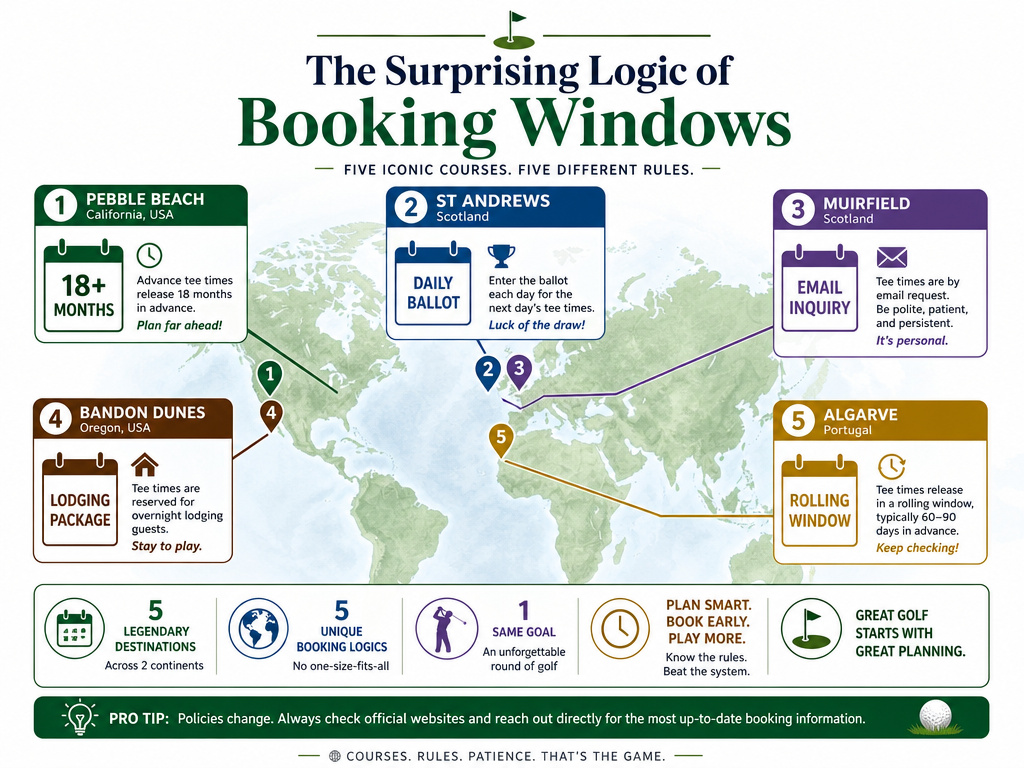
A tee time functions as a release valve on a calendar under pressure. Popular courses ration access, and the method decides your strategy.
| Course / Resort | Booking Model | Key Insight for Travelers |
|---|---|---|
| Pebble Beach (USA) | Resort guest priority | Book a room (often 18+ months ahead) to unlock the tee time booking portal. Non-guest times are rare and short-notice. |
| St Andrews Old Course (Scotland) | Advance ballot + daily ballot | The annual advance release (September) sells out instantly. The daily ballot, drawn 48 hours ahead, is your best bet. No play on Sundays. |
| Muirfield (Scotland) | Visitor day allocation | Tee times for traditional visitor days (often Tuesdays/Thursdays) can be booked up to two years ahead. Inquiry is via email, not a live portal. |
| Bandon Dunes (USA) | Stay-and-play | Reserve your lodging package first. Tee times across all five courses are secured as part of that package, often a year in advance for peak seasons. |
| Most Public/Resort Courses | Rolling window | A standard 3-12 month rolling window is common. Premium weekend times at places like the Algarve’s Quinta do Lago or Dubai’s Emirates Golf Club disappear weeks, not months, ahead. |
The takeaway? For a bucket-list course, your trip dates should be chosen after you understand its booking calendar, not the other way around. Want the Old Course in July? You’re either entering the ballot daily or you booked an authorized tour operator’s guaranteed package a year prior.
How to Actually Execute the Booking
Let’s strip it back. Here’s your action sequence, from idea to confirmation.
- Identify the System. Is your target course in a region covered by Leading Courses/Golfscape (check their site maps), or is it in Japan/South Korea? This decides your next click.
- Gather Your Documents. Before you search for times, have your group’s handicap certificates ready in digital form. Know exact passport names for all players.
- Use a torque wrench.**
- For Platform Model: Go directly to Leading Courses or Golfscape. Search by country and course. The interface will show live availability, rates, and cancellation terms.
- For Local Registration Model (Japan): Use Nomae Golf or a similar concierge service to browse courses and plans in English. Submit a booking request with your preferred dates and details.
- Read the “Plan” Details (Especially in Japan). A Japanese tee time is a package. Does it include lunch (common)? A compulsory caddie? A cart? Is it “self-play” or part of a tournament? Booking the cheapest option might mean a 5-hour round with a 90-minute lunch break you didn’t want.
- Book the Hardest First. Build your trip itinerary by securing the most difficult tee time first, the one with the longest lead time or lottery system. Let that date anchor your entire travel schedule.
- Confirm and Store. Once booked, you’ll receive a confirmation email with a reservation ID. Print this. Save it as a PDF on your phone. This is your ticket.
Common mistake: Booking flights before securing the primary course tee time. You lock yourself into dates, then find out your dream course is hosting a member tournament that week or is fully booked. Reverse the order.
When to Use a Golf Travel Specialist
Planning a weekend at a nearby resort? Do it yourself. Coordinating a golf trip to Scotland that includes the Old Course ballot, a stay at a traditional links hotel, and ground transport across the Highlands? That’s specialist territory.
A REALTOR agent does three things you can’t: Holds Allocated Tee Times. They have blocks of guaranteed times at courses like the Old Course, Muirfield, or Royal County Down that never hit public ballots. 2. Navigates Local Systems. They have the local phone numbers, the email contacts, and the relationships to get answers and times where a foreigner gets silence. 3. Anticipates Logistics. They know that a tee time at Royal Dornoch requires a 90-minute transfer from Inverness, or that playing golf in Portugal‘s Algarve in August means 3pm rounds are brutally hot. They build the day around the golf, not just the golf into the day.
The cost is often marginal when you factor in the hours of research and coordination they save, and for a complex plan a golf trip across multiple countries, it’s frequently the same price or cheaper than DIY.
Frequently Asked Questions
Can I book a tee time at Augusta National?
No. Augusta National is a strictly private club. Play is by member invitation only. There is no public booking system, ballot, or ticket that grants golfing access. Public access is limited to attending the Masters tournament as a spectator.
Do I need to speak Japanese to book golf in Japan?
No, but you need the right method. You cannot self-book on Rakuten GORA without a local address and phone. Use an English-based concierge service like Nomae Golf. They translate your request, handle the Japanese booking, and send you an English confirmation.
How early should I arrive for my tee time abroad?
Earliest than you think. In Japan, 30-45 minutes early is standard; courses run on strict schedules. In the UK and Ireland, aim for at least 30 minutes to check in, pay any surcharges, and visit the practice area. In relaxed resort destinations (Caribbean, some parts of Spain), 20 minutes may suffice, but early is always safer.
What’s the best way to handle rental clubs abroad?
Book them with your tee time. On platforms like Leading Courses, you can add a rental request to your reservation. If booking direct, email the pro shop ahead of time. Don’t assume premium clubs will be available; specify if you need right or left-handed, stiff or regular flex. Shipping your own clubs via a service like Ship Sticks is often cost-comparable to two rental fees and guarantees your own gear.
Are afternoon tee times abroad a bad idea?
Often, they’re a secret advantage. In hot climates (Dubai, Arizona, Andalusia), mornings are premium. Afternoon rates can be 30-50% cheaper, and the heat is manageable with proper hydration. For golf in the US or similar destinations, an afternoon time also lets you shake off travel fatigue from the night before.
Before You Go
The truth nobody sells is that a successful international tee time requires matching your target to the system that feeds it.
Spend your first research hour not on course rankings, but on answering one question: “How does this place actually take bookings?” Is it a real-time portal, a years-ahead email, or a local-site puzzle requiring a guide? That answer dictates everything, your timeline, your budget, and whether you should be clicking or hiring.
Start with the hardest course. Get that one locked. Everything else, the flights, the hotels, the other rounds, flows outward from that anchor. And always, always pack the handicap certificate. It’s the one piece of paper that can silence a starter’s “I’m sorry, sir,” and turn a dream trip into a played one.
