
The Proven Method for How to Break 90 in Golf Consistently
This post contains affiliate links. As an Amazon Associate, we earn from qualifying purchases.
This post contains affiliate links. As an Amazon Associate, we earn from qualifying purchases.
To break 90 in golf, you need three things: five Greens in Regulation, four or fewer double bogeys, and three or fewer three-putts per round. Data from thousands of tracked rounds shows golfers stuck in the 90s average 3.6 GIR and six troublesome tee shots. Cutting those trouble shots in half and adding two greens instantly bridges the gap.
The math behind that 5.4 GIR target is what most mid-handicappers miss. It’s not about hitting every green. It’s about what you do on the thirteen holes you miss. A concept called GIRp1—landing your next shot on the green—turns potential doubles into routine bogeys. That’s the real scoring lever.
What follows is a breakdown of the three specific shot areas where 90s-shooters lose strokes, the exact stat benchmarks you should track, and the pre-shot decision that eliminates the big number before you even swing.
Key Takeaways
- You only need one par on a par-72 course to break 90, provided you bogey the other 17 holes. The entire game is damage control.
- Greens in Regulation (GIR) is a red herring. The vital metric is GIRp1 (Green in Regulation plus one shot). Target 13 or more GIRp1s per round.
- Eliminate two double bogeys and two three-putts. Turning four disaster holes into routine bogeys is often enough to drop from 95 to 89.
- Tee shot trouble is the biggest score inflator. Golfers breaking 90 have four troublesome drives per round; 90s-shooters have six. Two fewer scrambles mean two fewer doubles.
- Aim for the center of every green on approach shots. The typical 15-handicap leaves half their approaches short. Take enough club.
The Three Shots That Matter Most
You don’t need to stripe every drive or stick every wedge. Breaking 90 is about fixing the three shots that turn pars into doubles. Data from MyGolfSpy and Shot Scope pinpoints exactly where golfers lose 1.5 strokes per round compared to players already in the 80s.
The first is the tee shot. This isn’t about distance. It’s about trouble. Penalty strokes, blocked drives into trees, and recovery positions are score killers. Golfers breaking 90 average four troublesome tee shots per round. Golfers in the 90s average six. Those two extra “oh no” moments directly lead to two extra double bogeys.
Common mistake: Trying to carry a corner hazard to save a stroke. The risk/reward math never works for a 90s-shooter. A punch-out and a bogey is a great score. A penalty and a chip-out leads to a triple.
The second is the 50-100 yard wedge from the rough. This is where strokes vanish quietly. From this range in the fairway, you might get it close. From the rough, you’re fighting for the green. Golfers in the 90s give up roughly a third of a stroke per round here compared to 80s-shooters. The fix is simpler than your swing: avoid the rough off the tee. If you’re in it, your goal shifts from pin-seeking to simply finding the putting surface.
The third is the 10-30 yard chip. This looks like a scoring opportunity. For a 90s-shooter, it’s a trap. Data shows players lose about 0.45 strokes per round on these shots from the rough compared to better players. The reason isn’t skill; it’s decision-making. A flubbed chip that stays off the green guarantees a double bogey. A conservative chip to the fat part of the green guarantees a putt for bogey.
The Math of Breaking 90: GIR vs. GIRp1
Everyone talks about Greens in Regulation. It’s the wrong thing to focus on. The benchmark for breaking 90 is 5.4 GIR per round. That means you’re missing 12 or 13 greens. What you do on those misses is everything.
Enter GIRp1: Green in Regulation plus one shot. It means that even if you miss the green, your next shot finds the putting surface. If you can achieve 13 GIRp1s in a round, you have 13 putts for par. You’ll make a few of those. The rest are two-putt bogeys. That’s a score in the 80s.
A golfer shooting 95 with 7 doubles and 5 three-putts can often break 90 without hitting a single better full shot. Just turn 3 of those doubles into bogeys and eliminate 2 three-putts, and you’re at 89.
This reframes your strategy on every par 4 and par 5. Your primary goal is not the green. It’s avoiding the one shot that prevents you from reaching the green in regulation plus one. That shot is usually a penalty or a severely blocked recovery.
| Scenario | Aggressive Play | Smart Play (GIRp1 Focus) |
|---|---|---|
| Tee shot with hazard left | Aim at corner, risk penalty. | Aim right-center, accept longer approach. |
| Missed green, tight pin | Flop shot over bunker, risk staying in sand. | Bump-and-run to the center, guarantee putting next. |
| 30-yard chip from rough | Swing for a tap-in, risk blading it over. | Focus on solid contact onto the green. |
The table shows the decision shift. The smart play doesn’t feel heroic. It feels boring. Boring golf breaks 90.
Your Target Stats: The Four Number Checklist
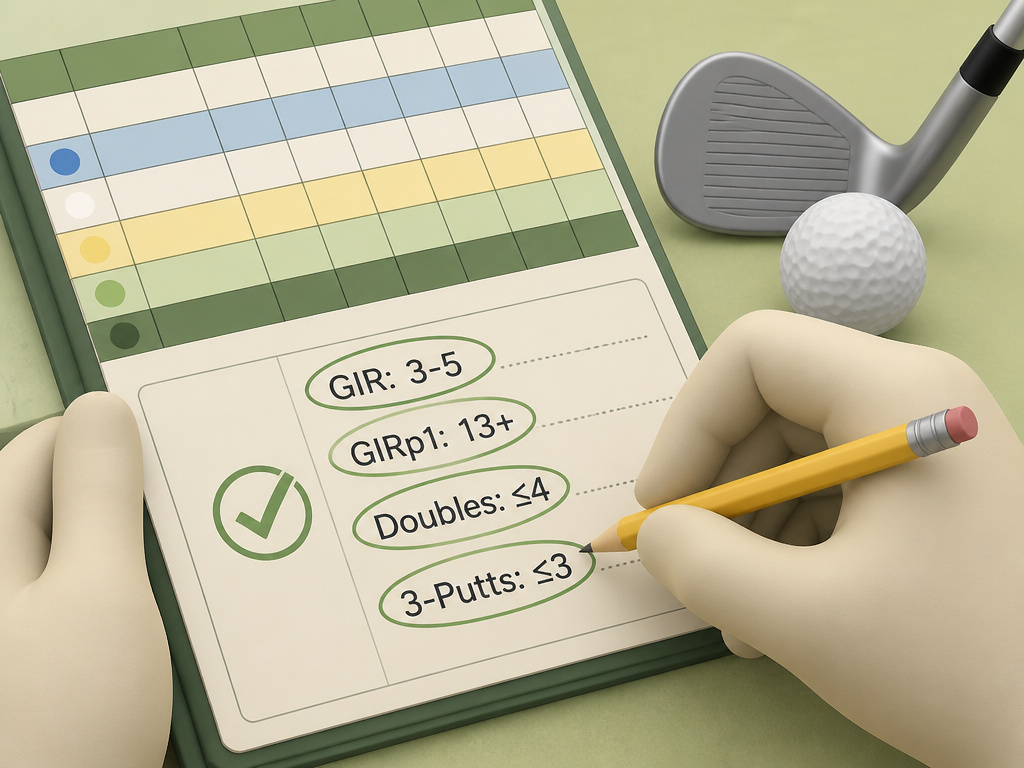
Forget feel. Track these four numbers over your next five rounds. They are the direct levers on your scorecard, drawn from analysis by Tangent.golf and Shot Scope.
- Greens in Regulation (GIR): 3-5. Yes, only 3 to 5. This is the most liberating number here. You don’t need to be a ball-striking machine. Hitting five greens is a great day.
- GIRp1: 13 or more. This is the non-negotiable. If you miss a green, your very next thought must be: “Get this on the putting surface.” Thirteen successful up-and-down attempts sets the floor for a good score.
- Double Bogeys (or worse): 4 or fewer. Every double bogey requires a par to offset it. You won’t make enough pars. The easiest way to cut doubles is to take penalty strokes and hero shots out of your vocabulary.
- Three-Putts: 3 or fewer. This is the fastest fix. Long putts are about speed, not line. Your goal on any first putt outside 20 feet is to leave a tap-in. A 25-handicap makes nearly 90% of putts inside three feet.
If your stats are outside these ranges, you know exactly what to practice. Lag putting. Conservative course management. A 60-degree wedge you can trust from the rough. These are the tools that move numbers.
The Short Game: Where Rounds Are Saved, Not Won
Your short game is a salvage operation. Pros use it to score. You use it to prevent disaster. This mindset change alone can save four strokes a round.
On any chip or pitch, your only thought is “make sure the next shot is a putt.” A bad chip that finds a bunker or stays in the rough turns a possible bogey into a sure double. A mediocre chip that rolls to 20 feet guarantees a putt for bogey. The 20-footer might even go in.
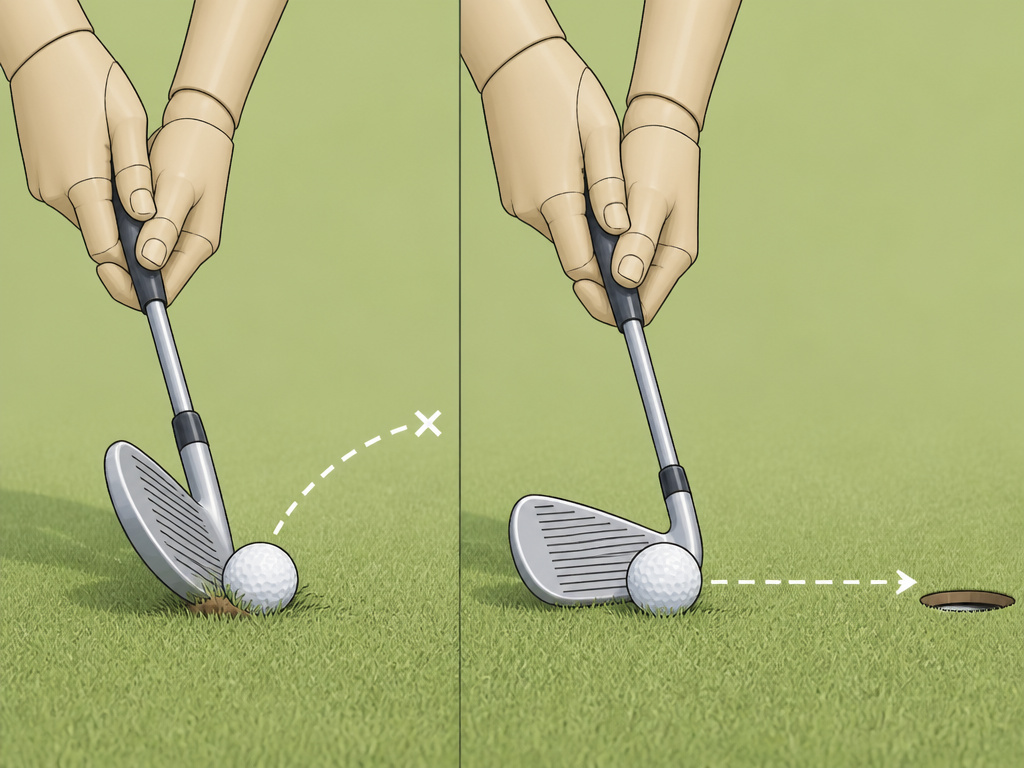
Where this goes sideways: Using a high-lofted wedge from tight lies when you lack the technique. The leading edge digs, the ball goes three feet. Use a 7-iron or a hybrid for a bump-and-run whenever there’s no obstacle. The margin for error is ten times wider.
Putting, especially lag putting, is pure arithmetic. From long range, read the green for speed first, break second. An uphill putt left six feet short is a dead stop; a downhill putt six feet long is a slippery comebacker. Always err on the high side of the hole on uphill putts, and on the amateur side of the break on downhill putts.
This is why a consistent putting routine matters. It’s not about making everything. It’s about eliminating the three-putt that wrecks a hole and your confidence for the next three.
The Tee Shot: Your Scorecard’s Foundation
Every hole starts here. A good drive doesn’t guarantee a par. A bad drive almost guarantees a bogey or worse. Your strategy is simple: find the widest part of the fairway, even if it leaves a longer club in.
For most players, a 3 hybrid or 4 hybrid is a more reliable fairway-finder than a long iron or a fairway wood. The club’s design gets the ball up quickly from the rough, which is where you’ll be if you miss. Having a hybrid you trust is like having a reset button.
Driver is not always the right play. On a tight par 4, ask: “What is the longest club I can hit that guarantees I avoid all trouble?” Often, it’s a 3-wood or that hybrid. The 20-yard sacrifice in distance is worth it to keep a ball in play. Remember, the goal is GIRp1, not GIR. A 170-yard approach from the fairway with a 6-iron is a better chance than a 150-yard shot from the trees with a 9-iron.
Worth knowing before you start: Golfers trying to break 90 lose about 1.5 strokes per round off the tee compared to golfers in the 80s. That’s the entire difference between an 89 and a 91. It’s not power. It’s position.
Your New Pre-Shot Checklist
Before every full shot, run through this three-question filter. It takes five seconds and it will change your scores.
- What is the absolute worst outcome? (e.g., water left, OB right). Visualize it, then pick a target and club that makes that outcome nearly impossible.
- If I miss, where is the best place to miss? Always miss to the fat side of the green or the short side of the fairway. A front bunker is better than long grass over the green.
- What is my target score for this hole? On a par 4, your target is 5. Play for a bogey. You’ll be surprised how many pars you stumble into when you’re not forcing them.
This checklist formalizes the boring, smart golf that leads to breaking 90. It turns double bogeys into bogeys and triples into doubles. That’s how you shave six shots off your card without hitting a single shot better.
| Club Selection | When to Use It | Common 90s-Shooter Mistake |
|---|---|---|
| Driver | Wide fairways, no penalty stakes within reach. | Using it on tight holes because “it’s the driver.” |
| 3 Hybrid / 4 Hybrid | Narrow fairways, par 3s, long approaches from rough. | Trying to hit a 3-iron for more “control.” |
| Putter from off the green | Any time there’s no fringe or obstacle in the way. | Automatically grabbing a wedge. |
| Pitching Wedge | Standard chips with plenty of green to work with. | Using a 60-degree wedge from a tight lie. |
Equipment Notes: Keep It Simple
Your gear should help your strategy, not complicate it. You don’t need the newest driver. You need clubs that fit your game of avoidance.
A 2-piece ball like a Callaway Warbird or a Titleist TruFeel is perfect. It’s durable, reduces side spin off the tee (keeping you in play), and provides enough feel around the greens. Switching to a 3-piece ball like a Titleist Pro V1 is a mistake until you’re consistently breaking 85; the extra spin will magnify your curve off the tee.
Carry a 60-degree wedge only if you practice with it weekly. Otherwise, your highest loft should be a 56-degree sand wedge. More loft means less margin for error. For most chips, a 52-degree gap wedge or even a 9-iron is the smarter play.
Finally, keep your clubs organized. A 14-way bag with full-length dividers stops club chatter, reduces grip wear, and lets you grab the right hybrid quickly when you need that safe tee shot. Chaos in the bag leads to rushed decisions on the course.
Frequently Asked Questions
How many pars do I need to break 90?
You only need one par on a par-72 course. An 89 is 17-over par. If you bogey 17 holes and par one, you shoot 89. This math highlights the real goal: eliminate doubles. A double bogey on any hole means you now need two pars to break 90.
What is the most important stat for breaking 90?
GIRp1 (Green in Regulation plus one shot). Hitting 13 or more GIRp1s per round means you’re always putting for your score within two shots of the green. It turns missed greens into routine bogeys instead of potential disasters, which is the foundation of breaking 90.
How do I stop hitting so many three-putts?
Practice lag putting with a focus on speed, not the hole. On the course, your goal on any first putt outside 20 feet is to get it inside a three-foot circle. From three feet, even a 25-handicap makes nearly 90% of putts. Also, read the green for uphill vs. Downhill before you read for break.
I keep hitting my drives into trouble. What should I do?
Hit fewer drivers. On any hole where a miss with driver brings penalty strokes or deep trees into play, use a 3-wood or a hybrid. The goal is to advance the ball into a position where your next shot can reach the green or a safe lay-up area. This is the single fastest way to cut two strokes off your average.
Is breaking 90 a realistic goal for an average golfer?
Absolutely. According to USGA data, about 26% of golfers consistently break 90. It’s a skill-based milestone, not a talent-based one. The path is clear: reduce tee-shot trouble, avoid double bogeys, and limit three-putts. Most golfers can achieve this with focused practice and smarter course management, not a swing overhaul.
The Bottom Line
Breaking 90 isn’t about birdies. It’s about avoiding the double and triple bogeys that litter a 95. The data gives you a clear blueprint: hit a few more greens, keep the ball in play off the tee, and clean up your putting from long range. Your strategy on every hole should be conservative, aiming for the bogey that keeps the big number off the card. Master that, and breaking 90 becomes a regular event. After that, you can set your sights on the next goal and learn the strategies to break 80.
