
How to Compress the Golf Ball with Irons for Solid Contact
This post contains affiliate links. As an Amazon Associate, we earn from qualifying purchases.
This post contains affiliate links. As an Amazon Associate, we earn from qualifying purchases.
To compress the golf ball with your irons, you need three things happening at impact: a descending attack angle (roughly -2° to -5° for a 7-iron), your hands ahead of the clubhead creating forward shaft lean, and 70-80% of your weight on your lead side. This moves the swing’s low point 2 to 4 inches in front of the ball, ensuring ball-first contact. The club momentarily flattens the ball against the face, which transfers energy efficiently for more speed, height, and spin.
Most instruction gets the cause and effect backward. You don’t create compression by trying to hit down on the ball. You create it by moving your body correctly toward the target, which produces the descending blow as a natural result. Trying to force the angle is how you end up with a steep, choppy motion that bottoms out behind the ball.
What follows: the three mechanical conditions that have to be true at impact, the exact body motion that makes them happen, the most common failure (the scoop) and its timeline, and how to check your progress without a $20,000 launch monitor.
Key Takeaways
- Compression is not “hitting down.” It’s the product of your body moving forward, which de-lofts the club and creates a descending path. Trying to hit down usually makes it worse.
- The low point of your swing must be 2 to 4 inches in front of the golf ball. Any divot that starts behind the ball is proof of a scoop or flip.
- Forward shaft lean is non-negotiable. Your hands must be ahead of the clubhead at impact. If they’re even with or behind it, you’ve added loft and killed compression.
- Ball position changes with club length: center for wedges, slightly forward for mid-irons, more forward for long irons. A ball too far forward guarantees a thin strike.
- The “scoop” feels helpful but has a predictable failure arc. It adds 5-7 degrees of dynamic loft, costs 15-20 yards of carry within two weeks of ingrained practice, and makes your most common miss a weak pull to the left.
The 3 Non-Negotiable Conditions for Compression
Forget feel for a minute. Launch monitors like TrackMan measure compression by looking at a combination of numbers. When they’re right, you get that heavy, penetrating strike. When one is off, the shot feels weak or inconsistent.
The first is attack angle. This is the vertical direction the clubhead is moving at impact. For a iron shot off the ground, it must be negative, meaning the club is still traveling downward.
TrackMan’s published PGA Tour average for a 6-iron is an attack angle of -3.7°. Their instruction research identifies the ideal range for a mid-iron (7-iron) as roughly -2 to -5 degrees.
That’s the benchmark. If your number is positive or barely negative (like -1°), you’re sweeping or scooping. If it’s too steep (below -6°), you’re likely chopping at it. The sweet spot is a controlled descent.
The second condition is forward shaft lean. This is your hands being ahead of the clubhead at the moment of truth. It de-lofts the club, turning your 7-iron into something closer to a 6-iron. That reduced loft is what presses the ball into the face.
The third is weight distribution. Published instruction data points to roughly 70 to 80 percent of your weight needing to be on your lead side at impact. If your weight is back, your body can’t move forward, and the low point of your swing stays behind the ball.
| Condition | What It Is | Ideal Measure (7-iron) | What Happens If It’s Missing |
|---|---|---|---|
| Attack Angle | Clubhead moving down at impact | -2° to -5° | Sweep or scoop; weak, high launch; no divot or divot behind ball |
| Forward Shaft Lean | Hands ahead of clubhead at impact | Visible shaft forward of hands | Added dynamic loft; ballooning flight; loss of distance and spin |
| Weight Distribution | Pressure on lead side at impact | 70-80% on lead foot | Low point stays behind ball; fat or thin contact; inconsistent strike |
These three work together. Your weight forward allows your hands to get ahead. Your hands ahead help create the descending angle. They’re a package deal.
Where this goes sideways: Chasing these positions by manipulating your hands or shoulders in isolation. That’s the “hit down” trap. The correct sequence starts from the ground up, not the hands down.
Why “Hit Down” Is the Worst Advice You’ve Ever Heard
GOLF Top 100 Teacher David Armitage nails the problem. Amateurs hear “compress the ball” and think it means they need to hit the turf before the ball. That’s a misunderstanding that weakens the strike.
The club’s descending path results from your body moving toward the target, not from your arms. “The club’s traveling down, but it is created because the body is going forward towards the target,” Armitage says.If you try to hit down, you usually stall your body and throw your hands at the ball, which is the exact opposite of good compression.
This is the core mechanical insight most golfers miss. Compression is an effect, not an action. The action is a forward weight shift with a rotating core. Get that motion right, and the attack angle, shaft lean, and low point fix themselves.
Think of a pitcher throwing a baseball. They don’t think “rotate my shoulder.” They drive off the mound, and the shoulder rotation is a consequence. Your iron swing is the same. Drive your weight forward, and the club will deliver itself correctly.
The Step-by-Step Swing Change (Not a Quick Fix)
This process involves retraining a fundamental movement pattern, not just trying a drill five times. You’ll need to commit to it on the range for at least a few sessions before it feels natural on the course.
Step 1: Recalibrate Your Low Point
The entire goal is to move the bottom of your swing arc forward. Take your 7-iron and set up without a ball. Place a towel flat on the ground about 4 inches in front of where a ball would be. Make slow, half-swings aiming to brush the grass after the imaginary ball, hitting the towel with your clubhead. The sound and drag of the towel give you instant, physical feedback. If you miss the towel, your low point is still too far back.
Step 2: Lock In the “Forward” Feel
Use Armitage’s tee drill. Set a ball in the middle of your stance. Place another tee in the ground about three ball-lengths toward your target. Make swings trying to hit that forward tee. After five swings where you clip it, put a ball back. Your only thought is to swing through to that forward tee. This divorces you from the instinct to help the ball up and trains your focus ahead of the ball.
Step 3: Integrate Full Motion with a Ball
Now hit balls with a 7-iron, but with a drastic ball position change: play it off your back foot. This is a training overlay, not a permanent fix. It forces your body to move forward aggressively to make contact. You’ll likely hit some ugly shots at first. That’s fine. You’re feeling the extreme end of the “low point forward” sensation. After ten shots, move the ball back to its normal position (slightly forward of center for a 7-iron). The feeling of needing to chase after it should remain.
Step 4: Check Your Work
You don’t need a TrackMan. Your divots are the report card. After a handful of shots, look at the turf. * Good: A thin, shallow divot that starts just after the ball’s position and points toward the target. * Bad: A deep, choppy divot that starts behind where the ball was. Also bad: no divot at all, just a scuff mark.
Common mistake: Making a perfect divot in practice, then losing the feeling on the course. When you’re under pressure, the old “scoop” instinct comes back. On the course, your only swing thought should be “low point forward.” Let your body figure out the rest.
Ball Position by Club: Why One Spot Doesn’t Work
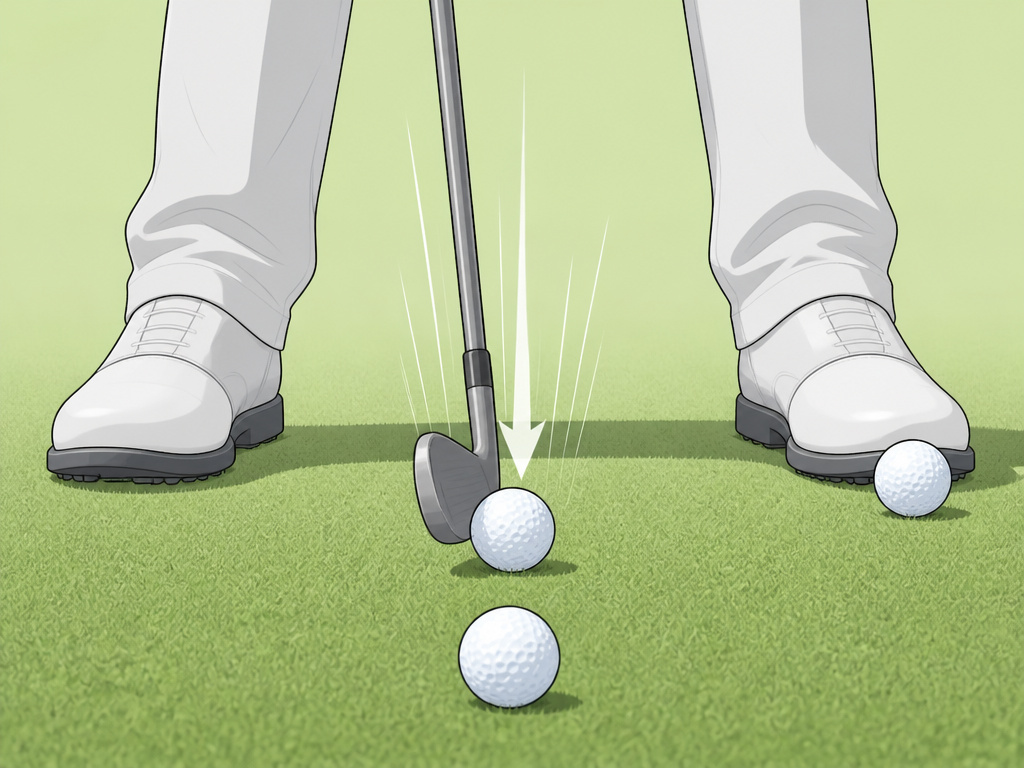
If you play every iron off the same spot in your stance, you’re making compression harder than it needs to be. A longer club has a longer, shallower arc. The ball needs to be in a place where your descending blow can find it.
| Club Type | Ball Position | Why This Works |
|---|---|---|
| Short Irons (PW, 9-iron) | Center of stance | Shorter shaft, steeper angle. Center stance ensures a crisp, descending strike. |
| Mid-Irons (6, 7, 8-iron) | 1-2 inches forward of center | Allows for a slightly shallower attack while maintaining a forward low point. |
| Long Irons (4, 5-iron) | 2-3 inches inside lead heel | Accommodates the longer, sweeping arc; too far back forces an overly steep hit. |
A ball too far forward with a short iron means the club is past its low point and moving up. You’ll top it or hit a weak thin shot every time. A ball too far back with a 4-iron forces you to chop down violently. Match the position to the club, and the descending blow becomes natural.
The Scoop: Its Timeline and How to Kill It
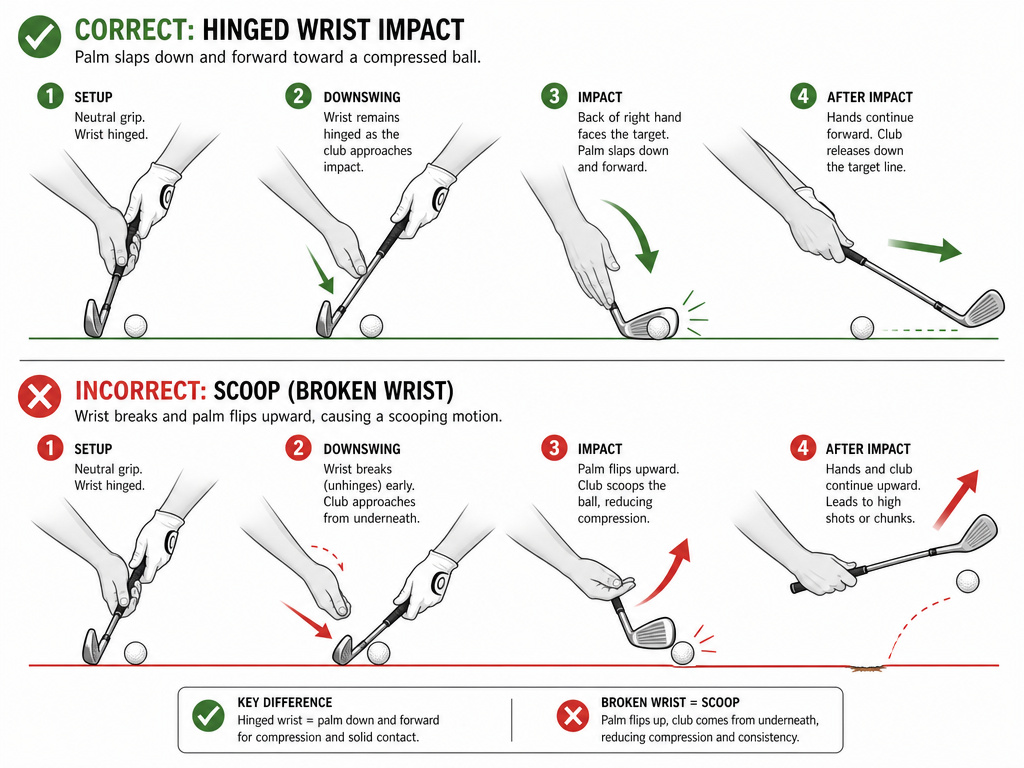
The scoop or flip is the enemy. It’s when your right wrist (for a right-handed golfer) uncocks too early, your hands slow down, and the clubhead overtakes the grip before impact. It feels like you’re helping the ball up. You are, but you’re also robbing yourself.
Here’s what the scoop costs you, in order: 1. Immediate: Adds 5-7 degrees of dynamic loft. Your 7-iron now launches like a 9-iron. 2. Within a Range Session: Lose 10-23 yards of carry (per Golf Digest’s robot testing comparing amateur vs. Pro attack angles). 3. Within Two Weeks: Your most common miss becomes a pull or pull-draw left, as the open clubface you present at impact snaps shut to rescue the strike. 4. Long-Term: Complete inconsistency. One shot is thin, the next is fat, the next is okay but short. You never know what you’ll get.
The fix is in the right hand. Feel like you’re keeping the back of your right hand facing the target longer through impact. Another image: imagine trying to slap the ball with your right palm down and forward, not upward. This maintains the wrist hinge and delivers the clubhead with leverage, not a flip.
Gear and Conditions That Actually Matter
Your technique is 90% of the battle. But your equipment and the environment play a supporting role. Using the wrong ball or not adjusting for the weather can make good contact feel unrewarding.
First, the ball. If you have a slower swing speed (below 85 mph with a driver), a very high-compression tour ball like a Titleist Pro V1 might feel like a rock. It won’t deform as easily on your iron strikes. A softer, lower-compression ball like a Callaway Supersoft or a Srixon Q-Star can help you achieve better feel and more distance. The right golf ball for your swing speed makes solid contact feel solid.
The construction of a golf ball matters too. Multi-layer balls with a soft urethane cover (like most tour models) generally provide more spin and a softer feel on iron shots, which can enhance the sensation of compression.
Then there’s the world around you. On a cold morning, the ball is harder. It compresses less. Don’t be surprised if your well-struck 7-iron comes up 5-10 yards short. The reverse is true in summer heat. Similarly, altitude affects distance dramatically. At high elevation, the air is thin, so the ball flies farther with less curve. Your compressed 7-iron might fly a club longer. You have to adjust your expectations and your club selection.
Frequently Asked Questions
What does compressing the golf ball actually feel like?
It feels heavy and solid, not clicky or thin. The sound is a crisp “snap” or “crack,” not a hollow “tock.” You’ll often feel the clubhead continue down into the turf after impact, and the ball will have a penetrating, rising flight that seems to hold its line in the wind.
I take divots, but I still don’t get distance. Why?
You’re likely taking divots that start behind the ball. This means you’re hitting the ground first, then the ball (a “fat” shot), which kills energy transfer. The divot must start after the ball’s position. Check where your divot begins. If it’s behind, you’re not compressing; you’re digging.
Can you compress the ball with a hybrid or fairway wood?
The principle changes. With those clubs, you want a slightly descending or level strike, not a steep one. The goal is still ball-first contact, but the “low point forward” is much shallower. Trying to hit down sharply with a hybrid often leads to heavy contact. Focus on sweeping the ball off the turf.
Does shaft flex affect compression?
Indirectly, yes. A shaft that’s too stiff for your swing speed can make it harder to release the clubhead properly, potentially reducing forward shaft lean. A shaft that’s too soft might allow the head to overtake your hands too early, promoting a flip. The right flex supports your mechanics but doesn’t create compression on its own.
How long does it take to learn this?
You can understand the concept in minutes. You might hit a few compressed shots in your first range session. To make it your default pattern under pressure takes consistent, focused practice over weeks. The body has to unlearn the scoop, which is a powerful instinct. Be patient. Use the towel and tee drills daily.
Before You Go
Compressing your irons is a matter of mechanics, not a magic trick. Stop trying to hit down on the ball.Start learning how to move your weight forward so the club has to hit down. Use the divot as your truth-teller—if it starts behind the ball, nothing else matters.
Work on one piece at a time: first the low point, then the hands-ahead feel, then blending them into a full swing. And remember, even a perfect move can be undermined by the wrong ball or not accounting for a 40-degree morning. Get the motion right first. The heavy, powerful strikes will follow.
