
How to Encourage Women in Golf: Build a Thriving Community
This post contains affiliate links. As an Amazon Associate, we earn from qualifying purchases.
This post contains affiliate links. As an Amazon Associate, we earn from qualifying purchases.
To encourage women in golf, you must bridge the gap between a casual introduction and a lasting commitment. The data shows retention hinges on three things: early, authentic course play (76% of retained women played a course 3+ times during their introduction), consistent social playing partners, and using short-format “transitional facilities” like par-3 courses that 91% of interested women have never tried.
The industry has a massive crossover problem. Almost half of all female participants play exclusively off-course, and those who do try traditional golf lapse at higher rates than men. This isn’t about a lack of interest, 29% of non-golfing women are interested in starting. It’s about a broken pathway. The standard offer of lessons, then 18-hole membership, misses the mark on time, confidence, and perceived value.
What follows is a map built from industry research, not guesswork. We’ll look at the seven touchpoints that decide whether a woman stays, the one format 91% have never tried, and how to retrofit your approach around time, access, and genuine fun instead of competition and tradition.
Key Takeaways
- Fun beats technique every time. Women who left golf were nearly three times as likely to rate their introduction as low-fun. Social, on-course experiences create more retention than technical range lessons.
- Par-3 courses are your secret weapon. Only 9% of golf-interested women have played a par-3 course, yet these short formats are the perfect “transitional facility” to build confidence and authentic experience.
- The economic case is clear. A retained female golfer represents an average annual value of $949, and they are 38% more likely to introduce children to the game than male golfers.
- Solve for time, not just interest. For time-poor women, the answer isn’t more daytime events, it’s flexible 3 or 6-hole options, evening play, and formats that fit a 90-minute window.
- Equipment matters, but access matters more. While proper women’s golf clubs help, the bigger barrier is not knowing how or where to start without feeling intimidated.
The 7 Key Touchpoints That Actually Matter
A woman’s journey into golf isn’t a straight line. It’s a funnel with specific, researched leak points. The Syngenta Golf global study mapped this and identified seven standout touchpoints that heavily influence whether she converts from interested to engaged. Ignoring any one of them can break the chain.
Most clubs focus on the middle, the lesson, the rental equipment. They miss the critical bookends: the first exposure and the long-term experience. The initial exposure often comes from TV (62% of non-golfers have seen it) or family, but without a clear, low-pressure next step, interest evaporates. The final touchpoints, like the condition of the locker room or the flexibility of tee times, determine if she comes back a third time.
Where this goes sideways: Spam marketing after a single visit. A generic email blast after a “Get into Golf” clinic feels impersonal and can trigger disengagement. The PGA’s Connecting with Her Playbook stresses personalized, relevant communication as a core retention tool.
Here is where the journey typically breaks, and what to do instead:
| Stage | Common Failure Point | The Fix |
|---|---|---|
| 1. Exposure | “I don’t know how to start.” | Offer “Free Golf Morning” events (74% of non-golfers said this would encourage them). |
| 2. Engagement | One-on-one range instruction feels intimidating. | Host affordable, social group coaching with peers of similar ability. |
| 3. Conversion | The jump to 18 holes is too big, too expensive, too time-consuming. | Create a structured pathway using par-3 or executive courses as the next step. |
| 4. Advocacy | The club culture feels unwelcoming or male-dominated. | Audit your signage, staff training, and social media to ensure visible inclusivity. |
The locker room matters. The course website matters. The availability of valet parking or a clean, welcoming food & beverage area matters. These aren’t frivolous details; they are signals that the facility is designed with her in mind. A golf bag that’s easy to carry and golf shoes that are comfortable from the first step are part of this tangible welcome. It’s a holistic experience, not just a transaction.
Why “Fun First” Isn’t Just a Slogan. It’s a Retention Stat

Let’s be clear about this. We overcomplicate introduction. The single biggest predictor of whether a woman stays in golf isn’t her swing plane or her putting stats. It’s whether she had fun. The National Golf Foundation data is brutal: 55% of women who left the game rated their introduction as low-fun, compared to only 19% of those who stayed.
What does “fun” mean in this context? It’s not clown hats and trick shots. It’s the absence of pressure. It’s the presence of camaraderie. It’s experiencing what the NGF calls “shot euphoria”, the genuine joy of hitting one pure shot and seeing the ball do what you envisioned. That moment is the hook. A technical lesson that produces ten chunks and tops before a single decent contact is not fun. It’s a chore.
The industry’s pathway issues are not about a lack of programs, but about the type of experience those programs deliver. A focus on fun and social connection over technical perfection is what bridges the gap between interest and committed play.
I learned this early. My first year teaching, I thought my job was to fix swings. I’d overload beginners with four swing thoughts before they’d even made contact. The result? Frustration. The ones who stuck with it were in the groups where we spent half the time on the putting green laughing, and the other half playing a two-club challenge on a short hole. They came back because it felt like play, not work. That’s the dynamic you’re trying to create.
Programs like Get Golf Ready get this right. It’s priced accessibly, built around group lessons, and designed to get people onto the course quickly. The PGA reports that 78% of participants stay engaged after the program, and 60% of them are women. The format works because it gives permission to enjoy the game without knowing all the rules. Your program format needs to do the same.
The Short-Course Blind Spot (And Your Biggest Opportunity)
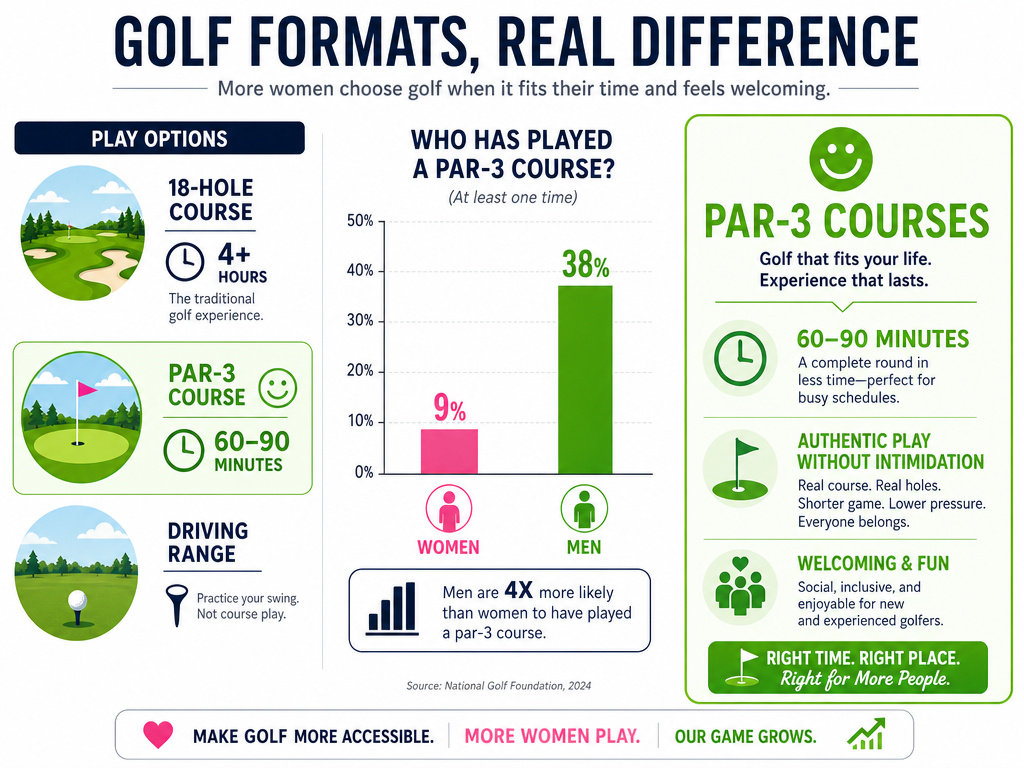
Here is the most underutilized asset in golf for growing the female game: the par-3 or executive course. The data from the National Golf Foundation retention analysis is staggering. Among female participants and prospects, only one-third are even familiar with par-3 courses. More telling: only 9% have ever played one.
Compare that to 38% of men. That’s a massive awareness and usage gap. These “transitional facilities” are the perfect bridge. They are less time-intensive, often less expensive, typically walkable, and they provide the authentic course experience, complete with shot euphoria and hearing the ball rattle in the cup, without the length or precision demands that frustrate newcomers on a 6,500-yard championship track.
| Format | Best For | Time Commitment | Key Retention Benefit |
|---|---|---|---|
| Full 18-Hole Course | Committed players, competitive rounds | 4+ hours | Traditional experience, handicap posting |
| Par-3 / Executive Course | Beginners, reintroduction, social play | 60-90 minutes | Authentic course play without intimidation |
| Driving Range Only | Technical practice, swing work | Variable | Zero. Lacks the crucial on-course experience for retention. |
Clubs that don’t promote their short course, or don’t have one and don’t partner with a local facility that does, are missing the single most effective tool for conversion. The England Golf workshops hammer this point: the pathway after the first engagement is where growth happens. “Full membership is not the next step for everyone,” they state. A 3-hole league after work, a 6-hole social scramble on a par-3 course, these are realistic next steps. This is where you need the right golf balls for women that offer forgiveness and feel on shorter approach shots, making the experience better.
Redesigning the Pathway, Not Just the Tee Box
The conversation about women’s golf often stops at forward tees. That’s a start, but it’s 1970s thinking. As outlined in industry critiques, true inclusion requires looking at the entire hole, and the entire pathway, through the lens of a shorter hitter. This isn’t about dumbing down the game. It’s about designing playability.
A modern approach considers the secondary landing area, the angles into greens for a lower-trajectory shot, and recovery options from hazards. If the goal is to reduce perceived difficulty, then the course itself must be part of the solution. This also applies to the retail pathway. Having a driver with 10.5 degrees of loft and low-spin design, a set of cavity-back irons, and a mallet-style putter is a good start.com/best-golf-clubs-for-women/) and drivers for women in the pro shop, not just a pink version of a men’s club, is a basic signal of inclusion.
Common mistake: Running all introductory programs during weekday daylight hours. If your target is women under 50 who are working, they cannot access a 10 a.m. Tuesday clinic. You’ve just filtered out your largest growth audience.
The pathway must be flexible. It must account for time poverty. The research is unanimous: time is a top barrier. So what can you offer within a 90-minute window? A sunset 5-hole play on a short course with rental clubs included. A weekend “Breakfast & Bogeys” session that includes coffee, a 30-minute clinic, and 5 holes of play. The program love.golf, which achieved a 90% retention rate in its pilot, succeeded by creating a non-technical, on-course learning experience for women in a social setting. They focused on the experience, not the lesson plan.
This is where equipment progression fits. A beginner might start with a complete set for new golfers. As she plays more and her swing speed increases, she’ll start to notice the limitations of that starter set. That’s your cue to discuss a fitting for best golf clubs for intermediate women golfers. The equipment journey follows the participation journey.
Building the Social Engine That Powers Retention
The data point is simple: women who stayed in golf were significantly more likely to find consistent playing partners (60% vs. 39%). Golf is a social game. For women, that social component isn’t a bonus; it’s the engine. The peer-reviewed study on female golfer retention identified “relatedness support”, feeling connected to peers, coaches, and the club, as a critical factor for young female golfers. This doesn’t change with age.
Your role is to architect those connections. Don’t just run a clinic and hope friendships form. Structure for it. * Create fixed groups: Register people in pods of four that stay together for a 5-week series. * Facilitate communication: Create a WhatsApp group for the cohort (with a staff member in it to guide). * Provide the next game: At the end of the program, have a dedicated “graduate” tee time block on the short course for those groups to play together.
The club’s culture is the backdrop. Are there visible female role models in leadership? Is the marketing imagery diverse? Does the bar and grill feel like a welcoming space for a group of women to have a drink after a round, or is it a locker room extension? These environmental cues answer the question, “Do I belong here?” faster than any mission statement.
Frequently Asked Questions
What is the biggest mistake clubs make when trying to attract women?
They lead with membership. The first ask after a beginner clinic is often a $3,000 annual dues commitment. The gap between a $99 introductory program and full membership is a chasm. The smart play is to offer a graduated pathway: clinic -> short-course play pass -> flexible, limited membership -> full membership. Most women need to fall in love with playing before they’ll commit to paying.
How important is equipment for female beginners?
It’s important, but it’s a second-order problem. The first priority is access and experience. However, ill-fitting, heavy clubs made for men will make the game physically harder and less enjoyable. A lightweight, starter set for women with higher lofts and more flexible shafts is a confidence booster. It tells her the game is designed for her, too.
Can women’s golf programs be profitable?
Yes, and the math is compelling. The Syngenta research values a retained female golfer at $949 annually. Beyond greens fees, she spends on equipment, apparel, food, and beverage. Female golfers are 38% more likely to bring children to the game. Retaining one woman can lead to acquiring an entire family.
What’s one simple thing a club can do next week?
Audit your signage. From the parking lot to the first tee, walk the facility and look at every sign, poster, and menu. Is the imagery exclusively male? Is the language geared toward “men’s club championship”? Swap out a few key images for ones featuring women and families playing. It’s a low-cost, high-impact signal of change.
The Bottom Line
Strip it back. Encouraging women in golf isn’t about a magic new program. It’s about fixing a leaky pathway. You have the tools: the par-3 course 91% of women haven’t tried, the “fun-first” group format that boosts retention by 300%, and the social engineering that turns strangers into playing partners.
The threshold for action is clear. If your female beginner retention rate is below 50%, your pathway is broken. The first step isn’t another marketing campaign, it’s dedicating your short course to beginner play every Thursday evening and Sunday afternoon. Make that space theirs. The pre-packaged sets and recommended clubs come later. First, give them a place to play that doesn’t ask for four hours they don’t have.
The industry talks about growing the game. The data shows us exactly where to start. It’s time to build the bridge.
