
How to Play Golf in the Rain: Essential Rules and Adjustments
This post contains affiliate links. As an Amazon Associate, we earn from qualifying purchases.
This post contains affiliate links. As an Amazon Associate, we earn from qualifying purchases.
To play golf in the rain, you need three adjustments: one extra club for every shot, a setup that keeps your hands and grips dry, and a swing you can control on soft ground. The ball flies shorter in dense, wet air and stops dead on saturated turf. Your goal is to hit solid, controlled shots that land on target with minimal roll.
The one-extra-club rule is a starting bid, not a fixed law. In heavy, cold rain, you might need two extra clubs. Every yardage becomes a carry yardage because the ball will not run. A fairway bunker that normally requires 240 yards to clear must be flown entirely.
This guide walks through the gear that keeps you dry, the swing changes that keep you balanced, and the specific Rules of Golf that let you towel grips, take relief from puddles, and avoid costly penalties. It also covers when to walk in — because lightning makes the score irrelevant.
Key Takeaways
- Always take at least one more club than your normal yardage; wet air and zero roll turn every shot into a carry-only calculation.
- Rain gloves get tackier when wet, but pulling your shirt sleeve over your hand to grip the club is a rules violation.
- You get free relief from casual water (temporary puddles) anywhere except in a penalty area, and you can lift, clean, and drop a ball embedded in its own pitch mark on the fairway.
- If you hear thunder, you are within 6–10 miles of a lightning strike. Stop play immediately and seek shelter in a substantial building, not under a tree or an open shelter.
- A wet clubface pinches grass between it and the ball, causing a “flyer” with less spin and more roll — even with modern square grooves.
The Right Gear for a Rainy Round
Your score is decided before you tee off. The goal is simple: keep your hands, your grips, and your feet as dry as possible. Everything else is secondary.
A full set of rain gear is the foundation. Look for a breathable, waterproof rain jacket and rain pants that allow a full swing without restriction. The best waterproof golf shoes have intact traction patterns to prevent slips on soggy slopes.
Common mistake: Relying on a single towel. Carry three microfiber towels: one dedicated to club grips, one for your hands and face, and a dry backup in your bag.
Rain gloves are non-negotiable. Unlike leather gloves, they are designed to get tackier when wet. Wear one on each hand for maximum control. Pair them with a large, double-canopy golf umbrella that vents wind instead of inverting. Don’t forget a rain cover for your bag to keep your spare clubs and grips dry.
Swing Adjustments for Soggy Conditions
A wet swing is a shorter, more controlled swing. Power comes from solid contact, not from speed you cannot control on unstable footing.
First, take a practice swing right next to your ball. Feel how the club interacts with the saturated turf. This tells you how much water is sitting there and how much force you need to get through it. Choke down on the club a half-inch. This counters the feeling of being cramped as your feet sink into the ground.
Stabilize your lower body. On a full shot, focus on rotating around a stable center instead of making a big lateral shift. A shorter backswing with a smooth tempo delivers more consistent contact than a long, aggressive swing that risks a slip.
| Dry Swing Thought | Wet Swing Adjustment | Why It Works |
|---|---|---|
| Full shoulder turn | Controlled, ¾ backswing | Maintains balance on soft ground |
| Shift weight forward | Rotate around stable center | Prevents feet from sliding |
| Hit down and through | Brush the turf, don’t dig | Avoids fat shots from taking too much divot |
| Maximum clubhead speed | Smooth, 85% tempo | Ensures clean contact over raw power |
For shots from wet rough, raise your hands a couple of inches at address. This helps the clubhead travel through the long grass more easily. Expect a “flyer.” Wet grass pinched between the clubface and ball reduces backspin, so the ball will fly farther through the air and roll out more upon landing.
What Are the Official Rules for Wet Weather?
The Rules of Golf specifically address wet weather. Knowing what you can and cannot do keeps you legal and can save strokes.
You ARE allowed to:
- Use towels to dry your grips, hands, or ball before a stroke.
- Apply drying powder to your grip or hands.
- Wear rain gloves designed for better grip when wet.
- Hold an umbrella over your own head while putting.
- Wrap a towel around the club handle for a better hold.
- Take free relief from casual water (temporary puddles) under Rule 16.1, anywhere except in a penalty area.
- Lift, clean, and drop a ball embedded in its own pitch mark in the general area (fairway or rough) without penalty.
You are NOT allowed to:
- Have your caddie or partner hold an umbrella over you while you make a stroke.
- Deliberately use your gripping hand to hold an article of clothing, like pulling your shirt sleeve down to grip the club. This breaches Rule 4.3, as it’s not the intended use of clothing and could assist the stroke.
- Use any equipment that artificially assists with grip pressure.
Where this goes sideways: Pulling your shirt sleeve over your hand for a better grip. It feels like a clever hack, but it’s a clear two-stroke penalty in stroke play. The rulebook states clothing is considered “equipment,” and using it this way is prohibited.
Course Strategy and Mental Game
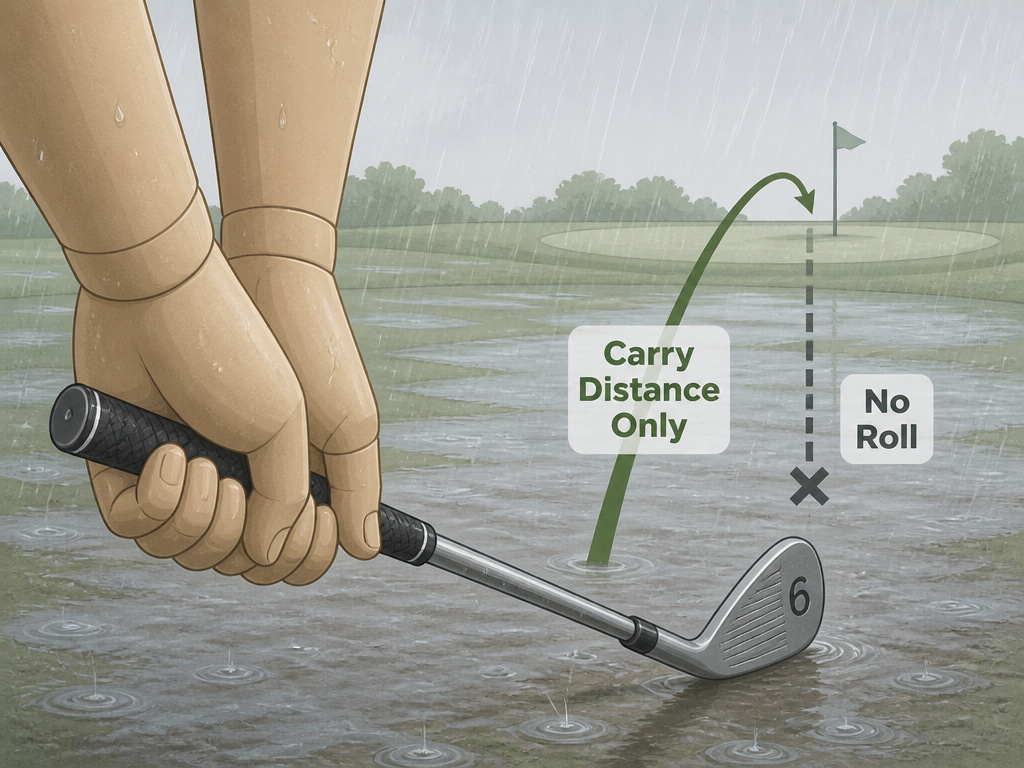 Rain changes the course more than it changes a good swing. Your strategy must shift from calculating total distance to planning carry distance only.
The USGA Green Section is direct: rain makes greens “slower and more receptive.” Putts will break less. Your read should be straighter and your stroke firmer. The ball will not skid; it will start rolling immediately, so focus on a pure roll over complex break.
| Condition | Strategy Adjustment | Club Selection Example |
|---|---|---|
| Light Rain / Drizzle | Add 1 club; expect minimal roll | 150yd shot: use 7-iron instead of 8-iron |
| Steady, Cold Rain | Add 1-2 clubs; no roll | 150yd shot: use 6-iron or 5-iron |
| Wet Rough | Club up for flyer; aim for center of green | Expect 5-10 extra yards of carry |
| Saturated Fairway | Play for all carry; ignore run-out | Fairway bunkers must be flown completely |
Embrace the elements. Everyone is playing the same course. A positive attitude and deliberate pace are advantages. Plan your next shot while others play, and take an extra moment to check your footing on any slope. A slip on a wet downhill lie is a common cause of injury.
When to Stop Playing: Safety First
 Golf is not the biggest lightning killer, and that is no reason to relax. A golf course is a worst-case scenario: open ground, isolated trees, and long walks from shelter.
The National Weather Service states the significant lightning threat extends 6 to 10 miles from the base of a storm cloud. If you can hear thunder, you are within that range. Stop play immediately. Do not finish the hole.
Never seek shelter under a tree. The NWS notes most “side flash” victims were under a tree avoiding rain. Current jumps from the struck object to the person. A roof with no walls, like an open halfway shelter, is also not safe. Seek a substantial building or a fully enclosed vehicle.
The official Rules of Golf signal for an immediate suspension due to danger is one prolonged air-horn blast. When you hear it, you must not make another stroke. The combination of wind, cold, and rain is what ends rounds. If standing water on the greens prevents a putt from holding its line, you’re not playing golf anymore. That’s when to head in.
Frequently Asked Questions
Can you get relief if your ball is in a puddle on the fairway?
Yes. This is “casual water” or “temporary water” under Rule 16.1. You get free relief anywhere on the course except in a penalty area. Find your nearest point of complete relief no closer to the hole, and drop within one club-length of that point.
Do rain gloves really work better when wet?
Absolutely. They are made from a synthetic material that becomes tackier with moisture. Leather gloves get slippery. For the best grip in a downpour, wear one on each hand. Our guide to the best rain gloves for golf details the top performers.
How much distance do you lose hitting a golf ball in the rain?
Expect to lose 5-15% of your normal carry distance, depending on the temperature and rain intensity. Cold, dense air and raindrops striking the ball in flight sap energy. This is why the “one extra club” rule is your baseline.
What is the most important piece of rain gear?
Waterproof shoes with good traction. If your feet are wet and cold, or if you slip during your swing, nothing else matters. A good rain jacket is a close second, but dry, stable feet are the foundation of any athletic move in the rain.
The Bottom Line
Playing golf in the rain is a test of preparation, adaptability, and patience. The golfer who shows up with the right golf rain gear, commits to taking more club, and shortens their swing will beat the golfer who fights the conditions.
Remember the rules: dry your grips, take your relief, but never use your clothes for a better hold. And respect the lightning rule of thumb — if you hear thunder, you’re already in the danger zone. A rainy round rewards the player who plans for the carry, accepts the mud, and keeps their grip dry. That’s how you turn a soggy day into a scoring advantage.
