
Conquer Left Handed Golf Challenges with These Pro Tips
This post contains affiliate links. As an Amazon Associate, we earn from qualifying purchases.
This post contains affiliate links. As an Amazon Associate, we earn from qualifying purchases.
Left-handed golf tips must address two things: the swing, which is a mirror image of a right-hander’s, and the far more frustrating world of equipment access and instruction. The physics are identical, just flipped. Your biggest gains won’t come from a secret move, but from learning how to navigate a game built for the other 90%.
Most guides stop at the swing mirror. They tell you to flip the advice and call it a day. That misses the whole point. The real work is translating that advice when you can’t test half the clubs you read about, when your coach stands on your “wrong” side, and when every course visual seems backwards.
What follows is a breakdown of the tangible hurdles, from the grip specs that actually matter to the lie angles that hide in plain sight, and the practical workarounds that let you play your game, not an adapted version of someone else’s.
Key Takeaways
- The lead wrist (your left wrist) needs about 20–25 degrees of extension at the top of the backswing for solid contact, a specific, measurable target most generic tips miss.
- Buying used left-handed clubs online requires demanding face, sole, and shaft photos; a “stiff” shaft label means nothing without the model name.
- Your biggest equipment disadvantage isn’t lack of heads; it’s the near-total absence of demo options for loft, shaft, and grip combinations, which forces you into “close enough” choices that add strokes.
- A 3:1 backswing-to-downswing tempo ratio is a universal benchmark, but for lefties, maintaining it often requires extra focus because most visual cues (coach demonstrations, video analysis) are reversed.
- Always hit from the right side of the tee box (as a lefty). The left side is perpetually trampled by right-handed golfers and offers worse turf.
The Equipment Challenge Is Real, Not Imagined
Walk into any big-box golf store. The wall of right-handed drivers, irons, and wedges stretches on. The left-handed section? It’s often a single rack, tucked in a corner. This isn’t a minor inconvenience; it’s the central obstacle. Manufacturers produce fewer left-handed heads and, critically, far fewer stock configurations. You might find the driver head you want, but only in one loft, paired with one shaft flex, and one grip size.
The limitation forces left-handed golfers into ‘close enough’ decisions. Maybe the lie angle is slightly off. Maybe the shaft is a bit too light. Individually, those details seem minor. Over 18 holes, they add up.
This scarcity creates a domino effect. You can’t test and compare like a right-handed player can. Demo days are famously skewed. The result is that many lefties buy clubs based on reviews and specs alone, hoping they’ll work. It’s an expensive guess.
Where this goes sideways: You buy a driver online because it’s the only left-handed model in your budget. The stock shaft is too whippy for your tempo. You start hitting high, spinning balloons that drift right. You then spend months, and more money, trying to fix a “swing flaw” that is actually an equipment mismatch. The fix was a different shaft, but you never got to test it.
This is why a true professional fitting isn’t a luxury for left-handed golfers; it’s a necessity. A fitter with a deep left-handed cart, like the team at JD’s Clubs in Minnesota notes, can show you options you didn’t know existed. They can also spot the swing compensations you’ve developed from years of adapting to ill-fitting gear. Your occasional pull might not be your path; it might be a lie angle pointing the face that way at impact.
If you’re assembling a bag, start by looking at our guide to left-handed golf clubs to understand the landscape before you get fitted.
Grip Pressure and Setup: The Two-Point Touch
Forget strong, weak, or neutral for a second. The first mistake I see left-handed players make is in their hands, not their hand rotation. They grip the club like they’re trying to choke it. Tension in the hands is a swing killer for anyone, but lefties often compound it by overthinking the “reversed” instructions.
Let’s be clear about this. Your right hand is on top. Your job is to let it sit there passively, with the lifeline of your right palm covering your left thumb. The real power and control comes from your left hand underneath. If you squeeze with your right, you lock your wrists and kill any chance of a proper release.
Here’s a sensory check: after you take your grip, hold the club out in front of you. Have a friend try to pull the club straight down out of your hands using a slow, steady force. If they can pull it free without a major struggle, your pressure is close. If your knuckles turn white and you win the tug-of-war, you’re holding on for dear life. You want a firm but supple hold, like you’re holding a small bird, enough pressure so it doesn’t fly away, not so much that you hurt it.
I learned that on the weekend rounds where I first got hooked. I’d watch friends with beautiful, fluid swings, then I’d try to muscle the ball. My hands ached by the 14th hole. The ‘aha’ moment came when I stopped trying to steer the club with my top hand and just let my left side do the work it was meant to.
Now, for hand rotation. As a lefty, you want a grip that helps you square the face. That generally means your left hand (the bottom hand) is rotated clockwise on the grip so that you can see 2-3 knuckles when you look down at address. This “stronger” position makes it easier to close the face through impact, countering the natural lefty fade or slice. Phil Mickelson, a right-hand-dominant player who swings lefty, uses an extremely strong grip for this exact reason.
| Club Type | Ball Position (Left-Handed) | Why It Matters |
|---|---|---|
| Driver | Inside of right heel (lead foot) | Promotes upward angle of attack for max carry. |
| Fairway Wood/Hybrid | Between center and inside of right heel | Ensures clean contact off the turf. |
| Long Iron (4-5) | Slightly forward of center | Balances launch and control. |
| Mid & Short Iron (6-9) | Centered in stance | Consistency is king for scoring clubs. |
| Wedge | Just behind center | Encourages a downward strike for spin. |
Once your grip is set, your ball position is the next critical factor. The chart above isn’t a suggestion; it’s the blueprint for where your low point should be. Getting this right makes clean contact routine instead of accidental.
The Mechanics Are a Mirror (With One Key Number)
The swing is a mirror image. The downswing sequence, the weight shift, the rotation, it’s all the same physics. A draw for you curves right-to-left, a slice goes left-to-right. The challenge is that 99% of the instruction you consume is demonstrated from the other side. This requires mental translation, which can be exhausting.
Strip it back. Focus on two universal truths that don’t need translating: tempo and wrist hinge.
First, tempo. A smooth, controlled swing isn’t just aesthetically pleasing; it’s efficient. Most golfers benefit from a 3:1 tempo ratio. That means your backswing should take about three times as long as your downswing. Count “one-two-three” back, then “one” through. Rushing the downswing is the root of most power leaks and inconsistent strikes. For lefties, practicing this with a metronome app can be highly effective because it removes the reversed visual.
Second, the lead wrist. Data from HackMotion, a swing-tracking tool, shows that the ideal position at the top of the backswing for most players is about 20-25 degrees of extension in the lead wrist (your left wrist). This is a specific, measurable target. Too much cup (extension) can open the face; too much bow (flexion) can close it violently. Finding that 20-25 degree window promotes a square face delivery. A hard number you can actually work towards, not just a feel.
Common mistake: Trying to copy the exact “positions” you see in a right-handed video. Your body can’t mirror a freeze-frame. Instead, understand the intent. If a tip says “tuck your right elbow,” you translate that to “tuck your left elbow.” Better yet, seek out the small but growing library of instruction filmed specifically for left-handed players.
Finding Clubs That Fit: The Online Imperative
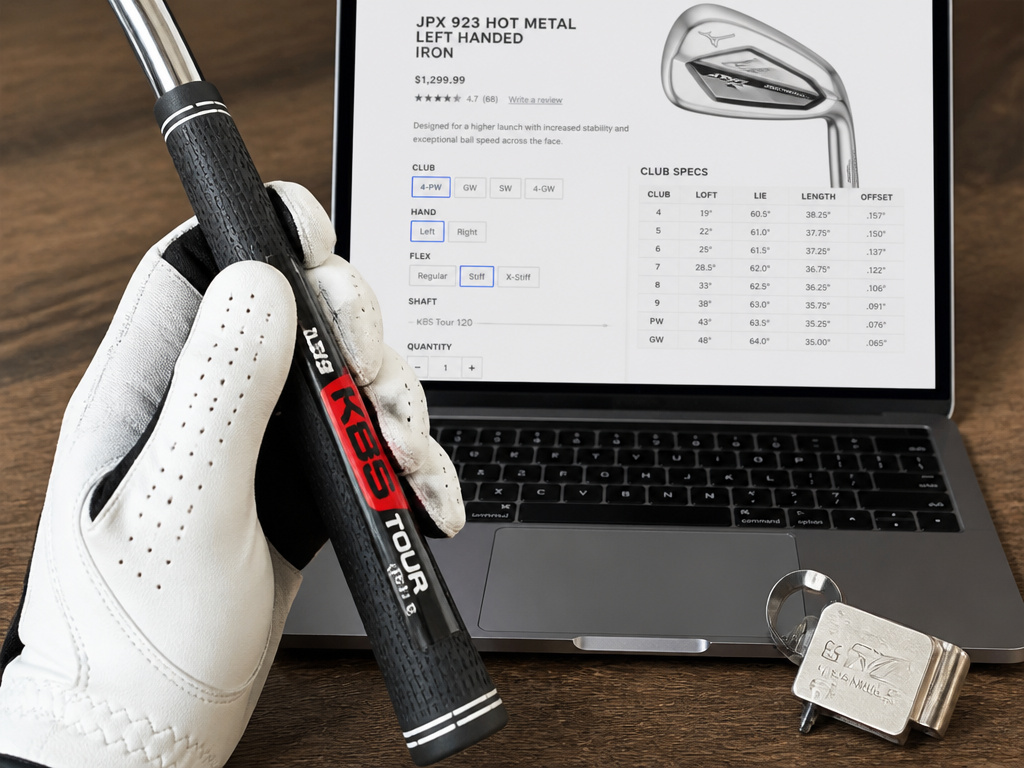
You can’t rely on walking into a shop. The modern solution for left-handed golfers is a strategic online approach, but it must be informed.
Start with brand availability. Mainstream game-improvement lines from Callaway, TaylorMade, and Ping are widely available left-handed. Where it thins out is in the niches: specific player’s irons (like the Mizuno Pro 245, which is available left-handed only 4-GW, while righties get 2-GW), exotic wedge grinds, and certain putter neck styles. Know this going in.
When buying new online, your three non-negotiable specs are flex, loft, and lie. The flex must match your swing speed. The loft must create the launch window you need. The lie angle, the most ignored spec, must match your delivery. A lie that’s too upright will point the face left of target at impact; too flat points it right. Many fitters use a lie board and impact tape to diagnose this in minutes. It’s worth the trip.
The part nobody mentions: Buying used left-handed clubs online is a minefield of hidden wear. Always, always ask for three photos: a close-up of the clubface to check for grooves and damage, a shot of the sole to see turf interaction and grinding, and a clear picture of the shaft label. A shaft just marked “Stiff” is worthless. You need the model name.
Used clubs can be a fantastic value, especially when you’re looking at complete club sets to get started. But that “bargain” disappears if the faces are polished smooth or the shafts are a terrible match for you. A driver with the wrong shaft flex can ruin your timing for an entire season.
For those new to the game, a well-chosen beginner club set designed for lefties is often a smarter play than piecing together a used set of mismatched specs.
The On-Course Left-Handed Edge (Yes, There Is One)

The golf course itself is often designed with right-handed hazards in mind, fairway bunkers placed to catch a common righty miss, doglegs that favor a right-to-left shot shape. This can feel unfair, but it also presents opportunities.
Your shot shape is the reverse. A fade for you moves left, a draw moves right. On a dogleg that bends left, a right-hander’s natural draw might run through the fairway. Your natural lefty fade, however, can be the perfect shape to hold that same fairway. Learn to see the course through this flipped lens. What’s a hazard for them can be a wide-open landing zone for you.
Use the tee box. This is a free advantage most lefties waste. Always set up on the right side of the tee markers (as a lefty). Your feet can be outside the markers as long as the ball is between them. The left side of the tee box is where every right-handed player in front of you has been standing and taking divots all day. The right side is almost always pristine, giving you perfect turf and a better angle. It’s a small thing that makes a real difference in confidence and strike quality.
Finally, practice with purpose. If you’re on a range surrounded by right-handers, go to the far left end. You won’t be subconsciously picking up their visual cues, and you’ll have a clearer sightline to your own target. And for lessons, don’t be shy. Ask a potential coach, “How many left-handed players have you taught?” Their answer will tell you everything about how useful the session will be.
Frequently Asked Questions
Are there fewer left-handed golfers?
Yes. Lefties make up only about 5-7% of the golfing population, which is why equipment selection is more limited. This small percentage is also why most instruction defaults to a right-handed perspective.
Should a left-handed person learn to play right-handed to make it easier?
Almost never. Golf is a motor skill best performed with your dominant side. Switching handedness to solve an equipment access problem creates a far bigger technical problem. The minor convenience of finding right-handed clubs is vastly outweighed by the long-term struggle of learning with your non-dominant side. Play left-handed. Shop online.
Is it harder for left-handed golfers?
The swing itself is not harder. The challenges are entirely logistical: less equipment to test, fewer visual learning aids, and course layouts that aren’t designed for your common miss. The actual mechanics of striking the ball are equally difficult for everyone.
What’s the most important spec for a left-handed golfer to check?
Lie angle. Because it directly influences your start line, an incorrect lie angle will have you constantly aiming and compensating to counteract a pull or push caused by the equipment itself. It’s the first thing a good fitter will check after watching you hit a few shots.
Before You Go
Good golf for a left-handed player isn’t about finding a magical swing tip hidden in a right-handed video. It’s a three-step process of acknowledgment, correction, and adaptation.
First, acknowledge the real hurdle: you have to work harder to get properly fitted equipment. Accept that browsing in a pro shop will be disappointing, and shift your research and buying strategy online. Use resources like our reviews of top left-handed clubs to narrow your focus before you ever see a fitter.
Second, correct the fundamentals you can control with precision. Your lead wrist has a target extension of 20-25 degrees. Your backswing tempo should be a 3:1 ratio to your downswing. Your ball position shifts with each club in your bag. These are non-negotiable, measurable checkpoints.
Finally, adapt your on-course strategy. See the layout in reverse. Claim the clean side of the tee box. Understand that your natural shot shape can be an asset on holes that trouble righties. The game is the same; your path to playing it well just requires a different map. Focus on the things you can measure and change, and the rest becomes just background noise.
