
Uncovering the Golfer With the Most Hole in Ones in History
This post contains affiliate links. As an Amazon Associate, we earn from qualifying purchases.
This post contains affiliate links. As an Amazon Associate, we earn from qualifying purchases.
The golfer with the most verified holes-in-one in history is Mancil Davis, with 51. For official PGA Tour records, Hal Sutton and Robert Allenby are tied with 10 career aces in tournament play. The highest claimed total is 59 by Norman Manley, but that record is widely disputed due to a lack of consistent, modern verification for many of those shots.
That distinction between a claimed number and a verified one is the whole story here. A hole-in-one isn’t just a lucky shot; it’s a documented event. The difference between 59 and 51 isn’t just eight golf balls, it’s decades of witness statements, scorecard attestations, and the shifting standards of who gets to keep the official count.
What follows is a breakdown of the two kings of aces, the undisputed tour leaders, and a look at why even the best players in the world might go thousands of par-3 attempts without one. By the end, you’ll know which names are supported by evidence and which belong to golf legend.
Key Takeaways
- The verified lifetime record belongs to club pro Mancil Davis (51 aces), not the often-cited Norman Manley (59).
- On the PGA Tour, Hal Sutton and Robert Allenby share the official record with 10 tournament aces each.
- Kathy Whitworth holds the LPGA Tour record with 11, the highest verified total for any major professional tour.
- Verification is everything. Many historic claims, like Manley’s 59, have faded because witnesses and documentation from decades ago are hard to substantiate today.
- Even for tour pros, aces are incredibly rare. The odds for an average amateur are about 12,500 to 1, underscoring that luck is a massive component.
The Lifetime Record: 59 vs. 51
The most common answer used to be Norman Manley, a retired engineer from California credited with 59 holes-in-one between 1963 and 1988. His most famous feat was acing two consecutive par-4 holes in 1964, a “Double Albatross” recognized by the Guinness Book of World Records. For decades, he was the default answer.
Where this goes sideways: Relying on decades-old witness testimony. As Manley aged and his playing partners passed away, modern outlets found it impossible to audit his claims systematically. Without a living witness for each ace, the record became a story rather than a statistic.
The problem isn’t that Manley was lying, he had plenty of witnesses for dozens of his shots, but that the standard for a verified record changed. Organizations like the Golf Digest Hole-in-One Clearinghouse, which once validated such claims, faded away by the late 2000s. In their place came private registries and a demand for contemporary, documented proof. Manley’s record, built in a different era, couldn’t survive that shift.
Enter Mancil Davis. The Texas club professional, dubbed the “King of Aces,” has 51 documented holes-in-one. His first came at age 11 in 1966; his 51st in 2007. He had 20 aces before his 20th birthday. What separates Davis is the quality of documentation: many occurred in professional or competitive settings, with well-known witnesses like Ben Crenshaw. His career also includes 10 double eagles, adding credibility to his extraordinary shot-making.
| Aspect | Norman Manley (Claimed) | Mancil Davis (Verified) |
|---|---|---|
| Total Aces | 59 | 51 |
| Timeframe | 1963 – 1988 | 1966 – 2007 |
| Key Strength | Incredible volume, famous consecutive par-4 aces | Extensive documentation, many in competition |
| Modern Standing | Largely disputed, cited as an unverified ceiling | Widely accepted as the de facto lifetime record by Golf.com and major publications |
| Why It Matters | Shows the ceiling of what’s been claimed | Shows the verified floor of what’s been proven |
The takeaway? Davis’s 51 is the number you can trust. Manley’s 59 is a fascinating part of golf lore, but it sits in the “claimed” column, not the “verified” one. In records, evidence outranks anecdotes.
Official Tour Records: When Every Shot Counts
 Tour records are different. Every shot is monitored, witnessed by thousands, and logged. There’s no ambiguity. Here, the numbers are smaller, but they mean more because they happened under the brightest lights and stiffest pressure.
The PGA Tour only began consistently recording holes-in-one in 1983. This means some earlier aces by legends are lost to history, but every one since is part of an official database.
The PGA Tour co-kings are Hal Sutton and Robert Allenby, each with 10 career aces in tournament play. Sutton, the 1983 PGA Champion, was a legendary iron player. Allenby, known for his ball-striking, notched his 10th at the 2016 Barracuda Championship. Their record highlights a career of elite precision on the most demanding par-3s.
On the European Tour (now DP World Tour), the record is also 10, held by Miguel Angel Jiménez. He set the mark at the 2015 BMW PGA Championship, holing out from 158 yards on the par-3 2nd hole to surpass Colin Montgomerie’s previous record of nine.
The most impressive official tour record belongs to Kathy Whitworth. The LPGA’s all-time wins leader also holds its ace record with 11. She stands alone as the only player with a verified double-digit total on a major professional tour.
The part nobody mentions: The pressure of a tournament actually reduces ace opportunities. Pros often aim for the fat part of the green to avoid trouble, not the pin. A casual round with friends presents more “go-for-it” chances than a Sunday back-nine with a cut line looming.
What about Tiger Woods or Jack Nicklaus? Tiger has an estimated 20 lifetime aces, but only three came in official PGA Tour events. Jack’s tour count isn’t among the leaders. This makes a critical point clear: volume of play is a huge factor. A club pro like Mancil Davis who teaches and plays daily on par-3s has exponentially more attempts over a lifetime than a tour star with a limited competitive schedule.
The Anatomy of an Ace: Why They’re So Rare
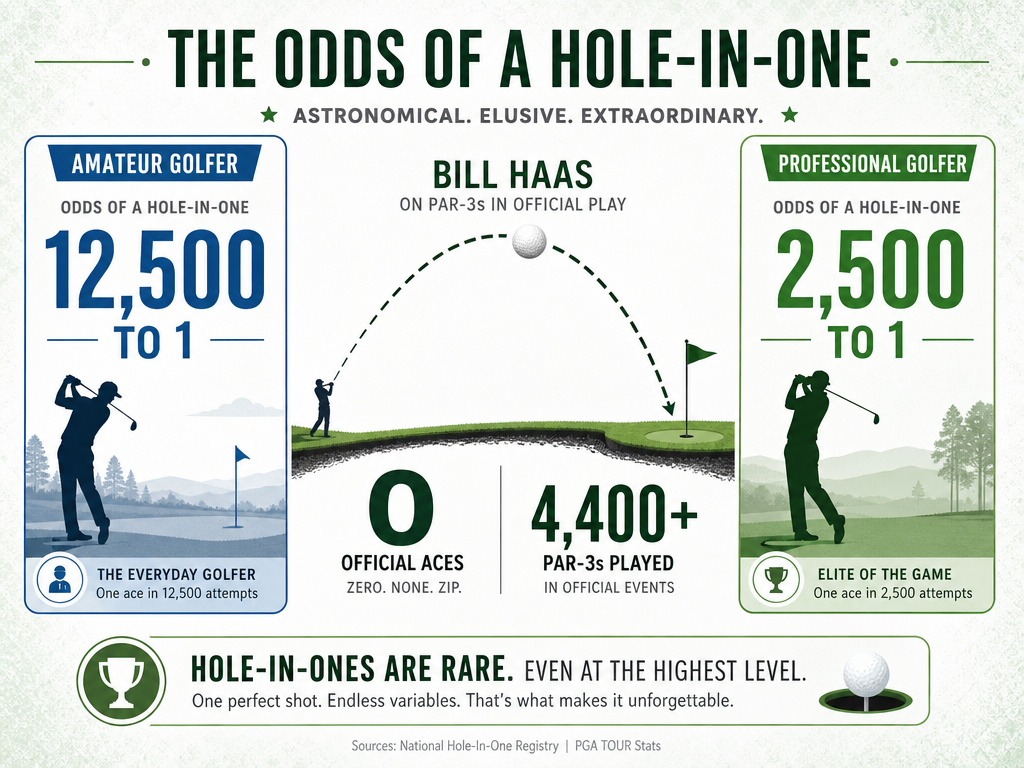 Let’s strip it back. A hole-in-one requires a perfect storm. You need the right club, the correct wind read, a pure strike, a friendly green contour, and a dimple’s worth of luck. The margin for error is zero.
The National Hole-in-One Registry puts the odds for an average amateur at 12,500 to 1. For a tour professional, the odds improve to about 2,500 to 1. That’s still a long shot.
Consider Bill Haas. He’s teed off on over 4,400 par-3s in his PGA Tour career and has zero official aces. He’s won the FedExCup. He’s one of the best ball-strikers of his generation. Yet, the ace eludes him. That’s the humbling reality of this feat.
I learned this lesson in a casual round years ago. I was playing with friends and tried to show off, taking driver on a tight par-4 I had no business attacking. The result was a lost ball, a triple bogey, and a quiet walk to the next tee. The moral? Chasing glory instead of playing the high-percentage shot rarely ends well. On a par-3, the high-percentage shot is the center of the green. Going straight at the pin every time is how you run up scores, not how you collect aces.
The sound of a pure iron shot is a crisp click. The sound of that same ball rattling the bottom of the cup is a hollow clunk you feel in your chest. Every golfer lives for that second sound, but building your game around chasing it is a recipe for frustration.
How Records Are Verified (And Why It’s Messy)
There is no single global governing body for hole-in-one records. It’s a patchwork system, which is why disputes like Manley vs. Davis happen.
- Historical Bodies: The Golf Digest Hole-in-One Clearinghouse (1952 – ~2000s) was the gold standard. They required witness names, attested scorecards, and club professional verification.
- Modern Registries: Private companies like the National Hole-in-One Registry (founded 2006) now fill the void. They provide verification and insurance for prize holes-in-one.
- Tour Databases: The PGA Tour, LPGA Tour, and DP World Tour maintain their own official statistics for events, which are the definitive source for professional records.
- State/Regional Associations: Groups like the Montana State Golf Association often certify aces for their members, adding another layer of local validation.
This decentralized system means a record’s credibility depends entirely on which source you consult. The Montana State Golf Association blog provides one of the most detailed narratives on the Manley-Davis debate, highlighting how verification standards have evolved.
When you read about a record, ask: Who verified it? When? Under what rules? The [Wikipedia hole in one entry](https://en.wikipedia.
Famous Ace Feats & Unbelievable Stories
While career totals are one thing, single moments of ace magic have their own legacy. Here are a few that stand out:
- Jonathan Byrd’s Walk-Off (2010): The only player to win a PGA Tour playoff with a hole-in-one. It was so dark he couldn’t see the ball go in.
- Two in a Row: John Hudson (1971) and more recently, Shane Lowry (2026 Masters) are among the few to record aces on consecutive holes in professional competition.
- Family Affairs: The National Hole-in-One Registry has records of aces spanning three and even four generations on the same hole.
- The Million-Dollar Shot: Jason Bohn made a hole-in-one at a college fundraiser that came with a $1 million annuity prize, which directly funded his launch into professional golf.
These stories remind us that an ace is more than a statistic. It’s a memory that lasts a lifetime, a story told forever in the grill room. It’s why we keep trying.
Frequently Asked Questions
What is the official definition of a hole-in-one?
Hole-in-one (or ace) occurs when a ball hit from the teeing ground on the first stroke of a hole finishes in the cup. It must be during a stipulated round; shots after a penalty (like a reload from a lost ball) do not count.
Has anyone ever had two holes-in-one in the same round?
Yes, but it’s extraordinarily rare. Amateur Jordan Dunlevy did it in 2025, acing a par-3 and a par-4 in the same nine holes. In professional play, John Hudson aced consecutive holes during the 1971 Martini International.
Do holes-in-one on par-4s count?
Absolutely. They are often called “double eagles” or “albatrosses” (two strokes under par). They are significantly rarer than par-3 aces because they require an extremely long and accurate drive.
Why don’t Tiger Woods or Jack Nicklaus hold the record?
Volume and variance. Tour players have fewer total par-3 attempts over a career compared to a club professional who plays daily. Also, luck is a huge factor. Tiger’s three tour aces show that even the greatest striker ever needs the right bounce.
How can I officially register my hole-in-one?
You should report it to your golf course’s pro shop, who can often assist with certification through a body like the National Hole-in-One Registry. Ensure you have your playing partners (witnesses) sign your scorecard.
Before You Go
The search for the most holes-in-one reveals a simple truth: in golf, what can be proven often outweighs what is claimed. Mancil Davis’s 51 is the bedrock answer. The tour records of Sutton, Allenby, and Whitworth are the benchmarks under pressure.
If you’re chasing your first ace, focus on what you can control: a smooth, repeating swing that finds the green. Don’t aim at the pin tucked behind the bunker, aim at the heart of the putting surface. The odds are long, but they drop to zero if you don’t hit the green.
Good golf should feel less complicated the more you understand it. An ace is a glorious accident in a game of controlled consistency. Celebrate the accident if it happens, but build your game on the consistency. That’s where the real records, like lower scores and more wins, are made.
