
Fix Your Overswing in Golf: Primary Causes and Solutions
This post contains affiliate links. As an Amazon Associate, we earn from qualifying purchases.
This post contains affiliate links. As an Amazon Associate, we earn from qualifying purchases.
Overswinging in golf is caused by a grip that collapses in the fingers, a backswing where the left wrist cups past 90 degrees, or a body that lacks the core control or mobility to turn within a stable 12-inch frame. The fix is not shortening your swing by force, but correcting the specific root cause, poor grip placement, insufficient lead-leg braking, or limited scapular stability, with targeted drills that rebuild the sequence.
Most instruction tells you to “swing shorter.” That’s the symptom, not the disease. The real problem is what lets the club travel too far in the first place: a breakdown in structure or a compensation for a physical limitation. You can’t willpower a shorter swing if your body is wired to over-rotate because it can’t turn properly.
What follows: the three mechanical checkpoints that fail, the two distinct body types that overswing for opposite reasons, and the drill progressions that take 4-8 weeks to stick. We’ll also touch on the new research suggesting your over-the-top move with the driver might be a completely different animal than your iron swing.
Key Takeaways
- An overswing isn’t just a long backswing; it’s a structural collapse, usually a cupped left wrist past 90 degrees or a left arm that bends because the grip is in the palm.
- Hyper-mobile golfers overswing from a lack of strength to control their flexibility; stiff golfers overswing by overusing arms to make up for a stiff thoracic spine.
- Fixing a true sequencing error, where the upper body starts the downswing, requires 4-8 weeks of consistent drill work to rewire muscle memory.
- New research proposes that an over-the-top move with the driver may be a “threshold-compensation” specific to full speed, even if your iron swing is stable.
- The fastest fix is often in your hands: shorten your left thumb so the tip sits a half-inch from the knuckle to support the club and prevent collapse.
The 90-Degree Wrist Check That Stops Overswinging
Forget parallel. The club shaft pointing past parallel to the ground is the visual result. The mechanical cause is almost always in the lead wrist.
For a right-handed golfer, the angle between the club shaft and the left arm (the lever arm) should not exceed 90 degrees significantly at the top. If your left wrist is cupped so the back of your hand bows toward your forearm, you’ve blown past that limit. That extra hinge is pure slack, it adds length you can’t control.
This is about a stable hinge. When the wrist cups past 90 degrees, the clubhead keeps traveling because the joint has given way.On the downswing, you now have to re-hinge it correctly and time that re-hinge perfectly. Most amateurs don’t. They either cast from the top or get stuck trying to find the clubface.
Check it in a mirror. Take your backswing and freeze. Can you draw a straight line down your left arm and along the club shaft, or is there a sharp angle at your wrist? A slight angle is power. A severe angle is a leak.
Why it matters: That excess cup often originates from a grip that’s too much in the palm of the left hand. When the club sits in the palm, you physically cannot create a stable hinge. The club has to travel farther because your wrist can’t support it early. Move the grip into the fingers, and the wrist can hinge properly, and earlier, creating width without overtravel.
Your Body Type Dictates the Cause (and the Cure)
Overswinging isn’t one fault. Your physiology points to the root cause. The Titleist Performance Institute (TPI) frames it as two primary profiles.
| Body Profile | Primary Cause of Overswing | The Compensation | Corrective Focus |
|---|---|---|---|
| Hyper-mobile / Very Flexible | Lack of strength to control excessive range of motion. | The joints simply keep going because the muscles can’t stop them. | Core stability and rotational strength. Building a “brake.” |
| Limited Thoracic Spine Mobility | Stiffness in the upper back prevents a full shoulder turn. | The arms and shoulders keep moving to create backswing length, disconnecting from the body. | Improving thoracic rotation; learning to turn the body as a unit. |
If you’re hyper-mobile, your overswing feels loose and whippy. You might even be proud of your flexibility. The fix is anti-rotation work. Exercises like Pallof presses or half-kneeling cable chops teach your core to resist unwanted motion, giving you the strength to stop your turn at the right spot.
If your upper back is stiff, your overswing feels armsy and disconnected. You’re trying to create coil with your arms because your body won’t turn. The fix is mobility first. Work on thoracic spine rotations and cross-body stretches. Then, drills that tie arm swing to shoulder turn, like the “sock drill” where you hold tension between your hands, reinforce that the arms stop when the shoulders stop.
Where this goes sideways: Treating a stiffness overswing with stability drills. If you make a stiff golfer’s core even more rigid without improving their turn, they’ll just lift the arms higher. You must match the drill to the diagnosis.
The Grip and Thumb Fix You Can Do in 60 Seconds
The fastest route to a more compact swing might be in your glove. Look at the left thumb. Is there a worn spot or hole?
People who wear a hole in the thumb of their glove are often overswingers who have their left thumb too flat, so it just gives way at the top. The tip of your left thumb should be about half to three-quarters of an inch away from the tip of the knuckle on your forefinger.
A long, straight thumb running down the grip offers no support. When you start your downswing, that thumb collapses, allowing the club to fall deeper behind you. Shortening the thumb, pulling it up so there’s a visible gap, creates a firm bridge of support. This simple adjustment can physically prevent the wrist from over-hinging and the left arm from collapsing.
The drill: Take your normal grip. Now, without moving your fingers, consciously shorten your left thumb so you see that half-inch gap. Make slow, controlled backswings, focusing on the pressure of the club against that shortened thumb. It will feel like the club is more “in” your hand, not “on top” of it. This support stops the overswing before it starts.
Sequencing: The 4-8 Week Timeline to Ingrained Change
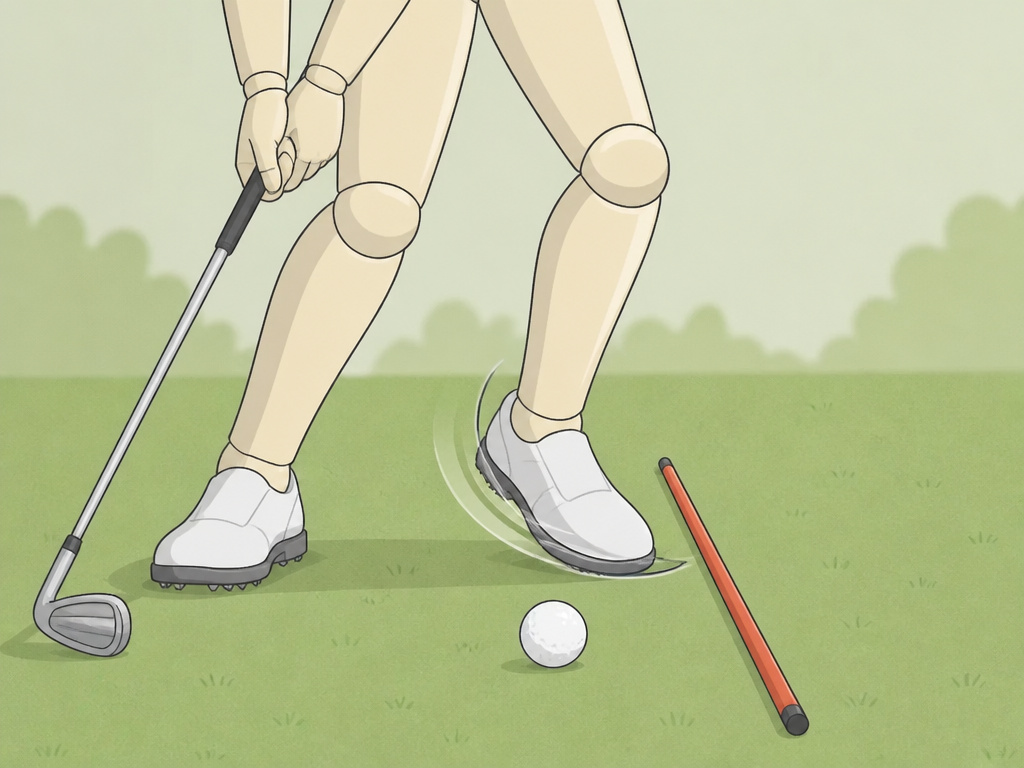
When your overswing is driven by poor sequence, your upper body starting the downswing before your lower body, the fix is a rewire.
Fixing a true over-the-top sequence caused by upper-body dominance takes 4–8 weeks of consistent drill work to ingrain. The pattern is truly cemented only after 3–6 months, including performing under pressure on the course.
This is the honest timeline most guides skip. You can’t think your way out of a sequence error during a swing. You have to build a new motor pattern through repetition.
- Lead with the Lower Body: The first move down must be a lateral shift of your weight toward the target, initiated by your lead leg. Feel your left hip bump left. This creates space for your arms to drop inside.
- Use a Barrier Drill: Place a headcover or an alignment stick just outside and behind your golf ball. Your goal is to swing down without hitting the barrier. This forces an inside path.
- The Step Drill: Start with your feet together. As you begin your downswing, step toward the target with your lead foot. This physically mandates that your lower body leads the action.
The throwing instinct is deep. You’ll revert under pressure. That’s normal. The 4-8 week mark is when the new move starts to feel more familiar than the old one.
The New Research: Driver OTT as a “Threshold-Compensation”
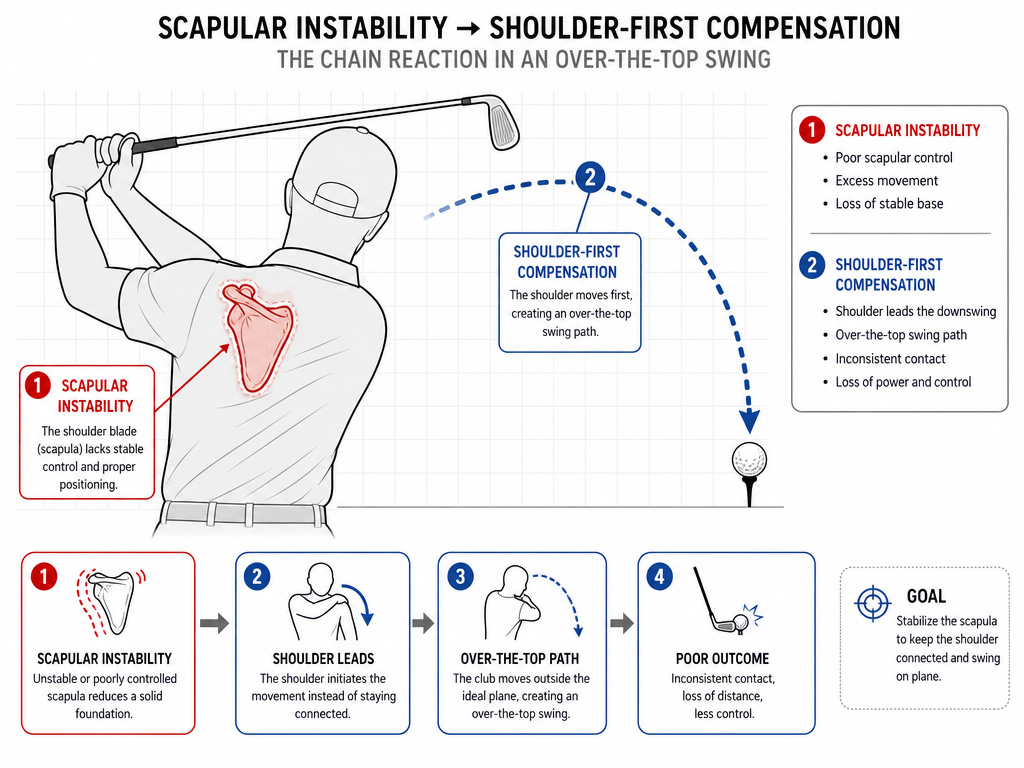
Here’s a non-commodity insight that reframes the issue for better players. A 2026 peer-reviewed paper proposed the “Threshold–Compensation Hypothesis” for driver over-the-top.
It suggests that for some golfers, OTT is a sequencing reorganization that appears only under high task demand, specifically, a full-speed driver swing. Your iron swing or a slowed-down driver swing might be perfectly stable.But when you approach the limits of your lead-leg braking force or your scapular (shoulder blade) stability, your body compensates by letting the upper body take over early.
The paper outlines four subtypes, but one is critical for the avid golfer: the “upper-chain limited” golfer. This player has adequate lower-body force, but their shoulder girdle stability hits a ceiling at full speed. The compensation is a “shoulder-first, arm cast-out” move that looks over-the-top.
Why this changes your practice: If this is you, generic “drop your arms” drills will fail. You need screening. A coach might use a half-kneeling diagonal pull-down exercise to test your scapular control under load. If you lose control of your left shoulder blade as the load increases, you’ve found a likely contributor. Training then focuses on raising that specific stability threshold, not just changing your swing thought.
Frequently Asked Questions
What is the main cause of an overswing in golf?
The main cause is a breakdown in structure at the top of the backswing, most commonly a cupped left wrist that exceeds a 90-degree angle or a collapse of the left arm due to a weak grip. This is often a compensation for either excessive flexibility without control or limited upper-back mobility.
Can an overswing be beneficial like John Daly’s?
For the vast majority of amateurs, no. Players like John Daly and Jon Rahm possess exceptional hand-eye coordination, timing, and athleticism to compensate for the overswing’s inconsistencies. They make it work despite the extra motion, not because of it. Trying to copy it introduces multiple moving parts that are incredibly difficult to synchronize.
How do I know if I’m hyper-mobile or stiff?
Simple test: Can you easily place your palms flat on the floor with straight knees? If yes, and you also feel loose or unstable in your backswing, you’re likely hyper-mobile. If you struggle to rotate your upper body independently of your hips (try sitting in a chair and turning your shoulders to look behind you), and your overswing feels all arms, limited thoracic mobility is a likely culprit.
What’s the fastest way to stop overswinging?
Check and adjust your left thumb position on the grip. Shorten it so the tip is a half-inch from the knuckle. This builds immediate support to prevent wrist collapse. Then, practice the “thumbs up” drill: at the top of your backswing, your lead thumb should be pointing roughly at your head, not behind you.
Is overswinging the same as coming over-the-top?
They are frequent partners. An overswing refers specifically to the length of the backswing.Coming over-the-top describes the downswing path. However, the extra length and loss of control from an overswing make it much harder to sequence the downswing correctly, often resulting in an over-the-top move as the arms race to catch up.
The Bottom Line
Stop trying to swing shorter. Start building a swing that’s supported. For most, that begins with a grip in the fingers and a shortened left thumb. For the chronic over-swinger, diagnose your body type, are you too loose or too stiff?, and attack that root cause with specific mobility or stability work.
If your issue is pure sequence, commit to the 4-8 week timeline. Use the step drill and barrier drills daily. And if you’re a solid ball-striker who only loses it with the driver, consider the new “threshold” idea. Your fix might be in the gym, raising your scapular stability ceiling, not on the range with another swing thought.
A compact, powerful swing is about efficiency. Build the structure that lets you turn with control, and the extra length, and the wild shots that come with it, will disappear on its own.
