
What Is a Club Championship? The Ultimate Club-Level Test
This post contains affiliate links. As an Amazon Associate, we earn from qualifying purchases.
This post contains affiliate links. As an Amazon Associate, we earn from qualifying purchases.
A club championship is a club’s premier annual tournament designed to crown its best golfer(s) for the year, typically contested through gross stroke play or a hybrid format that includes match play. The overall champion wins the title by posting the lowest score without handicap strokes, but most events feature multiple flights and divisions to include players of all skill levels.
That distinction between gross and net champion is where the tournament’s prestige lives. One is a pure test of shot-making under pressure; the other rewards consistency and improvement within a peer group. Both names go on the board, but only one carries the unqualified title.
What follows: the structural DNA of these events, from the strict Handicap Index cut-offs used by real clubs to the seeded bracket formats that turn a weekend into a drama. We’ll also break down how to move from a casual member to a legitimate contender.
Key Takeaways
- The overall Club Champion is almost always the winner of the scratch Championship Flight, playing without handicap aid.
- Eligibility often hinges on a specific Handicap Index maximum, with common cut-offs like 8.2 or 2.5 for different tiers.
- Modern formats frequently use initial stroke-play qualifying to seed a match-play knockout bracket, a hybrid that tests both consistency and head-to-head nerve.
- Preparation is non-negotiable: post all scores, know the official rules cold, and practice with the specific pressure of tournament golf in mind.
- Winning any flight secures bragging rights and a place on the club’s honor board, making it a goal for every serious member.
What Exactly Is a Club Championship?
Forget the weekend medal. This is your club’s major. A club championship is the annual, often multi-round tournament that determines the best golfer at a private, semi-private, or public facility. It’s the event where casual agreements and “gimmes” vanish, replaced by the full Rules of Golf and signed scorecards.
The winner’s name is engraved on a permanent plaque or trophy in the clubhouse, joining a legacy that can stretch back decades. It comes with a full year of bragging rights and is a true test of skill under pressure. Unlike a casual round, this is where you play against a field of members who all want to win as much as you do.
A club championship is a 54-hole gross stroke play competition to determine a club’s best player, but its structure has evolved to create inclusive, fair competition through multiple flights based on handicap.
The core tension is between tradition and inclusion. The purest form crowns a gross-score champion. But to engage the full membership, clubs layer in net flights, senior divisions, and sometimes separate women’s and junior championships. This turns a single contest into a club-wide festival of golf.
The Two Types of Champion: Gross vs. Net
You’ll hear two titles: Club Champion and Net Champion. They are not the same thing, and confusing them is a rookie mistake at the awards ceremony.
The Club Champion wins the Championship Flight. They play scratch golf, meaning no handicap strokes are applied. Every bogey, every double, counts exactly as posted. This title is about raw, unadjusted skill over 36, 54, or even 72 holes. It’s the highest honor.
The Net Champion wins their respective handicap flight. Their gross score has their Handicap Index strokes deducted. This champion is the best performer relative to their own potential on that given day. It’s a huge achievement, but it doesn’t come with the undisputed “best player” mantle.
Most members will compete for a net title. The Championship Flight is a smaller, more elite group. A club’s published criteria make this split clear. For example, one club’s 2026 rules state the main Club Championship is only open to members with a Handicap Index of 8.2 or lower. Another flight, the Salver Championship, is for those between 3.0 and 8.2. These aren’t suggestions; they are hard gates.
| Champion Type | Flight | Score Basis | Who It Crowns |
|---|---|---|---|
| Club Champion | Championship Flight | Gross (no handicap) | The club’s best absolute scorer |
| Net Champion | A, B, C, etc. Flights | Net (handicap applied) | The best performer relative to skill level |
| Senior Champion | Senior Division (e.g., 50+) | Usually Gross | The best absolute scorer in the age group |
Common Formats: Stroke Play, Match Play, and the Hybrid
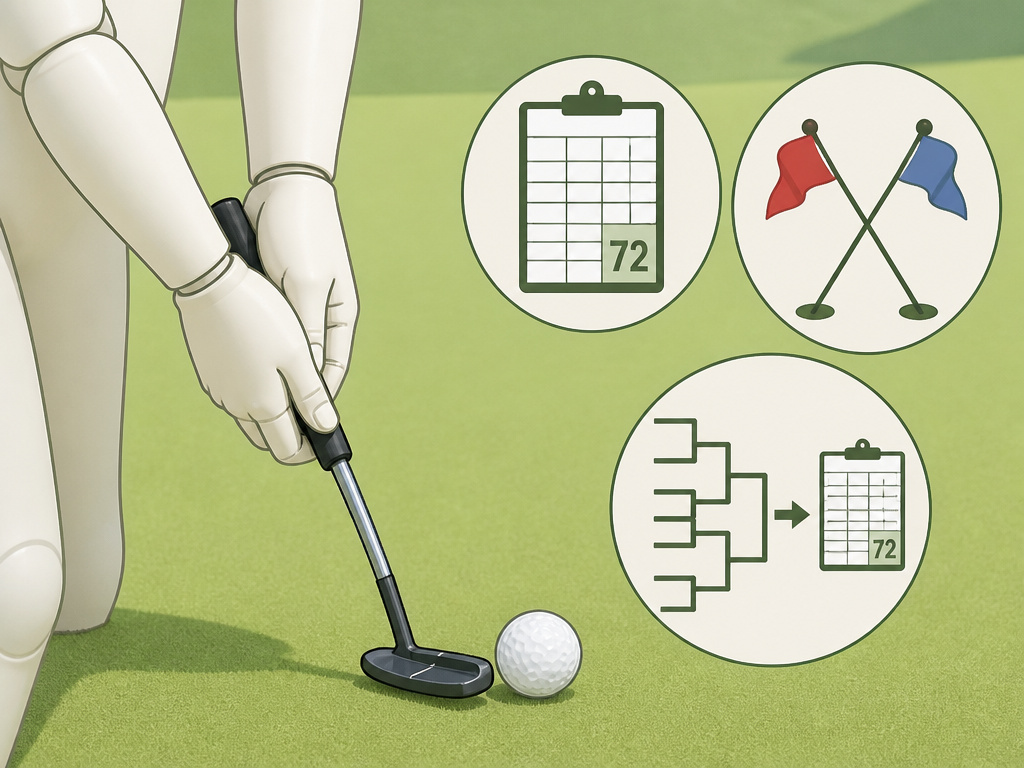
The format dictates the psychology of the entire event. You’re not just playing the course; you’re playing the system.
Stroke Play is the most common baseline. You post a total score over multiple rounds. Every stroke counts directly. It’s a brutal test of consistency; one disaster hole can ruin 17 good ones. This format is typical for the initial qualifying rounds or the entire net flights.
Match Play is a head-to-head duel. You win individual holes, and the match is over when you lead by more holes than remain (e.g., 3&2). A triple bogey only loses one hole, so it encourages aggressive play. This format is classic for the knockout stages of a championship.
The Hybrid Model is now the gold standard for determining a true Club Champion. It starts with 36-hole stroke-play qualifying. The low 16 gross scores advance to a seeded, single-elimination match-play bracket.
This tests everything. The stroke play proves you can handle scorecard pressure over two full rounds. The match play then tests your nerve in direct confrontation. Surviving this gauntlet leaves no doubt about the winner’s merit. It’s the format used by clubs like the one sourcing its 2026 rules, where the 16 lowest 2-round gross totals move to scratch match play.
Who Can Play? Decoding Eligibility Rules
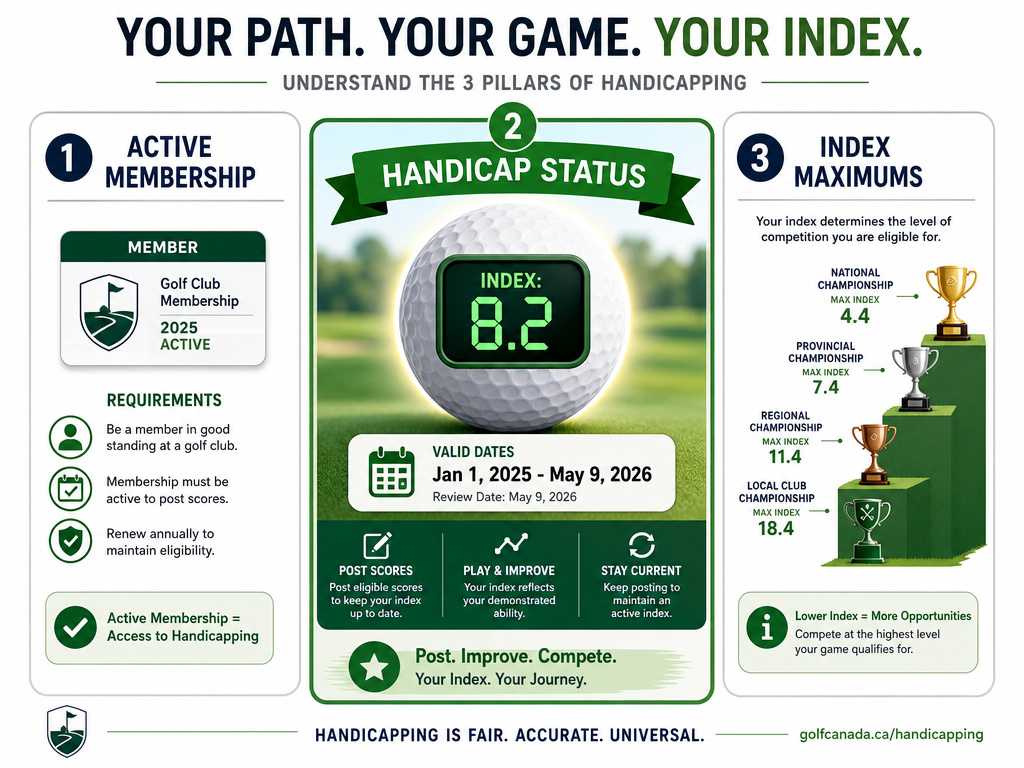
The flyer says “all members welcome,” but the fine print has numbers. Tournament committees use objective criteria to ensure fair and competitive brackets. Your Handicap Index is your ticket.
Where this goes sideways: Assuming your weekend handicap is accurate. Committees use your official index on a specific date. If you haven’t posted scores, you’re ineligible or placed in the wrong flight.
General eligibility rests on three pillars: 1. Active Membership: You must be a full golf member in good standing. 2. Handicap Status: You must have an active, compliant Handicap Index with a minimum number of posted scores. One club’s 2026 championship requires 3 qualifying scores between January 1st, 2025, and May 9th, 2026. 3. Index Maximums: Flights have ceilings. As noted, a Handicap Index of 8.2 might be the cut for the main championship, while a B Championship could be for those between 8.3 and 17.0.
These rules exist to prevent sandbagging and ensure players compete against true peers. They also create aspirational goals. Getting your index from 12.0 down to 8.2 to qualify for the Championship Flight is a legitimate season-long target.
For the absolute elite, events like the PGA National Club Championship raise the bar further. Their eligibility requires a competitor’s Handicap Index not to exceed 2.5 at registration. This highlights that a club championship exists on a spectrum, from local club hero to national amateur standout.
How to Prepare for Your First Club Championship
Stepping onto the first tee requires more than your usual Saturday routine. The pressure is different. The atmosphere is different. Your preparation must be, too.
Get Your Handicap in Order. This is step zero. Post every score, good and bad, for months in advance. Playing with an inaccurate index is poor form. It also misleads you about your real standing. Know your exact number and which flight it places you in.
Know the Rules. Really Know Them. This isn’t your friendly foursome. Refresh procedures for unplayable lies, penalty areas, and embedded balls. Understanding relief options can save you strokes when you inevitably find trouble. Not knowing costs you penalties and momentum.
Practice with Purpose.
- Play the actual championship tees.
- Practice hitting 3-wood off the tee on tight holes you normally driver.
- Spend 80% of your short-game time on lag putting and 10-footers.
- Simulate pressure: finish every practice session with a “must-get-up-and-down” chip to a chosen hole.
Manage Your Game Day. Eat a proper breakfast. Have a clear, conservative game plan for the first three holes to settle in. Pack snacks, water, and rain gear. Your physical stamina is part of the test over 36 holes.
The right equipment matters, but it doesn’t need to be new. Ensure your golf club grips are fresh for a confident hold under sweat and pressure. Make sure your golf club sets are built for consistency, not just distance. Many players find that a fitting session for a key club, like testing best golf club drivers for their swing, provides a tangible confidence boost. The goal is to eliminate doubt.
Beyond Golf: Club Championships in Other Sports
The concept isn’t unique to golf. It’s a universal club sports tradition, and seeing how others do it clarifies golf’s own choices.
In tennis, provincial guidelines recommend running singles, doubles, and mixed doubles events on separate weekends to avoid scheduling nightmares. The goal is the same: make the finals a spectator-friendly social event that celebrates the club’s top talent.
In professional football, the A-Leagues Club Championship takes a different, league-wide approach. Introduced in the 2021/22 season, it awards a trophy to the club whose men’s and women’s teams earn the highest combined points total. It’s a “one club” metric that values overall program strength, a concept foreign to golf’s individualistic focus but interesting for its emphasis on breadth.
These examples show that a club championship’s core purpose—crowning a champion and building community—transcends the sport. The structure adapts to the game’s nature.
Frequently Asked Questions
What’s the difference between a club champion and a tournament winner?
Tournament winner typically wins a one-day event, often with handicap strokes. The Club Champion wins the club’s designated annual multi-round championship, usually via gross score. The title carries historical weight and year-long status.
Can a high-handicap player win the club championship?
High-handicap player cannot win the overall Club Champion title, as that is a gross-score competition. However, they can absolutely win their designated net flight championship, which is a celebrated victory in its own right and earns a place on the club’s honor board.
How are ties broken in a club championship?
For stroke-play qualifying, clubs use a detailed countback procedure. One common method looks at the lowest second-round score, then the lowest back nine, last six holes, last three holes, and finally the last hole of that second round. If still tied, a draw of lots may decide. In match play, ties result in extra holes until a winner is decided.
Do I need a special set of clubs for a club championship?
No. You need the set you know and trust. The week of the championship is not the time for major equipment changes. Focus on ensuring your existing golf club sets are clean, properly gripped, and that you have confidence in every club. Consistency beats novelty under pressure.
What happens if I qualify for multiple championships?
Some clubs allow it, especially across age and skill divisions. Their rules will specify how schedule conflicts are resolved. For instance, a 2026 club document states that if a member qualifies for both the Senior Championship and another final, the Senior final will be moved to a specific date to avoid a clash.
The Bottom Line
A club championship is more than a tournament; it’s a benchmark. It measures your current game against your club’s history and your peers’ ambitions. Whether you’re fighting for the scratch title or your first net flight win, it represents a commitment to the game that goes beyond casual play.
Understand the format. Respect the eligibility rules. Prepare with intent. Then embrace the pressure. Seeing your name on that board, even in a lower flight, is a reward that lasts long after the final putt drops. It’s a story you’ll tell for years, and the reason you keep working on your game.
