
How to Master Golf Ball Position by Club for Every Shot Type
This post contains affiliate links. As an Amazon Associate, we earn from qualifying purchases.
This post contains affiliate links. As an Amazon Associate, we earn from qualifying purchases.
Correct golf ball position by club moves the ball forward in your stance as the club gets longer, from just behind center for wedges to inside your lead heel for the driver. This progression matches each club’s intended angle of attack, ensuring the clubhead meets the ball at the correct point in the swing arc for solid contact.
The difference between a pure strike and a fat chunk often comes down to a shift of one ball width, 2.14 centimeters. That tiny distance changes where your swing bottoms out, which changes everything about the shot that follows. A 2018 study in the Journal of Sports Science and Medicine measured it with motion-capture cameras on professional golfers: move the ball an inch left, and your shoulders open, your clubface closes, and your weight shifts to your lead foot before you even take the club back.
This guide gives you the system, not just a chart. You’ll learn the biomechanical reason each club needs its own spot, the single best reference point that doesn’t change with your stance, and the common error that makes even a good swing produce a bad result.
Key Takeaways
- Use your sternum, not your feet, as the primary reference. Your feet move apart for longer clubs, but your sternum stays centered, giving you a consistent anchor.
- For wedges, the ball belongs just behind your sternum. This promotes the steep, descending blow needed for compression and spin.
- The driver is the only club hit on an upswing. Place it just inside your lead heel to catch the ball as the clubhead ascends.
- A ball moved laterally (left or right) alters shoulder alignment and clubface aim at address, directly influencing the starting direction of your shot.
- The simplest system: start with feet together, ball centered. Take a small step forward with your lead foot, then adjust your trail foot width for the club. The ball position auto-adjusts.
The Biomechanics of a 2.14 cm Shift
Most advice tells you where to put the ball. The real question is why a half-ball shift matters so much. The answer is in the address position your body unconsciously adopts the moment you move the ball.
A 2018 study published in the Journal of Sports Science and Medicine used eight infrared Vicon MX-F20 cameras to track elite golfers. It found that moving the ball just 2.14 cm (one radius) laterally significantly changed shoulder rotation, clubface aim, and vertical ground reaction force at address. The same small movement forward or backward altered the angles of the trunk, hips, knees, and the club’s lie angle.
This isn’t about swing mechanics. It’s about setup geometry. When you move the ball left (for a right-handed golfer), your shoulders open, pointing left of target. Your weight naturally loads onto your left foot. Your clubface aims left. You haven’t swung yet, but you’ve already preset a pull or a hook. Move it right, and the opposite happens: closed shoulders, weight on the right foot, and a clubface aimed right, inviting a push or a slice.
The forward/backward shift is just as critical. Play the ball too far back with a driver, and your body extends, spine straightens, arms reach, to get to it. This steepens your angle of attack, forcing a downward hit on a club designed to sweep up. You get low spinny rockets, not high carries.
Where this goes sideways: Using your lead foot as your only guide. Your foot position changes with stance width. For a wedge, your feet are close together; for a driver, they’re wide apart. If you always align the ball with your lead heel, its position relative to your body’s center, your sternum, changes wildly. This is why so many golfers hit their wedges thin and their drivers fat. The fix is a constant reference point that doesn’t move.
Sternum vs. Lead Heel: Picking Your True North
Your body has two potential anchors for ball position: your moving feet and your stationary center. The choice between them decides your consistency.
The sternum is your kinetic center. It’s where the rotation of your swing is anchored. When you place the ball in relation to your sternum, you’re placing it in relation to the swing arc’s low point. This is why most top instructors use the sternum as the primary reference for irons and wedges. Your feet can be narrow or wide, but the ball stays in the same relationship to the engine of your swing.
The lead heel is a useful secondary marker, but only for the longest clubs. It works for the driver and fairway woods because with a wide stance, the inside of your lead heel is only slightly forward of your sternum. This gives you the forward position needed for a shallow or ascending strike. Using it for a wedge, where your feet are close, puts the ball far too forward.
| Reference Point | Best For | Why It Works | Risk If Misapplied |
|---|---|---|---|
| Sternum / Shirt Logo | Irons & Wedges | Ties position to body center, not variable stance width. | Using it for driver can place ball too far back, killing launch. |
| Inside Lead Heel | Driver & Fairway Woods | Promotes forward position for upward or sweeping strike. | Using it for short irons causes thin, scooped contact with no compression. |
| Step Method | All Clubs (Beginner-Friendly) | Automates positioning through stance width; no measuring. | Can become sloppy without checking alignment to target. |
So, the rule is simple: For anything shorter than a 3-wood, use your sternum. For your driver and fairway woods, use the inside of your lead heel. This separates the two competing systems and lets each do its specific job. If you want to understand how this positioning directly affects the ball’s behavior after impact, our breakdown of the ball flight laws shows the cause-and-effect chain.
Golf Ball Position by Club: The Specifics
Now for the map. These positions assume a right-handed golfer and are referenced from your sternum. Think of your sternum as the “center” point.
Wedges (PW, GW, SW, LW): Play the ball just behind your sternum, about half a ball width back. This is the most rearward position. It ensures you strike the ball with a sharply descending blow, trapping it against the turf. This creates the spin and control you need for approach shots. A ball placed too far forward with a wedge leads to bladed, skulled shots that scream over the green.
Short & Mid Irons (8-iron through 6-iron): Play the ball at your sternum. This is the neutral position. The club should make contact with the ball first, then take a shallow divot after. This is where you achieve the ideal correct impact, hands ahead, shaft leaning forward, ball compressing off the face.
Long Irons & Hybrids (5-iron through 3-iron/Hybrid): Play the ball slightly forward of your sternum, about half a ball width. These clubs need a shallower descent than a wedge. The forward position helps you catch the ball with a slight downward strike while still launching it high enough to hold a green. It’s the most forgiving position for getting these longer clubs airborne.
Fairway Woods (5-wood, 3-wood): Play the ball just inside your lead heel. You’re now switching references from sternum to foot. This encourages a sweeping strike, brushing the grass rather than digging. The ball is forward enough that you catch it just before the bottom of your arc.
Driver: Play the ball inside your lead heel, often with the ball lining up with the instep. This is the most forward position. Combined with a wide stance and a tilt away from the target, this lets you strike the ball on a 2 to 5-degree upswing. That positive angle of attack is non-negotiable for maximizing distance. It’s why choosing the right tool for the job starts with a proper golf driver setup.
Common mistake: Playing every iron in the center. A 4-iron and a 9-iron have different shaft lengths and lofts, so their low points occur at different spots in your stance. Playing them all in the same spot forces you to manipulate your swing to find the bottom. Let the ball position do the work.
The Step-By-Step System for Any Course
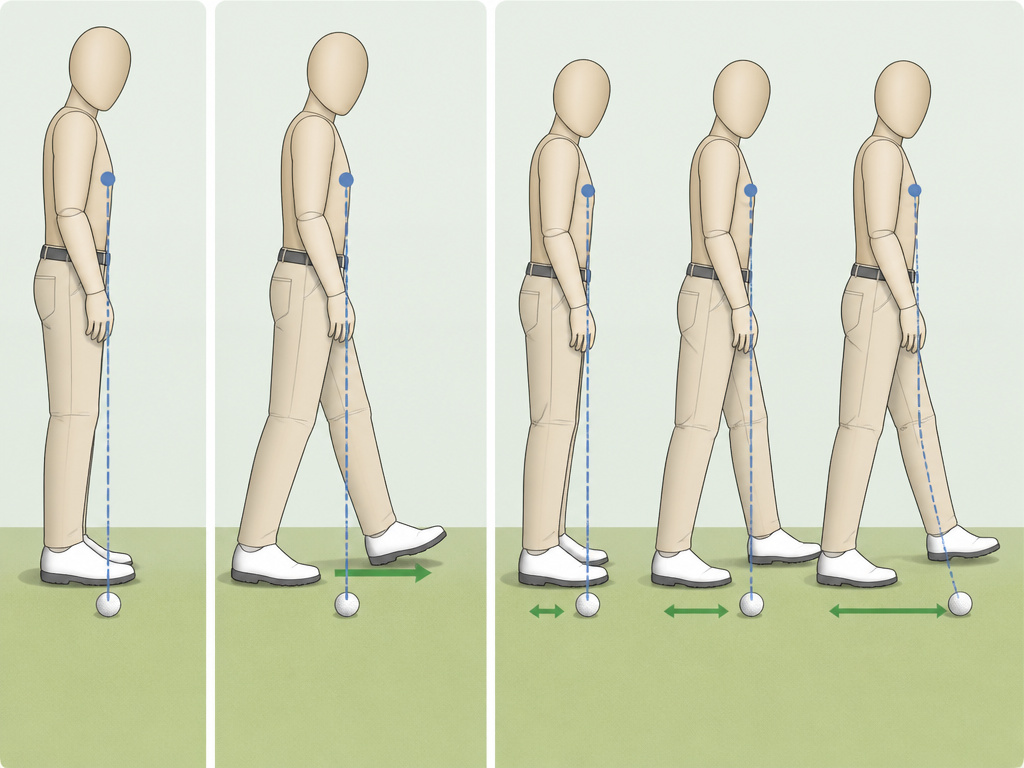
Theory is one thing. Getting it right under pressure on the 15th tee is another. This three-step routine builds consistency without overthinking.
- Start Centered: Stand with your feet together, the ball positioned directly opposite your sternum. This is your neutral starting point for every single club in the bag.
- Step Your Lead Foot: Take a small, consistent step forward with your lead foot (left foot for righties). This step is the same size for every club, about 4 to 6 inches. It does two things: it starts to create an athletic stance, and it begins to move the ball forward relative to your body center.
- Adjust Your Trail Foot: Now, adjust the width of your stance by moving your trail foot away from the target. This is the only variable that changes by club.
- Wedge: Small step. Feet are close. The ball is now just behind your sternum.
- Mid-Iron: Shoulder-width step. The ball is now at your sternum.
- Driver: Widest step. The ball is now inside your lead heel.
The beauty of this system is automation. You don’t have to remember “half a ball width forward for a 5-iron.” You just adjust your stance width, and the ball position falls into place. It ties directly into building a consistent pre-shot routine, which is as vital as having the right golf club sets for your game.
What Your Ball Flight Is Telling You
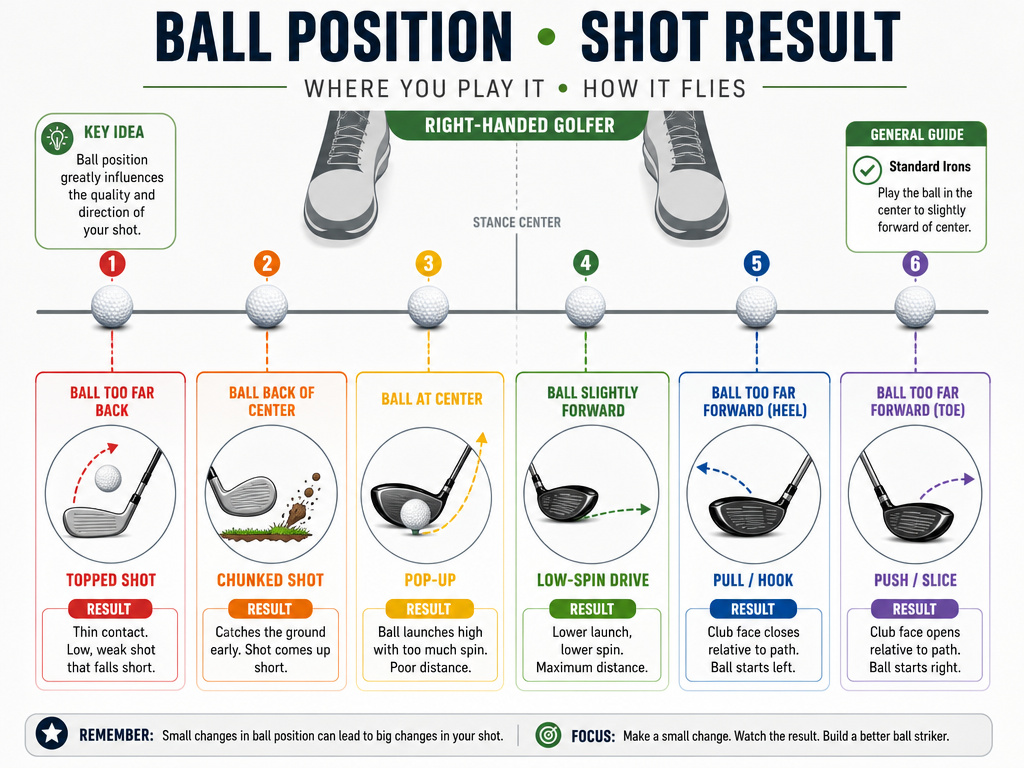
If you’re hitting poor shots, your ball position is a prime suspect. Use this diagnostic table before you start tearing your swing apart.
| Shot Pattern | Likely Ball Position Error | The Biomechanical Cause |
|---|---|---|
| Thin / Topped Irons | Ball too far forward in stance. | You are reaching the bottom of your swing before the ball, catching it on the upswing with an iron. |
| Fat / Chunked Irons | Ball too far back in stance. | The club is striking the turf before the ball because your swing’s low point is behind it. |
| Driver Pop-ups | Ball too far forward and tee too high. | The clubhead’s ascending path meets the bottom of the ball, adding extreme loft. |
| Low, Spinning Drives | Ball too far back. | You are hitting down on the driver, delofting it and creating excessive spin. |
| Consistent Pulls | Ball too far left (for RH golfer). | Address shoulder alignment is open, as shown in the JSSM biomechanics of ball position study, presettting a leftward path. |
| Consistent Pushes | Ball too far right (for RH golfer). | Address shoulder alignment is closed, presettting a rightward path. |
This is where understanding the ball flight principles pays off. A push isn’t just a bad swing; it’s often a setup error you can fix before you take the club away. Before you regrip or rework your takeaway, check where the ball is. It’s the fastest fix in golf.
Frequently Asked Questions
Can I just play every shot off my left heel like some pros did?
You can, but it makes the game much harder. Playing a wedge off your left heel forces an incredibly shallow strike, making it near impossible to generate spin or control trajectory. It requires extreme swing adjustments club-to-club. The progressive system is easier, more consistent, and is used by the vast majority of tour professionals today.
How does ball position change for a draw or fade?
For a shaped shot, you adjust your alignment and clubface, not your standard ball position. Playing the ball back to hit a draw is a common myth. That move actually encourages a steeper, more out-to-in path, which can promote a slice. For a draw, keep your normal ball position but align your body right of target with a slightly closed clubface. For a fade, align left with a slightly open face.
I’m very tall/short. Do the positions change?
Your reference points do not change, the ball still moves from sternum to lead heel. However, your posture and distance from the ball will be different. A taller player will stand farther from the ball with more spine tilt. The key is ensuring that when you are in your athletic posture, your sternum is directly over the ball for your mid-irons. This might require a fitting to ensure your golf club grips and shaft lengths are correct.
Does ball position matter on putts?
Absolutely. Conventional wisdom places the ball just forward of center in your putting stance, often off your lead armpit. This promotes a slight upward strike with the putter, helping the ball start rolling smoothly instead of skidding. It’s a small but critical part of a consistent putting setup.
How can I practice this effectively?
Use two alignment sticks. Place one along your toe line and another perpendicular to it, pointing at your target. Hit shots with a 7-iron, ensuring the ball is consistently on the target-side stick, aligned with your sternum. Then hit drivers, ensuring the ball is on that same stick but now aligned with your lead heel. This visual feedback is instant and powerful. While you’re dialing in your setup, keeping your equipment in top shape matters, dirty balls can mask strike quality, which is where a good golf ball cleaner comes in handy.
The Bottom Line
Stop trying to fix your swing to match a static ball position. Set the ball in the right place for the club in your hand, and let your swing be an athletic reaction to that setup. Wedges go behind your sternum, drivers go inside your lead heel, and everything else progresses smoothly between those two points.
The step method is the fastest way to build this into your routine forever. It removes the mental clutter and makes good positioning automatic. When your contact improves, you’ll find less need to constantly identify your ball, though having a reliable system for golf ball markings is always smart. Get the setup right first. The pure strikes will follow.
