
Master the Correct Golf Impact Position for Better Strikes
This post contains affiliate links. As an Amazon Associate, we earn from qualifying purchases.
This post contains affiliate links. As an Amazon Associate, we earn from qualifying purchases.
The correct golf impact position with an iron is defined by four shifts from your static setup: hands 3-4 inches ahead of the ball (forward shaft lean), hips rotated 30-40 degrees open toward the target, 70-80% of weight on the lead foot, and the lead wrist flat or bowed. This dynamic, rotational position creates a descending strike for ball-first contact and compression, not a return to your address posture.
That “return to address” advice you’ve heard is biomechanically impossible for a powerful strike. Your body isn’t built to rotate and transfer weight while staying in a square, static pose. The moment of impact is the result of everything that came before it, a delivery of force, not a pose to hold.
What follows is a breakdown of the four non-negotiable impact markers, the science behind why they matter, and the drills that rewire the muscle memory causing weak, flipped contact. By the end, you’ll know exactly what to feel and how to measure it.
Key Takeaways
- Impact is a dynamic, rotational position, not a return to your static setup. Trying to “get back to address” guarantees a weak, scooped strike.
- Forward shaft lean (hands ahead) is the primary lever for compressing the ball. Without it, you lose 15-25 yards per iron and hit the ground first.
- Weight must shift to your lead foot early in the downswing. If you can’t lift your trail foot at your finish, you hung back.
- Hip rotation opens the path for your arms. Hips that stay square block the swing and cause an early release or a flip.
- Verification beats feel. Use an impact bag, face tape, or a launch monitor like the Garmin R10 to get objective feedback on strike quality.
The Anatomy of a Pro-Level Impact Position
Forget the still images. A tour-quality impact is a snapshot of a body in motion, delivering force. If you freeze any elite player at contact, four elements are always present.
Weight is Forward. About 70-80% of your pressure should be on your lead foot at impact. This forward shift is what allows you to hit down on the ball. Golfers who hang back on their trail foot hit up on it, leading to thin shots or fat chunks behind the ball. A simple test: after your next shot, freeze at your finish. If you can lift your trail foot completely off the ground and balance on your lead foot, your weight transferred. If you’d fall backward, you hung back.
Hips are Open. Your belt buckle should already be pointing left of the target (for a right-handed golfer). This hip opening, roughly 30-40 degrees, clears space for your arms to swing through freely. It’s the engine of rotation. Hips that stay square at impact force your hands to flip the clubhead out and over, producing a weak slice or a pull.
Hands are Ahead (Forward Shaft Lean). This is the visual signature of compression. Your hands should be in line with or ahead of your lead thigh, while the clubhead is still at the ball. This forward shaft lean delofts the club, driving the ball into the turf for a millisecond before it launches. It’s the difference between a penetrating flight and a ballooning, short shot.
Forward shaft lean with a mid-iron places the handle roughly 3-4 inches ahead of the ball, equating to about 4-6 degrees of shaft lean. The tour average with a 7-iron is approximately 4 degrees. Exceeding 8 degrees often produces low, bullet-like trajectories that lack stopping power.
A Stable Lead Wrist. Look at a slow-motion replay. The lead wrist is flat or slightly bowed, the trail wrist is bent. This keeps the clubface square and stable through impact. The amateur killer is the “flip”, the lead wrist cups and the trail wrist straightens, scooping the ball with an inconsistent face.
Why “Return to Address” is a Damaging Myth
This is the most persistent and harmful piece of advice in golf instruction. Your address position is static. Impact is dynamic and rotational. The 2005 Korean Journal of Applied Biomechanics study makes this undeniable.
The research analyzed the swings of low-handicap golfers using different clubs. It found that at impact, compared to setup: – The head moved up to 3.5cm more to the right (for a righty). – The left shoulder raised up to 5cm, the right shoulder lowered up to 2.5cm. – The pelvis opened up to 31 degrees and moved toward the target line. – Hands moved left, forward, and upward by several centimeters due to pelvis and shoulder rotation.
Your body cannot do these things and “return to address.” The instruction actively fights the biomechanics needed for power. It encourages you to stall your rotation and scoop with your hands to make contact. If you’ve ever felt like you’re swinging hard but the ball just doesn’t go, this myth is likely the root cause.
How Impact Changes With Every Club in Your Bag
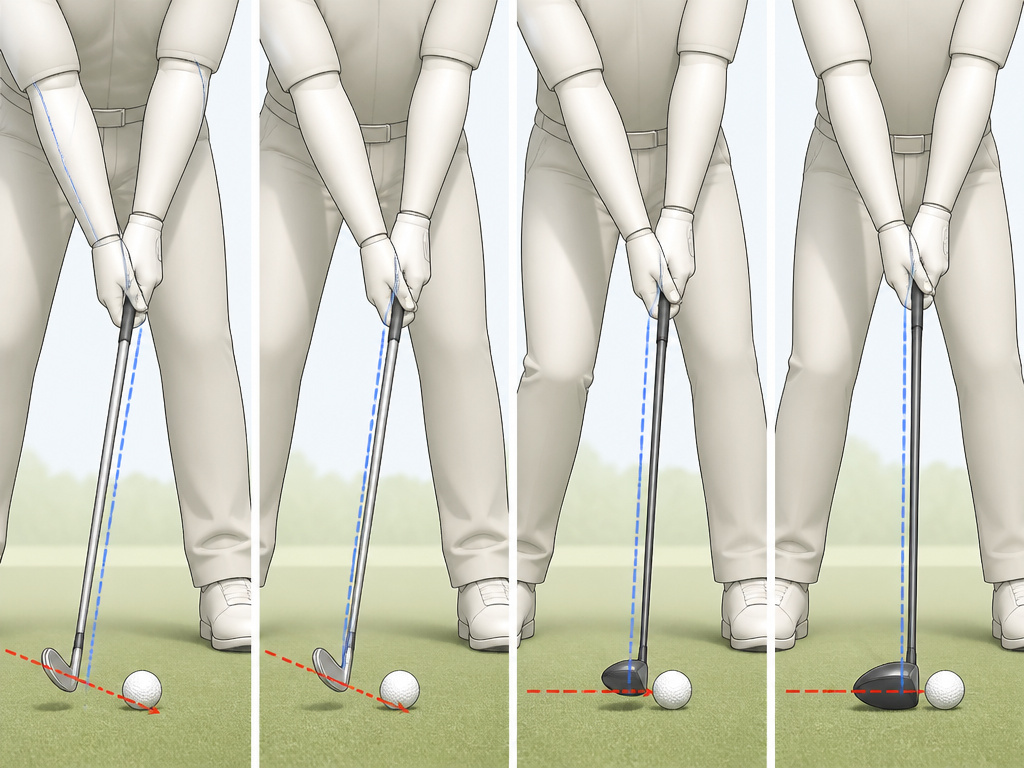
The correct position isn’t a one-size-fits-all pose. It scales with the length and purpose of the club. That same biomechanics study provides the specifics.
| Club | Key Impact Adjustment | Why It Matters |
|---|---|---|
| Short Iron (e.g., PW) | Greatest forward trunk side lean (up to 16°), steepest angle of attack. | Maximizes descent for spin and control. Steeper lean helps hit down sharply. |
| Mid-Iron (e.g., 7-iron) | Moderate side lean, forward shaft lean of ~4°. | The model for compressing the ball. Balanced descent for distance and accuracy. |
| Long Iron / Hybrid | Less side lean, more erect trunk. Right leg flexes more (up to 11°). | Shallower attack angle sweeps the ball. More leg flex maintains balance for longer lever. |
| Driver | Trunk most erect, minimal forward shaft lean, upward angle of attack. | Hands are even with or slightly behind the ball to launch it high with low spin. |
The driver is the clear outlier. With the ball teed up and forward in your stance, you want an ascending blow. Your weight is still forward, and your hips are still open, but your hands are not ahead. Trying to create forward shaft lean with a driver is a recipe for low, spinning bullets.
The Real Source of Power and Speed
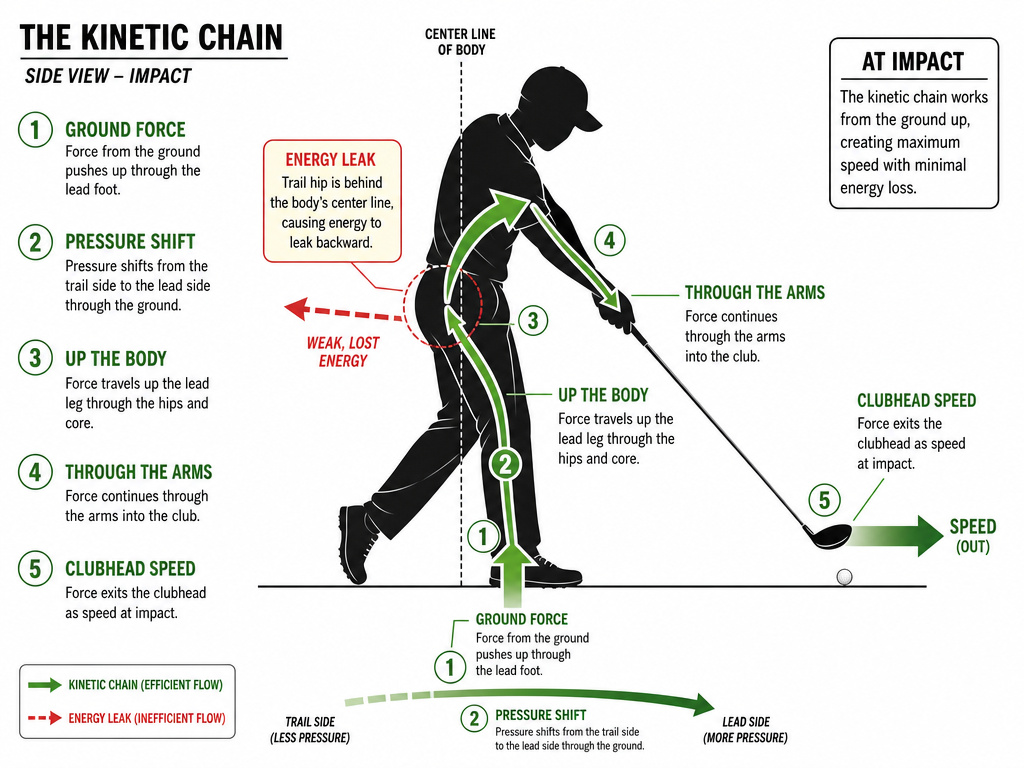
It’s not just about looking a certain way. The position exists to efficiently transfer energy. A 2026 study in Frontiers in Sports and Active Living pinpointed the mechanism.
The research found that clubhead speed isn’t directly about how much force your feet create early on. It’s about impulse-based energy transfer, how efficiently that force travels up your kinetic chain. You can have perfect trunk sequencing but if the energy leaks at your hips or shoulders, the club never accelerates fully.
Where this goes sideways: Chasing a perfect “X-factor” or hip turn without focusing on pressure shift. Your hips can be wide open, but if your weight is still on your trail foot at impact, you have to flip to reach the ball. The strike will be weak and the face will be open.
This is why weight shift is non-negotiable. It’s the foundational move that allows for efficient energy transfer. The Frontiers in Sports study confirms that the efficiency of this transfer, not the pose itself, is what separates speeds.
Common Impact Faults and Their Root Causes
Impact mistakes are usually symptoms of earlier errors. Diagnosing the real cause saves months of frustration.
The Flip or Scoop.
- What you see: The lead wrist cups, the trail wrist straightens through impact. The divot starts at or before the ball.
- The real cause: Weight stuck on the trail foot. Your body can’t get the club to the ball with your hands leading, so your wrists break down to bridge the gap.
- The fix: Drills that force pressure forward early, like the step-through drill.
Hanging Back.
- What you see: Finish position is on the trail foot, chest facing the sky. All weight is on the back foot.
- The real cause: Failure to initiate the downswing with the lower body. The arms outrace the pivot.
- The fix: Feel like your lead hip pulls your arms down. Use the “lift your trail foot” finish check.
Early Extension.
- What you see: The hips thrust toward the ball, the spine angle straightens. Loss of posture.
- The real cause: Often a compensation for poor weight shift or an overly steep downswing. The body moves toward the ball to create room for the arms.
- The fix: Practice swings maintaining your spine angle, feeling your tailbone move away from the target line in the downswing.
Fat and Thin Shots.
- What you see: Inconsistent low point. Chunks or skulls.
- The real cause: Inconsistent ball position and/or a moving head. The low point of your swing is changing.
- The fix: Check your stance and ball position for every club. Use an alignment rod to monitor head movement.
The 15-Minute Impact Practice Routine
You don’t need a two-hour range session. This routine, done consistently, rewires impact.
- Impact Bag (5 minutes): Place a sturdy bag (or a pillowcase filled with towels) where the ball would be. Make slow, controlled swings and thump into the bag, holding your impact position for two seconds. Check for forward shaft lean, open hips, and a flat lead wrist. This builds the neural pathway without ball flight distraction.
- Feet-Together Drill (3 minutes): Hit half-wedge shots with your feet touching. This drill makes flipping or hanging back impossible. It forces you to rotate and balance. If you can hit solid shots here, your weight shift is working.
- Knuckles-Down Feel (3 minutes): Without a ball, rehearse the impact position. Focus on the feeling of your lead hand knuckles pointing down toward the ground, not up at the sky. This promotes the bowed wrist position.
- Verification Shots (4 minutes): Hit 10 real balls with a short iron. Don’t worry about target. Focus solely on the sensation from the drill that felt best. Then, check your divots. They should start after the ball and point slightly left of your target (for a righty).
Use this routine as a warm-up or a reset when your strike feels off. The impact bag is the most effective tool for creating lasting change.
Frequently Asked Questions
What is the most important part of the impact position?
Forward shaft lean is the single biggest differentiator. It directly enables a descending strike, ball-first contact, and compression. If you only work on one thing, make it getting your hands ahead of the ball at impact.
How do I know if I’m compressing the ball?
You’ll hear a distinctive “click” or “snap” at impact, not a dull “thud.” The ball will have a penetrating, not ballooning, flight. Your divot will start after the ball’s position. Using impact tape on your clubface will also show a consistent, centered pattern.
Why do I sometimes get it right but can’t repeat it?
Inconsistency usually traces back to your setup and takeaway. A poor grip or unstable posture makes repeating a dynamic impact position a lottery. Before tweaking your swing, film your setup and compare it to a reliable model.
Can a launch monitor really help?
Absolutely. A monitor like the Garmin R10 provides objective data. For a 7-iron, look for an attack angle of -4 to -5 degrees (descending), a smash factor around 1.35 (solid contact), and a consistent spin rate. It turns “feel” into real feedback.
Is the impact position different for a fade vs. A draw?
The body positions are largely the same. The difference is in the clubface angle relative to the swing path. For a draw, the face is slightly closed to the path; for a fade, it’s slightly open. Trying to change your shot shape by altering your hip rotation or weight shift will break the entire mechanism.
The Bottom Line
Stop trying to look like your setup at impact. You’re built to rotate, shift, and deliver force dynamically. The correct golf impact position is the destination your entire swing is designed to reach.
Focus on the sequence: shift weight, rotate hips, deliver hands ahead, hold the wrist angle. Train it with an impact bag, verify it with your divots, and trust that the ball flight will follow. Compression isn’t a mystery, it’s a mechanical outcome of getting these four things right. Now you know what they are.
