
Master Weight Distribution at Address With the 60/40 Rule
This post contains affiliate links. As an Amazon Associate, we earn from qualifying purchases.
This post contains affiliate links. As an Amazon Associate, we earn from qualifying purchases.
Proper weight distribution at address sets your swing’s foundation by loading your lead side. For irons, favor your front foot 60/40. For the driver, shift to 55/45 or 50/50. This pre-load engages your lower body, prevents swaying, and primes the ground for a powerful coil. Get it wrong, and you’re fighting your own mechanics before you even take the club back.
That front-foot bias isn’t just about balance. It’s the trigger for your entire kinetic sequence. When you set up with more weight on your lead side, you create tension in your trail leg and glute. This stored energy is what you release in the downswing to generate speed, it’s the difference between swinging with your arms and swinging with your whole body.
What follows: the exact percentages that stop swaying, why your driver is different, three drills to feel the right load, and how a bad setup guarantees a weak slice or a fat shot. By the end, you’ll know how to stand so the swing happens almost by itself.
Key Takeaways
- Start with a 60/40 front-foot bias for irons and a more centered 55/45 or 50/50 for the driver.
- This preset load stops lateral sway and prevents the destructive reverse pivot.
- Proper distribution lets you use the ground, turning your lower body into the engine of your swing.
- Your stance width dictates where your weight can go, wider stances lock you in, narrower ones invite drift.
- Check your finish. If you can’t hold a balanced finish, your weight distribution at address was likely wrong.
Why Weight Distribution is More Than Just Balance
Most golfers think of setup as a static pose. You stand to the ball, maybe bend your knees, and try not to move. That’s wrong. Address is a loaded position. Your weight distribution is the first input in a chain of events that ends with clubhead speed.
Proper weight distribution at address is the pre-tensioning of your body’s spring. A 60/40 front-foot bias for irons creates immediate tension in the trail-side glutes and hamstrings, which is stored elastic energy for the downswing. This setup directly counters the tendency to sway off the ball during the backswing.
When you set up with more weight on your front foot, you accomplish two things mechanically. First, you make it physically harder to slide your hips laterally away from the target in the backswing, the fault known as swaying. Second, you put your lead leg in a position to accept more force as you start your downswing, which is how you efficiently transfer energy up the chain.
If your weight is 50/50 or, worse, favoring your back foot, you have to make a dramatic shift just to get to a powerful position. That shift is often late, leads to inconsistent strike, and robs you of power. Good distribution means the engine is already idling. Bad distribution means you’re trying to start the car while it’s rolling downhill.
The 60/40 Rule for Irons vs. Driver
The blanket “athletic stance” advice is useless. Your weight distribution must change with the club in your hand because the goals of the swing change. You hit down on an iron to compress it. You hit up on a driver to maximize launch. Your setup dictates which is possible.
For your irons and fairway woods, the rule is simple: 60% of your weight on your front foot, 40% on your back foot. This preset forward bias promotes a descending strike. It positions your center of gravity ahead of the ball at impact, which is non-negotiable for ball-first contact. A 50/50 setup makes hitting down a conscious effort; a 60/40 setup makes it the natural outcome.
The driver flips the script. Since you want to hit up on the ball, your center of gravity needs to be behind it at impact. Your address distribution should reflect this. For most players, a 55/45 or even 50/50 split is correct. This more centered or slightly trail-side-biased setup makes it easier to tilt your spine away from the target and create the upward angle of attack.
| Club Type | Target Weight Distribution | Primary Swing Goal | Risk of Wrong Distribution |
|---|---|---|---|
| Irons / Wedges | 60% Front / 40% Back | Descending Strike, Compression | Thin or fat shots, loss of distance |
| Fairway Woods | 60% Front / 40% Back (or 55/45) | Slight Descending to Level Strike | Topping, lack of launch |
| Driver | 50/50 to 55% Back / 45% Front | Upward Strike, Max Launch | Low spin drives, slices, no power |
Where this goes sideways: Using your iron weight distribution with your driver. It locks your upper body over the ball, makes spine tilt impossible, and guarantees a weak slice or a low bullet. The driver is a different swing. Give it a different setup.
This isn’t a tiny adjustment. The feel difference between a 60/40 iron setup and a 50/50 driver setup is dramatic. It should feel like you’re preparing for two different athletic movements, because you are.
How Your Stance Width Controls Your Weight
You can’t talk about weight distribution without talking about stance width. They are directly connected. Your stance width is the platform that either allows or restricts where your weight can go during the swing.
A wider stance provides more stability but restricts mobility. It’s great for preventing excessive lower body movement, but it can also lock your hips and make a full coil difficult. With a wide stance, your weight distribution at address is more critical because you have less ability to shift it dynamically during the swing.
A narrower stance allows for more hip turn and easier weight transfer, but it’s less stable. It can invite too much lateral movement, leading to a sway. If you struggle with swaying, your first check should be your stance width, it might be too narrow for your ability to control your center of gravity.
For a mid-iron:
- Stand with your feet roughly shoulder-width apart.
- This width lets you rotate around a stable center while still allowing your weight to move onto your trail side in the backswing.
For a driver:
- Widen your stance an inch or two beyond shoulder-width.
- The extra width stabilizes your lower body for the rotational speed of the driver swing and supports the more centered weight distribution.
If you find yourself constantly fighting a slide, try this. Take your normal iron stance, then move your trail foot back an inch. This subtly narrows your stance relative to the target line and makes it mechanically easier to load your weight into your trail side correctly, without a lateral slide.
The Direct Link to Swaying and Reverse Pivot
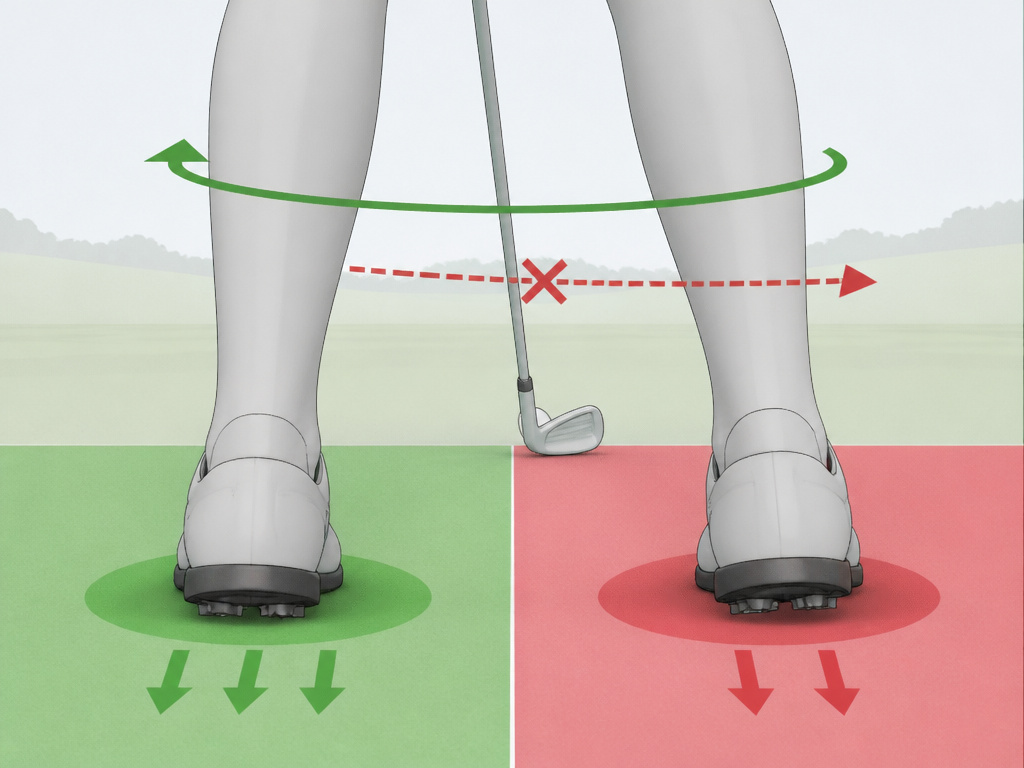
Bad weight distribution doesn’t just cause poor strikes. It creates the two most common power-leaking faults in golf: swaying and the reverse pivot. And they both start before you swing.
Swaying is a lateral shift of your hips away from the target in the backswing. It happens when your weight is too centered or on your heels at address. With no forward bias, your body’s easiest path is to slide laterally. A proper 60/40 setup for irons puts your weight on the balls of your feet and toward your lead side. This makes sliding back feel awkward and unnatural, your body will seek the path of rotation instead.
The reverse pivot is more sinister. In this fault, your weight moves onto your lead side during the backswing and then onto your trail side during the downswing, the complete opposite of correct. It’s almost always caused by an address position where the upper body is leaning toward the target, but the weight is stuck on the back foot. The player then “rotates” around their back foot, never transferring weight forward. The fix starts with establishing a clear front-foot bias and ensuring your spine is tilted away from the target, not toward it.
Common mistake: Trying to keep your head “still” by locking your lower body. This stops any chance of a proper weight shift and forces either a sway (if you move your hips) or a pure arm swing (if you don’t). Your head can move slightly; your weight must move significantly.
If you struggle with a reverse pivot, focus on the start of your swing. As you take the club back, feel your trail hip working behind you, not your whole body sliding. That feeling is only possible if you’ve pre-loaded your lead side at address.
Three Drills to Feel the Correct Load
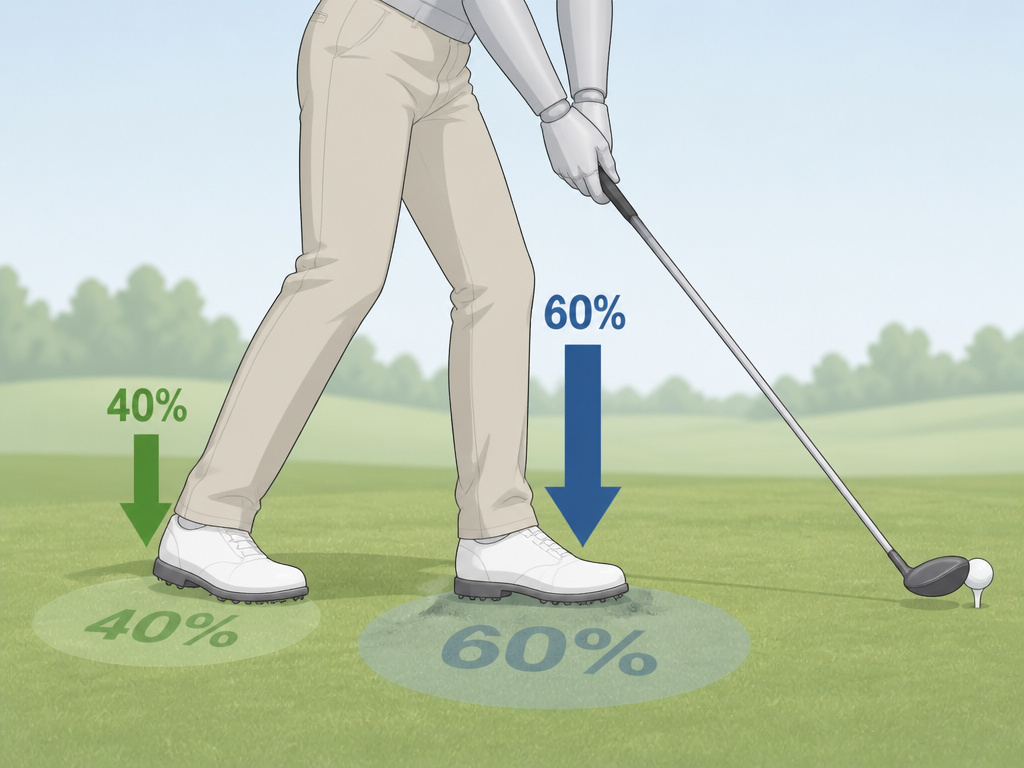
Feeling the correct weight distribution is better than thinking about it. These drills remove the guesswork.
1. The Step Drill:
- Take your setup with your feet together.
- For an iron, step your lead foot into position first, accepting most of your weight.
- Then place your trail foot, feeling the 60/40 split.
- This drill programs the feeling of starting from a loaded position. It’s impossible to do this and set up with your weight on your back foot.
2. The Pressure Mat Check:
- If you have access to a launch monitor with a pressure mat (like a GCQuad or TrackMan), use it.
- Don’t just look at the swing data. Look at the address screen. It will show you your pressure distribution in real numbers.
- The goal isn’t perfection, but awareness. See if you’re at 50/50 when you think you’re at 60/40. The mat doesn’t lie.
3. The Headcover Under the Foot:
- Place a headcover just outside your trail foot.
- Take your normal backswing. If you sway, your trail foot will roll outward and touch the headcover.
- This is instant feedback. A correct coil around your trail leg will keep pressure on the inside of your trail foot, and you’ll never touch the headcover.
Using the Ground: From Setup to Impact
Modern instruction talks about using the ground for power. That process starts at address. Your weight distribution determines how effectively you can push into the ground to create force.
When you preset weight on your lead side, you are essentially “loading” that leg. During the downswing, you push off the ground with your trail foot to initiate movement, then drive into the ground with your lead foot to stabilize and rotate. This is the essence of ground reaction forces. If your weight is back at address, that pushing-off motion has nowhere to go, it just shoves you toward the target, causing a slide, not a rotation.
“You can’t use the ground if you’re not connected to it at address. That 60/40 feel is the connection. It’s the difference between swinging on the ground and swinging into the ground.”
This is why a powerful, stable finish is the best diagnostic tool. If you struggle to hold your finish in balance, trace it back. Your inability to post up on your front leg through impact almost always stems from a failure to get your weight forward early enough, and that failure often starts at address.
Frequently Asked Questions
Should your weight be on your heels or toes at address?
On the balls of your feet. Weight on your heels locks your lower body and promotes a reverse pivot. Weight on your toes makes you unstable. The “balls of your feet” feel allows for ankle mobility and knee flex, which are essential for dynamic movement. You should feel athletic, like you’re about to jump laterally, not like you’re sitting in a chair.
How do I know if my weight distribution is wrong at address?
Your ball flight and strike pattern tell you. Consistent fat shots (especially with irons) often mean your weight is too far back at address and stays there. Consistent thin shots or a slice can mean you’re starting with too much weight forward and then sliding toward the target in the downswing. If you have no idea, film your swing face-on. Draw a vertical line down from your head at address. If your head moves laterally several inches off that line during your backswing, your distribution is wrong.
Does weight distribution change for a wedge shot?
Yes, slightly. For a full wedge shot, use the same 60/40 front bias as an iron. For a partial wedge or chip, you might move to a 70/30 or even 80/20 bias. This extreme forward weight promotes a steep, descending blow and minimizes lower body movement, ensuring clean contact and spin.
Can I overdo the forward weight bias?
Absolutely. If you set up with 80% of your weight on your front foot, you’ll be stuck. You won’t be able to rotate your upper body fully in the backswing because your lower body is already maxed out on its forward tilt. The result is an all-arms swing with no power. The 60/40 rule is a guideline, not an extreme. It should feel loaded, not restrictive.
The Bottom Line
Weight distribution at address isn’t a formality. It’s the first gear in your swing’s transmission. Set up with a 60/40 split for irons, a more centered position for the driver, and you engage the mechanics that create power automatically. You stop fighting sway and reverse pivot before they start. You connect to the ground in a way that lets your lower body drive the swing.
Forget standing still. Start loaded. Your first move away from the ball should feel like a release of tension you created before you even moved. That’s the feeling of a swing built on a solid foundation. Go to the range with only this in mind: set your weight, then swing from the ground up. The strike will surprise you.
