
Golf’s “Death Move”: How to Identify and Fix a Reverse Pivot
This post contains affiliate links. As an Amazon Associate, we earn from qualifying purchases.
This post contains affiliate links. As an Amazon Associate, we earn from qualifying purchases.
A reverse pivot in the golf swing happens when your weight and upper body move toward the target during the backswing, then fall away from it during the downswing. This fault, labeled the “death move” by instructors, inverts the proper kinematic sequence, strips power, causes inconsistent contact, and is the primary biomechanical cause of lower back pain in golfers. Fixing it requires retraining your weight shift, strengthening your trail-side glutes and quads, and maintaining your spine angle from address through the top of your swing.
The move isn’t just about being on the wrong foot. It rewires your entire swing’s geometry. Your body’s center of pressure moves forward when it should load backward, which shifts the swing’s low point behind the ball. From there, fat and thin shots are the only possible outcomes, and your trail leg has no stored energy to release.
What follows is a breakdown of why this fault is so common, how to spot it in your own swing with a simple household item, and the exact drills that rebuild the correct pivot from the ground up. You’ll learn the physical limitations that cause it, the compensations it forces, and how to integrate a stable, powerful turn.
Key Takeaways
- A reverse pivot isn’t just a bad move, it’s a primary cause of lower back injury in golfers because it places excessive compressive loads on the spine’s right side at impact.
- The fault often stems from physical weakness, specifically in the trail-side gluteus maximus and quadriceps, which causes the trail leg to straighten for balance instead of loading.
- You can diagnose it without a coach by filming your swing while wearing a necktie; if the tie drapes over your chest at the top, your upper body is leaning toward the target.
- The “Extend, Turn, and Tilt” drill establishes the correct 30-degree spine extension in the follow-through, which is impossible to achieve from a reverse-pivot position.
- Chasing a high hand position like a tour player without the requisite flexibility is the most common trigger for amateurs, forcing a breakdown in spine angle to achieve the look.
What Does a Reverse Pivot Feel and Look Like?
You will feel your weight stuck on your lead foot during your backswing. Your trail leg straightens, your lead shoulder dips down, and your chest points toward the target. The downswing then feels like a desperate fall backward onto your trail foot just to reach the ball. Contact is consistently weak, high, short shots with irons that either bounce off the turf (fat) or skim the top (thin).
Visually, from a face-on view, the golfer’s upper body leans toward the target at the top of the backswing. The Titleist Performance Institute defines this as a Reverse Spine Angle, noting it makes it “very difficult to start the downswing in the proper sequence.” The swing’s center, which should stay relatively centered, shifts behind the ball.
A Reverse Spine Angle is any excessive upper body backward bend or left lateral upper body bend during the backswing. This swing fault places excessive tension on the lower back due to forced inhibition of the abdominal musculature and places excessive compressive loads on the right side of the spine at impact.
This faulty position dismantles the kinematic sequence, the ordered firing of pelvis, torso, arms, and club. Without the trail side loaded, the pelvis has no stored energy to initiate the downswing. The upper body takes over, leading to an out-of-sync, arms-dominated swing that has no chance of delivering power consistently.
| What You Feel | What You See (Face-On) | The Immediate Result |
|---|---|---|
| Weight on lead foot early | Upper body leans toward target | Loss of balance at the top |
| Trail leg locks straight | Lead shoulder lower than trail shoulder | Inability to start downswing with lower body |
| “Falling back” through impact | Head moves backward toward trail foot | Thin or fat contact, loss of power |
| No coil or stretch in trail side | Minimal hip turn, excessive shoulder turn | High, weak ball flight with all clubs |
Why This Fault Is So Common (The “Double-Headed Demon”)
In 2004, instructor Ernie Boshers told Golfweek that the reverse pivot is “almost 100 percent of average players.” He called it a “double-headed demon.” The first head is the universal desire to hit the ball farther. The second is watching tour players on TV achieve incredibly high hand positions at the top of their backswing.
The average golfer lacks the spinal mobility and hip internal rotation of a tour pro. To mimic that high-hands look and chase distance, they subconsciously reroute the club. The body’s compensation is to change the spine tilt, leaning toward the target to create more room for the arms to go back. This single change moves the entire swing circle, making solid contact a matter of luck.
Common mistake: Trying to copy the high hands of a tour player without the flexibility to support it. This forces a reverse tilt of the spine to make room, which moves the swing’s low point and guarantees inconsistent strikes.
This ties directly to a poor understanding of proper weight transfer. The correct move isn’t just about weight on the trail foot; it’s about pressure and mass moving together to create a stable coil. When you focus only on getting your hands high, you sacrifice that foundation.
The Physical Culprits Behind the Fault
Often, this isn’t a technical misunderstanding. It’s a physical limitation. Your brain is smart, it won’t let you put your weight on a leg that isn’t strong enough to support it. The reverse pivot is frequently a compensation for weakness.
The CardioGolf analysis pins the cause on weakness in the trail leg’s hip and thigh muscles, specifically the gluteus maximus and quadriceps. If these are weak, the golfer cannot physically handle shifting weight onto that trail leg. The knee locks straight to use bone instead of muscle for support, and weight shifts forward to the lead leg to maintain balance. This isn’t a choice; it’s the body’s survival mechanism.
Limited trunk-to-pelvis separation, often from tight lats and reduced spinal mobility, compounds the issue. If your upper body can’t rotate independently from your lower body, it will tilt instead. Combine that with weak glutes, and a lateral sway away from the target becomes the only way to create a turn, forcing the spine into that backward bend.
| Physical Limitation | How It Manifests in the Swing | Quick Self-Test |
|---|---|---|
| Weak trail-side glutes & quads | Trail leg straightens, knee locks; weight shifts forward | Perform a single-leg squat on your trail leg. Inability to control descent indicates weakness. |
| Poor right hip internal rotation (for righties) | Hip doesn’t rotate back; pelvis sways laterally | Sit in a chair, cross trail ankle over lead knee. Gently press down on the trail knee. Pain or severe restriction indicates limited rotation. |
| Tight latissimus dorsi muscles | Limits shoulder turn, forces upper body tilt | Raise arms overhead. If you can’t get your biceps by your ears without arching your back, lats are tight. |
| Weak core (abs & glutes) | Inability to stabilize spine angle during rotation | Hold a plank for 60 seconds. Shaking or sagging in the hips indicates core instability. |
How to Diagnose Your Own Reverse Pivot
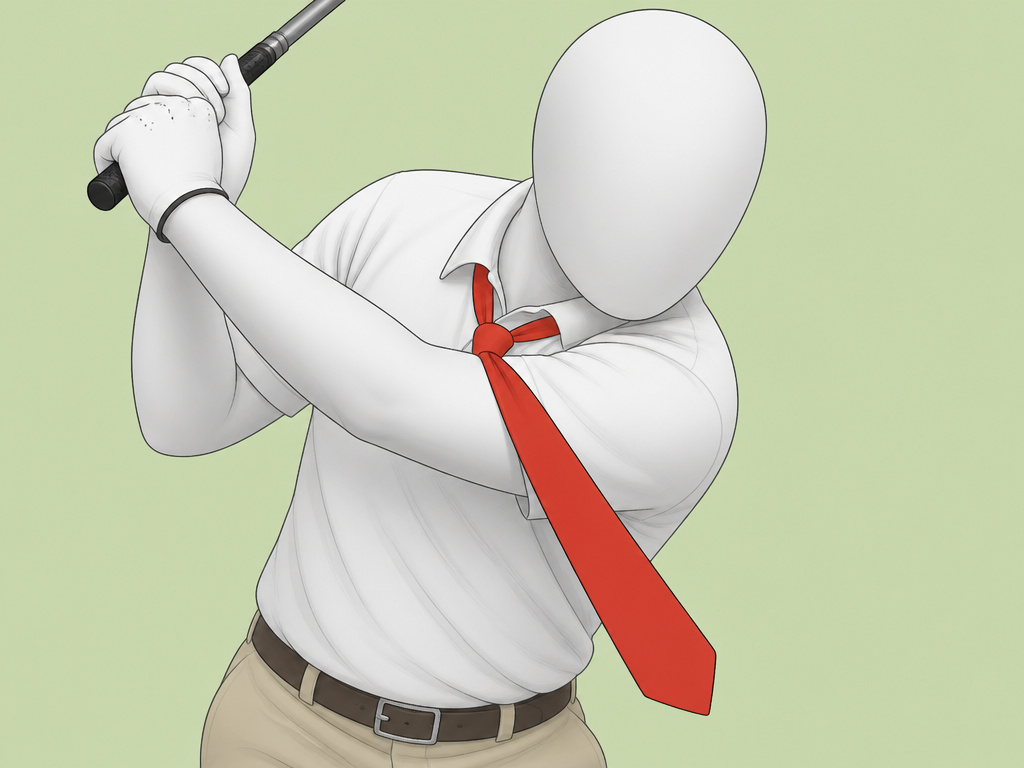 You don’t need a launch monitor. You need a smartphone and a necktie.
The Rotary Swing instruction highlights a brilliantly simple diagnostic: the “necktie drill.” Put on a necktie and film your swing face-on. Make a backswing and pause at the top. Look at the tie. * If it hangs straight down or drapes over your belly, your pelvis has moved away from the target and your spine angle is likely intact. * If it drapes over your chest, your upper body is leaning toward the target, a clear sign of a reverse spine angle.
This visual feedback is immediate and unambiguous. It removes the “feel vs. Real” confusion. Your swing might feel like a big turn, but the necktie shows the truth of your tilt.
Another method is the drop-foot drill. Set up normally, then drop your trail foot back about 18 inches, with only the toe touching the ground. This baseball-pitcher stance makes it geometrically impossible to fall backward on the downswing. Make ten swings here to ingrain the sensation of moving pressure forward through impact, then return to your normal stance and try to replicate it. This directly attacks the compensation pattern.
Step-by-Step Fixes and Drills
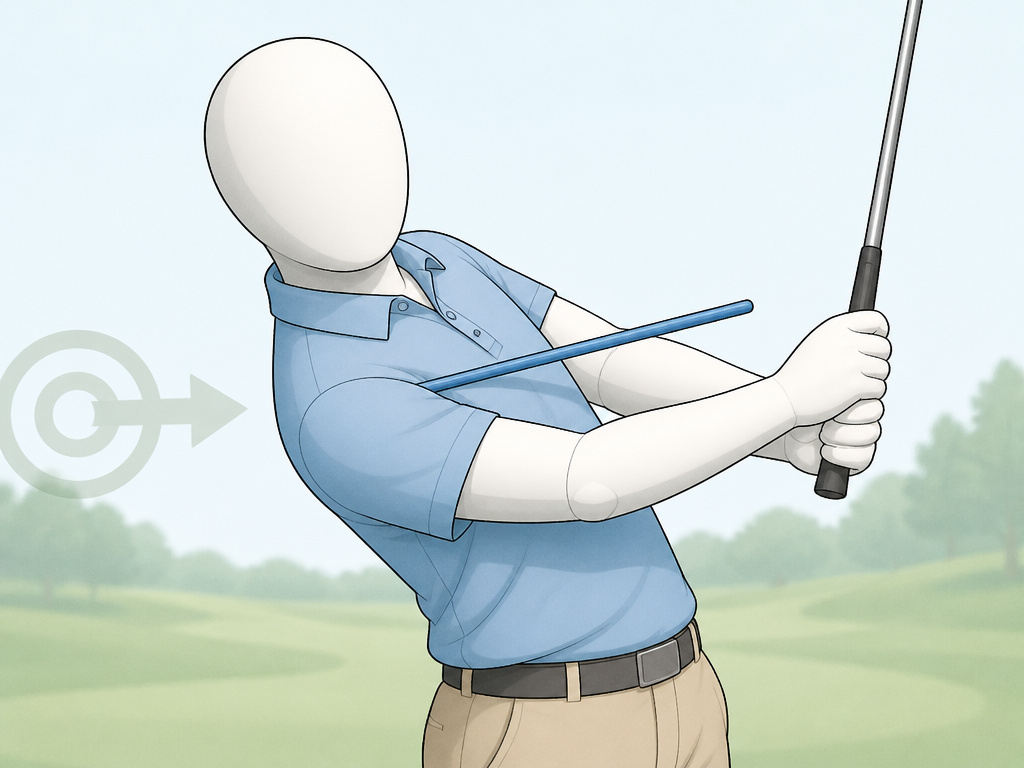 Fixing a reverse pivot is a two-part process: address the physical limitations with targeted exercise, and retrain the motor pattern with specific drills. Do the drills daily, without a ball, to build the new feeling.
1. The Extend, Turn, and Tilt Drill (For Follow-Through)
This drill from Golf Smart Academy builds the correct finish position, which dictates the backswing. * Setup: Stand without a club, as if you were at address. * Extend: From your hips and upper back, not your lower back, lean backward about 30 degrees. Keep your core braced. * Turn: Rotate your chest to face the target. * Tilt: Let your lead shoulder tilt down toward where the ball would be. * Hold this finish. This is the “bracing” position of a powerful, balanced swing. Your body cannot reach this position from a reverse pivot.
2. The Baseball Pitcher Drill (For Backswing Load)
This drill, echoed by instructors like Mel Sole, trains the correct weight shift feel. * Setup: Without a club, mimic a baseball pitcher’s wind-up. * Action: Shift your weight to your trail leg as you raise your lead knee. Feel your trail hip move back and your spine tilt slightly away from the target. * Transfer: Now, with a club and your lead foot down, replicate that sensation. Focus on the trail hip moving backward, loading the glute, and keeping the knee flexed.
3. Strengthen the Weak Links
Incorporate these simple exercises off the course: * Single-Leg Glute Bridges: Lie on your back, trail knee bent, foot flat. Lift your hips, squeezing your trail glute. Hold for 3 seconds. Do 3 sets of 10. * Split Squats: With your trail foot behind you, lower your back knee toward the floor. This builds quad and glute strength in a golf-relevant position. Do 3 sets of 8 per side. * Seated Rotations: Sit tall in a chair, cross your arms. Rotate your shoulders as far as you can without moving your hips. Hold for 20 seconds each side.
Where this goes sideways: Strengthening without re-training the pattern. You must do the drills to teach your nervous system how to use the new strength, or you’ll just create a stronger golfer with the same bad move.
How a Reverse Pivot Wrecks Your Ball Striking
The consequences are mechanical and predictable. When your weight is forward going back, the low point of your swing arc is behind the ball. To make contact, you must either: 1. Hit the ground early (fat shot). 2. Stand up and lift through impact to avoid the ground (thin shot).
Furthermore, you forfeit ground reaction force. Powerful swings generate force equal to 1.5-2 times bodyweight through the lead leg in transition. A reverse-pivot player has their lead leg already extended and loaded backward, it cannot produce this push. The power source is disconnected.
This fault also forces other compensations. The most common is casting, an early release of the wrists, because the body, out of sequence, uses the hands to generate any semblance of speed. It also makes achieving a balanced finish nearly impossible, as you’re falling backward through impact, not rotating through toward a stable, posted-up finish on your lead leg.
Frequently Asked Questions
Can you have a good short game with a reverse pivot?
Maybe, but it’s harder. The reverse pivot disrupts your sense of low point control. Chipping and pitching require precise, downward contact. If your pivot moves your low point unpredictably, you’ll struggle with consistent solid contact even around the greens. Fixing the pivot cleans up strike quality throughout the bag.
Is a reverse pivot the same as swaying?
No, but they are frequent partners. Swaying is excessive lateral movement of the entire body away from the target in the backswing. A reverse pivot can cause a sway as the body tries to create turn by sliding the hips. Conversely, a sway can lead to a reverse pivot as the upper body tilts to compensate for the slide. Both destroy your swing center.
How long does it take to fix a reverse pivot?
It depends on the root cause. If it’s purely a technical misunderstanding, diligent drill work for 2-3 weeks can rewire the pattern. If physical weakness or severe mobility restrictions are the cause, it may take 4-8 weeks of consistent strength work and stretching alongside the drills. The new move will feel short and restricted at first, that’s normal.
Does the Stack and Tilt method cause a reverse pivot?
No. The Stack and Tilt method is often confused with a reverse pivot because it keeps weight forward. The critical difference is spine angle. In Stack and Tilt, the spine tilts away from the target at the top of the backswing (secondary tilt), maintaining the correct angles. In a reverse pivot, the spine tilts toward the target. One is a controlled, athletic coil; the other is a dysfunctional lean.
Will fixing my reverse pivot add distance?
Absolutely, and immediately. Power comes from the stretch-shorten cycle, loading the trail side muscles and then explosively releasing them. A correct pivot creates this elastic energy. By fixing it, you tap into your body’s natural power source, adding clubhead speed without any additional “swing hard” effort. Solid contact from a better low point will also improve your smash factor, making the speed you have more efficient.
The Bottom Line
A reverse pivot isn’t just a bad habit; it’s a systemic breakdown of the golf swing’s foundational mechanics. It robs power, guarantees inconsistent contact, and is the fastest route to lower back pain. The fix starts with an honest diagnosis, use your phone and a necktie. Then, commit to the unsexy work: strengthening your trail-side glutes and quads, and drilling the correct “Extend, Turn, Tilt” sequence until it overwrites the old pattern.
Stop chasing the high-hands look. Focus on building a stable, loaded coil over your trail leg. The distance and consistency you gain will come from a motion that feels shorter, simpler, and far more athletic. Your back will thank you, and your scores will drop.
