
Wrist and Shoulder Injuries in Golf: The Data-Driven Facts
This post contains affiliate links. As an Amazon Associate, we earn from qualifying purchases.
Wrist and shoulder injuries in golf stem from repetitive swing mechanics, overuse, and acute trauma, with amateurs most often hurting elbows and shoulders while pros face a 3.3 times greater lifetime risk for hand and wrist issues. The lead (non-dominant) shoulder and the lead wrist absorb the highest forces at impact, making them primary sites for injuries like rotator cuff tears and ulnar-sided wrist pain.
The difference between an ache that fades and a season-ending injury often comes down to a few specific forces. A swing isn’t just a motion; it’s a kinetic chain loading your joints in a precise sequence thousands of times a year.
What follows is a breakdown of the real numbers, the specific mechanics that cause damage, and the practical adjustments that keep you playing. We’ll move from the broad epidemiology to the exact moment in your swing where things go wrong, and then to the drills and gear that actually change the outcome.
Key Takeaways
- Professional golfers have a 3.33 times greater lifetime risk for hand and wrist injuries compared to amateurs, according to a meta-analysis in the British Journal of Sports Medicine.
- For amateurs, the elbow and shoulder are the most common upper extremity injury sites, often due to overuse from poor mechanics rather than a single event.
- Pain in your lead (non-dominant) shoulder is a documented pattern, with studies showing a higher likelihood of supraspinatus tears correlated with more than 4 hours of weekly practice.
- The rapid “flexor burst” in the wrists just before impact places massive stress on the elbow and wrist tendons, a primary mechanism for both medial and lateral epicondylitis.
- Prevention is less about sheer rest and more about targeted strength, swing modifications (like flattening your swing plane), and equipment tweaks such as larger, softer grips.
The Real Scale of the Problem
How common are these injuries? The numbers are more concrete than most golfers realize. Between 2011 and 2020, U.S. Emergency departments saw an estimated 70,868 golf-related upper extremity injuries. Fractures, sprains, and soft tissue damage led the list.
The risk isn’t distributed evenly. That same U.S. golf injury epidemiology study shows age changes the injury profile. Younger players (under 29) suffer more fractures and wrist injuries. Golfers over 60 face more nerve damage and shoulder issues, often tied to existing degenerative changes. This scare talk is actually the predictable outcome of a rotational sport played across a lifetime.
The starkest divide is between amateurs and professionals. A 2023 systematic review published in the British Journal of Sports Medicine put hard numbers on it. The lifetime injury prevalence for pros is 73.5%, versus 56.6% for amateurs. But the detail that matters: pros have a 3.33 times greater relative risk for hand and wrist injuries specifically. They hit more balls, with more force, more often. Their bodies record the tally.
Common mistake: Treating all golf pain as simple overuse. A sharp pain in your lead wrist after a fat shot is a different mechanism, and requires a different response, than the dull ache in your trailing shoulder from hundreds of practice swings.
How Wrist and Shoulder Injuries Happen
The golf swing is a kinetic chain. Power generates from the ground up, through the hips and core, and transfers out through the shoulders, elbows, and wrists to the clubhead. A weak link or a flawed sequence doesn’t just cost you distance; it overloads a joint not designed to handle that force alone.
For the wrist, the most vulnerable moment is impact. The lead wrist (left wrist for a right-handed golfer) moves from a cocked position into rapid extension and ulnar deviation as it strikes the ball, or the ground. Hitting behind the ball (a “fat” shot) creates a violent deceleration. This is the classic cause of ulnar-sided wrist pain, where the small bones and tendons on the pinky-finger side of the wrist get pinched or torn.
The elbow is a casualty of the wrist’s action. That rapid uncocking just before impact is called the “flexor burst.” It’s a huge spike in muscle activation that places tremendous stress on the tendons anchoring to the medial and lateral epicondyles. Grip the club too tightly, and you amplify this stress exponentially. This is why both “golfer’s elbow” (medial) and “tennis elbow” (lateral) are prevalent, despite the different names.
The shoulder’s vulnerability is about range of motion and stability. At the top of the backswing, your lead shoulder is in extreme horizontal adduction and internal rotation. If your rotator cuff muscles are weak or your thoracic spine is stiff, the humeral head can jam into the front of the joint capsule or the acromion bone. This leads to impingement. In the follow-through, the lead shoulder must control massive forces in external rotation. Lack of strength or flexibility here stresses the rotator cuff’s posterior fibers and can lead to instability.
| Body Part | High-Risk Swing Phase | Common Injury | Typical Cause |
|---|---|---|---|
| Lead Wrist | Impact / Follow-Through | Ulnar-sided pain, TFCC tear | Fat shots, excessive wrist hinge, deceleration force |
| Elbow | Late Downswing / Impact | Medial/Lateral Epicondylitis | “Flexor burst” stress, tight grip, poor ground contact |
| Lead Shoulder | Top of Backswing / Follow-Through | Rotator Cuff Impingement, AC Joint Pain | Limited trunk rotation, weak rotator cuff, overuse |
Amateur vs. Professional Injury Patterns
Your handicap doesn’t just predict your score; it predicts what’s likely to hurt. The PMC upper limb injury review synthesizes the data: amateur injuries cluster in the elbow (24.9%) and shoulder (18.6%). For pros, it’s the back, wrist, and shoulder.
Why the difference? Amateurs typically have less efficient, more variable mechanics. We compensate for a lack of core power with arm strength, overloading the elbows and shoulders. We also hit the ground more often, transmitting shock directly into the wrists and elbows. A pro’s swing is a refined, repeatable engine, but it runs at a much higher RPM. Their injuries are often pure overuse from volume, the repetitive strain of hitting 500 balls a day, year after year.
The volume threshold is critical. Research indicates injury rates climb for amateurs playing more than three rounds per week. For professionals, the link between volume and specific injuries is even clearer. That Korean amateur golfer shoulder pain study found a significant association between practicing more than 4 hours per week and supraspinatus muscle tears. The body has a limit. Exceed it regularly, and tissue breaks down.
I favor straightforward drills players can actually stick with. The student who shows up with elbow pain from hitting 300 range balls every Saturday is usually trying to fix a swing flaw with brute repetition. That’s how you turn a technical problem into a medical one.
The Critical Role of Swing Mechanics
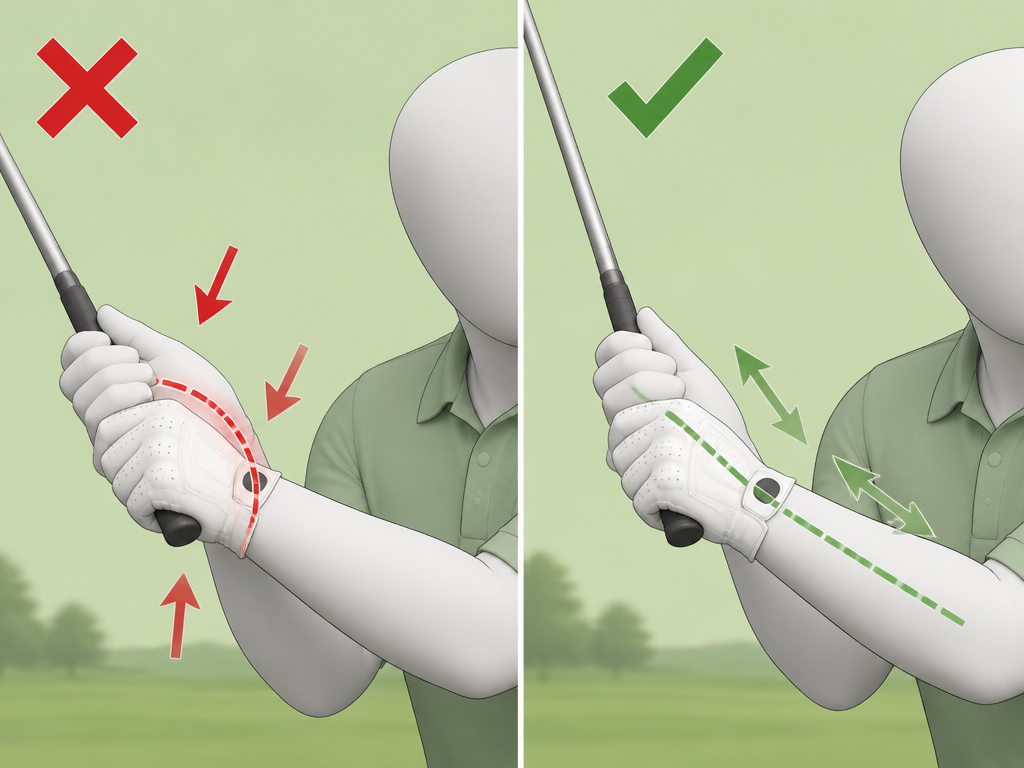
You can’t strengthen your way out of a fundamentally destructive move. Your mechanics are the primary driver of load. Fix the swing, and you often fix the pain.
Let’s start with the wrist. Excessive wrist hinge on the takeaway and a casting motion on the downswing put the wrists in a vulnerable, over-extended position at impact. The fix isn’t stronger wrists; it’s quieter wrists. Focus on a one-piece takeaway where the hands, arms, and shoulders move together. This keeps the wrists in a more neutral, stable position. I abandoned teaching this as a rigid, robotic move after seeing it create tension in golfers with different body types. The goal is connection, not a frozen triangle. Feel the clubhead with your torso turn, not your hands.
For the shoulder, the killer is a disconnect between the shoulder turn and the hip turn. If your shoulders rotate 90 degrees but your hips only turn 45, that extra 45 degrees of torque has to go somewhere, it stretches and stresses the muscles and ligaments around your lead shoulder. You must create separation, but it has to be powered from the ground up, not yanked with your arms.
A stiff, rounded upper back (thoracic spine) is a major contributor to both shoulder and wrist issues. It forces you to achieve your backswing length by over-rotating your lead shoulder or over-hinging your wrists. Improving your thoracic mobility with specific rotations can take 10 degrees of destructive strain off your shoulder joint overnight.
Here is a simple 3-step drill to integrate better mechanics and reduce joint load:
- The No-Hit Takeaway: Set up without a ball. Make your backswing slowly, focusing on turning your chest away from the target while keeping your wrists firm. Stop at the top. Feel the tension in your core and back, not your lead shoulder or wrist. Do this 10 times before every practice session.
- The Impact Bag Drill: Place an old pillow or a purpose-built impact bag in front of you. Swing to impact and stop, pushing the bag with your clubface. This teaches you to deliver force with a forward shaft lean and a flat left wrist, not a flipped or cupped wrist that jams the joints.
- The Wall Slide: Stand with your back against a wall, feet slightly forward. Slowly slide your arms up the wall into a “field goal” position, keeping your lower back and elbows in contact with the wall. This directly combats the internal rotation and scapular dysfunction that leads to shoulder impingement.
Prevention and Practical Management
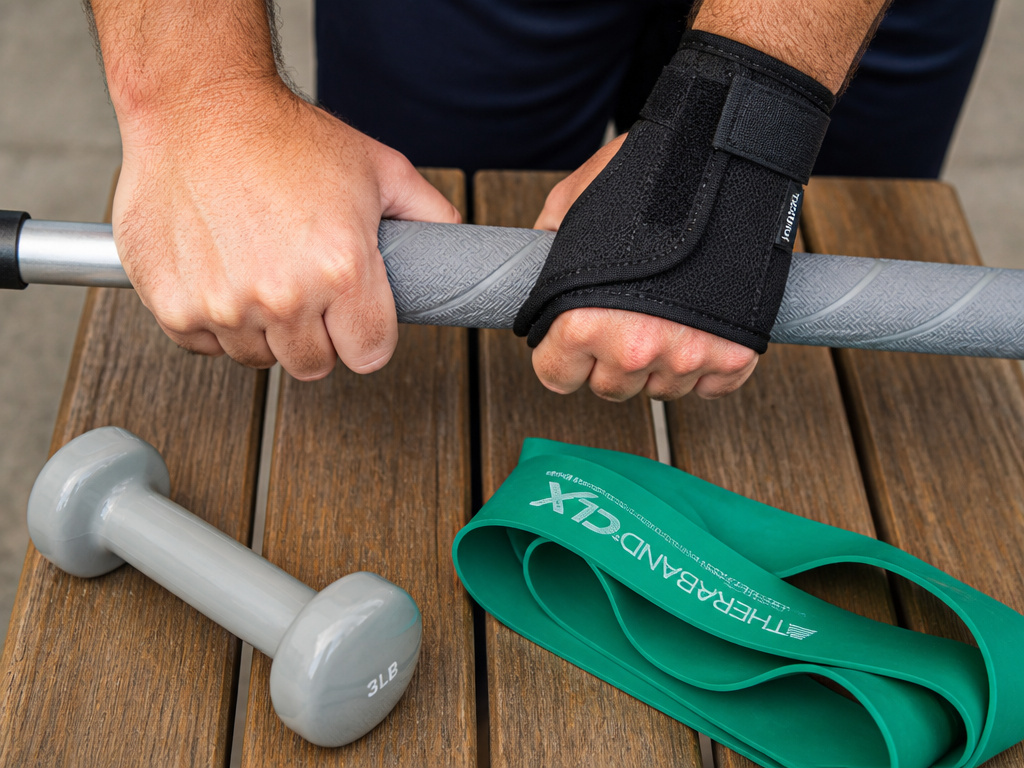
When pain strikes, the answer is often to modify rather than to stop. Smart prevention blends equipment, targeted exercise, and activity management.
Equipment Tweaks That Actually Work:
- Grip Size: Oversized, softer grips reduce the compressive force needed to hold the club. This can directly ease strain on the forearm tendons that cause elbow pain. Don’t just guess, get fitted.
- Shaft Flexibility: A shaft that’s too stiff for your swing speed forces you to over-swing to load it, increasing stress on your wrists and elbows at impact.
- Support Gear: For persistent issues, a wrist support or brace can provide proprioceptive feedback and limit harmful ranges of motion during practice. It’s a training aid, not a permanent crutch.
The Non-Negotiable Warm-Up:
A dynamic warm-up that includes movements like leg swings and torso rotations is the cheapest insurance you can buy. It should involve your whole kinetic chain. – 5 minutes of dynamic movement: Arm circles, torso twists, leg swings. – Club-less swings: Start with half-swings, focusing on smooth connection, building to full speed over 10-15 repetitions. – Never start your session by ripping driver at full speed. Your tissues need a gradual ramp-up in load.
Building Resilience:
Strength isn’t about bulk; it’s about stability and endurance for the specific demands of the golf swing. – For Wrists: Wrist curls and extensions with light weight, and rice bucket exercises for grip strength and fine motor control. – For Shoulders: External rotation exercises with resistance bands, “Y-T-W-L” raises for scapular stability, and prone horizontal abduction to strengthen the posterior cuff. – For the Chain: Core work like dead bugs and planks, and rotational medicine ball throws to teach your body to generate power from the center.
If you’re already injured, the path back is sequential. A study in a clinical sports medicine publication outlined a clear tendon-rehabilitation progression: relative rest, isometric exercises, light concentric/eccentric loading, then sport-specific drills. Trying to “play through” tendinopathy usually makes it worse and extends your downtime by weeks.
Where this goes sideways: Rushing back from a wrist injury by only practicing putting. You lose the strength and mobility for full swings, so when you return, you overcompensate with your shoulders and back, creating a whole new injury cycle.
Frequently Asked Questions
What is the most common wrist injury in golfers?
Ulnar-sided wrist pain, often involving the Triangular Fibrocartilage Complex (TFCC), is the most frequent issue. It’s typically caused by the lead wrist absorbing shock from hitting the ground or from excessive twisting at impact. Pain on the pinky-side of the wrist when gripping or during the follow-through is a telltale sign.
Why does my non-dominant shoulder hurt more?
This is a documented pattern, especially in right-handed golfers with left shoulder pain. Your lead shoulder goes through a greater range of motion under load, particularly in the follow-through phase where it must decelerate the entire swing. Studies also note a higher incidence of supraspinatus tears in the lead shoulder correlated with practice volume.
Can I use a brace or support to prevent injury?
Yes, but strategically. A wrist brace can be excellent during practice sessions to limit extreme ranges of motion that aggravate an existing condition. It’s a tool for managing load, not a magic fix. For the elbow, a counterforce brace may help disperse tendon stress during activity, but evidence on its effectiveness is mixed. The best use is temporary, while you work on the underlying mechanical cause.
How long should I rest a golf injury?
It depends entirely on the diagnosis. A mild muscle strain might need 3-5 days of relative rest with light mobility work. A tendon issue (tendinopathy) often requires 2-6 weeks of modified activity and progressive rehab. The key is “relative rest”, you might stop full swings but continue putting, chipping, and doing your rehabilitation exercises. Always seek a diagnosis that includes a cervical spine assessment; what feels like elbow tendon pain could be a referred issue from your neck.
Do pros get the same injuries as amateurs?
The types overlap, but the prevalence differs. Pros have a significantly higher rate of hand, wrist, and lower back injuries due to sheer volume and force. Amateurs see more elbow and shoulder injuries, often tied to inconsistent ball-striking and compensatory mechanics. Both groups suffer from overuse, but the “how” and “where” reflect their skill level and practice habits.
Before You Go
The data makes one thing clear: wrist and shoulder injuries in golf are the predictable result of specific forces applied to specific joints, often amplified by our own habits. The professional’s 3.33x greater wrist risk and the amateur’s elbow pain share a root cause, mechanics meeting volume.
Your first move shouldn’t be to buy the most expensive wrist support on the market. It should be to audit your own patterns. How many balls are you hitting without a clear purpose? Is your warm-up a few lazy tugs with a driver? Does your lead shoulder feel tight at the top of every backswing?
Good golf should feel less complicated the more you understand it. Start with the body you have. If you’re over 60, acknowledge that your warm-up and recovery need more attention than they did at 30. If you’re a weekend warrior playing 36 holes on Saturday, understand that your injury profile matches the data, and that a stretching routine on Friday night might be the best investment you make.
The goal is to play with knowledge, not in a bubble wrap of fear. Know why it hurts, fix the reason, and build the body that can handle your swing.That’s how you keep the swing on par, season after season.
