
Golf Injury Prevention: The Best Daily Stretching Routines
This post contains affiliate links. As an Amazon Associate, we earn from qualifying purchases.
This post contains affiliate links. As an Amazon Associate, we earn from qualifying purchases.
Effective stretching routines to prevent golf injuries separate preparatory stretching from the active warm-up. A 2023 study of 439 professional golfers found 33.7% reported spine injuries, but a “fair” grade on the shoulder reach test cut lower-back injury risk by 71%. The research-backed sweet spot is a 10-minute routine that pairs dynamic movement with sport-specific motion, not just holding static stretches.
That gap between stretching and warming up is where most weekend players get it wrong. Stretching improves range of motion, but an active warm-up elevates heart rate, increases blood flow to muscles, and preps the nervous system for the explosive rotation of a golf swing. Isolating one without the other leaves you either flexible but cold, or warm but tight.
What follows breaks down the two routines you actually need: a daily flexibility maintenance plan drawn from injury statistics, and the exact 10-minute pre-round sequence proven to boost carry distance and protect your spine. We’ll name the tests that matter, the one hip metric that predicts back pain, and why your driver might thank you for skipping extra practice swings.
Key Takeaways
- A 2023 study of professional golfers showed a “fair” score on the shoulder reach test lowered thoracolumbar spine injury risk by 71%, while “excellent” flexibility showed no extra benefit.
- The research-backed GRIPP intervention for injury prevention is just six exercises totaling a maximum of 10 minutes, emphasizing that duration and consistency beat marathon sessions.
- For immediate performance gain, combine foam rolling and dynamic stretching (FR+DS) on your lead hip; a study found it improved carry distance more than extra swing practice.
- Isolated static stretching before a round can dampen performance; save it for post-round or off-day flexibility work and lead with dynamic, movement-based stretches.
- Limited lead hip internal rotation directly forces more lumbar spine rotation during your swing, a documented mechanism for lower back pain.
The Stretching vs. Warming-Up Distinction Most Golfers Miss
A 2023 cross-sectional study of 439 professional golfers in South Korea found that while improved warm-up routines stabilized scores and maintained driver distance after a back injury, stretching habits alone showed no significant association with performance recovery.
This finding flips the common advice. Flexibility is crucial, but it’s a separate project from your pre-shot routine. Think of flexibility as your hardware, the available range of motion in your joints. Your warm-up is the software boot-up, it prepares that hardware for the specific task.
A complete golf warm-up routine is essential for preventing injury and improving your swing.com/golf-warm-up-routine-before-a-round/) does three things: raises core temperature, dynamically takes joints through their ranges, and rehearses the movement patterns of the swing. Holding a hamstring stretch for 30 seconds does none of these. This is why the PMC spine injury study noted warm-up’s role in preventing performance decline post-injury. The golfers who avoided a drop in driver distance were the ones who extended their warm-up time, not just their stretching.
Your first job is to stop conflating the two. Schedule them separately.
| Goal | Flexibility Routine | Active Warm-Up Routine |
|---|---|---|
| Primary Purpose | Increase long-term range of motion (ROM) | Prepare body for immediate explosive activity |
| Best Time | Post-round, or on non-playing days | 10-15 minutes immediately before play/practice |
| Key Sensation | Gentle tension in muscle belly | Elevated heart rate, light sweat, muscles feeling “ready” |
| Effect on Performance | Can reduce power if done alone pre-round | Improves club speed, smash factor, and movement consistency |
| Injury Prevention Role | Reduces long-term strain risk by improving mobility | Reduces acute injury risk by priming neuromuscular system |
The static stretches you know belong in the left column. The dynamic moves we’ll outline next belong in the right. Mixing them up is how you start cold or lose yards.
The 10-Minute, Research-Backed Pre-Round Routine
What does an adequate warm-up look like? Older data suggested less than 3% of amateurs did one properly. Modern research gives us a clear template: the GRIPP intervention protocol. This is a six-exercise program developed for golfers 45+ with a maximum total duration of 10 minutes. Its existence proves effective preparation doesn’t need to be complex or time-consuming.
The goal is muscle activation and movement rehearsal, not fatigue. Here is a distilled version you can do at the course.
- Torso Rotations (with Club): Hold a club across your shoulders. Gently rotate your upper body back and forth, letting your hips follow naturally. Do 10 rotations each side. Why it works: This directly mimics the rotary loading of your swing, warming up the obliques and thoracic spine.
- Leg Swings (Forward/Side): Hold onto your cart or a post for balance. Swing one leg forward and back 10 times, then side-to-side 10 times. Switch legs. Skip this and your hip turn in the backswing will feel stiff and restricted.
- Arm Circles: Extend arms out to sides. Make 10 small forward circles, then 10 large ones. Repeat backward. This lubricates the shoulder joints, critical for avoiding impingement during the takeaway.
- Cat-Cow Stretch: On all fours, arch your back upward (cat), then dip it down while looking up (cow). Flow through 8 cycles. This mobilizes the entire spine in flexion and extension, prepping it for the combined forces of the swing.
- Walking Lunges with Twist: Take 5 walking lunges. As you lunge, twist your torso toward your front leg. This integrates lower body stability with upper body rotation, the core of the golf swing.
- Gradual Swing Rehearsal: Start with half-speed wedge swings, focusing on smooth tempo. Over 10 swings, gradually increase length and speed to a full driver swing. This is the sport-specific primer. It tells your brain and body “golf swing” is next.
This sequence ticks every box: it’s dynamic, raises your temperature, and is golf-specific. It also fits in the time you’d normally waste pondering which ball to play.
Why Your Hips Are Your Back’s First Defense
The research here is unambiguous. A 2024 randomized crossover study published in the Journal of Strength and Conditioning gave us a powerful tool. It compared a Foam Rolling and Dynamic Stretch (FR+DS) intervention on the lead hip against just practicing golf swings. The FR+DS group saw significantly better “carry” distance and increased lead hip internal rotation (IR) ROM and strength.
Where this goes sideways: Neglecting your lead hip’s internal rotation. When that joint can’t turn inward enough during your backswing, your lower spine twists more to compensate. This extra lumbar rotation is a primary mechanism for chronic lower back pain in golfers.
The body will find the range of motion somewhere. If your hips are locked, your lumbar spine becomes the swivel. You’ll feel this as a sharp pinch or deep ache on your trail side during or after your swing. The fix isn’t just stretching your back, it’s opening up your hips.
The Lead Hip Internal Rotation Test: Sit on the edge of a chair with your knees bent 90 degrees and feet flat. Keep your trail leg still. Rotate your lead leg inward, letting your knee drop toward your other leg. How far does it go? Less than 30 degrees of motion is considered limited and a direct risk factor for back stress.
If you fail that test, the FR+DS protocol is your prescription. Spend 60 seconds foam rolling your lead hip glutes and hamstrings. Then, perform 10 dynamic stretches like figure-four stretches or kneeling hip flexor stretches with a rotation. Do this before your general warm-up. It takes five minutes and changes how your whole swing loads and unloads.
This isn’t just theory. It’s the direct recommendation from the amateur golfer rotation study, which found improving hip IR influences lumbar movement. Your golf fitness work should prioritize this.
Building a Long-Term Flexibility Plan That Actually Works
The pre-round routine handles acute preparation. Your long-term flexibility plan handles chronic prevention. This is where you address the imbalances and restrictions that build up over hundreds of swings. The goal isn’t to become a contortionist; it’s to achieve and maintain the “fair” grade of flexibility the pro study found protective.
Focus on three key areas: the posterior chain (hamstrings, glutes), the thoracic spine (mid-back), and shoulder internal/external rotation. Here’s a simple, off-course routine you can do 3 times a week.
- 90/90 Hip Stretch: Sit on the floor with one leg bent 90 degrees in front, the other bent 90 degrees to the side. Gently lean forward. Hold for 45 seconds per side. This specifically targets hip internal and external rotation capacity.
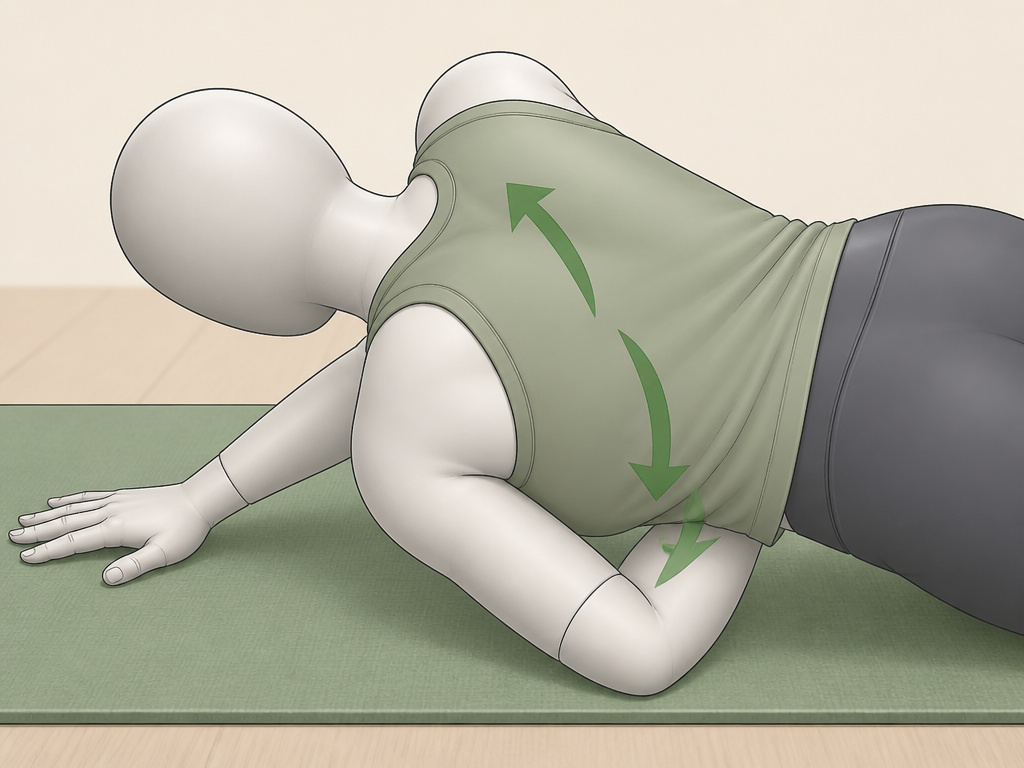
- Thread the Needle: Start on all fours. Slide one arm under the other, lowering your shoulder to the floor. Hold for 30 seconds per side. This improves thoracic spine rotation and shoulder mobility.
- Sleeper Stretch: Lie on your side with your lead shoulder down. Bend your lead arm 90 degrees, then gently push that hand toward the floor with your other hand. Hold a mild stretch for 30 seconds per side. This maintains crucial shoulder internal rotation, preventing rotator cuff strain.
Consistency with these three moves does more than a monthly yoga class. They directly combat the specific tightness caused by the golf posture. For older players, this work is essential; it’s the foundation of joint health for golfers.com/golf-and-joint-health-for-older-players/) who want to play for decades.
The Static+Club Dynamic Stretching (SCS) Performance Boost
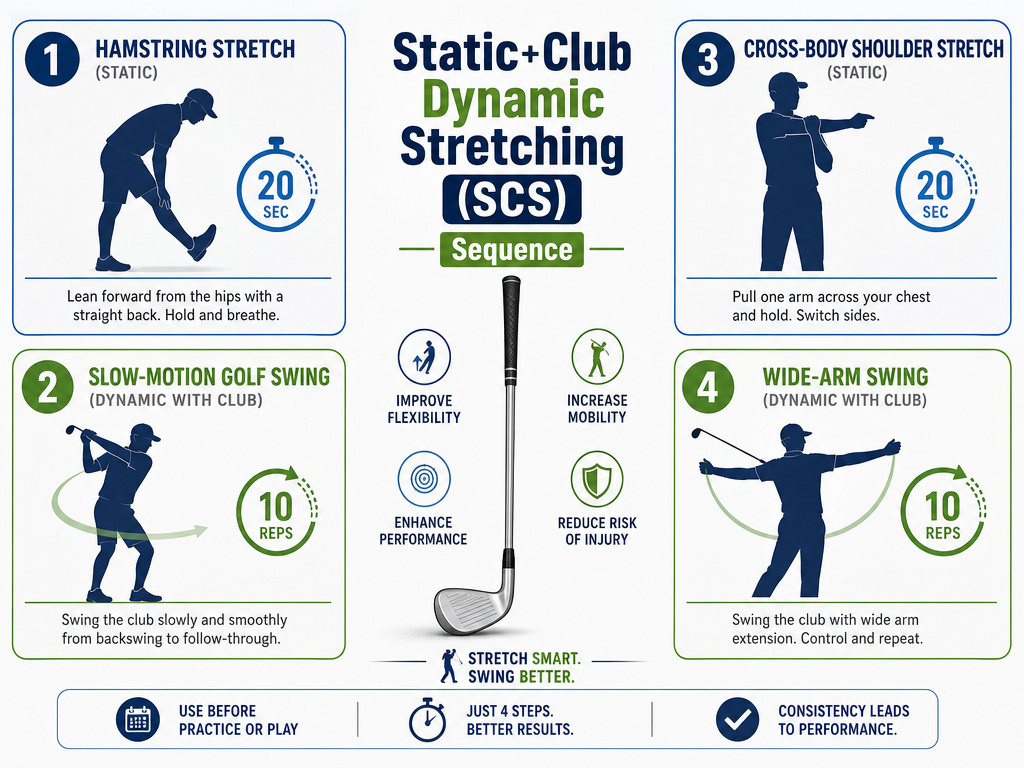
Sometimes, the right routine does both: prevents injury and adds yards. Research on elite high school golfers pinpointed one method. Static+Club Dynamic Stretching (SCS), holding a stretch, then using a club for a dynamic movement, produced the highest levels of trunk flexion, shoulder rotation, club speed, and smash factor.
This high school golfer study is a gem because it measured driver performance, not just feelings. The SCS method beat pure static stretching, pure dynamic work, and band-based routines. It works because it combines the ROM gains of static stretching with the nervous system activation of dynamic movement, all using the tool you’re about to swing.
Try this SCS sequence before your next range session:
- Hold a standard hamstring stretch for 20 seconds.
- Immediately perform 10 controlled, slow-motion golf swings focusing on full turn.
- Hold a cross-body shoulder stretch for 20 seconds.
- Immediately perform 10 swings with a focus on wide arm extension.
The static stretch temporarily increases muscle length. The dynamic swing with a club teaches your body to use that new range under controlled conditions. It’s a potent one-two punch. This is a more advanced tactic than the basic GRIPP warm-up, but for players looking for every edge, it’s validated and effective.
Common Golf Injuries and How Stretching Routines Address Them
A flexibility plan based on the principles of dynamic stretching and proprioceptive neuromuscular facilitation is a targeted defense system. You know the common trouble spots: the lower back, elbows, wrists, and shoulders. Each has a specific mobility deficit that contributes to it.
| Common Injury | Primary Mobility Deficit | Corrective Stretch Focus |
|---|---|---|
| Lower Back Pain | Limited Lead Hip Internal Rotation & Tight Hamstrings | 90/90 Hip Stretch, Standing Hamstring Stretch |
| Golfer’s Elbow (medial) | Tight Wrist Flexors & Poor Shoulder External Rotation | Wrist Flexor Stretch, Sleeper Stretch |
| Rotator Cuff Strain | Lack of Shoulder Internal Rotation & Weak Scapular Control | Sleeper Stretch, Scapular Wall Slides |
| Wrist Tendonitis | Restricted Forearm Pronation/Supination | Wrist Circles, Forearm Extensor Stretch |
For example, the classic fix for lower back pain isn’t just stretching the back. It’s attacking the tight hamstrings that pull on the pelvis and the stiff hips that force lumbar rotation. Similarly, wrist and shoulder pain often stems from a chain of issues starting at the shoulder blade. Your stretching must be as connected as your swing mechanics.
The part nobody mentions: Stretching alone won’t fix an injury caused by a flawed swing. It’s a supportive player, not the star. If you have chronic pain, use these routines to create a more resilient body, but also invest in a lesson from a certified physical therapist to fix the mechanical root cause. A training aid that promotes proper sequencing can be more valuable than another stretching strap.
Frequently Asked Questions
What is the single best stretch to prevent golf injuries?
There isn’t one “best” stretch because injuries stem from different limitations. However, the most globally important area is the lead hip. The 90/90 hip stretch systematically improves both internal and external rotation, which directly protects the lower back and improves swing kinematics. If you only do one off-course stretch, make it this one.
How long before a round should I stretch?
Separate your routines. Do any static stretching (holding a pose for 30+ seconds) at least 60 minutes before you tee off, or ideally after your round. Your immediate pre-round time (10-15 minutes prior) should be dedicated exclusively to the dynamic active warm-up outlined earlier. This prevents the temporary power reduction static stretching can cause.
Can stretching really improve my distance?
Yes, but indirectly and with the right type. The study on Static+Club Dynamic Stretching (SCS) showed it improved club speed and smash factor more than other warm-ups. The mechanism is increased usable range of motion in the torso and shoulders, allowing for a bigger, more powerful turn without strain. It’s not magic, it’s biomechanics.
I’m a senior golfer. Should I stretch differently?
The principles are the same, but the focus intensifies on joint mobility and connective tissue health. Prioritize gentle, consistent movement over aggressive stretching. The GRIPP intervention protocol was designed for golfers 45+. Emphasize exercises that maintain rotation in the hips and thoracic spine. Always warm up thoroughly, older tissues take longer to become pliable. Our guide on the best stretching and strength exercises for senior golfers offers a safe progression.
If I’m tight on time, what’s the absolute minimum warm-up?
If you have only 5 minutes, spend it on dynamic movement, not static stretching. Do 1 minute of torso rotations with a club, 1 minute of leg swings (30 seconds per leg), and 3 minutes of gradual swing rehearsal starting with a short iron and working up to driver. This will do more for injury prevention and performance than rushing through a series of static holds.
Before You Go
The data from the 2023 pro study is the clearest guide: aim for “fair” flexibility, not extreme. A simple shoulder reach test can tell you if you’re in the protective zone. Your daily practice should include the 90/90 stretch for your hips and the sleeper stretch for your shoulders, these two address the most common injury chains.
Before a round, your mantra is “dynamic and specific.” The 10-minute GRIPP-inspired routine is the blueprint. If you want to feel the performance benefit, try the Static+Club Dynamic method on the range. This all changes if you’re currently in pain; then, stretching is just one piece of a puzzle that needs a professional diagnosis. Otherwise, keep it simple, keep it consistent, and let your improved mobility quietly lower your scores and your risk.
