
Short-Game Fix: Mastering Elevated Greens and False Fronts
This post contains affiliate links. As an Amazon Associate, we earn from qualifying purchases.
This post contains affiliate links. As an Amazon Associate, we earn from qualifying purchases.
To play elevated greens and false fronts, you must match two things: the right club for extra carry and a shot type that uses the slope. A false front is a short, steep slope at the front of the green designed to repel poorly struck approach shots. An elevated green sits higher than the surrounding fairway, requiring more club and a higher, softer landing.
The difference isn’t just visual. It’s mechanical. A false front punishes a shot that lands short with a guaranteed roll-back into the collection area. An elevated green punishes a shot that lacks the total distance to carry the entire rise. Misreading which one you’re facing costs at least one stroke, often two.
What follows breaks down the identification, the mandatory club adjustment, and the three shot types that actually hold these surfaces. You’ll learn how to read the slope from the fairway, when to abandon the high shot, and the one practice green drill that translates to the course.
Key Takeaways
- A false front is a defensive slope; always add one extra club and aim for the middle or back of the green to carry it.
- Elevated greens demand a higher, softer shot; a lower-trajectory bump-and-run will rarely hold.
- The sound of a ball landing on an elevated green is a hollow thump; on a false front, it’s a sharp click followed by rolling noise.
- Greens in Regulation (GIR) stats drop on courses with these features unless you plan for the extra carry.
- On fast, firm bentgrass greens, even a perfect shot into a false front can release forward 10-15 feet.
How Elevated Greens and False Fronts Change Your Approach
You don’t hit the same shot to a flat target. The ground itself becomes an active defender.
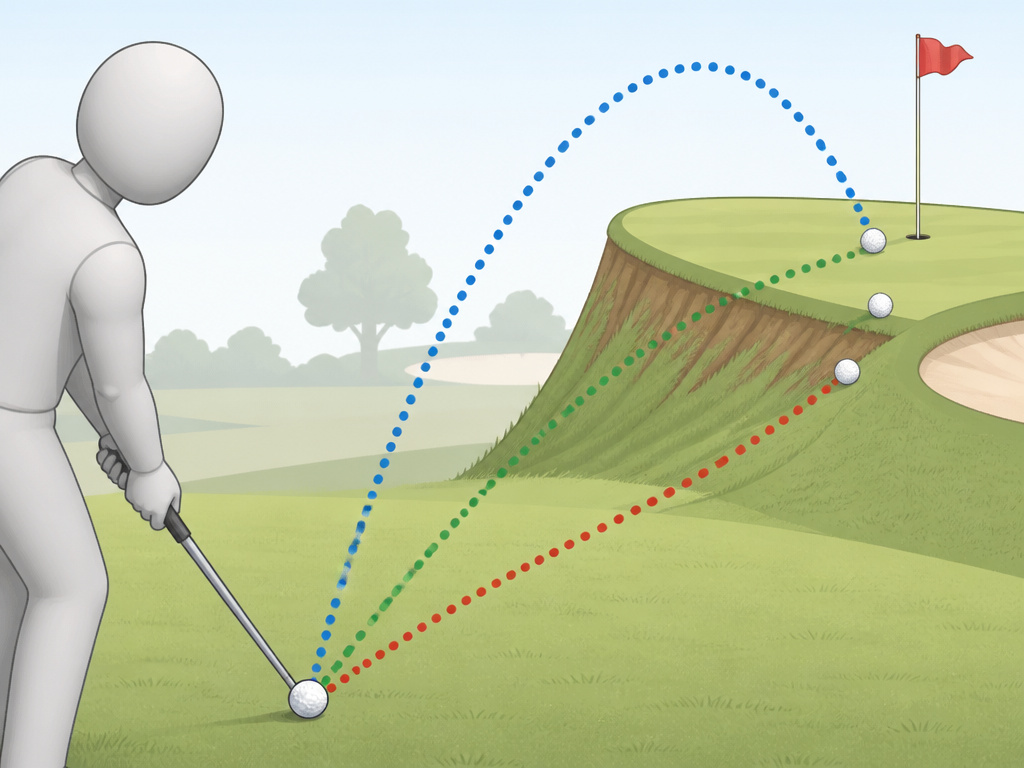
An elevated green is a raised putting surface, often framed by bunkers or slopes. The entire green complex is above your feet. The challenge is geometric: you need enough height and distance to land the ball on the surface, not on the face of the slope. A shot that lands on the upslope loses all its energy and rolls back down. A shot that flies the slope but comes in too low will skip over the green.
A false front is more specific. It’s a steep, often narrow grass slope built into the very front of the green. Its only job is to reject shots. A ball landing on the false front will not hold; it will roll back down into the fairway or a collection area. The putting surface truly begins behind this slope.
Common mistake: Taking the yardage to the pin at face value on a hole with a false front. If the pin is 150 yards away but sits 20 feet behind the false front, your effective target is 165 yards. Playing the 150-yard club leaves your ball in the collection area every time.
The design intent is different. Elevated greens test your ability to hit a high, accurate approach with enough stopping power. False fronts test your discipline and course management—they ask, “Did you commit to carrying the trouble?”
Club Selection and Shot Type: The Two-Step Decision
Your process here is essential. First, choose the club for the carry. Then, choose the shot shape for the hold.
Start with the elevation. As a rule, for every 10 feet of elevation between your ball and the green surface, add one more club. If you’d normally hit a 7-iron 150 yards to a flat green, and the green is 20 feet above you, you’re now hitting a 6-iron or even a strong 5-iron for the same carry distance. The loft gets the ball up; the extra club provides the distance.
Now, match the shot type to the green conditions and your lie.
| Situation | Recommended Shot | Why It Works | Risk If You Get It Wrong |
|---|---|---|---|
| Elevated Green, Good Lie | High, spinning pitch | Maximizes descent angle, stops quickly. | Can come up short if you don’t account for wind or take enough club. |
| False Front, Tight Lie | Bump-and-run with a mid-iron | Uses the slope as a backstop; runs up like a putt. | If the green is too firm or the slope too severe, the ball checks and rolls back down. |
| Windy Day, Any Elevation | Low, penetrating flight | Cuts through wind, uses ground roll. | On super-elevated greens, can land on the upslope and die, leaving a long putt or chip. |
| Pin Back, Green Slopes Back to Front | Standard high approach | Lands soft, uses the green’s own slope to feed the ball toward the hole. | Landing area is smaller; missing left or right leaves a treacherous downhill putt. |
The bump-and-run is the most misunderstood shot here. It’s not a default. It only works if the ground in front of the green is firm, smooth, and the slope leading up is gradual. On a steep false front, a bump-and-run is a wasted stroke. You must fly the ball to the putting surface.
The Right Shot for the Situation
Knowing the theory is one thing. Executing under pressure is another. Your lie dictates your options.
From a clean fairway lie, you have the most control. This is where you can manufacture the high, soft shot. Grip down slightly on a wedge—your sand wedge or lob wedge—and position the ball forward in your stance. Make a three-quarter swing, accelerating through impact. The goal is a towering shot that lands with a thud, not a click. You’re trying to leave a pitch mark.
I abandoned teaching the ‘one-piece takeaway’ as a rigid concept after seeing it create tension in golfers with different body types. The same goes for the ‘high shot’ here. For some, a forward ball position feels unstable. If that’s you, keep the ball centered, but focus on swinging your arms faster while keeping your body quiet. The height comes from clubhead speed, not just setup.
From rough, everything changes. The grass will grab the club and reduce spin. You cannot rely on the ball stopping quickly. Your only reliable play is to take more club—often two clubs more—and play for the center of the green. Forget about firing at pins. The objective is to get the ball on the correct level, even if it means a 40-foot putt.
What about a downhill lie to an elevated green? This is the hardest shot in golf. The slope wants to de-loft your club and send the ball low. You must counteract this by aiming further left (for a right-hander), taking even more club, and trying to swing along the slope’s contour. It feels unnatural. The success rate is low. This is a textbook time to play for the fat part of the green and accept par as a great score.
Reading the Green From 100 Yards Out
Your green reading starts in the fairway. Before you select a club, you must answer two questions: What is the grain doing? Where is the slope?
Look for color changes on the green. A shiny, darker hue indicates the grain is growing toward you, which will slow the ball down. A lighter, ashier color means the grain is growing away from you, and the ball will release forward. On an elevated green, the grain often grows down the slope, away from the approach. That’s one more reason you need a soft landing.
For slope, don’t just look at the green. Look at the surrounding terrain. Water runs downhill. Bunkers are often dug into the low sides. If there’s a lake behind the green, the surface likely slopes from back to front. Your shot into a back-to-front slope needs to land in the middle third; a ball landing on the front will release toward you, while a ball landing too far back might trickle down toward the hole.
This is where understanding local green maintenance pays off. A recently aerated and topdressed green will be much slower and softer. You can be more aggressive, as the ball will stop faster. A firm, closely mown championship green requires absolute precision. There is no margin for error on the landing spot.
Practice Drills for Elevated and False-Front Greens
 Range practice on flat ground doesn’t help here. You need to simulate the challenge.
The Stair Drill: Find a practice green with a slope or a bunker fronting it. Drop three balls at the same spot in the fairway, 50-100 yards out. Your goal is not to hit the same shot three times. Hit one high pitch, one low spinner, and one bump-and-run. See which one finishes closest. Pay attention to the sound and the bounce. The high pitch should thud; the low spinner will hop-stop; the bump-and-run will skid. This teaches feel and feedback.
The Carry-Only Game: On the course, during a casual round, play an approach shot to any elevated green or green with a false front twice. First, play your normal shot. Then, drop another ball and play it with the explicit rule: the ball must land on the putting surface, no exceptions. Compare the results. You’ll quickly see how much extra club you actually need.
Where this goes sideways: Practicing these shots with range balls. Range balls have limited spin and a hard cover. They will not react like your gamer golf ball. Use old game balls or dedicated practice balls that mimic your ball’s performance, especially around the greens.
Finally, work on your wedge distance control. Know exactly how far you hit your 56-degree wedge with a smooth, 50%, 75%, and full swing. This granular control is what lets you take more club for the carry but then dial back the swing to hit a soft, high shot that stops. It’s the difference between flying a 52-degree wedge 100 yards and flying a pitching wedge 100 yards with a three-quarter swing. The latter will have a steeper descent angle and more spin.
Frequently Asked Questions
What’s the biggest mistake amateurs make with false fronts?
The biggest mistake is using the pin yardage. They see 130 yards to the flag, grab the 130-yard club, and hit a shot with a controlled trajectory. But if the flag is 15 feet behind the false front, that decent shot lands on the slope and rolls 20 yards back down. Always get a yardage to the back of the false front, and use that for your club selection.
How does green speed (Stimp) affect shots into elevated greens?
Faster greens amplify the challenge. On a Stimp 12 green, a ball landing on the upslope of an elevated green will not just stop; it may roll back down the entire slope. On a false front, a ball that lands even a foot onto the putting surface might still zip back down if the green is fast and firm. Faster greens demand more height, more spin, and a more conservative target.
Can you putt from the bottom of a false front?
You can, but it’s a low-percentage play. Putting up a steep false front is like putting up a wall. The ball will lose all momentum before it crests the slope and will likely roll back to your feet. It’s almost always better to use a wedge and chip the ball, allowing it to carry the steepest part of the slope and land on the flatter surface above.
Do certain grass types make false fronts more severe?
Absolutely. Bentgrass greens, which are often very firm and tightly mown, make false fronts incredibly punitive. There’s almost no friction to hold a ball. Bermuda grass, with its grainier texture, can sometimes grab a ball slightly better, but the grain often grows down the slope, accelerating the ball’s roll. Knowing the grass type tells you how much the slope will fight you.
What’s a good strategy if I’m between clubs?
When in doubt, take more club. It is far easier to hit a smooth, controlled shot with a longer club than to try to murder a shorter club. Choking down on a 7-iron and making an easy swing is a more repeatable motion than swinging a full 8-iron as hard as you can. The extra club also helps ensure you clear the trouble.
The Bottom Line
Elevated greens and false fronts are not there to be cute. They’re there to turn an approach from 150 yards or less into a bogey if you’re not disciplined. The fix is mechanical: more club, a committed swing, and a target that’s behind the trouble.
Superintendents will often change the mowing pattern at the base of a false front. If you see a distinct line where the grass goes from slightly longer (fairway/fringe) to very short (green), that’s your warning sign. Everything above that line is designed to repel.
So, the next time your yardage book shows an elevation arrow or a tiny “FF” notation, your decision is already made. Take the extra club, visualize the ball landing and stopping, and make the swing that matches. Good golf on these holes is about the shot you choose before the club ever moves.
