
Bentgrass vs Bermuda vs Poa Annua Greens | Turf Comparison
This post contains affiliate links. As an Amazon Associate, we earn from qualifying purchases.
This post contains affiliate links. As an Amazon Associate, we earn from qualifying purchases.
Bentgrass, Bermuda, and Poa annua greens are defined by climate first, then maintenance. Bentgrass (Agrostis stolonifera) thrives in cool, humid regions and provides a uniform, true roll. Ultradwarf Bermudagrass dominates warm-season areas but introduces grain and winter dormancy. Poa annua is a cool-season annual that survives via aggressive seed production, creating a firm but potentially bumpy surface, especially in afternoon heat. Your putting strategy must adapt to the grass’s inherent biology.
The choice isn’t about which grass is “best.” It’s about which grass survives where you are. A superintendent in Oregon isn’t choosing Bermuda; a course in Florida isn’t seeding bentgrass. The real question is how each grass’s physical structure, its leaf blade, growth habit, and stress response, changes the game you play on it. This is agronomy, not opinion.
What follows is a breakdown of the three surfaces by their hard requirements: climate zone, maintenance tolerance, and the specific putting adjustments each one forces. We’ll use data from turf trials, documented failure modes, and the clear performance splits seen on professional tours.
Key Takeaways
- Climate is the ultimate selector. Bentgrass and Poa annua rule cool, humid zones; Bermuda owns the heat. Trying to force one outside its range costs a fortune in water, chemicals, and lost turf.
- Modern bentgrass cultivars like Shark and Piranha are bred to fight. Recent research shows they out-compete Poa annua invasion in fairways by a significant margin, a critical upgrade over older varieties.
- Poa annua’s bumpiness is a timing issue, not a flaw. The surface rolls pure in the morning. Afternoon seedhead growth changes the putt, demanding a firmer stroke to hold the line.
- Bermuda’s grain dictates your read. The direction the grass lies adds a second layer of break on top of slope. Downgrain putts run out; into-the-grain putts die.
- Low-input management is now a breeding goal. Cultivars like Piper and Diplomacy are proving they can maintain quality with less water, fertilizer, and pesticide, changing the calculus for sustainable course management.
The Agronomic Breakdown: Climate, Cost, and Culture
You don’t pick a grass. You pick a climate, and the grass that survives there picks you. The maintenance budget and daily playability are direct consequences of that choice.
Where this goes sideways: Treating Poa annua as a “weed” on a cool-season course. Modern turf science recognizes it as a managed species on many iconic courses. The goal shifts from eradication to stabilization within the putting surface.
Bentgrass: The Cool-Season Standard
Bentgrass (Agrostis stolonifera) is the high-maintenance artist of cool, humid regions. It demands daily mowing below 0.125 inches, precise irrigation, and vigilant disease control. In return, it provides a dense, carpet-like surface with a fine leaf texture that produces a famously true roll. Its weakness is summer heat stress; without ample water and air movement, it thins and succumbs to diseases like dollar spot.
The cultivar revolution matters here. Older varieties like Penncross are coarser and less dense. Modern entries like Shark and Piranha are bred for aggression. A 2023 study in the International Turfgrass Society Journal found these cultivars provided 79–90% bentgrass cover in Poa annua-infested fairways, while Penncross languished at 57–61%. This genetic density is a direct defense against invasion.
Ultradwarf Bermudagrass: The Heat Warrior
Ultradwarf Bermuda (Cynodon dactylon x C. Transvaalensis) is a warm-season grass built for sun and heat. It spreads via rhizomes and stolons, creating a tight, resilient sod. Its superpower is drought tolerance and rapid recovery from traffic. Its curse is winter dormancy. When temperatures drop, it turns brown and stops growing, often leading to weed invasions like Poa annua in the off-season. Courses in the transition zone may overseed it with ryegrass for winter color, creating a unique dual-texture surface.
Management shifts with the seasons. Summer demands frequent vertical mowing to control grain and thatch. Winter requires strategies for weed control in dormant turf, as outlined in the University of Tennessee turfgrass publication on dormant Bermuda care.
Poa Annua: The Resilient Annual
Poa annua (annual bluegrass) is a cool-season grass with a bunker mentality. It’s an annual that survives through prolific seed production, a single plant yields thousands of seeds, and germination kicks off when soil temps drop below 70°F. It tolerates incredibly low mowing and heavy traffic. This is why it’s not just a weed; it’s the dominant putting surface on iconic courses like Pebble Beach.
Its reputation for bumpiness comes from its growth habit. Seed heads can form in spring (and sometimes fall), creating an uneven surface as the day progresses. It also has higher water and nitrogen demands than bentgrass and is susceptible to a long list of diseases, including anthracnose and summer patch. Successfully managing mixed Poa annua greens is a testament to advanced agronomic skill.
| Grass Type | Optimal Climate | Key Strength | Achilles’ Heel | Maintenance Verdict |
|---|---|---|---|---|
| Bentgrass | Cool, humid (Pacific NW, NE US) | Uniform, true roll; fine texture | Summer heat/disease stress | High-input, precision required |
| Bermudagrass | Warm, sunny (Southeastern US, Desert) | Drought tolerance; recovery speed | Winter dormancy & grain | Seasonal management shift |
| Poa Annua | Cool, adaptable (Coastal CA, UK) | Traffic tolerance; low-mow adaptation | Afternoon bumpiness; disease pressure | High water/fertility; vigilant monitoring |
Cultivar Wars: The Data Behind Modern Bentgrass
The label “bentgrass” is too broad. The difference between a 30-year-old cultivar and a modern one is the difference between a porous defense and a fortified wall. This is where non-commodity trial data changes the recommendation.
The 2024 A-LIST (Alliance for Low-Input Sustainable Turf) trials at Ohio State evaluated bentgrasses under reduced water, fertilizer, and pesticide use. The winners, Piper and Diplomacy, maintained acceptable quality with fewer resources. This isn’t just about performance, it’s about economic and environmental sustainability for courses.
National Turfgrass Evaluation Program (NTEP) data reveals more than rankings. It shows failure modes. In one fairway trial, high-density cultivars like Declaration and Proclamation were noted for scalping damage during warm, rainy periods. The very density that creates a superb surface can lead to a “puffy” turf and rapid thatch build-up if not managed with precise aeration and topdressing.
Here’s what to look for in a modern bentgrass cultivar, based on documented research:
- Poa annua competitiveness: Shark, Piranha, 007, Luminary. Their density physically crowds out the invader.
- Low-input performance: Piper, Diplomacy. Proven under the stress of limited resources.
- Disease resistance: Check NTEP ratings for dollar spot and brown patch specific to your region.
- Avoid the legacy defaults: Penncross and Princeville consistently rank lowest in modern trials for density and texture.
Choosing a cultivar is the most impactful decision after choosing the species itself. It directly affects your long-term budget for fungicides, water, and essential green maintenance practices.
Which Grass Type Wins on the PGA Tour?
Tournament scores and strokes-gained statistics cut through the agronomy to show the playing effect. The pattern is unambiguous, as detailed in reports like the PGA Tour putting green analysis.
Bermuda greens produce lower winning scores. Events at Bay Hill (Bermuda) regularly see winning scores between 10 and 18 under par. The Players Championship at TPC Sawgrass, another Bermuda course, has seen winners average nearly 0.75 strokes-gained putting per round. The theory is that Bermuda’s consistent, if grainy, surface allows elite players to make a confident, repetitive stroke and see the ball hold its line.
Poa annua greens protect par. Winning scores at Pebble Beach or Riviera are typically several shots higher. The challenge isn’t the grass itself in the morning, but the evolving surface throughout the day and week. The player who adjusts best to the increasing bumpiness, often by hitting putts more firmly, gains an edge. It rewards adaptability over pure mechanical repetition.
This tour-level data reinforces the core point: you don’t conquer a grass type. You learn its language. A player skilled on the firm, fast poa of the West Coast may struggle initially with the grainier, slower Bermuda of the Southeast, and vice-versa. Understanding the fundamentals of reading greens is universal, but the application is local.
Putting Adjustments for Each Surface

Your stroke doesn’t need to change. Your expectations do. Here’s how to translate the agronomy into a game plan.
On Bentgrass: Trust Your Read.
A well-maintained bentgrass green is the truest test. The ball generally does what the slope dictates. The primary challenge is speed, as these greens can be set up extremely fast. Focus on your line and commit. The surface won’t trick you. This is where confidence in your putting alignment pays the highest dividends.
On Bermudagrass: Read the Grain, Then the Slope.
Grain is the direction the grass blades lie. Look for sheen (downgrain, faster) versus a dark, matte look (into the grain, slower). A cross-grain putt will break more than the slope suggests. Your process: find the hole, read the slope, then check the grain from the low side and adjust. Mastering [grain on greens](https://golfworldtrips.Grain in golf greens affects putting and is an essential skill for playing in the South.
On Poa Annua: Factor in the Clock.
Morning poa is often smooth and true. Afternoon poa, after seed heads have grown, is a different game. The bumpiness isn’t random, but it’s unpredictable on a micro-scale. The adjustment is tactical: take a little less break and hit the putt with enough pace to hold its line through the bumps. Decelerating is death. This is one reason some players prefer a soft feel ball on these surfaces, for better speed control.
| Situation | Bentgrass Adjustment | Bermuda Adjustment | Poa Annua Adjustment |
|---|---|---|---|
| Breaking Putt | Play the pure slope. | Add 10-20% more break for cross-grain. | Play less break, use more pace. |
| Fast Downhill | Extreme caution; ball will roll out. | If downgrain, it’s very fast. | Pace is critical; bumps can kill speed. |
| Slow Uphill | Can be aggressive; surface holds line. | If into grain, hit it. | Hit firmly to overcome friction. |
| 3-Foot Tester | Purely a stroke test. | Check for grain around the cup. | Hit center-cup with conviction. |
The Low-Input Future and the Home Green
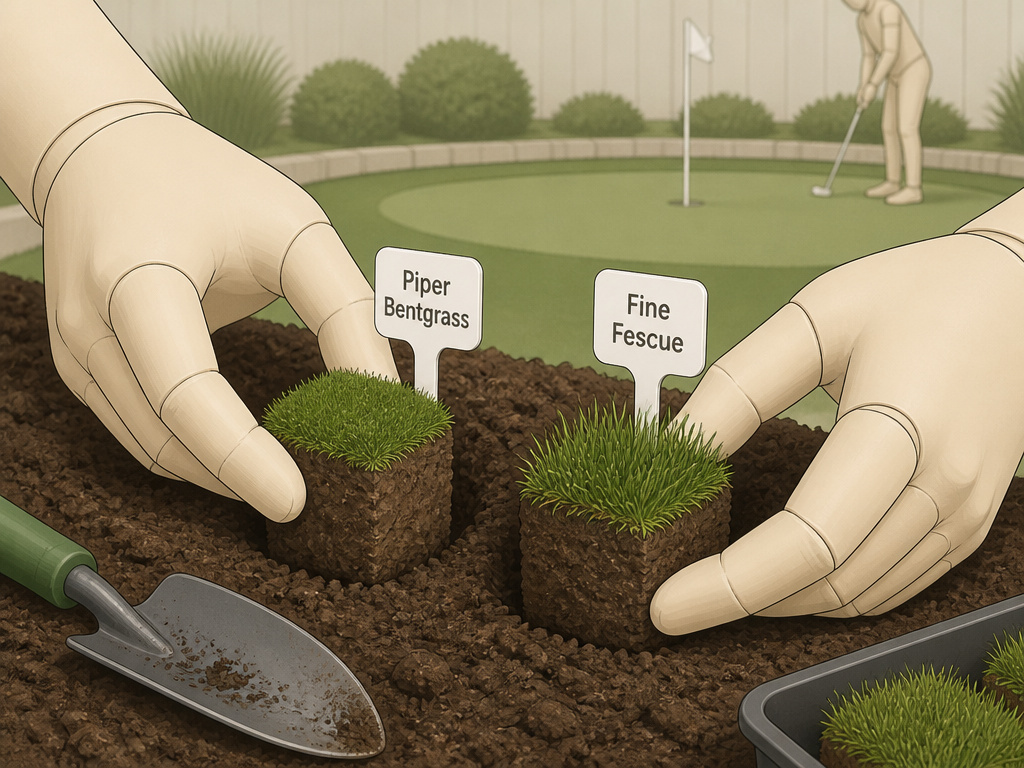
The conversation is shifting from pure performance to sustainable performance. The A-LIST trials are a direct response to this. For a club or a homeowner considering a backyard putting green, the calculus involves more than just climate.
For cool-season home greens, a low-input bentgrass cultivar like Piper or a fine fescue blend might offer acceptable quality with less watering and mowing. In the South, a high-quality synthetic turf often outlasts the struggle to maintain a tiny patch of ultradwarf Bermuda. The principles of good green maintenance, drainage, aeration, vertical mowing, scale down, but the fundamental choice remains: what grass can survive here with the care I can provide?
The USGA cool-season grass selection guide remains the authoritative starting point for superintendents. For the player, the knowledge ends in a simpler place.
Frequently Asked Questions
Can a golf course have both Bermuda and bentgrass greens?
Yes, but it’s rare and logistically challenging. It typically only happens in the “transition zone” (e.g., parts of the Carolinas, Virginia) where both grasses can survive, but not thrive. The course would need two completely different maintenance regimens, equipment, and agronomic plans for each set of greens, effectively doubling the workload and budget.
Why do some pros complain about Poa annua greens?
The complaints are usually about afternoon conditions. As Poa annua produces seed heads, the surface becomes physically uneven. A perfectly struck putt can hop offline over the last few feet. Pros are seeking a predictable outcome for a perfect input; afternoon poa reduces that predictability. They’re not criticizing the grass itself, but the inconsistency it introduces within a single round.
Is bentgrass always better than Poa annua?
No. “Better” is context-dependent. For a tournament seeking the purest, fastest possible surface, a bentgrass like V-8 or Barracuda might be better. For a public course in a cool, coastal climate with heavy traffic, Poa annua’s legendary wear tolerance might make it the more sustainable, playable choice. The USGA mixed turfgrass management resources address this balance.
How does grain on Bermuda greens actually work?
Grain is the direction the grass blades grow, usually toward the setting sun or a water source. It affects putting in two ways: speed and break. A putt rolling with the grain (downgrain) will run out significantly farther. A putt rolling against the grain (into the grain) will slow down dramatically. A putt rolling across the grain will be pulled in the direction the grass is lying, adding to or subtracting from the slope’s break.
What’s the most important thing to know when playing a new type of grass?
Spend your first five minutes on the practice green doing a simple audit. Hit a few medium-length putts up a slope and down a slope. Then, specifically on Bermuda, find a flat putt and hit it from four directions (north, south, east, west) to feel the grain’s effect on speed. On any grass, hit a few chips to see how the ball reacts. This action gathers data on the surface rather than warming up your stroke. Good golf should feel less complicated the more you understand it.
Before You Go
The grass is the field of play, not an opponent. The best players in the world don’t waste energy wishing for a different surface; they decode the one in front of them.
The practical takeaway is this: before you play a course, know its primary grass species. That single fact tells you about the climate, the likely green speed, and the main challenge you’ll face, whether it’s the grain of Bermuda, the afternoon bumps of Poa, or the pure speed of bentgrass. Your putts might not drop, but at least you’ll know why.
I once believed that more technical knowledge always led to better play, until I saw it cause paralysis for several students. The point of understanding bentgrass vs. Bermuda vs. Poa simplifies your read, removing the need for guesswork.You’re adjusting to a known variable. Now go hit the putt.
