
Legacy of Pebble Beach Golf Links | A Historical Deep Dive
This post contains affiliate links. As an Amazon Associate, we earn from qualifying purchases.
Pebble Beach Golf Links officially opened in 1919, but its history is defined by a premature launch in 1918 that forced a year-long closure, and by a relentless evolution of its iconic 18th hole from a short par-4 into a 543-yard par-5 that hugs the Pacific. The course was designed by amateur golfers Jack Neville and Douglas Grant with the explicit goal of placing as many holes as possible along the rugged coastline, a vision that created golf’s most dramatic meeting of land and sea. Its legacy is cemented by hosting six U.S. Opens and the annual AT&T Pebble Beach Pro-Am, challenging the world’s best with its tiny greens and punishing winds.
That 1918 false start is the key to the whole story. The course wasn’t ready, the fairways were rocky, the greens were soggy, and the professionals who played a preview tournament panned it. This immediate failure forced the owners to invest in serious improvements, setting a precedent for continuous refinement that has lasted over a century. You don’t get to host a U.S. Open by accident. You get there by listening to criticism, filling in ravines, moving greens, and battling the ocean for every inch of fairway.
What follows is the timeline of that struggle: the original design’s overlooked flaws, the specific changes that created the masterpiece, and the agronomic realities, like 3,500 square foot greens and 116 bunkers, that make it the ultimate test of precision. This is how a piece of coastal California clay became a national treasure.
Key Takeaways
- The course had a failed, premature opening in April 1918 and was closed for nearly a year for major improvements before its official February 1919 opening.
- The iconic 18th hole was originally a short, “dull” 379-yard par-4; it was transformed into a dramatic 543-yard par-5 in 1922 by architect Herbert Fowler, who moved the green 170 yards down the coast.
- Pebble Beach’s greens are the smallest on the PGA Tour, averaging just 3,500 square feet of pure Poa annua, which makes approach shots a test of extreme precision.
- The course has hosted six U.S. Opens, with legendary moments like Jack Nicklaus’s 1-iron in 1972 and Tiger Woods’s 15-shot victory in 2000 defining its championship legacy.
- Ongoing erosion is a physical threat; the 18th fairway has lost an average of three inches per year to the Pacific Ocean since 1950.
The Premature Opening of 1918
Forget the tidy 1919 date for a moment. The real beginning is messier. In March 1918, the course then called Del Monte No. 2 at Pebble Beach opened for play. It was 6,588 yards from the championship tees. The company held an Open tournament in April. Mike Brady won by 13 strokes. And the reviews from the rest of the field were brutal.
The fairways were rugged and full of rocks. The bunkers had pebbles in them. The greens were so soft and saggy players could hardly putt. One newspaper called the course “a conspiracy to make necessary the purchase of large quantities of golf balls.” The San Francisco Chronicle said the course was opened “somewhat prematurely.” It was a disaster. The course was closed for nearly a year of repairs and turf work before the official, polished reopening on Washington’s Birthday in 1919.
That first failure is the most important lesson in Pebble Beach’s history. Samuel Morse, the Yale graduate managing the property for the railroad, was stung by the criticism. He didn’t double down on the original design. He invited other experts to suggest improvements. This established a pattern: Pebble Beach has never been a museum piece. It’s a living course that has been reshaped by architects like Herbert Fowler, Chandler Egan, and Jack Nicklaus to meet the demands of championship golf. The drive for perfection started with a very public stumble.
Where this goes sideways: Assuming the 1919 opening was the first attempt. The 1918 preview was a critical flop that directly led to the major investments and redesigns that made the course worthy of a national championship.
The 18th Hole’s Dramatic Evolution
Every great course has a signature. At Pebble Beach, it’s the 18th, a 543-yard par-5 that curves along Stillwater Cove. But it didn’t start that way. Neville and Grant’s original 18th was a 379-yard par-4, and the professionals in 1918 declared it “rather dull” and a “woefully poor finishing hole.” The green was where it was because a ravine behind it prevented building farther down the coast.
The transformation began in 1920 when English architect Herbert Fowler was hired. He told Morse he had a location for a new green about 200 yards away that would create a magnificent finishing hole. Morse agreed. Fowler’s team built a bulkhead to fill the old ravine, created a new fairway over it, and built a new green on the other side. By 1922, the hole was a par-5 stretching about 520 yards. The green you see today is essentially Fowler’s creation, moved 170 yards down the coastline from its original spot.
The hole kept evolving. A strip of fairway bunker was added where ocean spray killed the grass. Trees were planted, died, and were replaced. Most critically, the ocean itself has been a constant architect. The superintendent in the 1990s reported the 18th fairway was losing an average of three inches per year to the sea. Since 1950, that’s 13 feet of fairway gone. The hole is a fight against nature, and the battle lines are drawn at the water’s edge.
| Era | Hole Type | Approx. Length | Key Change |
|---|---|---|---|
| 1918 (Original) | Par 4 | 379 yards | Dull, inland green blocked by a ravine. |
| 1922 (Fowler) | Par 5 | ~520 yards | Green moved 170 yds down coast; hole becomes dramatic. |
| 1965 | Par 5 | ~543 yards | Trees in fairway; out-of-bounds stakes added for new homes. |
| Present Day | Par 5 | 543 yards | Constant battle with coastal erosion; target for pros and amateurs. |
Design Philosophy: “As Nature Intended It”
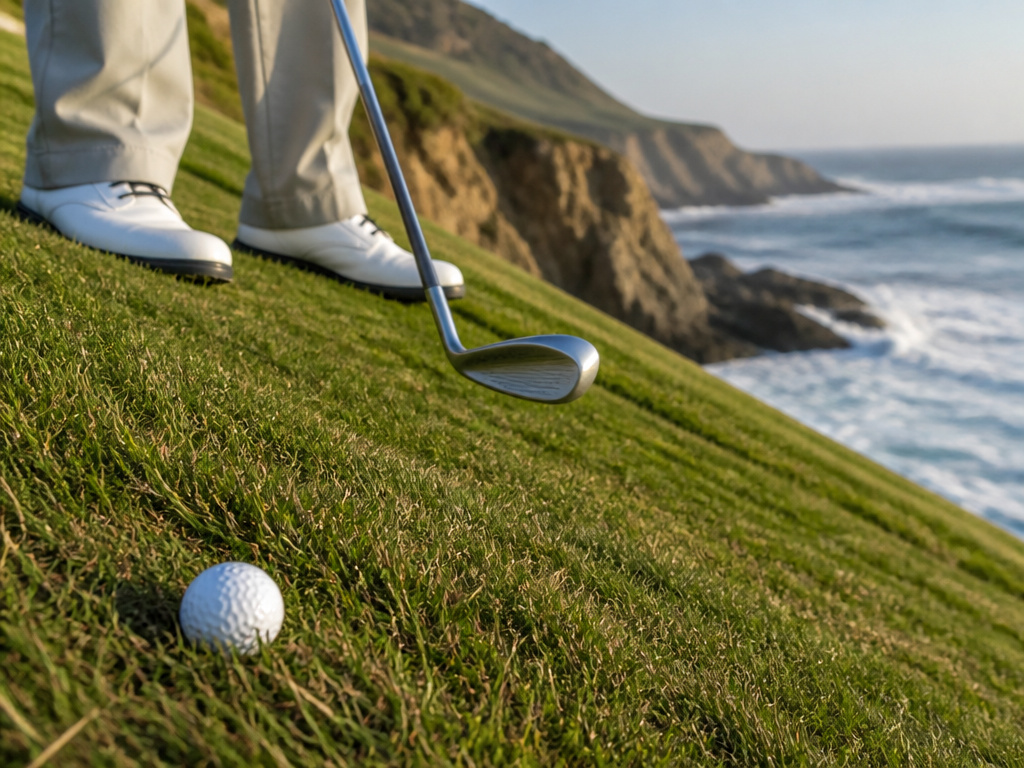 Jack Neville’s design mandate was simple: “get as many holes as possible along the bay.” He said, “Nature had intended it to be nothing else but a golf links.” He and Douglas Grant created a figure-eight routing that delivers ten holes directly along the Pacific coastline. But the early design was conservative. Key greens, like on the par-3 7th and the par-4 8th, were initially set back from the cliffs. The potential was there, but the full drama wasn’t yet harnessed.
The course’s greatness lies in how it uses the land’s natural drama. This isn’t a flat links. The fairways tilt and slope toward the ocean, forcing uncomfortable stances. On the 9th hole, the fairway slopes sharply toward Carmel Beach. For a right-handed player, the ball sits well below your feet on the approach shot, a lie that naturally pushes the ball to the right, which is exactly where the ocean waits. Good golf here requires working the ball against the slope.
The small greens are the final piece of the design puzzle. Averaging just 3,500 square feet, they are the smallest targets on the PGA Tour. When you combine those tiny targets with constant ocean wind and uneven lies, you have a test that favors precision and control over raw power. This is why Pebble Beach, often one of the shortest courses on tour, remains a brutal championship venue. It’s a second-shot course where the approach is everything.
By the Numbers: What Makes the Course a Test
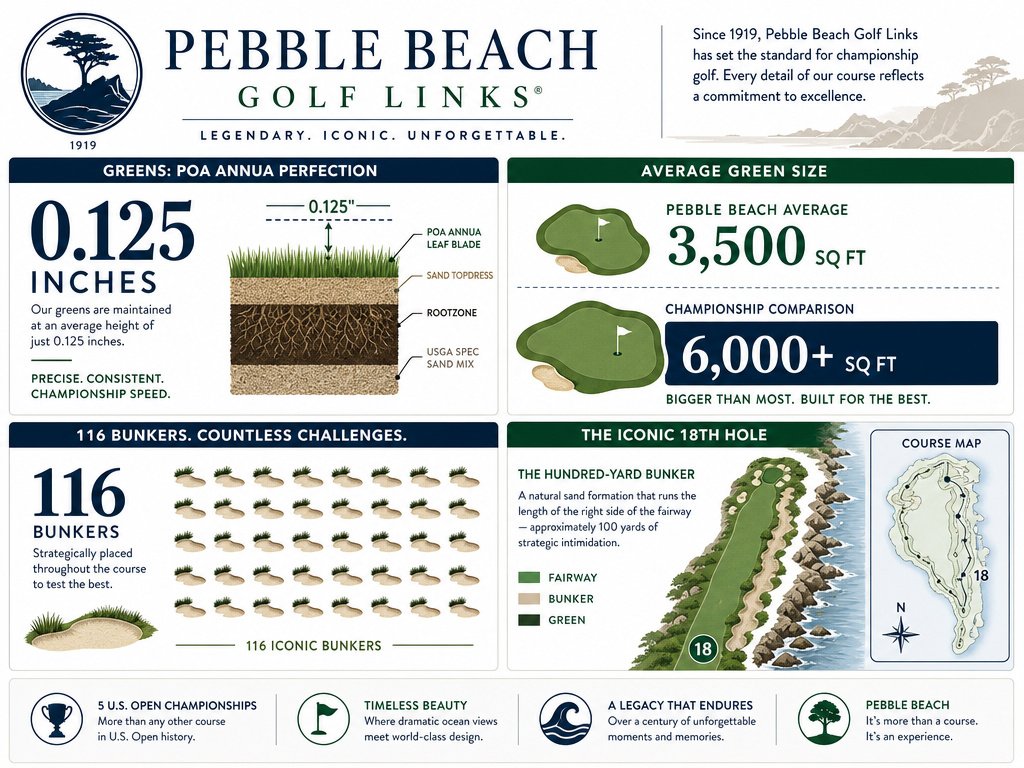 The legacy isn’t just about views. It’s enforced by hard agronomic specs that haven’t changed much in decades. The greens are pure Poa annua, cut to .125 inches. That grass type creates a bumpy, unpredictable surface under foot, especially in the afternoon. The 3,500 square foot average is a real number. Harbour Town’s are about 3,700, and most tour courses are over 6,000. There’s no margin for error.
Then there are the 116 bunkers, the third-most on tour. They aren’t just decoration. The fairway bunker on the right side of the 18th runs for over a hundred yards, catching any drive that strays. The course also features a unique soil challenge. Unlike the sandy soil of a true links course, Pebble sits on clay-based ground. This affects drainage and how the ball reacts on the ground, adding another layer of complexity that pure links golf doesn’t always present.
The maintenance of this stage is a year-round operation. The course hosts roughly 78,000 rounds a year while preparing for professional events. Superintendents like Pete Bachman manage a crew that constantly battles salt spray, wind damage, and the sheer traffic of being one of the world’s most famous golf destinations. Keeping the Poa annua greens alive and playable at tournament speed is an art form in itself.
A Stage for Historic Championships
Pebble Beach’s competitive legacy is unmatched among American public courses. It has hosted six U.S. Opens, with a seventh scheduled for 2027. Each Open has added to the lore. In 1972, Jack Nicklaus sealed his win by hitting a 1-iron on the 17th that struck the flagstick. A decade later, Tom Watson chipped in from the rough on that same 17th to beat Nicklaus. In 1992, Tom Kite won in brutal, windy conditions.
Then came 2000. Tiger Woods’s 15-shot victory at 12-under-par remains the largest margin in major championship history. He dominated a course that barely yielded a red number to anyone else. These moments are possible because the course design creates clear, dramatic decisions. The 18th hole, for instance, offers a classic risk-reward choice on the second shot: play safe left or challenge the corner of the ocean to set up an eagle putt. This kind of design produces memorable finishes, which is why the USGA keeps coming back.
The annual AT&T Pebble Beach Pro-Am, dating back to Bing Crosby’s “Clam Bake” in 1947, adds a different layer of legacy. It’s a tournament where celebrities and professionals play alongside each other, embedding the course in popular culture. Winners of this event include legends like Arnold Palmer, Jack Nicklaus, and Phil Mickelson. This dual identity, brutal U.S. Open venue and celebratory pro-am host, is unique in golf.
I learned through poor results that if you can’t execute a shot calmly on the range, you definitely shouldn’t try it on the course. Watching amateurs in the Pro-Am try heroic carries over the 18th cove that they have no business attempting is a yearly reminder of that lesson. The course tempts you into a mistake as surely as it rewards a perfect strike.
The Legacy and Constant Evolution
Pebble Beach’s story isn’t finished. The U.S. Open is booked here through 2044. The course will continue to be lengthened and tweaked, as it was under Arnold Palmer’s guidance for the 2010 Open. New holes, like the Jack Nicklaus-redesigned 5th, have been inserted to keep the challenge relevant for modern players. The ongoing erosion on the coastline will demand engineering solutions, just as Fowler’s bulkhead did a century ago.
Its legacy is twofold. First, it stands as the ultimate American links style achievement, a course that used a breathtaking piece of land exactly as nature intended. Second, it represents the idea that a golf course is never truly done. From that rocky 1918 opening to today’s pristine condition, it has been a project of continuous improvement. This willingness to change, documented in resources like the Golf Historical Society centennial article, is what has preserved its place among the world’s best clubs.
For the average golfer, the legacy is more personal. It’s the dream round. It’s the recognition of every hole from television. It’s the understanding that golf, at its highest level, is played on a canvas where strategy, skill, and environment collide. Pebble Beach is more than a course; it’s a benchmark in the history of golf.
Frequently Asked Questions
When did Pebble Beach Golf Links actually open?
The course had a “preview” opening in March 1918 that was widely panned. After nearly a year of closures and improvements, it held its official grand opening on February 22, 1919. The 1918 failure is a critical part of its origin story, forcing the upgrades that made it championship quality.
Who designed Pebble Beach Golf Links?
The original design was by two amateur golfers, Jack Neville and Douglas Grant, in 1919. However, the course has been significantly modified by other architects, most notably Herbert Fowler in 1922 (who completely changed the 18th hole) and Jack Nicklaus (who redesigned the 5th hole in 1998).
How many U.S. Opens has Pebble Beach hosted?
Pebble Beach Golf Links has hosted six U.S. Open championships (1972, 1982, 1992, 2000, 2010, 2019). It is scheduled to host its seventh in 2027, with future Opens already slated for 2032, 2037, and 2044. It is the only course to host the U.S. Open in back-to-back years more than once.
Why are the greens at Pebble Beach so famous?
The greens are famous for being the smallest on the PGA Tour, averaging just 3,500 square feet. They are also pure Poa annua grass, which can become bumpy and unpredictable, especially later in the day. This combination makes hitting and putting the greens a supreme test of precision.
What is the most famous hole at Pebble Beach?
The par-5 18th hole is the most iconic, but the most famous stretch is holes 6 through 10 along the Pacific cliffs. The par-3 7th and the par-4 8th (which requires a long carry over a chasm) are particularly celebrated. The 18th’s fame comes from its dramatic evolution and its role as a closing hole in major championships.
The Bottom Line
Pebble Beach’s history is a rejection of the idea that great courses are born perfect. It was flawed, criticized, and closed. That humility led to a century of tinkering, moving greens, fighting erosion, and tightening the screws for each new generation of champions. The legacy is in that relentless pursuit. It’s not a fossil under glass. It’s a living, breathing test that changes just enough to stay relevant, all anchored by ten holes that hang above the Pacific. You can trace the entire evolution of the golf ball and the game’s technology, but the challenge here remains fundamentally the same: control your ball in the wind, hit a tiny target, and don’t let the beauty of the place distract you from the difficulty of the task. That’s the legacy.
