
Exploring the History and Evolution of the Modern Golf Ball
This post contains affiliate links. As an Amazon Associate, we earn from qualifying purchases.
This post contains affiliate links. As an Amazon Associate, we earn from qualifying purchases.
A golf ball’s history spans over 600 years, defined by four core eras: the early wooden/hairy ball, the leather-and-feather “featherie,” the gutta-percha “gutty,” and the modern rubber-core wound or solid ball. Today’s ball is strictly regulated, it cannot exceed 1.620 ounces in weight, must be at least 1.680 inches in diameter, and its flight distance is capped under standardized testing. The shift from natural materials like boiled feathers to synthetics like DuPont Surlyn created the durable, high-performance ball we know, culminating in designs like the Titleist Pro V1.
That weight and diameter limit wasn’t settled until 1932, and the distance cap came a decade later. Before that, manufacturers raced to build a ball that flew farther, which repeatedly made courses obsolete and forced the game’s rulers to step in.
This guide walks through the four major material shifts, the regulatory battles that standardized the ball, and the specific inventions, from William Taylor’s dimple mold to the Ram Golden Ram‘s Surlyn cover, that created the modern game. By the end, you’ll see why today’s ball is a product of engineering and rule-making, not just tradition.
Key Takeaways
- The modern ball’s 1.620-ounce weight and 1.680-inch diameter were finalized in 1932, but a failed “balloon ball” experiment in 1931 proved lighter wasn’t better.
- DuPont’s Surlyn resin, first used in the 1968 Ram Golden Ram ball, replaced brittle balatá sap and created the durable, cut-proof cover that enabled two-piece distance balls like the Top-Flite.
- For decades, a smaller “British” ball (under 1.68 inches) was legal in R&A events, offering a distance advantage in wind until it was banned in 1990, unifying global standards.
- Liquid cores in early rubber balls sometimes contained caustic alkali, posing a real injury risk to curious children who cut them open well into the 20th century.
- The current distance rollback for elite players, starting in 2028, is just the latest chapter in a 100-year fight to control how far technology lets the ball fly.
From Wooden Spheres to the Featherie
Golf likely began with a shepherd hitting a stone, but the first manufactured balls were hardwoods like beech or box. Evidence for their use in Scotland is thin. It’s more probable the game used the “hairy” ball, a leather pouch stuffed with cow hair, imported from the Netherlands as early as 1486.
The “featherie” represented the first major technological leap. Craftsmen stuffed a boiled hatful of goose feathers into a wet leather pouch, then stitched it shut. As the leather dried and shrank, the feathers expanded, creating a remarkably hard, spherical ball.
A single featherie could take a maker hours to produce, limiting output to a handful per day and making each one expensive. Losing a ball was a serious financial hit.
This cost made golf a pastime for the wealthy. The balls had a short lifespan, too. They softened in wet conditions and were easily damaged by the thin-faced “long nose” clubs of the era. A well-struck drive might carry 150-175 yards, with a record 361-yard shot recorded at St Andrews. The featherie’s era ended not because something better was invented, but because something cheaper and more consistent was discovered by accident.
The Gutta-Percha Revolution
In the 1840s, a Scottish divinity student named Robert Paterson received a statue packed in gutta-percha, a rubber-like sap from the Malaysian sapodilla tree. He boiled the material, molded it into a sphere, and painted it white. The “gutty” ball was born.
It was a revelation. Gutta-percha was cheap, durable, and could be mass-produced by heating and molding. Willie Dunn of Musselburgh created a metal mold for the process in 1871, driving the cost down to about one shilling, a fraction of a featherie’s price. This drop in cost is what truly opened golf to the masses.
The first gutties were smooth, but players soon noticed that scuffed, nicked balls flew more truly. A St Andrews saddler used his tools to hammer regular patterns into the balls, beginning the deliberate engineering of surface texture. Molds were then created with raised “bramble” or “mesh” patterns.
| Ball Type | Primary Material | Average Drive | Key Limitation |
|---|---|---|---|
| Featherie | Leather & Goose Feathers | 150-175 yards | Extremely expensive, water-sensitive |
| Gutty | Gutta-Percha Sap | 180-200 yards | Become brittle in very cold weather |
The harder gutty ball also forced a change in equipment, leading to shorter, squatter wooden club heads and the broader adoption of iron clubs. The gutty ruled for about 50 years, until another accidental discovery in an American rubber factory.
The Haskell Revolution and the Rise of Regulation
The modern ball was invented out of boredom. In 1898, Coburn Haskell waited for a friend at the B.F. Goodrich plant in Akron, Ohio. He idly wound rubber thread into a ball, bounced it, and watched it rocket toward the ceiling.
Haskell added a solid rubber core and a balatá sap cover, creating the wound rubber “Haskell” ball. It flew dramatically farther than the gutty. Legend Bobby Jones called it the most important development in golf history, though he lamented that it rewarded strength over finesse and forced longer courses.
This arms race for distance is the central tension in golf ball history. Unregulated early Haskell balls were light and large, even floating. After the patent expired in 1915, competition intensified, shrinking balls to about 1.62 ounces and 1.63 inches.
Where this goes sideways: In 1931, the USGA introduced a “balloon ball” limited to 1.55 ounces and 1.68 inches. It proved too light to hold its line in wind or on greens, and was abandoned after a single disastrous year.
The governing bodies had to act. The R&A and USGA’s 1920 joint agreement set the first major standards: a 1.62-ounce maximum weight and a 1.62-inch minimum diameter. The modern 1.68-inch minimum diameter was set in 1932. In 1942, the USGA implemented the first velocity restriction, capping ball speed at 250 feet per second off a standardized machine. The modern regulatory framework was now in place.
The Official Specifications (And Why They Matter)
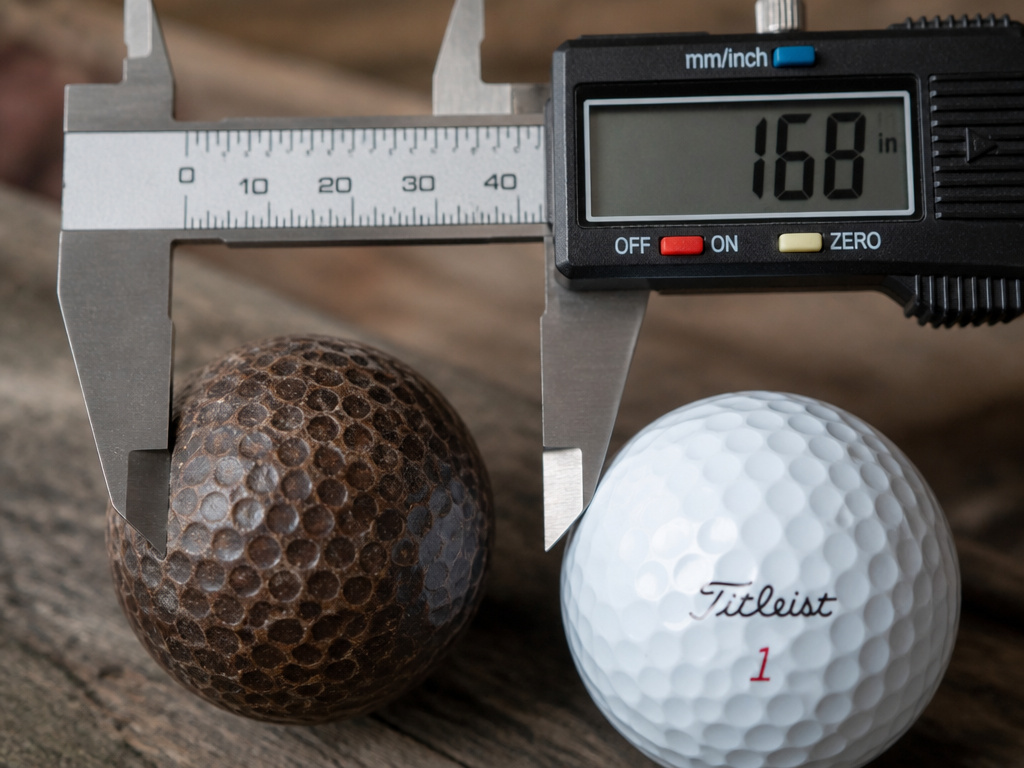 Today’s conforming golf ball is a tightly controlled piece of equipment. The rules exist to preserve skill and prevent technology from overwhelming course design.
The current standards, per the R&A and USGA Rules of Golf, are explicit: * Weight: Maximum 1.620 ounces (45.93 grams). * Size: Minimum diameter of 1.680 inches (42.67 mm). * Symmetry: Must be spherically symmetric. * Distance: Under test conditions (120 mph swing speed, 10° launch), it cannot exceed 317 yards (+3 yard tolerance).
A golf ball’s construction, from its core to its cover, directly influences its feel and performance, which is why understanding golf ball construction is key for any serious player.
These aren’t arbitrary numbers. The 1.68-inch diameter settled a decades-long transatlantic split. Until 1990, the R&A permitted a smaller “British” ball (under 1.68 inches), which had an aerodynamic advantage in wind. Its ban unified the global game. The distance limit is constantly under pressure, leading to the announced 2028 “rollback,” which will test balls at a higher 125 mph swing speed to reduce elite driving distance by 13-15 yards.
The Modern Materials Breakthrough
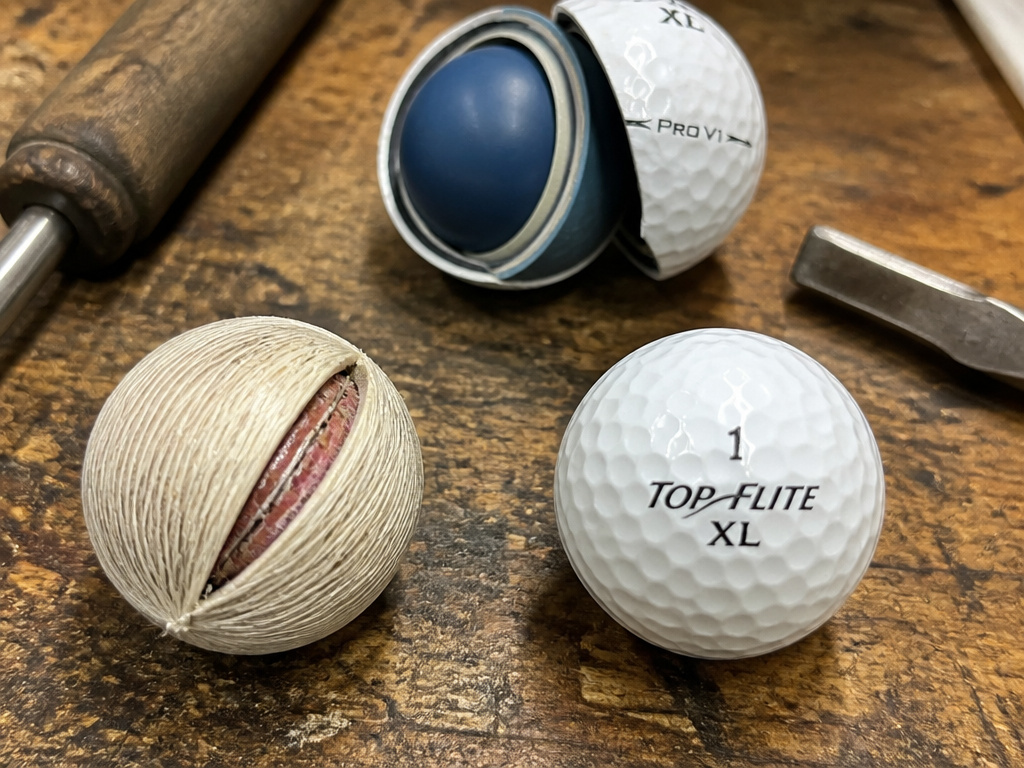 The post-war era saw chemistry replace natural materials. Balatá covers, while soft and receptive for skilled players, cut easily. The search for durability led to DuPont’s synthetic resin, Surlyn.
The Ram “Golden Ram” ball, patented in 1968, was the first to use a Surlyn cover. Its toughness made a significant difference. Also in 1968, Spalding launched “The Executive,” the first two-piece ball (a solid core with a cover). By 1972, Spalding had switched its cover to Surlyn and renamed it the “Top-Flite”, the archetypal durable, distance-oriented ball.
This material shift enabled new designs. Manufacturers experimented with dimple patterns to optimize golf ball aerodynamics. Titleist’s 1973 icosahedral pattern divided the cover into 20 regions for consistent flight.
The final major shift was from wound construction to solid cores. Wound balls dominated for most of the 20th century, but at the 1986 Open Championship, Greg Norman won using a Spalding “Tour Edition,” a non-wound ball. The dam broke in 2000 with the Titleist Pro V1, the first solid-core, multi-layer ball to achieve widespread professional adoption. Today’s premium balls are all solid-core, with multiple layers fine-tuning golf ball compression and spin.
| Era | Core Technology | Cover Breakthrough | Flagship Product |
|---|---|---|---|
| Pre-1900 | Feathers / Solid Gutta-Percha | Leather / Gutta-Percha | Featherie / Gutty |
| 1900-1960s | Liquid or Solid Rubber (Wound) | Balatá Sap | Various Wound Balls |
| 1970s-1990s | Solid Rubber (Two-Piece) | DuPont Surlyn | Spalding Top-Flite |
| 2000-Present | Multi-Layer Solid Core | Advanced Urethane / Surlyn Blends | Titleist Pro V1 |
Frequently Asked Questions
What was the first golf ball made of?
The earliest confirmed manufactured balls were likely the “hairy”, leather stuffed with cow hair, used in the 15th and 16th centuries. The more famous “featherie,” a leather pouch stuffed with boiled goose feathers, succeeded it and was the premier ball for over 200 years before the gutta-percha revolution.
Why are golf balls covered in dimples?
Dimples reduce aerodynamic drag. A smooth ball creates a large, turbulent wake behind it, slowing it down. Dimples energize the air layer around the ball, allowing it to flow more cleanly and travel much farther. The modern dimple traces back to William Taylor’s 1908 patent, which reversed a mold’s bramble pattern to create indentations.
What’s the difference between a “British” and “American” ball?
Before 1990, a rules split existed. The USGA mandated a minimum diameter of 1.68 inches. The R&A allowed a smaller “British” ball (as small as 1.62 inches). The smaller ball had less drag, offering a distance advantage, especially in windy conditions common on UK links courses. The R&A aligned with the USGA standard in 1990, making the smaller ball illegal worldwide.
Are “X-out” golf balls legal for tournament play?
No. “X-outs” are balls that failed a manufacturer’s quality control, usually for minor cosmetic flaws. While they often perform identically, they are not listed on the official USGA Conforming Golf Ball List. Any tournament that adopts the “Condition of Competition” requiring a conforming ball list prohibits their use.
How will the 2028 golf ball rollback work?
The rollback changes the test conditions, not the physical ball. Currently, balls are tested at 120 mph swing speed. Starting in 2028 for elites and 2030 for recreational players, the test swing speed will increase to 125 mph with a lower spin rate. This means today’s balls will fail the new test, effectively mandating a new generation of balls that fly shorter for the game’s longest hitters.
Before You Go
The history of the golf ball is a cycle of innovation and regulation. A new material or design makes the ball fly farther, courses become obsolete, and the governing bodies step in to set a new limit. We’re in that cycle now with the 2028 rollback.
Good golf should feel less complicated the more you understand it. Knowing why your ball is 1.68 inches, why it has dimples, and why it might change in a few years connects you to 600 years of that cycle. It’s not just a piece of equipment; it’s the physical record of the game’s eternal debate between skill and technology. For your next round, that history is in your pocket.
