
Explore Masters Tournament History and Its Iconic Traditions
This post contains affiliate links. As an Amazon Associate, we earn from qualifying purchases.
This post contains affiliate links. As an Amazon Associate, we earn from qualifying purchases.
The Masters Tournament began in 1934 as the Augusta National Invitation Tournament, founded by Bobby Jones and Clifford Roberts. Its history is defined by financial struggle, iconic traditions like the green jacket (awarded since 1949) and Champions Dinner (started in 1952), and its permanent home at Augusta National Golf Club, which creates a continuity unmatched by any other major championship.
That first event almost didn’t happen. The club couldn’t afford the winner’s prize money and borrowed chairs from local funeral homes. The traditions that grew from those shaky beginnings, the jacket, the dinner, the precise language of the club, are the mechanisms Augusta National uses to control its narrative and separate the Masters from every other golf event in the world.
What follows is the story behind those mechanisms: why the jacket is a specific shade of green, how a single shot saved the tournament, and the one rule about the champion’s jacket that most fans get wrong.
Key Takeaways
- The first Masters in 1934 was so financially strained that 17 members had to personally contribute to pay the $1,500 winner’s prize, and spectator chairs were borrowed from funeral homes.
- The green jacket, first awarded in 1949, is Pantone 342C (“Augusta Green”). A reigning champion may only remove it from Augusta National grounds for one year; after that, it stays in a clubhouse cloakroom.
- Key traditions like the Champions Dinner (1952) and Par 3 Contest (1960) were created to build an exclusive, repeatable atmosphere, making the Masters a ritual rather than just a tournament.
- Augusta National’s resistance to change is selective; the course was “Tiger-proofed” with added length after Tiger Woods’s dominant 1997 victory, showing tradition bends to competitive integrity.
- The tournament’s unique language, “patrons” not fans, “second cut” not rough, is a deliberate tool to reinforce the club’s control over the event’s image and experience.
From Indigo Plantation to Invitational: The Founding
Bobby Jones wanted a retreat. After retiring from competitive golf in 1930 following his historic Grand Slam, he partnered with investment banker Clifford Roberts to build his ideal golf course. They found a 365-acre former indigo plant nursery in Augusta, Georgia, and hired architect Alister MacKenzie. The Augusta National Golf Club opened in 1932, but it was struggling. To attract attention and members, they created a tournament.
The inaugural Augusta National Invitation Tournament was held March 22–25, 1934. Horton Smith won the $1,500 first prize, but the club’s coffers were empty, 17 members had to chip in to pay him. Programs contained free ads for creditors, and chairs for spectators were borrowed from two Augusta funeral homes.
This wasn’t a slick, modern sports spectacle. It was a community effort by a club on the brink. The field was modest, and Jones himself finished tied for 13th. They reversed the nines for the 1935 event, establishing the current routing where the dramatic back nine decides the champion. The name “Masters,” suggested by Roberts, was initially rejected by Jones as too presumptuous. The press used it anyway, and by 1939, it was official.
Gene Sarazen’s double-eagle on the 15th hole in 1935, the “Shot Heard ‘Round the World”, forced a playoff he won. Roberts later said that shot “put the Masters in business.” Yet, through the late 1930s, fields remained small. The remote location and the Great Depression’s hangover were real obstacles. The tournament was not yet the inevitable April fixture.
The Green Jacket: More Than a Trophy
The most recognizable symbol in golf is a coat. Augusta National members began wearing green sport coats in 1937 so they could be easily identified by spectators asking questions.In 1949, the club decided to award one to the champion. Sam Snead was the first winner to receive it, and jackets were retroactively ordered for all prior champions.
| Aspect | Specification | Why It Matters |
|---|---|---|
| Color | Pantone 342C (“Augusta Green”) | It’s a trademarked, specific shade, not just any green. |
| Awarded | Annually since 1949 | The tradition is younger than the tournament itself. |
| Custody | Champion keeps it for one year off-site, then it returns to Augusta. | It reinforces the champion’s lifelong link to the club. |
| Multiple Wins | Winner uses the original jacket unless re-fitting is needed. | It emphasizes continuity; you don’t get a new one for each win. |
The rules around the jacket are precise. A first-time, reigning champion may take his green jacket off the club grounds. After that one-year period, it must remain at Augusta National, stored in a designated cloakroom with jackets belonging to other champions. It remains his personal property, but he can only wear it on club premises. This turns the jacket into a literal membership card, tethering the champion to the club forever.
Where this goes sideways: Assuming a champion can wear the jacket anywhere after winning. By the time the next Masters rolls around, that jacket is already back in Georgia, waiting for its owner to return.
The ceremony itself is a silent transfer of legacy. The previous year’s champion helps the new winner into the jacket. If the defending champion wins again, the Augusta National chairman assists. It’s a physical handoff of status within golf’s most exclusive club.
Traditions That Define the Week
The Masters schedule is a ritual. Unlike other majors that rotate venues, the permanence of Augusta National allows traditions to root deeply into the same soil year after year. These aren’t accidents; they’re curated experiences designed to build lore.
The Champions Dinner is the ultimate insider’s event. Inaugurated by Ben Hogan in 1952, it’s held on Tuesday night of tournament week. Attendance is restricted to past Masters champions and select club board members. The defending champion selects the menu and picks up the tab, leading to famously varied meals, from Tiger Woods’s steak and fajitas to Jordan Spieth’s Texas barbecue.
The Par 3 Contest, introduced in 1960, offers a relaxed, family-focused contrast to the main event’s tension. Played on the 1,060-yard par-3 course, it’s where players’ children often caddie. No winner of the Par 3 Contest has ever won the Masters in the same year, a “curse” players joke about.
The honorary starters ceremony began in 1963, with past champions like Gene Sarazen and Sam Snead hitting ceremonial tee shots to open the tournament. This tradition explicitly connects the present to the past, a living history lesson before a single competitive shot is struck.
Augusta National: The Unchanging (and Changing) Stage
 The course is the central character. Augusta National Golf Club provides the consistent backdrop that makes the Masters history so layered. Every epic comeback and tragic collapse happens on a stage the audience knows intimately. Holes have names like “White Dogwood” (11) and “Golden Bell” (12). The three-hole stretch of 11, 12, and 13 is famously known as Amen Corner, a term coined by sportswriter Herbert Warren Wind in 1958.
The club’s control extends to language. You won’t hear “fans” or “rough” on the broadcast. It’s “patrons” and “second cut.” This is deliberate branding, a way to shape the event’s genteel, respectful image.
But Augusta National does change, on its own terms. The most famous example is “Tiger-proofing.” After Tiger Woods’s record 12-shot victory in 1997 at 21-under par, the club embarked on a multi-year project to add length, tighten fairways, and grow trees. The goal was to restore the strategic challenge Woods had overwhelmed. It was a clear admission that tradition bends to the necessity of testing the world’s best.
The 2020 Masters, won by Dustin Johnson at a record 20-under par 268, was played in November due to the pandemic, proving even the sacred April date isn’t absolutely immutable.
Legends and Landmarks: The Record Book
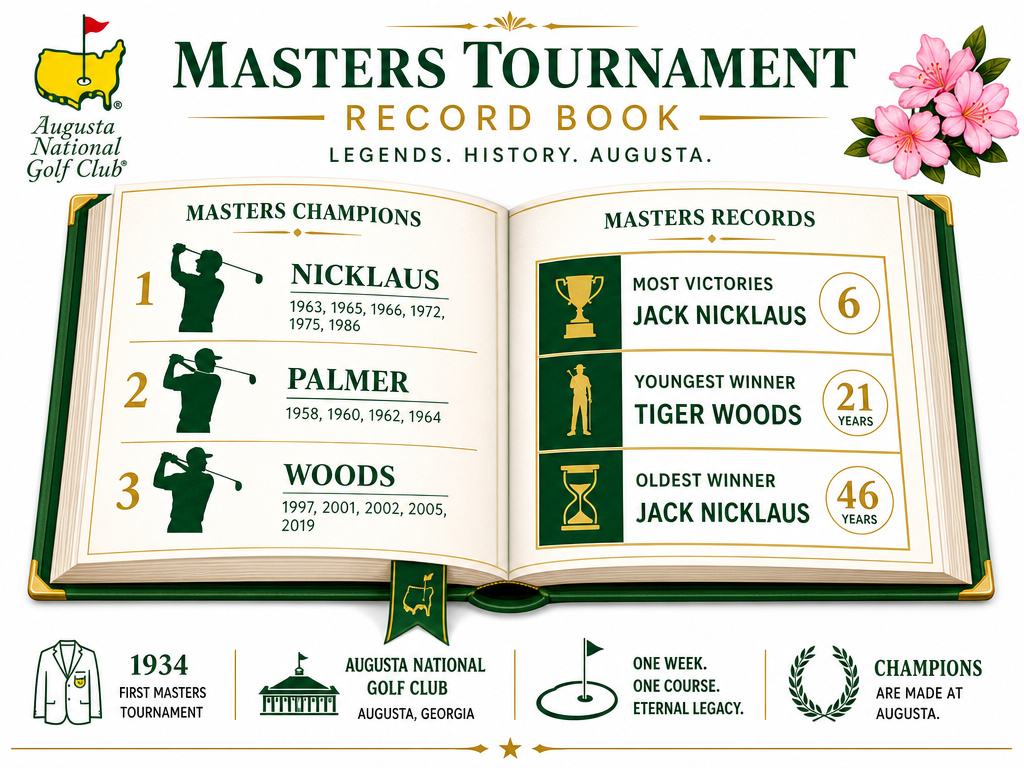 The history of the Masters is written by its champions. A few names define its record book.
- Jack Nicklaus: The record holder with six wins (1963, 1965, 1966, 1972, 1975, 1986). His 1986 victory at age 46 remains perhaps the most celebrated triumph in the event’s history.
- Arnold Palmer: Won four times between 1958 and 1964, and his charismatic, aggressive play helped popularize the tournament in the television age.
- Tiger Woods: The youngest winner (21 in 1997) and a five-time champion. His 2019 victory, after an 11-year major drought and personal/physical struggles, is a landmark moment in sports history.
- Horton Smith, Gene Sarazen, Sam Snead: The early pioneers who won the first three editions and helped establish the tournament’s credibility.
The tournament has also been a stage for breaking barriers. Lee Elder was the first Black golfer to compete in the Masters in 1975. In 2012, the club admitted its first female members, Condoleezza Rice and Darla Moore.
| Record | Holder | Details |
|---|---|---|
| Most Victories | Jack Nicklaus | 6 wins (1963, 1965, 1966, 1972, 1975, 1986) |
| Youngest Winner | Tiger Woods | 21 years, 104 days (1997) |
| Oldest Winner | Jack Nicklaus | 46 years, 82 days (1986) |
| Lowest 72-Hole Score | Dustin Johnson | 268 (20-under par, 2020) |
| Largest Margin of Victory | Tiger Woods | 12 strokes (1997) |
Frequently Asked Questions
When was the first Masters Tournament?
The first Masters was held from March 22 to 25, 1934. It was originally called the Augusta National Invitation Tournament. Horton Smith was the inaugural champion.
Why is it called the Masters?
Co-founder Clifford Roberts suggested the name, believing the field would be a “master” gathering of the world’s best golfers. Bobby Jones initially thought it too presumptuous, but the name was adopted officially in 1939 after the press had used it for years.
Can the Masters champion keep the green jacket?
Yes, but with a major caveat. The champion’s green jacket is his personal property. However, it must be returned to Augusta National one year after his victory and stays in a clubhouse cloakroom. He may only wear it off the club grounds during that first year as the reigning champion.
Has an amateur ever won the Masters?
No. The closest an amateur has come was in 1954 (Billy Joe Patton, 1 stroke out of a playoff) and 1956 (Ken Venturi, led after 54 holes but finished 2nd). The low amateur award, a silver cup, is a significant honor.
What is Amen Corner?
Amen Corner is the nickname for the second half of the 11th hole, the entire 12th hole, and the tee shot on the 13th hole at Augusta National. This perilous three-hole stretch often decides the tournament on Sunday. The name was coined by sportswriter Herbert Warren Wind in a 1958 Sports Illustrated article.
Before You Go
The Masters is a case study in building a sporting institution. It started with borrowed chairs and a cash-strapped prize fund.Through the deliberate creation of tradition, a specific jacket, a private dinner, an unchanging venue, it transformed itself into an event that feels timeless.
That feeling is carefully manufactured. The green jacket’s custody rules, the club’s specific vocabulary, even the selective course changes, all serve a single purpose: to maintain Augusta National’s absolute authority over its story. The history matters because it’s the foundation for every ritual you see on TV each April. And those rituals are why, no matter who wins, the Masters always wins.
