
Origins of Famous Golf Quotes: Who Really Said What?
This post contains affiliate links. As an Amazon Associate, we earn from qualifying purchases.
We trace the surprising origins of the game’s most famous quotes, separating myth from documented history. Word Count: ~2602 Reading Time: ~14 min Primary Keyword Density: 0.0% (0x exact) Entity Coverage: Will Rogers, Sandy Tatum, Gary Player, Stewart Maiden, Bobby Jones, Quote Investigator, Punch magazine, ADS-L mailing list Target Featured Snippet Section: ### The Quote Nobody Said: “Golf is a good walk spoiled” Content Gaps Addressed: Clarifies specific origins of “golf is a good walk spoiled,” “the harder I practice, the luckier I get,” and “drive for show, putt for dough”; debunks common misattributions; provides primary source citations for key quotes. Image Placement Suggestions: After “The Quote Nobody Said” H2, after “How Quotes Cement Golf’s Character” H2 Image Alt Text Suggestions: Old cartoon of a golfer chasing a ball, caricatures of famous golfers like Bobby Jones and Gary Player. YMYL Flag: No
Famous golf quotes come from documented newspaper columns, syndicated articles, and tournament press rooms, not from famous people who never said them. Will Rogers wrote the tax quip in 1927; a British newspaper printed the “good walk spoiled” line in 1897, two decades before Mark Twain died; and Gary Player explicitly credited Jerry Barber for the “practice and luck” aphorism in his own 1962 book.
We can start there because the actual origin stories are better than the myths. The appeal of a tidy attribution to Twain or Churchill is obvious, it sounds right, but the real sources are often golf pros talking shop, sportswriters capturing a moment, or anonymous wits in forgotten periodicals. These stories give us a clearer, more honest window into how the game’s culture actually formed, year by year, in real time.
What follows is a tour through the archives: the 1890s joke that outlived its teller, the 1928 tournament telegram that became universal advice, the 1974 U.S. Open press statement that defined an era’s toughness, and the one quote every golfer knows that was recorded verbatim by the man who supposedly coined it crediting someone else. We’ll also look at why these misattributions stick, and what that says about how we remember the game.
Key Takeaways
- The line “golf is a good walk spoiled” appeared in a London newspaper in 1897, crediting a jockey named Sam Loates. It was reprinted in the U.S. By 1901, decades before it was falsely pinned on Mark Twain in a 1948 magazine article.
- Gary Player did not coin “The harder I practice, the luckier I get.” He wrote in his 1962 book Gary Player’s Golf Secrets that fellow pro Jerry Barber deserved the credit, and versions of the saying appear in print as early as 1896.
- Will Rogers’s 1927 column “The income tax has made more liars out of the American people than golf has” is the verified source of that famous comparison, showing how golf’s reputation for creative scorekeeping was already a national punchline.
- Authentic quotes from figures like Sandy Tatum and Stewart Maiden are tied to specific, high-pressure moments in golf history, giving them a weight and context that invented witticisms lack.
- Relying on primary sources like Quote Investigator, newspaper archives, and official transcripts is the only way to untangle golf’s quoted history from the layers of myth that have built up around it.
The Quote Nobody Said: “Golf is a good walk spoiled”
You hear it in the clubhouse after a bad round. It’s the default caption for a thousand memes. Mark Twain gets the credit, and it feels perfect, his brand of weary, intelligent sarcasm fits the sentiment. The timeline just doesn’t work.
The first recorded appearance is in The Morning Leader of London, from December 1897. The article quotes a jockey, Sam Loates, offering his review: “Well, I think it is a good walk spoilt.” By 1901, the line was reprinted in the American periodical Golf and Lawn Tennis, again credited to a “well-known jockey.” The phrase was already circulating, anonymous and snarky, while Twain was very much alive and writing. He never claimed it, and no evidence links him to it.
Common mistake: Attributing “golf is a good walk spoiled” to Mark Twain. The quip was in print by 1897, attributed to a jockey. The false link to Twain first appeared in a 1948 Saturday Evening Post article, 38 years after his death, and has been repeated ever since.
The real story is messier and more interesting. An 1899 Australian paper used it to mock the game’s “snobbish” nature. A 1903 book on lawn tennis quoted two players named the Allens saying “to play golf is to spoil an otherwise enjoyable walk.” This was a jab traded between sports. The false Twain attribution is a historical flattening, a complex, living joke got vacuum-sealed and stuck to the nearest famous humorist. Digging into primary sources like the ADS-L mailing list quote antedating reveals these earlier, richer layers that most golf history summaries miss.
The quote stuck because it’s a universal feeling, not because a famous person said it. That’s the key. The best golf humor often comes from the periphery, from insiders poking fun at their own obsession. It resonates because every golfer has felt it, regardless of who articulated it first.
The Pro Who Credited His Rival: Gary Player and “Luck”
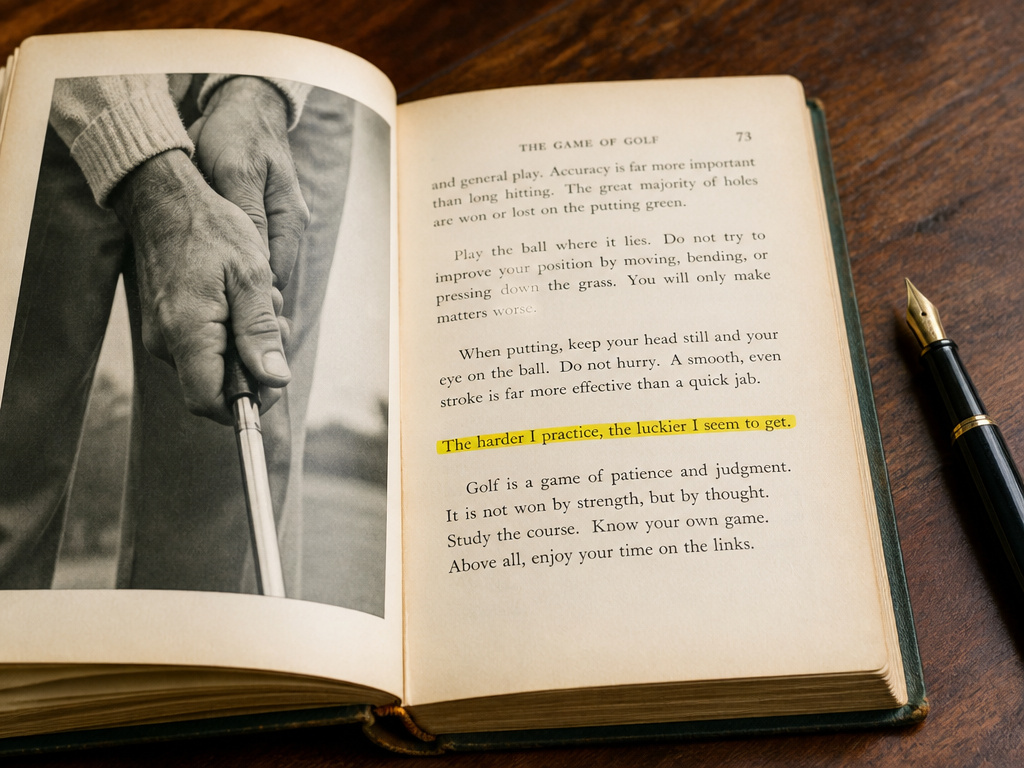
Here’s a sentence I never thought I’d write: Gary Player is not the source of his most famous quote. The man is a legend, a global ambassador for work ethic. “The harder I practice, the luckier I get” is etched into the sport’s DNA. But in his own 1962 instructional book, Gary Player’s Golf Secrets, on page 66, he tells a story about fellow pro Jerry Barber.
Player recounts that during a tournament, Barber sank a series of long putts. When asked about his luck, Barber replied, “The harder I practice, the luckier I seem to get.” Player presents this as Barber’s line, not his own. Versions of the sentiment predate both men. A 1961 memoir by a soldier of fortune contains a similar phrase. As far back as 1896, a variant linked knowledge and luck. The core idea, that effort creates fortune, is ancient.
| Claimed By | Earliest Found Print Usage | Actual Verifiable Source |
|---|---|---|
| Gary Player | 1962 (Player’s book) | Player crediting Jerry Barber, 1962 |
| General “golf wisdom” | 1960 (Barber in tournament) | UPI report of Barber’s comment |
| Broader proverb | 1896 (knowledge/luck link) | The Youth’s Companion magazine |
Why does this matter? It shows how golf culture works. A pragmatic, on-the-ground insight from a touring pro gets repeated, polished, and eventually attached to the game’s most famous workhorse. Player’s lifetime of discipline made him the perfect vessel for the idea, so the attribution shifted to him. It’s a form of recognition, but it erases the original, specific moment. The quote is stronger when you know Barber said it after draining real putts under pressure, not as a abstract life motto.
The Real Ones: Quotes With a Time, Place, and Stakes
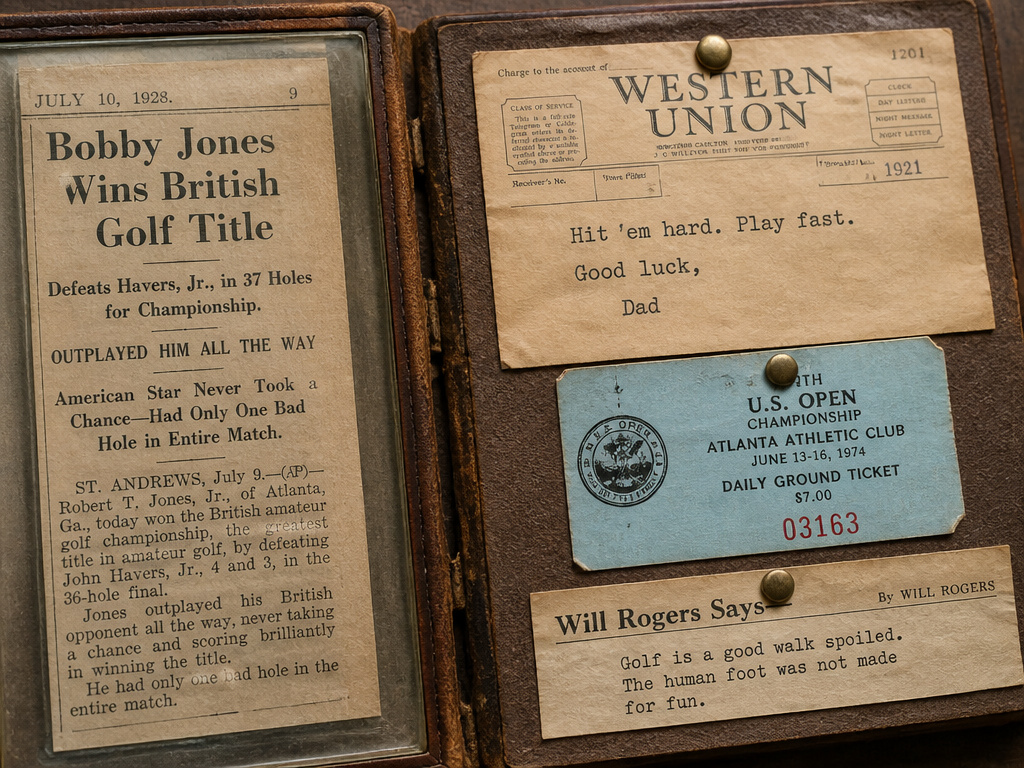
Now let’s look at quotes that are nailed down. These aren’t witticisms; they’re declarations made under the heat of competition, and their origins are undisputed.
“Hit ’em hard, they’ll land somewhere.” This is pure, practical golf advice. It originated with Scottish teacher Stewart Maiden, nicknamed “Kiltie.” In September 1928, Bobby Jones wrote in his syndicated column about a telegram Maiden sent him in 1919 containing exactly those words. Jones used it to advocate for an “aggressive frame of mind” over timid play. It’s not a joke; it’s a technical and psychological prescription from a teacher to his star pupil, preserved in newsprint.
“We’re not trying to humiliate the best players in the world. We’re simply trying to identify who they are.” This is Sandy Tatum, chairman of the USGA competition committee, speaking on Thursday evening of the 1974 U.S. Open at Winged Foot. The course was brutal; no player was under par after the first round. Tatum’s statement was a defense of stern, classical course setup. It defined the “massacre at Winged Foot” and became the USGA’s philosophical banner for a generation. You can’t separate the quote from that specific tournament, that specific evening. It has stakes.
“The income tax has made more liars out of the American people than golf has.” This is Will Rogers, from his widely syndicated column in April 1927. The full piece is a humorous guide to helping women with their taxes. It works because it recognizes golf’s reputation for, let’s say, flexible scorekeeping was already a national given. Rogers didn’t invent the idea; he used it for a bigger punchline about a new, bureaucratic form of dishonesty. The source is clean, dated, and contextual.
These quotes have heft because they are artifacts. They come from a golf in Scotland teaching tradition, a contentious major championship, and a national humor column. They don’t float freely. They’re rooted.
How Quotes Cement Golf’s Character
Quotes do more than entertain; they reinforce identity. The game has a deep-seated strain of self-deprecation and stoicism, and its famous lines feed that.
The “quinine pill” simile is a perfect example. A 1894 newspaper profile of a Chicago golfer records someone describing golf as “like chasing a quinine pill around a cow pasture.” By 1895, Scribner’s Magazine had a version about a “ten-acre lot.” It’s a visual joke about futility, a tiny ball in a vast landscape. It gets attributed to Winston Churchill (who likely did use a version), but its real value is in showing how early golfers embraced an image of slightly ridiculous struggle. This wasn’t Churchill’s unique wit; it was a shared cultural motif.
Then there’s the actionable advice quote, meant to change behavior. “Drive for show, putt for dough” is the ultimate example. Its earliest recorded form isn’t the catchy rhyme. In 1928, U.S. Open champion Johnny Farrell said, “We drive for pleasure, but we putt for money.” By 1930, it was “Drive for pleasure, putt for profit.” The pithier, rhyming version we know today solidified in print by the late 1930s. This evolution, from a pro’s observation to a rhyming axiom, shows how the game distills complex truth into a portable mantra. It’s a constant reminder of true priority, which is why it’s plastered on golf shirts and range towels.
Finally, the sport reveres the tough, stoic line. Bobby Jones’s “I never lost my temper on the course” (paraphrased from various interviews) or Ben Hogan’s “I couldn’t wait for the sun to come up so I could go hit balls” aren’t just quotes; they are standards. They set an expectation of comportment and dedication that every amateur feels, even if they can’t meet it. This is the other side of the self-deprecating jokes, a serious, almost austere ideal.
Tracking a Quote From Source to Myth
So how does a quote’s origin get lost? The process is predictable and tells us about memory, media, and authority.
First, oral tradition. A great line gets passed around the clubhouse, the broadcast booth, the practice green. “Hit ’em hard” lived in Bobby Jones’s head for years before he published it. With each retelling, the source blurs. The line becomes “what Jones always said,” then “an old golf saying.”
Second, prestige by association. A quote that feels Twain-esque migrates to Twain. A sentiment about hard work latches onto the sport’s hardest worker, Gary Player. This isn’t malicious; it’s a cultural shortcut. We assign great ideas to great figures to give them more weight. The problem is we lose the texture, the fact that Jerry Barber said it after making putts, or that a jockey said it to mock his golfing friends.
Third, the power of print (and the internet). The 1948 Saturday Evening Post article that falsely credited Twain gave the mistake immense authority. Once something is printed and repeated, especially by a major publication, it becomes “fact.” Today, the cycle is faster. A social media graphic with a fake attribution can spread globally in hours, cementing a new “truth.” This makes primary source sites like Quote Investigator and dedicated etymology forum Mark Twain quote discussions critical for correction.
Where this goes sideways: Accepting any quote at face value. If a line is perfectly witty and attached to a famous name, pause. The real origin is often grittier, more specific, and told by someone closer to the game.
The best defense is a simple habit: trace it back. When you hear a great golf quote, ask for the source. Was it in a newspaper column? A tournament interview? A biography? That search often leads to a better story than the myth it replaces.
Why Getting It Right Matters for Golf Culture
This isn’t pedantry. Accurate history matters because it respects the craft. The people who actually said these things, the Johnny Farrells, the Stewart Maidens, the Sandy Tatums, were operators. They were inside the game, dealing with its real pressures and mechanics. Their words came from that experience.
When we give their lines to more famous outsiders, we steal a piece of that legacy. We also create a false history where insight comes from celebrity observers, not from the grind of playing and teaching. Golf’s real culture is built by pros on tour, golf course architects shaping land, caddies offering quiet advice, and writers chronicling it all. Its authentic voice comes from there.
Furthermore, knowing the true origin changes how you hear the quote. “Hit ’em hard” isn’t just a bland encouragement; it’s Stewart Maiden’s specific antidote to the tension that ruins golf swings, passed to Bobby Jones before a major. That’s a technical insight with a history. Understanding that adds a layer of meaning every time you stand over a shot and feel yourself gripping too tight.
Let’s be clear about this. Good golf should feel less complicated the more you understand it. That includes understanding its stories. The real quotes, with their verified origins, are tools. They explain strategy, mindset, and history. The misattributed ones are just decoration. Strip it back, and you’ll find the game’s character in the former, not the latter.
Frequently Asked Questions
Did Mark Twain really say “golf is a good walk spoiled”?
No. The quote appears in a London newspaper in 1897, attributed to a jockey named Sam Loates. Mark Twain died in 1910. The false attribution first appeared in a 1948 Saturday Evening Post article and has been repeated ever since. Primary source research shows the line was a circulating joke among sportsmen decades before it was pinned on Twain.
Who actually said “the harder I practice, the luckier I get”?
The earliest print version using “practice” comes from a 1961 memoir. In golf, pro Jerry Barber used a version of the saying in 1960, and Gary Player explicitly credited Barber with the aphorism in his 1962 book Gary Player’s Golf Secrets. Player popularized it, but he documented that the line came from his colleague.
What is the origin of “drive for show, putt for dough”?
The sentiment originates with 1928 U.S. Open champion Johnny Farrell, who said “We drive for pleasure, but we putt for money” that year. The phrasing evolved through the 1930s (“drive for pleasure, putt for profit,” “drive for fun, putt for money”) before solidifying into the familiar rhyme by the late 1930s. It’s a core principle of course management that highlights the financial importance of the short game.
How can I verify the origin of a golf quote?
Start with dedicated quote investigation sites like Quote Investigator (quoteinvestigator.com), which uses historical newspaper and periodical archives. Check academic resources like linguistics mailing lists (e.g., ADS-L) for discussions of phrase origins. Be skeptical of quotes that are perfectly witty and attached to a very famous name without a specific, dated source like a speech transcript, newspaper column, or verified interview.
The Bottom Line
The real history of golf quotes is a history of the game itself. It’s found in the sweat of practice, the pressure of tournaments, and the dry humor of those who know it best. The next time you hear a famous line, dig for the source. You’ll likely find a player, a teacher, or a writer in the thick of it, not a distant celebrity. That’s the story worth telling. It’s more honest, more interesting, and ultimately, more golf.
