
How Golf in Scotland Began: The Origins of the Modern Game
This post contains affiliate links. As an Amazon Associate, we earn from qualifying purchases.
This post contains affiliate links. As an Amazon Associate, we earn from qualifying purchases.
Modern golf began in Scotland. The game evolved from medieval stick-and-ball pastimes on the country’s sandy coastal links, was first officially mentioned in a 1457 parliamentary ban, and was formally codified by the Honourable Company of Edinburgh Golfers in 1744 with thirteen rules that are the direct ancestor of today’s laws.
That 1457 ban is the crucial pivot. It wasn’t a footnote; it was repeated in 1471 and 1491 because people kept playing. The authorities saw golf as a threat to military readiness and church attendance. Yet, within fifty years, a king was buying clubs. The story is a fight between popular passion and official decree, played out on ground that uniquely suited it, rather than a straight line from ancient game to modern sport.
What follows is the sequence that turned a pastime into a global game: the landscape that made it possible, the royal flip from foe to fan, the first written analysis of a golf swing from 1687, and the moment the gentlemen of Edinburgh wrote it all down. By the end, you’ll see why the claim “golf is Scottish” rests on three specific things you can point to in a museum.
Key Takeaways
- The first written record of golf is a 1457 Act of Parliament that banned the game to encourage archery, a ban restated in 1471 and 1491 because Scots kept playing.
- King James IV’s 1502 purchase of golf clubs from a Perth bow-maker marks the moment the royal ban was effectively lifted, linked to the rise of cannon warfare over archery.
- A 1687-88 student diary by Thomas Kincaid contains the world’s first known golf swing analysis and equipment advice, preferring clubs of “hazell” and leather balls without pores.
- The 1744 “Articles & Laws in Playing at Golf” created by the Honourable Company of Edinburgh Golfers for a competition on Leith Links are the undeniable foundation of all modern golf rules.
- Scotland’s sandy, well-drained coastal links land was the essential physical catalyst, providing the only reliable playing surface before lawn mowers and modern agronomy.
The 1457 Ban: When Golf Was Illegal
Golf enters the historical record not as a sport, but as a public nuisance. The Act of Parliament of 6 March 1457, issued by King James II, is the oldest surviving document that mentions the game. It didn’t celebrate golf. It sought to stamp it out.
The law commanded that “football and golf should be utterly condemned and stopped.” The reason was national security. Every able-bodied man and boy over twelve was required to practice archery for homeland defense. Parliament viewed non-military sports as a dangerous distraction. The act also reveals where people were playing: “in enclosed public spaces, like streets and churchyards.” This was likely “short golf,” a target-game version that was disruptive and occasionally fatal to bystanders.
Common mistake: Thinking the 1457 ban worked. It didn’t. The fact that it had to be restated by James III in 1471 and again by James IV in 1491 proves Scots were playing golf persistently for over thirty years after it was outlawed.
The ban’s failure is the first real evidence of golf’s deep-rooted popularity. Authorities could pass the law, but they couldn’t change what people did on common ground. This tension between top-down decree and bottom-up passion defines the game’s early history. The landscape itself was a co-conspirator. Scotland’s coastline provided miles of open, sandy “links” land, free, public, and perfect for the emerging “long golf” that would define the sport. You can read more about the significance of this landscape in the broader history of golf in Scotland.
From Ban to Royal Hobby: The 1502 Pivot
The official stance on golf flipped because warfare changed. By 1502, King James IV, the same monarch who had reaffirmed the ban in 1491, was purchasing golf clubs. The Accounts of the Lord High Treasurer of Scotland note a payment “to the bow-maker of Saint John’s Town (Perth), for golf clubs, 14 shillings.”
This receipt is a signal. James was a practical military modernizer who recognized that cannons were making mass archery obsolete.If archery practice was no longer a national imperative, the primary reason for banning golf vanished. The king’s purchase also tells us two things about the game’s development. First, a specialized trade already existed; bow-makers, with their skill in shaping resilient wood, were the early clubsmiths. Second, golf had moved up the social ladder. It was now a worthy pursuit for the wealthy, not just a street game.
| Year | Event | Significance |
|---|---|---|
| 1457 | Act of Parliament bans golf. | First written record of the game; frames it as a public order issue. |
| 1502 | King James IV buys clubs in Perth. | De facto end of the ban; golf becomes a sanctioned royal pastime. |
| 1552 | St Andrews Charter reserves rights for golf. | First formal recognition of golf on a specific links (St Andrews). |
| 1687-88 | Thomas Kincaid’s diary analyzes swing. | Earliest known technical instruction and equipment review. |
This shift opened the floodgates. Within decades, references to golf on specific links, like the 1552 charter for St Andrews, become more common. The game was moving from the streets to the dedicated, open terrain where its true character could form. For a modern golfer planning to walk these historic grounds, a guide to Scottish golf is essential.
The First Golfer’s Notes: A 1687 Swing Analysis
Before there were teaching pros, there was a medical student with a diary. Thomas Kincaid’s 1687-88 journal is a stunning document. It’s the earliest known manual on how to play, covering swing mechanics, equipment, and even an early handicapping system. This isn’t a law or a ledger; it’s the voice of a player thinking through his game.
Kincaid broke down his swing in detail, emphasizing posture and a smooth, controlled motion. He gave specific equipment recommendations: clubs made of “hazell” and a ball of “thick and hard leather not with pores or grains.” His focus on leather without pores points directly to the “featherie”, the hand-stitched leather ball stuffed with wet feathers that shrank as it dried, creating a hard, durable sphere. This ball, expensive and time-consuming to make, dictated the game’s early economics and influenced club design.
His notes reveal a game that was both analytical and established. Players were already tinkering with technique and gear, seeking an edge. Kincaid’s systematic approach feels familiar to anyone who has ever worked on their mental game or a specific swing drill. It proves that the core obsession of golf, the relentless pursuit of a better method, was present at the very dawn of its recorded practice.
The Landscape That Built the Game: Links Land
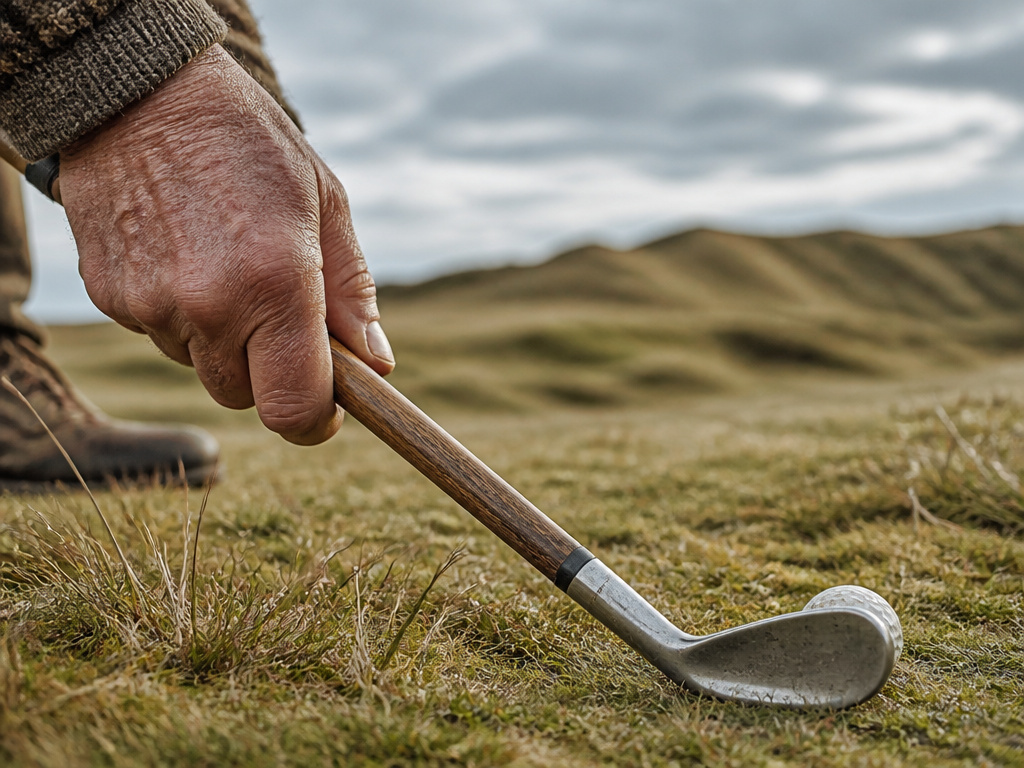
You can’t separate early golf from the ground it was played on. Scotland’s east coast links land, sandy, undulating, naturally drained terrain between the beach and farmland, wasn’t just a convenient spot. It was the essential, required ingredient. Before mechanized mowers, only the links’ short, hardy grass provided a reliable playing surface. Inland fields were too soft, too long, or too muddy.
This specific geography did more than host the game; it designed the first courses. The game adapted to the land’s natural hazards: sandy hollows became bunkers, dunes defined targets, the wind became a central strategic factor. As the historian Rand Jerris noted, “Every golf course in the world is an imitation of landforms that naturally occur on the Scottish coast.”
The concentration of early golf sites along this coast, from Aberdeen down to Leith, is a map of necessity. The earliest Scottish golf sites list is, effectively, a list of usable links.This environmental constraint kept the game geographically focused for centuries, allowing a consistent culture and set of challenges to develop. Playing elsewhere simply wasn’t feasible, which is why similar stick-and-ball games in the Netherlands, played on flat polder land, never evolved into the cross-country game Scotland produced.
The First Rules: The 1744 Articles & Laws
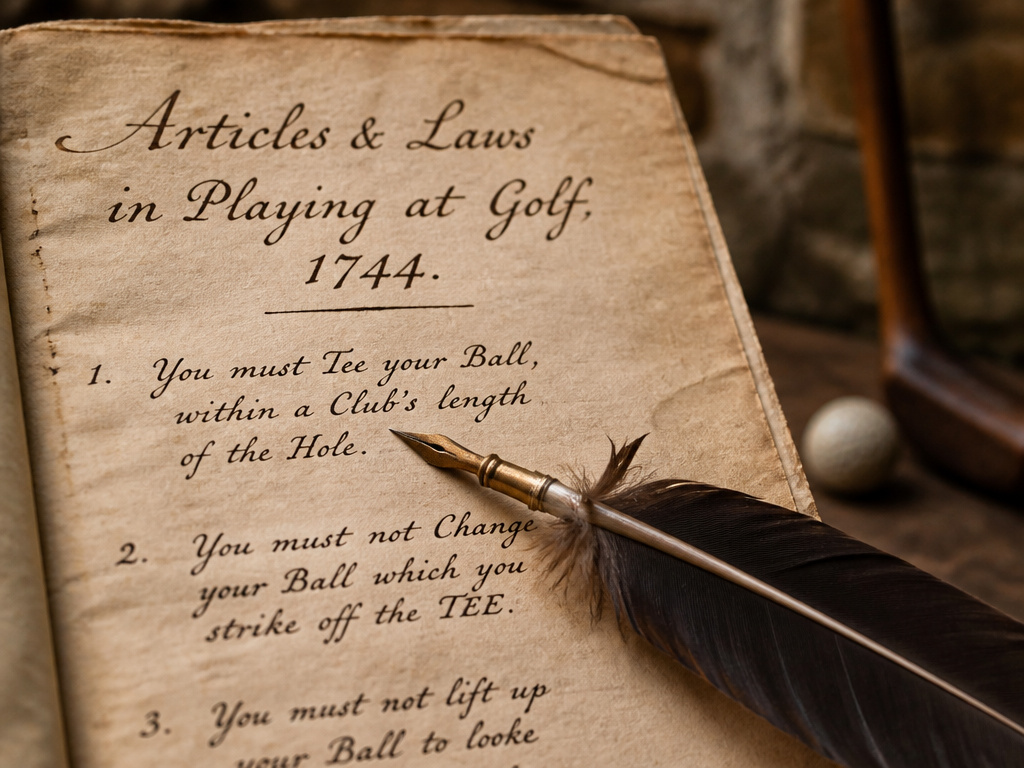
Golf’s journey from pastime to codified sport culminates on Leith Links in Edinburgh on 2 April 1744. A group calling itself the Company of Gentlemen Golfers (today’s Honourable Company of Edinburgh Golfers) petitioned the town council for a silver club to award as a prize. The council agreed, on the condition the group formalize its regulations. The result was the “Articles & Laws in Playing at Golf,” thirteen rules that are the direct DNA of today’s rulebook.
“You must Tee your Ball, within a Club’s length of the Hole. Your Tee must be upon the Ground. You are not to change the Ball which you Strike off the Tee.” . First three rules from the 1744 “Articles & Laws,” establishing fundamentals of play.
These rules are strikingly modern in their concerns. They address the tee shot (Rule 1), playing the ball as it lies (Rule 2), and lost balls (Rule 4). They deal with hazards, loose impediments, and even the concept of a “stymie” (an opponent’s ball blocking your line). This wasn’t a casual agreement. It was a framework for fair competition, necessary for the silver club tournament that was open to “noblemen and gentlemen golfers from all over Britain.”
The creation of a standard code had a ripple effect. Other societies, like the Royal Burgess Golfing Society (playing at Bruntsfield Links) and the group at St Andrews, adopted and adapted these rules. For the first time, a golfer could travel from one course to another and understand the basic terms of engagement. This formalization paved the way for the game’s spread beyond Scotland. Just as understanding the rules of a skins game clarifies that format, the 1744 rules gave the broader game a consistent structure.
The 18-Hole Standard and Global Spread
The 18-hole round is a St Andrews accident that became a global standard. The Old Course at St Andrews originally had 22 holes. Golfers would play 11 holes out, turn around, and play the same 11 back, for a total of 22. In 1764, the society decided to combine the first four short holes into two, creating an 18-hole layout (9 out, 9 back). This 18-hole model was later adopted by the Royal and Ancient Golf Club of St Andrews (the R&A) as it grew in influence.
The game’s export followed trade and empire. Scottish soldiers, merchants, and emigrants took their clubs with them. The first golf clubs outside Britain appeared in the 18th and 19th centuries: the Royal Calcutta Golf Club (1829), the club at Pau, France (1856), and others. The invention of the gutta-percha “guttie” ball in 1848 was a catalyst. Cheaper and more durable than the featherie, it made the game more accessible and consistent.
The real explosion came with the industrial age and improved transportation. Railways made golf tourism to Scottish resorts like St Andrews possible for the English middle class. The game boomed in England, then crossed the Atlantic. The first Open Championship was held at Prestwick in 1860. By the 1890s, the R&A and the newly formed United States Golf Association (USGA) were working to unify the rules globally. The story of golf’s origins, from its complete golf history article to its local club traditions, is now a shared global heritage.
Frequently Asked Questions
Did golf really start in Scotland?
Yes, the modern game as we know it, played over varied terrain to a hole in the ground with specialized clubs, developed in Scotland. While many cultures had stick-and-ball games, the combination of the Scottish links landscape, the featherie ball, the long-nosed club, and the written rules of 1744 created the unique sport that spread worldwide.
What is the oldest golf course in the world?
The Old Course at St Andrews in Fife, Scotland, is widely considered the oldest and most iconic golf course. Golf was officially played there under charter by 1552, and it has been continuously used as a links course ever since. Musselburgh Links also claims great antiquity, with documented play from the 1670s.
Why was golf banned in Scotland?
Golf was banned by Acts of Parliament in 1457, 1471, and 1491 because the government believed it distracted men and boys from mandatory archery practice, which was seen as vital for national defense against English invasion. The bans also targeted golf played in streets and churchyards, which disrupted communities and church services.
Who wrote the first rules of golf?
The first standardized rules were the “Articles & Laws in Playing at Golf” (1744), written by the Company of Gentlemen Golfers, later the Honourable Company of Edinburgh Golfers. They created these thirteen rules for their inaugural competition on Leith Links, with the winner’s name engraved on a silver club.
What did early golf balls look like?
The first advanced golf ball was the “featherie.” It was made from a leather pouch stuffed tightly with wet goose feathers. As the feathers dried, they expanded, making the ball hard and surprisingly long-flying. They were expensive, handmade, and could split open if struck poorly. The gutta-percha ball, introduced in 1848, replaced it.
Before You Go
The story of golf’s beginning is about a convergence: the right land, a ball that could fly, clubs that could shape shots, and a culture that kept playing even when told not to. The 1457 ban proves its early popularity, the 1744 rules prove its maturity, and Thomas Kincaid’s 1687 diary proves its depth.
If you take one thing from this, let it be the physical reality of the links. The game was forged on ground that demanded creativity and punished error. That’s why the oldest courses still feel different. They aren’t just layouts; they are the original template. Understanding that foundation, the wind, the hard turf, the natural obstacles, changes how you see every course built since. It turns a history lesson into a playing lesson. The game began as a negotiation with the land, and at its best, it still is.
