What Causes a Hook in Golf? The Role of Club Shaft Dynamics
A golf hook is caused by a clubface that is closed relative to the swing path at impact. For a right-handed player, this combination makes the ball start right and curve sharply left. The five primary causes are a strong grip, an inside-out swing path, poor weight transfer, ball position too far back, and, occasionally, an ill-fitting shaft that promotes excessive closure.
That closed face is the non-negotiable. You can have a perfect path, but if the face points left of that path at impact, the ball hooks. The path dictates the initial direction; the face angle dictates the spin.
What follows breaks down the five mechanical roots of that closure, the one equipment wildcard most players never consider, and the specific drills that rewire the pattern. By the end, you’ll know whether your hook lives in your hands, your hips, or your hybrid.
Key Takeaways
- A hook requires two things: a clubface closed relative to the swing path. Fix one, and the curve dies.
- A strong grip (seeing 3+ knuckles on your lead hand) pre-sets the face to close rapidly. Weakening it just one knuckle changes everything.
- An inside-out swing path amplifies hook spin. The feeling of “swinging left” through impact is the corrective cue.
- Poor weight transfer, specifically a reverse pivot or an early extension (hips thrusting toward the ball), forces the hands to flip and close the face.
- Graphite hybrid shafts can have inconsistent stiffness, causing a “miss left.” The fix might be a stiffer profile, not a swing change.
The Two Non-Negotiables: Face Angle and Swing Path
The ball doesn’t lie. Its flight obeys a simple law: the clubface direction at impact controls about 85% of the ball’s starting direction. The swing path relative to that face controls the curve.
A hook is the product of a face pointed left of the target line (for a righty) combined with a path that is further to the right than that face angle. This imparts a vicious clockwise spin. A pull-hook is a different animal, the face is left, and the path is also left, but the path is even more left than the face. Both start left, but the hook curves more.
The relationship is absolute. A face closed 3 degrees to a path that is 5 degrees in-to-out produces a predictable, strong hook. If you only change the path to 0 degrees (straight) but leave the face closed, you get a pull. You have to fix both.
This is why band-aid fixes fail. Aiming further right to “allow for the curve” just entrenches the inside-out path. The real fix is upstream.
The Five Root Causes of a Hook
Diagnose which of these you’re doing. Most players have two going at once.
1. A Grip That’s Too Strong
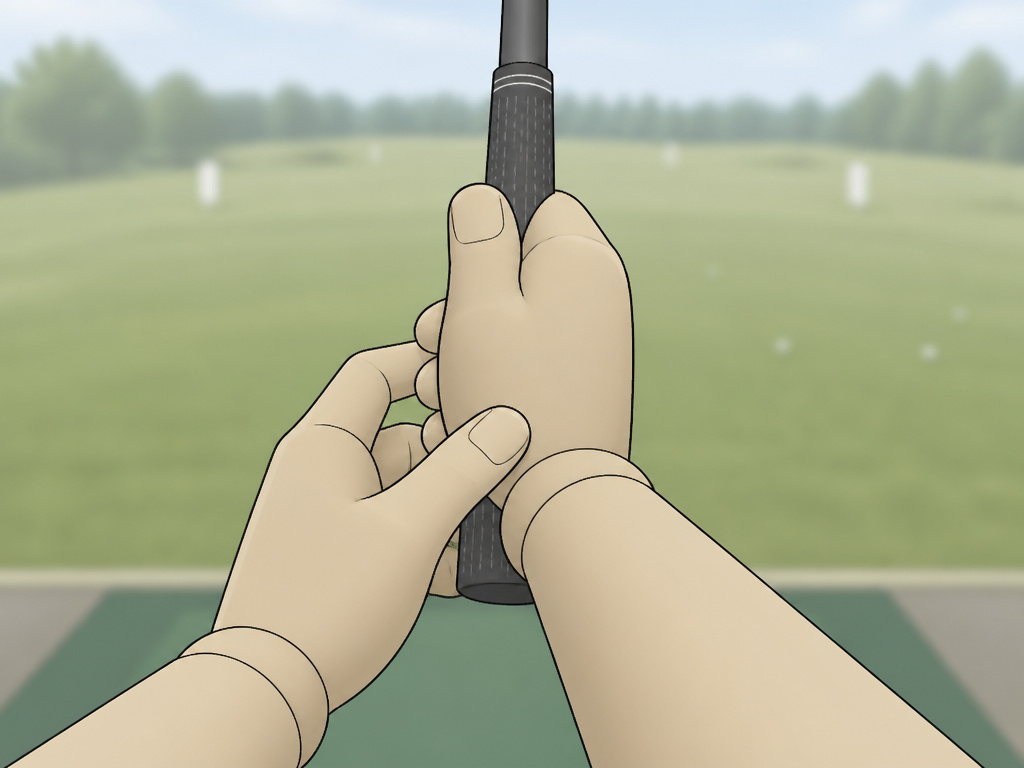
Your grip is the steering wheel. If it’s turned too far to the right (strong), the clubface is pre-set to snap shut through impact. You’ll see three or more knuckles on your left hand at address, and the “V” formed by your thumb and forefinger points well outside your right shoulder.
A strong grip isn’t inherently wrong. Some powerful players use it. But it demands precise timing to prevent the face from closing too early. For most, it’s a liability. Weakening the grip, rotating both hands slightly to the left until you see two knuckles, slows the face rotation. It feels weird for a week. Then the hard left misses stop.
2. An Inside-Out Swing Path
This is the path component of the hook equation. When your swing direction in the downswing is too far from the inside (right of the target line), you’ve set the stage. The body often does this to try and “hit from the inside” for power, but overdoes it.
The feel fix is counterintuitive: try to swing more to the left after impact. This isn’t about an over-the-top slice move. It’s about neutralizing an extreme in-to-out path. A simple driveway or range drill makes it concrete.
Common mistake: Trying to swing more in-to-out to “draw the ball.” This exaggerates the hook miss when the face control isn’t perfect. A neutral path is safer.
3. Faulty Weight Transfer and Body Motion
Your lower body leads the downswing. If it doesn’t, your hands take over. Two specific faults cause hooks.
Early Extension: Your hips thrust toward the ball in the downswing, eliminating the space you created in the backswing. The club gets stuck behind you, and the only way to reach the ball is to throw your hands and flip the clubface closed. You’ll often feel like you’re “humping the ball” and losing your posture.
Reverse Pivot: Your weight stays on your back foot through impact. To compensate, your upper body leans forward, creating an extreme inside path and a shut face. Your finish will feel off-balance, falling back onto your trail foot.
Both faults rob power and force your hands to manipulate the face. The fix is in the ground, learning to shift pressure to your lead side while maintaining spine angle.
4. Ball Position Too Far Back
Where you play the ball dictates when the clubface meets it. Play it too far back in your stance (toward your right foot), and the clubhead is still traveling on a severe in-to-out arc when it makes contact. The face hasn’t had time to square up; it’s still closing.
Move the ball forward. For a driver, just inside your lead heel. For a mid-iron, center of your stance. This small adjustment gives the clubface time to rotate to square by the time it reaches the ball.
5. The Hidden Role of Your Equipment
Sometimes, the hook isn’t you. It’s the stick. This is most common with hybrids and fairway woods, where the stock graphite shaft might be a poor match.
| Equipment Factor | How It Causes a Hook | The Fix |
|---|---|---|
| Hybrid Shaft Too Soft | A shaft with a “weak tip section” or overall low flex kicks forward aggressively, closing the face at impact. This is common in lightweight graphite. | Try a heavier or stiffer hybrid shaft option. The KBS Tour Hybrid Proto, for example, mimics iron shaft stiffness for control. |
| Driver Draw Bias | A clubhead weighted to promote a right-to-left ball flight will exaggerate an existing hook tendency. | Switch to a neutral or fade-biased head setting, if adjustable. Ensure your driver isn’t a “draw model.” |
| Lie Angle Too Upright | If your irons are too upright for your swing, the toe digs, effectively closing the face at impact. | Get a lie angle check. A few degrees flat can open the face at impact. |
Graphite shaft manufacturing can lead to consistency issues. Kim Braly of KBS noted that many graphite hybrid shafts have “large windows of frequency and they tend to be weak or soft,” which can result in a persistent miss left. If you hook your hybrid but not your irons, the shaft is the prime suspect.
Why Shaft Physics Matter (More Than You Think)
The shaft isn’t a passive pipe. It bends and recoils during the swing, influencing where the clubhead is at impact. Research from Sasho MacKenzie’s 2010 forward dynamics model quantified this.
The force you apply at the grip splits into two components: tangential (swinging the club around you) and radial (pulling the club inward). The radial force is significant, reaching over 450 Newtons in a driver swing. This force pulls the shaft into a “toe-down” deflection during the downswing.
Crucially, the shaft’s recoil from its bent position plays an equal role in determining the clubhead’s delivery. Maximum “kick velocity” happens after the clubhead passes the neutral, straight position. This means a flexible shaft can actually delay closure, while a very stiff one might not recoil enough to square the face for a slower swinger.
This is the science behind fitting. The wrong shaft flex can fight your natural timing, making you hook or slice as you subconsciously adjust.
Hook vs. Slice: Understanding the Opposite Problem
 A slice is the mirror opposite, a face open to an out-to-in path. While a hook often comes from an active, rolling release of the hands, a slice usually comes from a passive, held-off release. The fixes are inverses.
If you’re battling a hook, understanding the causes of a slice reinforces what you need to do. Your over-active release is their problem in reverse. The ball flight laws are the same map, just read from a different direction.
How to Start Fixing Your Hook Today
 Don’t try to change everything at once. Pick one root cause and work on it with a specific drill.
- Grip Check: At address, look down. If you see three knuckles, weaken your grip until you see two. Hit half-shots with a 7-iron, focusing only on the new hand position.
- Path Drill: Place a headcover or alignment stick just outside and behind the ball, on the target line. Your goal is to miss it on the backswing and downswing. This encourages a more neutral path, not an extreme in-to-out one.
- Weight Transfer Drill (Step Drill): On your downswing, literally step your trail foot toward your lead foot. This forces your weight forward and prevents a reverse pivot.
- Face Awareness: Practice with a impact sticker on your clubface. After each shot, check where the mark is. Centered and square is the goal. This gives you direct feedback on face angle.
If your hook is persistent, a quality swing trainer can provide the feedback you need to ingrain a new, neutral motion. Devices that monitor club path or face angle are invaluable.
Frequently Asked Questions
Is a hook the same as a draw?
No. A draw is a controlled, modest right-to-left curve (for a righty). A hook is a more extreme, often uncontrollable version of that shape. The difference is in degrees of face closure and spin rate. A draw starts right of target and curves back. A hook starts right and curves violently left, often missing the target left.
Can my clubs cause a hook if my swing is good?
Yes. As outlined, a shaft that is too soft, too light, or has a inconsistent flex profile can close the face prematurely. Similarly, a draw-biased clubhead or irons with a lie angle too upright for your build can promote hooks. If your miss is suddenly a hook with a new club, look at the equipment first.
Why do I hook my driver but not my irons?
This is common and points to two issues. First, the longer shaft and lower loft of a driver magnify swing flaws, especially an inside path. Second, many stock driver shafts are lighter and more flexible than iron shafts, which can exaggerate face closure timing. You might need a stiffer driver shaft or a more neutral clubhead setting.
Is a hook better than a slice?
In terms of distance, often yes. A hook usually has lower spin and more roll, so it can travel farther than a high-spinning slice. However, a hook is often less predictable and can result in more severe penalties (out-of-bounds left vs. Rough right). Most instructors would prefer to fix either extreme.
How does the USGA view “spining” a shaft to reduce hooks?
The USGA equipment rules on shafts acknowledge that graphite shafts can have a “spine.” They allow for “reasonable tolerance” if the shaft is manufactured with the intent to conform. However, the rules state that orienting a shaft “for the purpose of influencing the performance of a club, e.g., to correct wayward shots, would be contrary to the intent.” Essentially, using spining to intentionally correct a hook could render the club non-conforming for sanctioned play.
The Bottom Line
A hook is a feedback loop. A strong grip or inside path shuts the face, so you aim right, which makes you swing more inside, which shuts the face more. Break the loop at the source.
Start with your grip and ball position, these are static fixes you can make before you even swing. Then, work on moving your weight forward without lunging at the ball. If the hook persists, look at your hybrid or fairway wood shaft. The answer is almost never “swing harder.” It’s in matching your mechanics to the immutable laws of face and path. Once you do, that destructive left curve becomes a playable draw.
