
Golf Club Loft Explained Simply: Why the Angles Matter
This post contains affiliate links. As an Amazon Associate, we earn from qualifying purchases.
Golf club loft is the angle between the clubface and a vertical line. More loft sends the ball higher with more spin; less loft sends it lower with more roll. The number on your club is a set position, not a universal standard—a modern 7-iron can be 28°, while an older one might be 35°.
That gap between the number and the real angle is where most confusion starts. Manufacturers have spent thirty years quietly strengthening lofts to sell distance, so trusting the stamped digit is a mistake. Your bag’s performance lives in the actual degrees, not the marketing.
What follows: the simple physics of loft, the real ranges for every club type, and the three measurements that decide whether your set is gapped or garbled.
Key Takeaways
- The number on your club is a lie. A 7-iron’s loft can vary by 8 degrees between brands. The stamped number tells you the club’s place in the set sequence, not its actual angle.
- Loft changes over time. Ground impact can weaken an iron’s loft by several degrees over two seasons. What you bought isn’t what you’re hitting now.
- Manufacturing isn’t perfect. New clubs have a tolerance of ±1° to ±2°. Two “identical” drivers off the shelf can deliver different ball flights right out of the box.
- Putter loft has a hard limit. The Rules of Golf state a putter’s loft must not exceed 10 degrees. Most sit between 3° and 4° to lift the ball from its pitch mark.
- Bending has limits. You can adjust a forged iron’s loft by 1°–2° safely. Bending a metal wood’s hosel, however, changes the face angle and can ruin your shot direction.
What is Golf Club Loft? (The Simple Definition)
Golf club loft is the angle, measured in degrees, between the face of the club and a perfectly vertical line. Imagine holding a club so the shaft is straight up and down; the amount the face leans back is the loft.
Loft is the primary governor of launch angle and spin. A higher-lofted club, like a 60-degree lob wedge, presents a more laid-back face to the ball, launching it high with lots of backspin for a soft landing. A lower-lofted club, like an 8-degree driver, presents a more vertical face, producing a lower, piercing ball flight that maximizes roll.
This angle is a static measurement. What actually happens at impact—your dynamic loft—is a blend of this static number, your angle of attack, and the shaft’s behavior. The static loft sets the baseline.
Why-Layer: Loft works by changing the vertical force component of the impact. A more upright face directs force more horizontally, propelling the ball forward. A more laid-back face directs more force upward, fighting gravity to create a higher trajectory. The spin comes from friction between the grooved face and the ball’s cover; more loft typically means more friction and more backspin.
Driver, Wood, Hybrid, Iron, Wedge, Putter: The Real Loft Ranges
Forget “standard.” Loft is a range, and where your club sits in that range changes everything about your distance gaps.
| Club Type | Typical Loft Range | Best For / Key Detail |
|---|---|---|
| Driver | 8° – 12° | Faster swings (100+ mph) use lower lofts (8°–9.5°). Slower swings need 10.5°–12° for carry. |
| 3-Wood | 13.5° – 16° | Most stock 3-woods are 15°. Lower lofts here favor better players with high swing speed. |
| 5-Iron (Modern) | 21° – 24° | This is the “loft jacking” epicenter. A modern 5-iron often has the loft of an older 3-iron. |
| Pitching Wedge (PW) | 42° – 48° | Game-improvement iron sets often have PWs as strong as 42°, creating a huge gap to your sand wedge. |
| Sand Wedge (SW) | 54° – 56° | Designed for bunker play and full shots. The loft must be spaced 4°–6° from your PW. |
| Putter | 3° – 4° (Max 10°) | The 3°–4° range helps the ball roll cleanly. The Rules of Golf set the maximum legal putter loft at 10 degrees. |
A modern driver loft fits your swing speed. Slower swings need more loft to get the ball airborne and maximize carry. Faster swings with a positive angle of attack can use less loft to reduce spin and optimize total distance.
Fairway woods and hybrids follow a similar logic. A 7-wood (21°–22°) is far easier to hit than a 3-iron of the same loft because the wood’s larger head and lower center of gravity launch the ball higher.
Where this goes sideways: Assuming your wedges are spaced correctly. If your game-improvement pitching wedge is 43°, and your next wedge is a 56° sand wedge, you have a 13-degree gap. That translates to a 30–40 yard hole in your scoring arsenal. You need a 48°–50° gap wedge.
Irons are where the “standard” myth falls apart completely.
The Loft Inflation Problem (Why Your 7-Iron is a 5-Iron)
Manufacturers have aggressively strengthened iron lofts over the past 30 years. They do this by moving weight low and deep in the clubhead, which helps launch the ball high even with a stronger (lower-lofted) face. The result? Your new 7-iron goes as far as your old 5-iron. The marketing team sells distance; your gap wedge gets lonely.
| Iron | Traditional Loft (c. 1990) | Modern “Players” Iron | Modern “Distance” Iron |
|---|---|---|---|
| 5-Iron | 30° | 26° | 21° – 23° |
| 7-Iron | 37° | 34° | 28° – 31° |
| 9-Iron | 46° | 42° | 38° – 41° |
| P-Wedge | 51° | 46° | 42° – 44° |
This table isn’t hypothetical. It’s compiled from actual spec sheets. Notice the modern distance 9-iron (39°) is stronger than a traditional 7-iron (37°). That’s two whole clubs of difference hiding under the same number.
Why-Layer: The physics is about vertical gear effect. By lowering the center of gravity (CG), the clubhead twists slightly upward at impact, imparting more dynamic loft and higher launch than the static loft would suggest. This lets engineers decrease static loft (for more forward energy and less spin) while maintaining a playable trajectory. The golfer gets more distance; the manufacturer gets a marketing bullet point.
The problem is gapping. You now have only 12–14 degrees of loft spread across your 5-iron through pitching wedge, where you used to have 20+. This compresses your distances and creates a massive void between your strong PW and your sand wedge. You must fill it with specialty wedges.
Static Loft vs. Dynamic Loft: What You See vs. What You Get
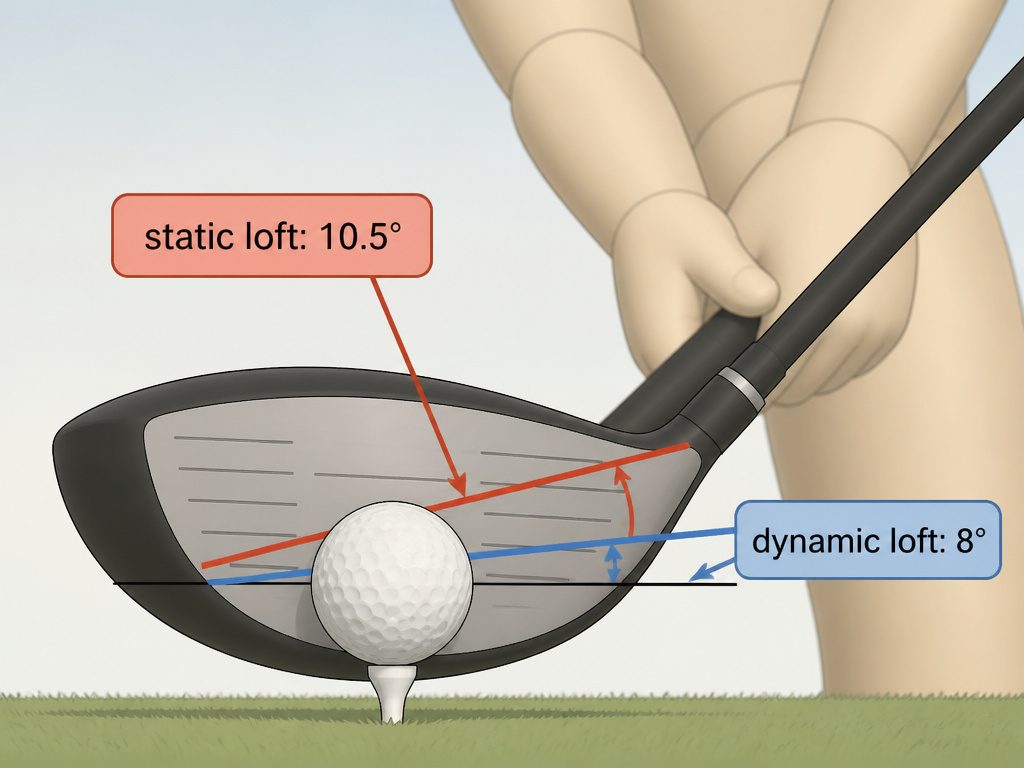
Your club’s stamped loft is its static loft—the angle measured in a lab. Dynamic loft is the actual loft of the clubface at the moment of impact. This is the number that matters.
Dynamic loft is static loft plus or minus your delivery. If you hit down on the ball (negative angle of attack), you decrease dynamic loft. If you sweep up on it (positive angle of attack), you add loft. A shaft that bends forward at impact can also reduce dynamic loft.
A player with an excessively steep attack angle can turn a 10.5° driver into an effective 8° driver at impact. That’s why launch monitor data is non-negotiable for fitting. The static spec on the website is just the starting point.
This is why two golfers with the same driver can have wildly different ball flights. Their swings deliver different dynamic loft. A good club fitter uses a launch monitor to find the static loft that produces your ideal dynamic loft and launch conditions.
How to Find and Adjust Your Clubs’ Real Loft
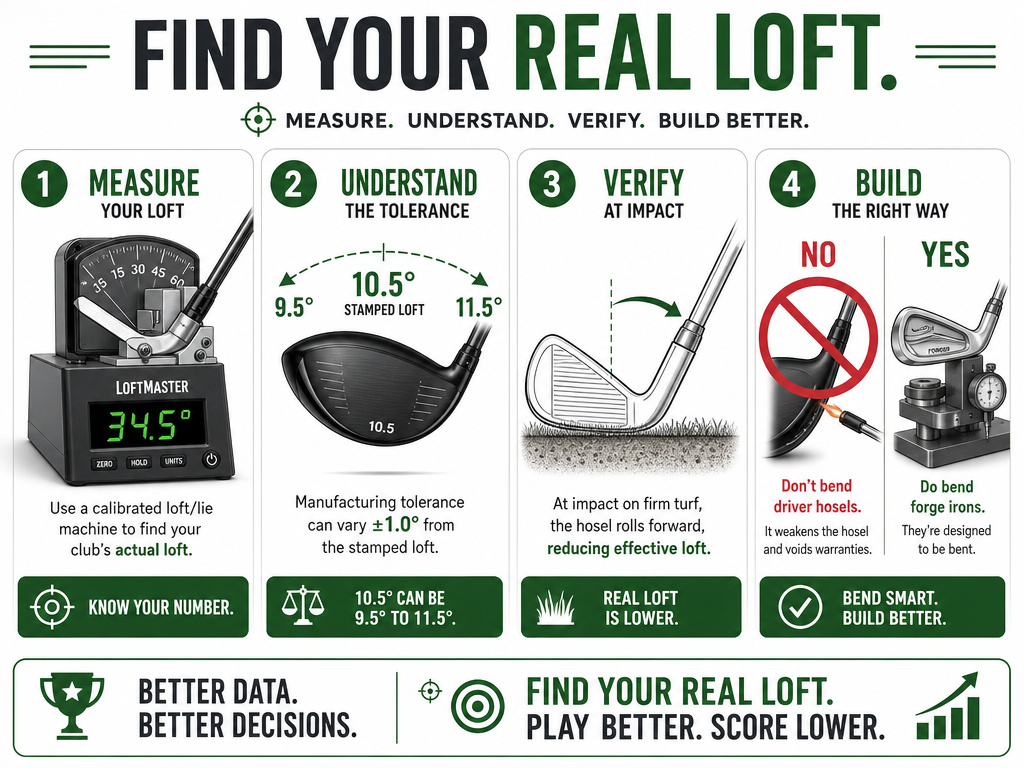
You cannot trust the spec sheet. You need to measure.
- Get on a Loft and Lie Machine. This is the only way. Any reputable club fitter or repair shop (often at a golf course) has one. The process takes minutes and tells you the exact loft and lie of every club in your bag. The cost is trivial compared to the insight.
- Understand Manufacturing Tolerance. The Mitchell Golf guide notes that new clubs can be ±1° to ±2° off their stated loft. Your “10.5° driver” could be 9.5° or 11.5°. This is normal in mass production, but it’s your problem if the clubs aren’t gapped.
- Check for Loft Drift. That favorite 7-iron you’ve hit off hard turf for two years? The hosel can gradually roll forward from ground impact, weakening the loft. A club that started at 31° might now be 33°. It happens over hundreds of strikes.
- Bend with Caution. Forged irons and many cast irons can be bent 1°–2° strong or weak to fine-tune gaps or trajectory. This is a job for a pro with a bending machine. Do not attempt to bend metal woods. Bending the hosel on a driver or fairway wood changes the face angle, which will alter your shot direction dramatically.
The Rules of Golf: What’s Legal and What’s Not
For tournament play, your equipment must conform to The Equipment Rules, published jointly by The R&A and the USGA. The 2024 rules are clear on loft.
The key limit: A putter’s loft must not exceed 10 degrees. Most putters have 3°–4° to help the ball roll smoothly out of its slight depression. The rule exists to prevent someone from using a highly-lofted putter to effectively chip on the greens.
For other clubs, there are no maximum loft limits. There is, however, a rule against “non-traditional” forms. The rules document suggests that a negative loft exceeding 15 degrees (a face pointing downward) would not be considered traditional.
The player’s responsibility: Rule 4.1 states it is the player’s own duty to ensure their clubs conform. If in doubt, consult the governing bodies. Making a stroke with a non-conforming club in competition leads to disqualification.
This is why buying from reputable manufacturers and having adjustments done by certified technicians matters. It keeps your gear legal.
Frequently Asked Questions
What is a good loft for a beginner driver?
Beginners and players with slower swing speeds (under 85 mph) should look for drivers with 10.5 to 12 degrees of loft. The extra loft helps get the ball airborne, maximizes carry distance, and is more forgiving on off-center hits. Ignore the low-lofted drivers pros use.
How much does 1 degree of loft affect distance?
For a driver, 1 degree of loft change can alter carry distance by 2-4 yards, depending on your swing speed and delivery. For irons, the effect is similar but part of a larger system—the main goal is consistent gapping, not max distance on one club.
Can I increase the loft on my driver?
Many modern drivers have adjustable hosels that allow you to change loft, usually within a range of ±1.5 degrees. Turning the hosel to a higher setting adds loft and can also slightly close the face angle. Check your driver’s manual for specific adjustment instructions.
Why are modern irons so strong?
Manufacturers strengthen lofts (make them lower) to market increased distance. By lowering the center of gravity, they can maintain a high ball flight with the stronger loft, so the 7-iron goes farther. It’s a technical reality, but it distorts club numbers and creates larger gaps at the bottom of your bag.
What is the loft of a sand wedge?
Standard sand wedge loft is between 54 and 56 degrees. This loft is designed for bunker play and full-swing approach shots from the fairway. It should be spaced approximately 4-6 degrees from your gap wedge and/or lob wedge to ensure even distance gaps.
How often should I check my lofts?
If you play regularly, have your lofts checked once a year. Over time, clubs can bend from impact and bag chatter. An annual check-up at a fitter with a loft and lie machine ensures your specs are still correct and your distance gaps haven’t drifted.
The Bottom Line
Loft isn’t just a number on a chart. It’s the fingerprint of your set, unique to the clubs in your bag right now. The stamped number is a suggestion, not a law. Real performance comes from knowing your actual degrees, understanding how they’ve been shifted by marketing, and ensuring they progress evenly from your longest club to your shortest.
Spend thirty minutes with a loft and lie machine. Map your real specs. That data sheet is worth more than any new club purchase, because it tells you what you’re actually working with. Then you can build your wedge system, tune your driver, and close those distance gaps for good. Your scores will thank you.
