
The Complete Guide to Golf Club Bounce for Better Short Game
This post contains affiliate links. As an Amazon Associate, we earn from qualifying purchases.
This post contains affiliate links. As an Amazon Associate, we earn from qualifying purchases.
Golf club bounce is the angle between the leading edge and the lowest point of the sole. This angle, combined with sole width and camber, determines how the club interacts with turf or sand, skimming versus digging. Low bounce (4-6°) suits firm conditions and shallow swings; mid bounce (7-10°) is versatile; high bounce (10°+) prevents digging in soft conditions or for steep swings.
That stamped number on your wedge is a starting point, not the whole story. The real performance comes from “Effective Bounce,” a combination of five sole design factors that change with how you deliver the club. A 13-degree wedge can play with less effective bounce than a 10-degree model if its sole is narrow or heavily ground.
What follows: a breakdown of the stamped angle myth, the five factors of effective bounce, and how the latest rules and patents reveal where traditional fitting advice falls short.
Key Takeaways
- Effective Bounce, not the stamped angle, dictates turf interaction. Sole width, camber radius, leading edge grind, and proper lie angle change how a wedge performs.
- Shaft lean and face angle change bounce dynamically. Forward shaft lean delofts the club, reducing effective bounce; opening the face adds loft, increasing it.
- The USGA’s 2024 Equipment Rules distinguish “wear” from “damage.” A conforming club remains legal despite wear, but you cannot deliberately alter its playing characteristics during a round.
- Low bounce (4-6°) is expert-only on soft turf. Below 0.101 in.² of effective bounce, the club becomes prone to digging and inconsistent strikes for most players.
- New patent designs aim for variable bounce. Adjustable sole members and variable bounce across the heel-toe axis are in development to adapt to changing course conditions.
What is Golf Club Bounce?
Rest a wedge on a flat surface. The leading edge sits off the ground. The space between that edge and the sole’s lowest point forms the bounce angle.
Think of a water ski planing across a lake. Bounce lets the sole skim through sand or turf instead of digging like a shovel. It’s a built-in forgiveness mechanism for when your strike is a fraction heavy or the lie is softer than you judged.
The Technical Definition: Bounce is the angle measured from the leading edge tangent to the sole’s lowest point when the club is in its designed address position. It is one component of “Effective Bounce,” which also includes sole width, sole camber, leading edge grind, and lie angle.
This is where most guides stop. They match a stamped number to a swing type. The reality is more nuanced. Your swing delivers the club with a certain attack angle and shaft lean. The turf has a specific firmness. The sole has a three-dimensional shape. All three variables interact at impact.
Where this goes sideways: Choosing a wedge based only on the stamped bounce angle. A high-bounce wedge with a narrow, heavily cambered sole can play like a low-bounce club. A low-bounce wedge with a wide, flat sole can offer more forgiveness. This is why two golfers with the same attack angle can have completely different experiences with the same wedge model.
How Shaft Lean and Face Angle Change Everything
You don’t deliver the club square and neutral on every shot. Your adjustments change the bounce you actually use.
Forward shaft lean, hands ahead of the ball at impact, delofts the club. This presents more leading edge to the ground, reducing the effective bounce. It’s why a steep swinger can still dig with a high-bounce wedge if their hands are too far forward.
Opening the clubface for a flop shot increases loft. This exposes more of the sole to the ground, increasing the effective bounce. A lob wedge with 8 degrees of bounce can play with the effective bounce of a sand wedge when opened up.
This manipulation is a skill. It’s also a trap. If you don’t understand how your technique alters the club’s geometry, you’ll blame the wedge for mistakes you’re creating.
The Three Bounce Categories (And Where They Fail)
The low-mid-high framework is useful, but it’s a broad generalization. Here’s what each category is designed for, and the specific condition that breaks it.
| Bounce Category | Stamped Angle | Designed For | Fails When |
|---|---|---|---|
| Low Bounce | 4° – 6° | Firm turf, tight lies, hard sand, shallow attack angles. | Used in soft conditions; the leading edge digs and the clubhead stops. |
| Mid Bounce | 7° – 10° | Average conditions, neutral divots, most versatile. | The sole is too wide for very tight lies or too narrow for very soft sand. |
| High Bounce | 10°+ | Soft turf, fluffy lies, deep sand, steep attack angles. | The sole “bounces” off hardpan, leading to thin, bladed contact. |
Low Bounce (4-6°): The Tight-Lie Specialist
This is for sweepers. If you brush the grass with minimal divot, low bounce keeps the leading edge close to the ground for clean contact on firm fairways and tight lies around the green. It’s essential for hard-packed bunkers where you need the club to slide under the ball, not bounce off the concrete-like sand.
The catch? It offers almost no margin for error in soft conditions. Hit slightly behind the ball on damp turf and the wedge digs. The clubhead stops, the ball goes nowhere, and you’ve left a crater. This is why low-bounce lob wedges are scoring weapons in the right hands and frustration machines in the wrong conditions.
Mid Bounce (7-10°): The Default, Not Always Correct
Mid bounce is the safe recommendation because it does nothing terribly. It works from average fairways, moderate rough, and bunkers with normal sand. For a player with a neutral attack angle taking a moderate divot, it’s a reliable choice.
Its weakness is its compromise. On very firm ground, that 8 degrees of bounce can still cause the club to deflect, leading to thin shots. In very soft sand, it might not have enough sole to prevent digging. It’s a jack-of-all-trades, master of none.
High Bounce (10°+): The Digging Preventer
A high-bounce wedge is insurance against fat shots. The wide, angled sole pushes through soft turf and fluffy sand, keeping the clubhead moving. If you have a steep attack angle and take deep divots, high bounce is non-negotiable. It turns a chunk into a slightly heavy shot that still reaches the green.
The common fear is that high bounce causes skulled shots. That’s usually a delivery issue, trying to help the ball up and adding loft late. The real failure mode for high bounce is hardpan. On bare, firm ground, the sole can literally bounce the leading edge into the middle of the ball. You get that infuriating thin line-drive that screams over the green.
The Five Factors of “Effective Bounce”
The stamped angle is just one variable. Expert fitters at places like Engineered Golf talk about five elements that combine to create the bounce you actually experience.
- Bounce Angle: The stamped number. It sets the baseline.
- Sole Width: A wider sole increases effective bounce by presenting more surface area to the ground. A narrow sole decreases it.
- Sole Camber/Rocker: The curvature of the sole from front to back. More camber (a rounded sole) reduces effective bounce by minimizing ground contact. A flat sole maximizes it.
- Leading Edge Grind: Relief ground into the heel or toe of the sole. This allows you to open or close the face without drastically altering the bounce, crucial for shot-making.
- Proper Lie Angle: If the lie angle is too upright or too flat, the sole won’t interact with the ground as designed. The leading edge or heel can dig, negating the bounce.
I prefer the term “Effective Bounce” when dealing with all the many sole design elements. A 13-degree wedge doesn’t automatically perform with greater bounce than a 10-degree wedge. The sole width and grind can reverse that relationship.
This is why buying wedges off the rack is a gamble. A complete guide to wedge bounce and grind dives deeper into how grinds like the Vokey M, D, or C alter these factors for specific techniques.
How to Diagnose Your Bounce Needs
Don’t start with a number. Start with your common misses and your course conditions.
- You take deep divots and play on soft courses. You need higher effective bounce. Look for wedges for average golfers with wider soles and bounce angles of 10° or more in your sand and gap wedges.
- You are a sweeper who plays firm, links-style turf. Lower effective bounce is your friend. Seek narrower soles with moderate camber and bounce angles in the 6-8° range.
- You constantly blade shots from tight lies. Your bounce might be too high for the conditions, or your technique is adding loft. Try a wedge with less bounce and focus on keeping your hands ahead through impact.
- Your wedge digs violently in bunkers. You need more sole width and bounce. A specialized sand wedge for average golfers with 12-14° of bounce will glide through the sand.
The best test is impact. Use a wet face spray or foot powder spray on the sole. Hit a few shots from a lie similar to your course. Where does the sole make contact? If it’s only on the leading edge, you need more effective bounce. If it’s a long smear way back on the sole, you might have too much.
Rules, Wear, and the Future of Bounce
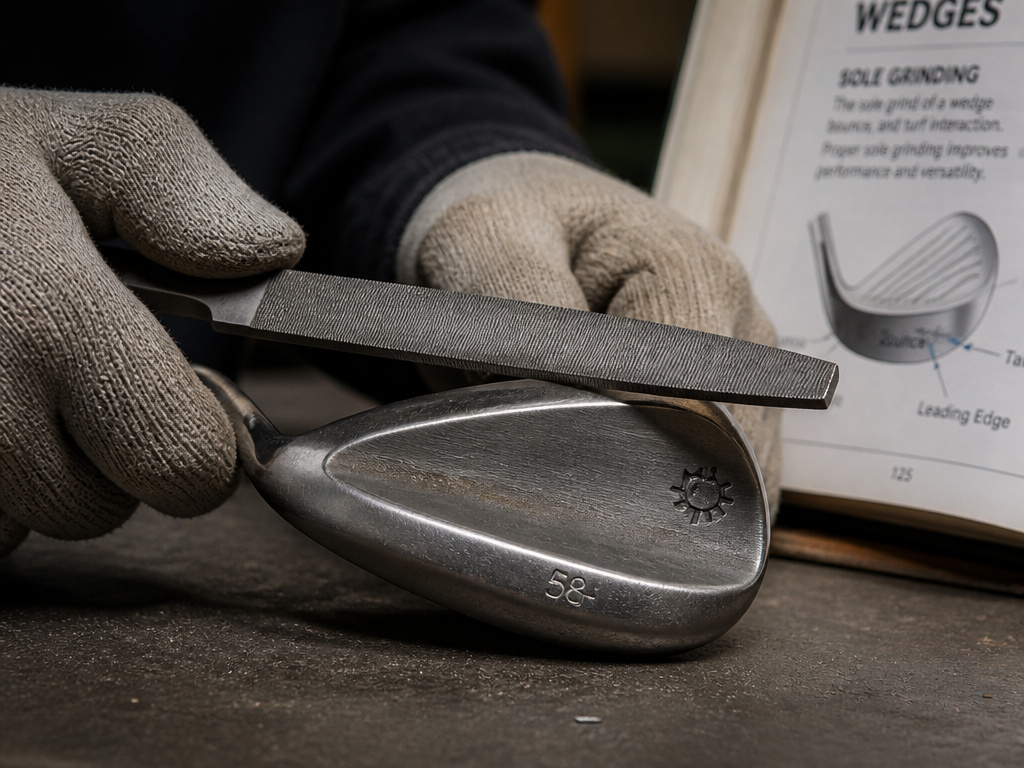
The USGA and R&A’s Equipment Rules, updated for 2024, draw a critical line between “wear” and “damage.” Normal wear from play, grinding down the sole and bounce from sand and turf, does not make a conforming club illegal. You cannot, however, deliberately alter your club’s playing characteristics during a round.
Rule 4.1a(3): “A player must not make a stroke with a club when they have deliberately changed its playing characteristics during the round.”
This means you can’t take a file to your wedge’s sole between holes to reduce the bounce. That’s a penalty. But if your 10-degree bounce wedge wears down to 8 degrees over three seasons, it’s still legal. This rule protects the intent of the game while acknowledging reality.
The Patent Pipeline: Adjustable and Variable Bounce
The future isn’t a fixed number. Patents reveal where manufacturers are looking next.
US Patent 10137341, assigned to Karsten Manufacturing (Ping), describes a club head with a recess that accepts different attachment members. Swap a thin plate for a thicker one, and you change the bounce height and effective sole width. The goal is a single club head adaptable to morning dew versus afternoon crust.
Another application describes variable bounce across the sole, more bounce in the center for standard shots, less at the heel for relief on open-faced shots. This seeks to solve the problem of a single bounce angle trying to fit multiple lie scenarios.
These are responses to a real problem: a golfer plays in varied conditions, but their equipment is static. The next generation of game improvement irons and wedges may bring this adjustability from the driver down into the scoring clubs.
Building Your Wedge Setup
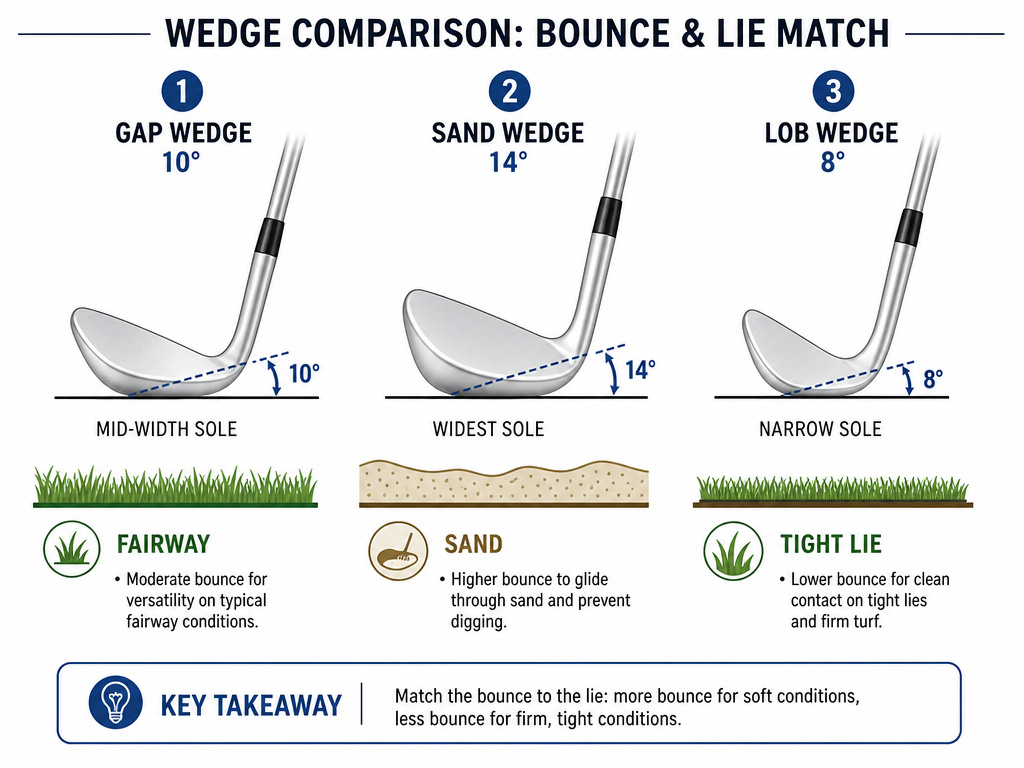
Your wedges are a system. They should cover distances and conditions without overlap or gaps in performance.
A typical three-wedge wedge sets configuration might be a 50° gap wedge, a 54° sand wedge, and a 58° lob wedge. Vary the bounce to match their primary jobs.
- Gap Wedge (48°-52°): Used for full swings from the fairway. Mid-bounce (10°) is a safe default. It provides enough forgiveness for slightly heavy contact without bouncing on tight lies.
- Sand Wedge (54°-56°): Your bunker and soft-condition weapon. This is where high bounce (12°-14°) pays dividends. It should have the widest sole in your bag to glide through sand.
- Lob Wedge (58°-60°): For finesse shots and tight lies. Lower bounce (6°-8°) offers versatility. Since you often open the face, which adds effective bounce, you don’t need a high stamped number.
Don’t copy a pro’s setup. They play pristine, firm conditions most weeks. Most amateurs play softer public courses. Your sand wedge likely needs more bounce than theirs. For a deep dive on this, our guide on when to use each wedge breaks down the decision by yardage and lie.
Frequently Asked Questions
What bounce should a beginner use?
Beginner should err toward mid-to-high bounce (10°-12°) in their primary sand wedge. It reduces the penalty for hitting slightly behind the ball, which is the most common short-game mistake. A forgiving sand wedge with a wide sole will build confidence faster than a low-bounce blade.
Can you have too much bounce?
Absolutely. On very firm ground, hardpan, or tightly mowed collection areas, too much bounce prevents the leading edge from getting under the ball. The sole contacts the ground first and skids, causing thin contact. If you play a lot of links or firm parkland courses, limit high bounce to your sand wedge only.
Does bounce affect spin?
Indirectly, yes. Bounce affects turf interaction. A clean strike with proper compression creates spin. If the club digs (too little bounce) or bounces (too much bounce), strike quality suffers, and spin plummets. For pure spin generation, focus on clean contact first, then explore wedges for spin with fresh, sharp grooves.
How do I know if my bounce is wrong?
Your misses tell you. Consistent fat shots, especially from rough or soft sand, suggest you need more bounce. Consistent thin shots from tight fairway lies suggest you need less bounce. Also, look at your divots. A deep, narrow trench means digging, add bounce. A shallow, long scrape means bouncing, reduce bounce or add more camber.
Do all wedge brands measure bounce the same?
No. There is no industry standard for where or how to measure the bounce angle. One brand’s 10 degrees might be another’s 12. This is why “Effective Bounce” and physical testing are more important than the number. Always test, don’t assume.
The Bottom Line
Bounce is a dynamic interaction between your swing, the club’s sole, and the ground. The stamped angle is a clue, not the answer.
Start with your most common conditions and your most common miss. Choose a wedge selection that offers forgiveness where you need it. For most players, that means a higher-bounce sand wedge and a more versatile, mid-to-low bounce lob wedge.
Remember, you can change the effective bounce with your setup and swing. Hands forward reduces it. Open face increases it. Learn that skill, and a single wedge can handle more situations than the stamped number implies. The goal is to understand how bounce works so you can make any wedge work for you.
