
When to Use Which Wedge – The Definitive Guide for Golfers
This post contains affiliate links. As an Amazon Associate, we earn from qualifying purchases.
This post contains affiliate links. As an Amazon Associate, we earn from qualifying purchases.
To decide when to use which wedge, match three things: the yardage to the pin, the lie of the ball, and the obstacle between you and the hole. The pitching wedge (44-48°) covers full swings from 110-130 yards. The gap wedge (48-52°) fills the 90-110 yard slot. The sand wedge (54-58°) handles bunkers and rough from 70-90 yards. The lob wedge (58-64°) is for short, high shots over hazards from inside 70 yards.
That’s the basic map, but it’s static. Your actual decision happens in real time, with grass under your feet and wind in your face. The loft printed on the sole is just the starting point.
What follows breaks down the three variables that change the club in your hands: the number on your rangefinder, the texture of the turf, and the shape of the shot you need to play. By the end, you’ll have a system, not just a chart.
Key Takeaways
- Your pitching wedge is a full-swing distance club, not a short-game tool. Use it for approach shots from clean lies.
- The gap wedge exists because modern iron lofts have created a 20-30 yard hole between your PW and SW. Ignoring it costs you two strokes a round.
- Bounce is for conditions, loft is for height. A high-bounce sand wedge digs in fluffy sand and soft turf. A low-bounce lob wedge slides under the ball on tight lies.
- Distance control with wedges isn’t about swinging harder; it’s about the clock system. A “9 o’clock” swing with your 56° wedge goes a consistent 60 yards every time.
- Most amateurs carry a lob wedge they cannot hit. If you fear blading it over the green, use your sand wedge and play a bump-and-run.
The Simple 3-Step Wedge Decision Tree
Forget memorizing a chart. When you’re standing over the ball, run through this sequence. It takes five seconds.
Step 1: What’s the distance to the pin?
This picks your baseline club. If you have 115 yards to a front pin, that’s a smooth pitching wedge. If you have 50 yards to a back pin over a bunker, that’s a lob wedge. Your full-swing distances with each wedge are the foundation. You must know them.
Common mistake: Guessing wedge distance. If you don’t know your full-swing yardage with each wedge within a 5-yard window, you are guessing. Write them down.
Step 2: What’s my lie?
This adjusts your club selection from Step 1. A bad lie often means adding loft. * Tight Fairway / Hardpan: Use less bounce. The club needs to slide, not dig. A low-bounce wedge or your gap wedge is better than a high-bounce sand wedge here. * Fluffy Rough / Soft Sand: Use more bounce. The wide sole prevents digging. This is where your sand wedge earns its name. * Buried Lie (Fried Egg): Add loft and use a steeper swing. You often need your most lofted wedge to get under the ball, even if the distance says otherwise.
Step 3: What’s in my way?
This decides the shot shape, which can override the first two steps. * Clear path to the hole: Consider a low bump and run with a less-lofted club. It’s more reliable. * Bunker or mound in front: You need height. This mandates your sand wedge or lob wedge. * Pin cut tight behind a bunker: This is a flop shot situation, demanding your highest-lofted wedge and a committed swing.
If these three answers point to different clubs, the obstacle (Step 3) usually wins. You can’t run the ball through a sand trap.
Your Essential Wedge Yardage Gaps
This table assumes standard modern lofts. Your clubs may vary, which is why step one is knowing your own numbers.
| Wedge Type | Standard Loft | Full-Swing Yardage (Men) | Full-Swing Yardage (Women) | Primary Job |
|---|---|---|---|---|
| Pitching Wedge (PW) | 44° – 48° | 110 – 130 yds | 70 – 90 yds | Full-swing approach shots |
| Gap Wedge (GW) | 48° – 52° | 90 – 110 yds | 60 – 75 yds | Filling the 20-30 yard gap |
| Sand Wedge (SW) | 54° – 58° | 70 – 90 yds | 50 – 65 yds | Bunkers, fluffy lies, high shots |
| Lob Wedge (LW) | 58° – 64° | 40 – 70 yds | 30 – 50 yds | Short flops, clearing high hazards |
The bottom line: If your full-swing gap between your pitching wedge and sand wedge is more than 25 yards, you need a gap wedge. It’s not optional.
Pitching Wedge vs. Gap Wedge: The Distance Savers
Think of your pitching wedge as your 10-iron. With modern sets strengthening lofts, a pitching wedge is often 44 degrees—it’s a distance iron. You use it for full swings from the fairway when you have a clean look at the green.
The gap wedge was invented because that pitching wedge loft got so strong it left a canyon before your sand wedge. If your PW goes 125 and your SW goes 85, you have a 40-yard desert with no club to cross it. You end up trying to feather a PW or smash a SW, and both miss the green.
A gap wedge is your bridge club. It gives you a confident, full swing for those in-between distances. For most players, the Cleveland CBX 2 is the easiest gap wedge to hit well straight out of the box.
Your gap wedge is also your primary club for longer bump and run shots from just off the green. It provides enough loft to clear a fringe but not so much that the ball balloons and stops dead.
Sand Wedge vs. Lob Wedge: The Short-Game Specialists
This is where conditions and technique take over. Loft is important, but bounce is the secret handshake.
Bounce is the angle between the leading edge and the lowest point of the sole. Think of it as a ski on the bottom of your club. More bounce (10-14°) prevents digging in soft ground. Less bounce (4-8°) allows the leading edge to get close to the ball on hard ground.
| Condition | Recommended Bounce | Why It Works | Risk of Using the Wrong Wedge |
|---|---|---|---|
| Soft Sand, Fluffy Rough | High Bounce (10°+) | The wide sole glides through sand, preventing dig. | Club digs, ball stays in bunker. |
| Wet Fairway, Tight Lie | Low Bounce (4-8°) | Leading edge sits lower, cleaner contact. | Club bounces into ball, causing a thin or bladed shot. |
| Average Conditions | Mid Bounce (8-10°) | Versatile for most lies. | Slight mishits are forgiven. |
Sand Wedge (54-58°): This is your workhorse. It has enough loft for high shots and enough bounce for forgiveness. Use it for: * All standard greenside bunker shots. * Full-swing approach shots from 80 yards. * Pitches from rough where you need the bounce to slice through grass. The Titleist Vokey SM9 in 56° with 10-12° of bounce is the tour standard for a reason.
Lob Wedge (58-64°): This is a specialist tool, not a default. Use it only when you need maximum height and minimum roll. * Short-sided pins with a bunker in front. * Hitting over a hazard from tight lies close to the green. * When you have no green to work with. If you struggle with thin contact, a Callaway Jaws Raw lob wedge has aggressive grooves that help generate spin even on slight mishits, giving you a margin for error.
Where this goes sideways: Using a 60-degree lob wedge from a tight fairway lie with a low-bounce sole. The leading edge digs, the ball rockets over the green, and you’re left with the same shot all over again. If the lie is tight, use your sand wedge.
Matching Bounce to Your Course Conditions
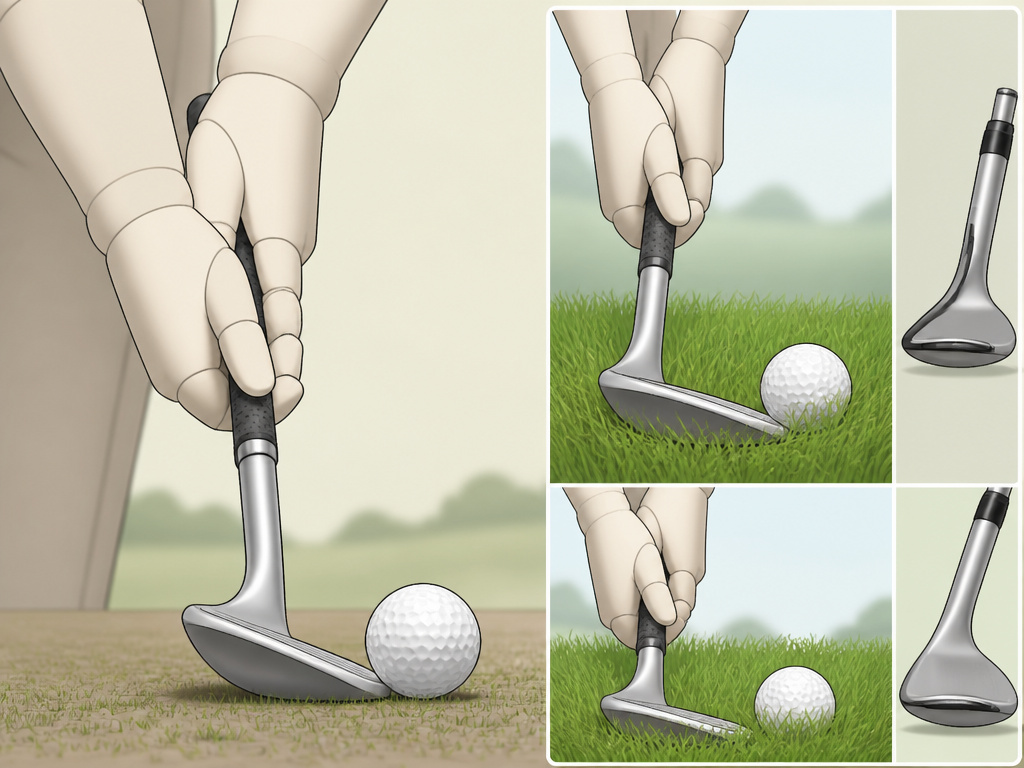
Your wedge setup shouldn’t be static. It should reflect where you play most.
For firm, links-style courses: You want lower bounce. The ground is hard, and the turf is thin. A low-bounce lob wedge (like a 60° with 6° bounce) is essential for nipping the ball cleanly. Your sand wedge should also be on the lower end, maybe 8-10°.
For soft, parkland courses: You want higher bounce. The ground is soft, the rough is lush, and the bunkers are fluffy. A high-bounce sand wedge (56° with 12-14° bounce) will save you from digging disasters. A mid-bounce lob wedge is safer here.
The one-wedge solution: If you only carry three wedges total, make your sand wedge a 54° or 56° with mid-bounce (around 10°). It’s the most versatile loft and bounce combo for unknown conditions.
How to Control Distance with Any Wedge
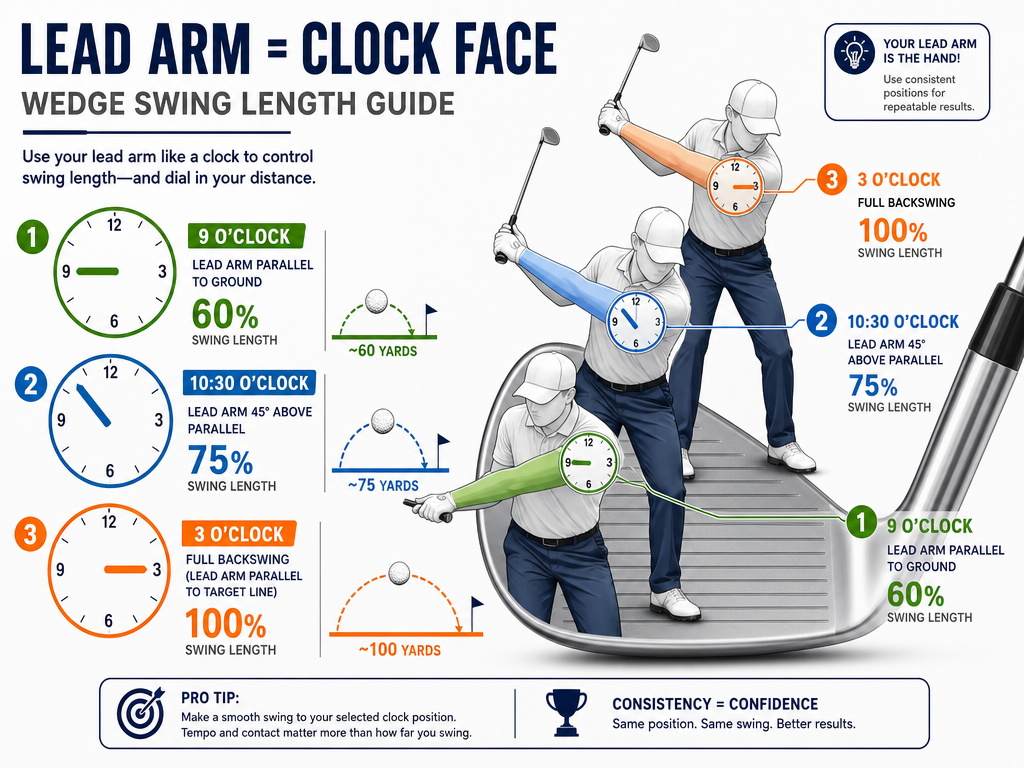
Full swings are only part of the story. Scoring happens inside 100 yards, where you’re never taking a full swing. This is where amateurs lose strokes by decelerating or trying to manipulate their swing.
Use the clock system.
Imagine your lead arm is the hour hand on a clock. A full swing is “9 o’clock” to “3 o’clock.” * 9 o’clock swing (arm parallel to ground): Goes ~60% of your full distance. * 10:30 swing: Goes ~75% of your full distance. * Full swing (3 o’clock): 100% distance.
Here’s how to build your ladder: 1. Take your sand wedge (56°). 2. Hit ten balls with a smooth 9 o’clock swing. Measure the average carry. 3. Repeat for 10:30 and full swing. 4. Write down the three numbers. That’s your wedge distances ladder for that club. 5. Repeat for your gap wedge and lob wedge.
Suddenly, a 50-yard shot isn’t a guess. It’s a 9 o’clock swing with your 56°. A 30-yard shot is a 9 o’clock swing with your 60°. It’s mechanical, repeatable, and takes the fear out of partial wedge shots.
Building Your Personal Wedge Setup
You can’t carry all the options. Most players should carry three, maybe four wedges. Your goal is to cover yardages without overlap and to match your course’s conditions.
Start with your pitching wedge loft. Then, build down in 4-6 degree increments. * Example: PW 44°, GW 50°, SW 56°, LW 60°. * Simpler: PW 46°, GW 52°, SW 58°.
Your wedge shafts should match your iron shafts for consistency. Using a heavier or lighter shaft just in your wedges disrupts the feel of your partial swings.
When selecting wedge sets, consistency is key. Mixing brands can work, but matching the look, feel, and grind philosophy across your short-game clubs builds confidence. Many players do well with a cavity-back gap wedge for forgiveness and blade-style sand and lob wedges for feel.
Frequently Asked Questions
What is the most versatile wedge loft?
56-degree sand wedge with 10-12 degrees of bounce is the single most versatile wedge. It can handle most bunkers, full shots from the fairway, and a variety of short-game shots. If you could only have one wedge beyond your PW, this is it.
Should a high handicapper use a 60-degree wedge?
Probably not. The margin for error is tiny. A high handicapper is better off using a 56-degree sand wedge for most short shots and learning to use the bounce properly. Blading a 60-degree wedge over the green is a double-bogey waiting to happen. Master the bump and run with an 8-iron first.
How often should I replace my wedges?
When the grooves wear out. For a player who practices short game regularly, that’s about every 60-80 rounds. You’ll notice a lack of spin first—the ball starts landing and running out instead of biting. If you see a shiny, flat spot on the face where the grooves are gone, it’s time. Fresh grooves are cheaper than strokes lost.
What’s the difference between pitching and chipping?
Pitching is a longer, softer swing with a lofted wedge (SW, LW) where the ball spends more time in the air. Chipping is a shorter, firmer stroke with a less-lofted club (7-iron to GW) where the ball rolls out more. The choice depends on the amount of green you have to work with. Our guide on the difference between pitching and chipping breaks down the decision.
Can I use my gap wedge out of sand?
Yes, if the bunker has very hard, wet sand or a low lip. The lower bounce of a gap wedge can help you pick the ball cleanly. For standard, fluffy bunkers, the higher bounce of a sand wedge is a much safer choice.
The Bottom Line
Choosing the right wedge isn’t about having the coolest brand in the bag. It’s about solving the problem in front of you with the right tool. Know your full-swing distances cold. Let the lie tell you how much bounce you need. Let the obstacle dictate the shot height.
Start by auditing your gaps. If you have more than 25 yards between your pitching wedge and sand wedge, get a gap wedge. Then, practice the clock system with your sand wedge until you own three distances with it. That single change will save you more strokes than any new driver.
Finally, be honest about your lob wedge. If it’s a magic wand sometimes and a disaster others, leave it in the bag for a month. Use your sand wedge and play simpler shots. Lower scores come from avoiding big mistakes, not pulling off miracles.
