
Golf Grip Material Types | The Patent Specs That Change Feel
This post contains affiliate links. As an Amazon Associate, we earn from qualifying purchases.
This post contains affiliate links. As an Amazon Associate, we earn from qualifying purchases.
Golf grips are made from four primary materials: rubber, cord, polymer, and leather, each defined by specific manufacturing patents and USGA equipment rules. The material determines the grip’s hardness (measured in Durometer Shore A), skin thickness (0.2mm to 3mm), and its reaction to moisture, temperature, and wear. Your choice dictates the swing’s tactile feedback, not just its comfort.
That hardness number is the first thing a patent lawyer cites. It’s the measurable difference between a grip that lasts two seasons and one that goes slick in six months, between a firm connection to the clubface and a dampened, disconnected putt. The rules allow for that difference, especially on the putting green where feel is the whole game.
What follows is a breakdown of each material by its documented specs, the physical trade-offs you can’t see, and the one rule exception that changes everything for putters. By the end, you’ll read a grip’s description and know exactly how it will perform in your hands.
Key Takeaways
- Rubber grips like the Golf Pride Tour Velvet have a defined hardness range (50-70 Durometer Shore A) for consistent tack; they degrade under UV exposure faster than cord.
- Cord grips embed string-like material for traction; they outperform all others in wet conditions but can feel harsh and abrasive in cold weather.
- Polymer/synthetic grips from SuperStroke or Lamkin use lightweight closed-cell foam cores (often EVA) with a thin anti-slip skin (0.7-2mm preferred); they dampen vibration but can mute crucial clubhead feel.
- Leather grips, such as those from Grip Master, offer a traditional, non-slip feel when treated but require consistent maintenance to prevent hardening.
- Putter grips operate under a unique USGA rule allowing non-circular, asymmetric shapes to promote wrist stability, a freedom not granted to any other club in the bag.
The Core Four: Rubber, Cord, Polymer, and Leather
Your hands communicate with the club through one square inch of contact. The material there filters every vibration, every twitch, every change in humidity. It’s not a sleeve. It’s a transducer.
A golf club grip includes a molded tubular foam body of closed-cell foam material and an anti-slip rubbery skin bonded to it. The skin thickness can vary from 0.2 mm to 3 mm, with a preferred range of 0.7 to 2 mm. Skin materials include natural or synthetic rubber, thermoplastic elastomers, or polyurethane synthetic leather. U.S. Patent 6,656,057
That patent from 2003 defines the modern polymer grip. The foam core dampens shock. The thin skin provides the grab. The exact thickness decides whether you feel the graphite flex or just a cushioned thud.
Rubber: The Measurable Standard
Rubber is the baseline. Its performance is quantified by its hardness, measured on the Durometer Shore A scale per ASTM D2240. A patent for silicone grips cites an optimal sleeve hardness range of 50 to 70 Durometer Shore A.
This isn’t abstract. A grip at 50 Shore A feels soft and tacky but wears quickly. A grip at 70 Shore A feels firm and durable but transmits more shock. The Golf Pride Tour Velvet lives in the middle of this range. It’s the default because its properties are predictable and repeatable.
Rubber’s enemy is ultraviolet light and ozone. Leaving clubs in a hot car trunk accelerates a chemical process called oxidation. The surface loses its plasticizers, turns shiny, and hardens. You’ll feel it go slick first in the thumb pad of your trail hand.
Cord: The Traction Engine
A cord grip isn’t a different material. It’s a rubber or polymer base with cotton or synthetic cord strands embedded in the upper hand area. The cord acts like a thousand tiny wicks, pulling moisture away from your skin and into the grip’s texture.
The trade-off is abrasion. In dry, warm conditions, the cord provides unmatched control. In cold weather, those same strands can feel like sandpaper. Players who sweat heavily or play in humid climates get the most value from a corded grip like the Golf Pride Multi-Compound.
Where this goes sideways: Switching to a full cord grip in the fall. By the third hole in 45-degree weather, your palms are raw and your grip pressure has tightened by twenty percent.
Polymer/Synthetic: The Dampener
Companies like SuperStroke, Winn, and Lamkin specialize here. These grips use advanced synthetic materials, thermoplastic elastomers (TPE), polyurethane (PU), or proprietary blends, over a lightweight foam core.
The core is often ethylene vinyl acetate (EVA) foam, a closed-cell material chosen for its shock absorption. The goal is to reduce vibration, which can benefit players with arthritis or joint pain. But the patent itself warns of the trade-off.
Efforts to reduce vibration can lead to a “hollow, muffled, or disconnected feeling” due to reduced tactile feedback. U.S. Patent 10,391,372
You gain comfort. You can lose the minute feedback that tells you whether you struck the center of the face. For a driver, that might not matter. For a wedge shot where feel is everything, it can be costly.
Leather: The Traditionalist’s Choice
Leather is the original grip material. Modern versions, like the Grip Master Kangaroo Leather Swinger, treat the hide with compounds (their ProTack system) to maintain tackiness when wet. The feel is unique, initially firm, it molds to your hand over time.
The maintenance is non-negotiable. Leather dries out. It cracks. A monthly wipe with a dedicated leather conditioner is the price of admission. Skip it for a season, and the grip hardens into a brittle shell. For a player with a latex allergy, however, a quality leather grip is often the only viable, high-performance option.
| Grip Material | Best For | Primary Trade-Off | Key Spec (from Patent) |
|---|---|---|---|
| Rubber | Consistent feel, durability, range practice | Degrades under UV/heat; can become slick | Hardness: 50-70 Durometer Shore A (ASTM D2240) |
| Cord | Wet conditions, high-sweat players, maximum control | Abrasive in cold weather; faster wear on gloves | Composite construction: rubber base + embedded cord |
| Polymer/Synthetic | Vibration reduction, arthritic hands, comfort | Can mute tactile feedback, “disconnected” feel | Skin thickness: 0.2mm – 3mm (0.7-2mm preferred) |
| Leather | Traditional feel, latex allergies, molded fit | High maintenance; requires regular conditioning | Material: Treated natural hide (e.g., kangaroo) |
The Feel Trade-Off: Vibration vs. Feedback
Every grip designer faces the same physics problem. To dampen vibration, you must insert a material that absorbs energy. That absorbed energy is information your hands never receive.
The patent for a multi-compound grip states it directly: too much dampening creates a hollow feeling. This is critical for putter grips, where the weight of the head and the strike’s purity are communicated through the shaft. A super-soft, oversized polymer putter grip can hide a mis-hit. A thinner, firmer rubber grip will tell you the truth, harsh as it may be.
Your job is to match the material to the club’s purpose. * Driver/Fairway Woods: Vibration dampening can be beneficial. You’re seeking power and distance; a muted feel on a miss-hit off the toe is not a disaster. A polymer grip like a Winn Dri-Tac works here. * Irons/Wedges: You need feedback. A firmer rubber or half-cord grip gives you the clearest signal on strike quality. This is why most tour players use a consistent rubber or cord grip through their irons. * Putter: This is a separate category entirely, governed by a different USGA grip equipment rule.
The Putter Grip Exception: Where the Rules Bend
The USGA equipment rules treat putters differently. For all other clubs, a grip must be circular in cross-section, with no concavities, and generally symmetrical. The putter gets a pass.
A putter grip may have a non-circular cross-section, provided it has no concavity, is symmetrical, and remains generally similar throughout its length. USGA Equipment Rules 2024 v1.3
This single rule allows for the entire universe of flat-sided, pistol-shaped, and oversized putter grips. The goal is wrist stability. A flattened front panel (like on a SuperStroke Traxion Pistol) encourages the palms to face each other, reducing hinge. This is legal only on a putter. Installing a flat-sided putter grip on a 9-iron violates the official golf grip standards and makes the club non-conforming for play.
This exception highlights the real purpose of a grip material: it’s an interface engineered for a specific task. The rulebook acknowledges that task on the putting green is unique.
How Material Dictates Maintenance and Lifespan
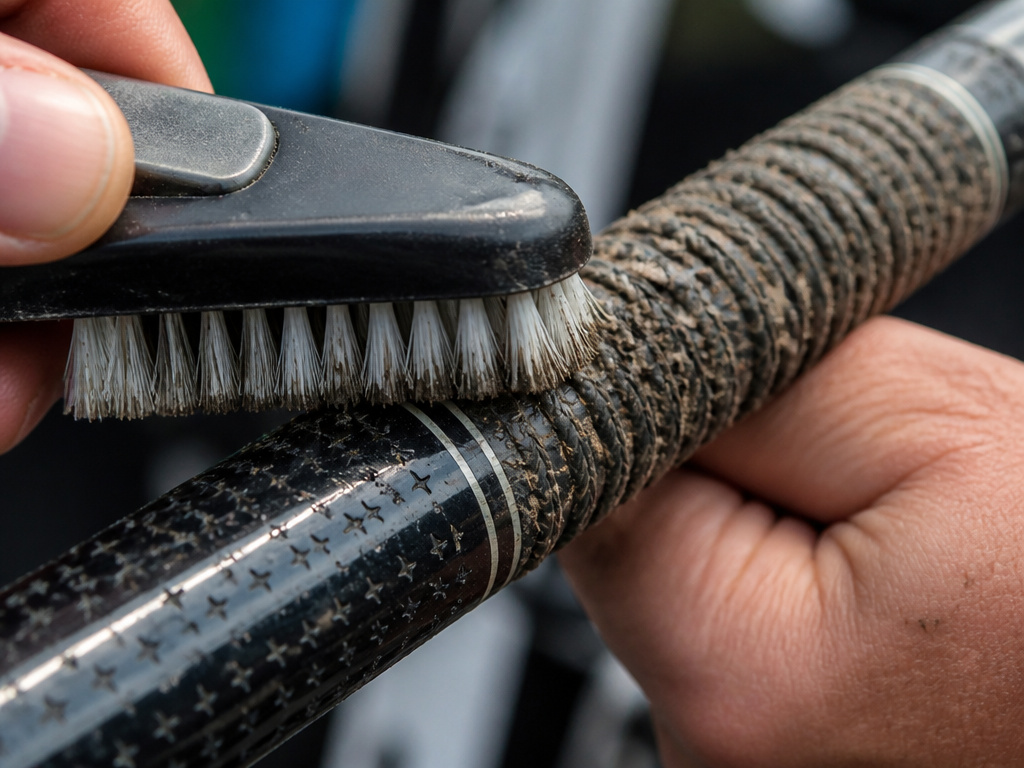
A grip doesn’t just wear out. It fails by specific, material-dependent mechanisms. Knowing them tells you when to clean and when to replace.
Rubber & Polymer: UV attack and oil breakdown. Sweat and sunscreen contain oils that break down the chemical bonds in rubber and some synthetics. The surface glazes over. A thorough scrub with a dedicated grip cleaner and a stiff brush can restore tack temporarily. Once hardening sets in, cleaning is a stopgap.
Cord: The cord fibers collect dirt and salt. When clogged, they lose their wicking ability. Cleaning is more effective here, a brush can dig into the cords, but eventually, the fibers wear down and the grip becomes smooth rubber.
Leather: Dries and cracks. Conditioning is preventive, not restorative. Once the leather has hardened, it cannot be softened back to its original state.
Common mistake: Using household cleaners or alcohol on polymer grips. Harsh solvents can strip the plasticizers from the material, accelerating the hardening process. The grip feels clean for a week, then turns into a hard, slick tube.
Follow this simple decision tree: 1. Is the surface visually shiny or smooth? Try cleaning. 2. After cleaning, does it still feel hard or slick? Replace it. 3. For leather, is it stiff or cracked? Replace it. Conditioning is for prevention.
Most players need a new set of grips every 30-40 rounds. If you store your clubs in a garage or car trunk, cut that estimate in half. Heat is the universal accelerator.
Choosing Your Grip: A Practical Framework
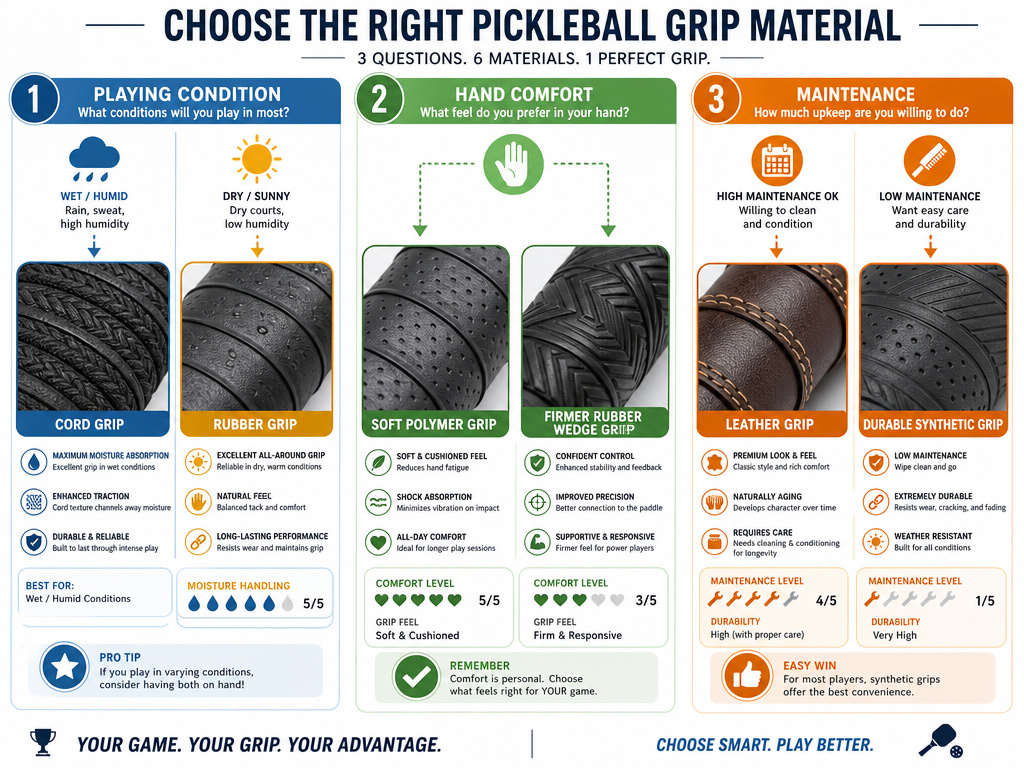
Forget the marketing. Match the material to your physical needs and your environment. Ask these three questions:
- What is my primary playing condition? (Humid/Wet vs. Dry/Cold)
- Humid/Wet: Prioritize cord or a hybrid.
- Dry/Cold: Prioritize rubber or a softer polymer.
- Do I have any hand pain or desire less vibration?
- Yes: Start with a polymer grip on longer clubs. Keep firmer rubber on wedges for feel.
- No: Rubber or cord will provide the best, most direct feedback.
- How often will I maintain them?
- Regularly: Leather is an option.
- Rarely: Stick with durable rubber or synthetic.
Your grip size is a more important variable than material. An undersized grip promotes overactive hands. An oversized grip can restrict release. The material choice fine-tunes the feel of a correctly sized connection. Always start a grip fitting with size, then test material textures.
Finally, consistency matters. Use the same grip model and material across all your clubs (except the putter). This uniform feel builds muscle memory. Switching between a slick rubber driver grip and a corded wedge grip introduces an unnecessary variable in a game full of them.
Frequently Asked Questions
What is the most durable golf grip material?
Traditional rubber grips, like the Golf Pride Tour Velvet, often demonstrate the longest lifespan under normal conditions due to their resistance to abrasion. However, cord grips can wear out gloves faster, and polymer grips with soft foam cores can break down more quickly if exposed to excessive UV light and heat.
Can I use a putter grip on my other clubs?
No. The USGA Rule 4 interpretations specifically allow non-circular cross-sections only for putter grips. Using a flat-sided putter grip on an iron or wood violates the equipment rules, rendering the club non-conforming for sanctioned play.
How does grip material affect swing speed?
The material itself has a minimal direct effect. However, the security and comfort it provides influence your grip pressure. A slippery grip forces you to squeeze tighter, which can tense forearm muscles and restrict a fluid release. A confident, tacky grip promotes lighter pressure, which can support a freer, faster swing.
Are there grips for players with arthritis?
Yes. Polymer/synthetic grips from Winn or Lamkin are specifically engineered with shock-absorbing foam cores to reduce vibration transfer. This can significantly decrease joint stress. A larger, midsize grip can also help by distributing pressure across a wider area of the hand.
What’s the difference between rubber and polymer grips?
The difference is in construction and primary goal. A classic rubber grip is a single, homogeneous layer designed for consistent tack and durability. A polymer grip is typically a multi-material system: a soft foam core for cushioning bonded to a thin, tacky outer skin. The polymer prioritizes comfort and dampening; the rubber prioritizes feedback and longevity.
The Bottom Line
A grip’s material is a set of engineering specifications, not just a texture. The Durometer hardness, the skin thickness, the core density, these numbers from old patents decide how a club feels today. Your choice is a direct trade-off: cord for wet-weather control at the cost of cold-weather comfort, polymer for vibration relief at the cost of tactile truth.
Start with the rulebook, especially for your putter. Then match the material to the climate you play in and the physical feedback you need. Ignore the generic replacement schedule. Look at your grips. Feel them. If they’re shiny, hard, or cracked, the material has already failed. Change them. That connection is too important to leave to chance.
