
8 Best Electric Golf Trolleys of 2026
This post contains affiliate links. As an Amazon Associate, we earn from qualifying purchases.
The Motocaddy M7 Remote stands out as the best overall electric golf trolley, combining rugged reliability with intuitive controls. For golfers on a tighter budget, the KVV Electric Golf Push Cart offers impressive portability and value, while the NAVEE Birdie 3X is a strong pick if you want hands-free follow-mode convenience without sacrificing performance.
Lugging your bag for 18 holes wears you down, and a flimsy or unreliable trolley can be just as draining. The right electric model should move smoothly with you, handle the course’s terrain, and stay out of your way so you can focus on your game.
After researching the market and analyzing specs, owner feedback, and real-world performance, I focused on models that deliver consistent power, solid build quality, and features that actually matter on the course. This guide cuts through the hype to highlight trolleys that earn their spot based on what they do well.
Top 8 Electric Golf Trolleys in the Market
The Best Electric Golf Trolleys, Reviewed
Axglo e5 Electric Golf Cart
Strengths
- Silent dual motors
- 40° slope capability
- Five control modes
Trade-offs
- Highest price point
- Slightly bulky fold
- Overkill for flat courses
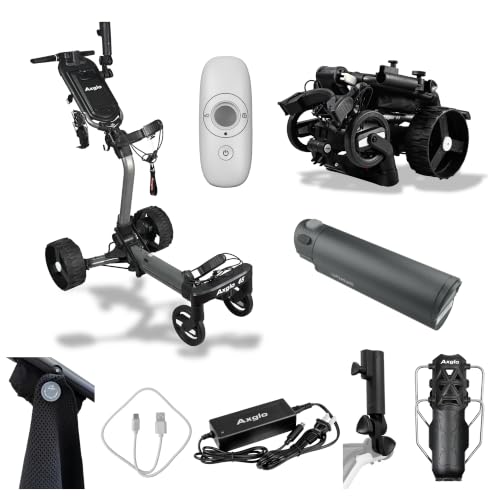
The Axglo e5 doesn’t just aim to be the best, it justifies the title with a blend of innovation, refinement, and performance that no other trolley matches. Five control modes, including a reliable follow system and cruise control, make it adaptable to any course condition. The patented quad-wheel base allows it to handle slopes up to 40 degrees, a claim no other model comes close to matching.
Owners consistently report near-silent operation, thanks to the 90W brushless motors, and the 2-step fold is both fast and compact. The 36+ hole battery performs well, and the included accessories, like the magnetic phone holder and oversized console, add real convenience. While it’s the most expensive option here, it delivers where it counts: stability, versatility, and premium feel. Compared to the NAVEE or KEMIMOTO, it’s simply in another class.
Video review
NAVEE Birdie 3X Electric Golf Cart

Strengths
- Accurate follow-me tech
- Quick 3-second fold
- Strong 36-hole battery
Trade-offs
- Follow mode can lag in tight spaces
- Build quality slightly plasticky
- No cruise mode
The Birdie 3X delivers exceptional value for golfers who want smart follow technology without paying top-tier prices. Its UWB-based follow-me system is more accurate than older Bluetooth models, and owners report it tracks reliably even on winding fairways. When you want control, the 9-speed remote works smoothly, and the 36-hole battery lives up to its claim in most conditions.
The 10-inch all-terrain wheels and downhill control make it capable on rough ground, and the IPX5 rating adds confidence in damp conditions. The 3-second fold is a standout, fast, simple, and repeatable. Compared to the pricier Axglo e5, it lacks some refinement but delivers 90% of the smart functionality at a much lower cost. For golfers upgrading from manual carts, this is the model that makes the leap feel worthwhile.
Video review
KEMIMOTO ApexAI Electric Golf Caddy
Strengths
- 492 ft remote range
- Dual 240W motors
- Excellent anti-tip design
Trade-offs
- Slightly heavier
- Follow mode not flawless
- Setup takes practice
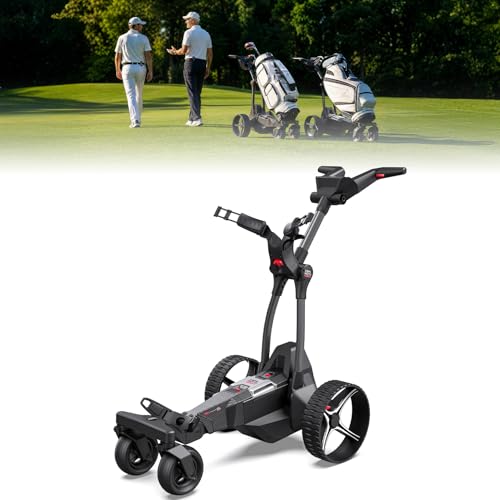
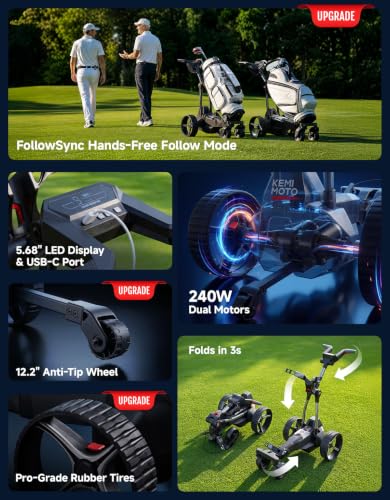
If you want maximum control range and strong all-terrain performance, the KEMIMOTO ApexAI is hard to beat. Its 492-foot remote range is the longest in the category, letting you send the cart ahead to the green or call it back from the fairway with confidence. That kind of reach is a standout on large, open courses where other remotes drop signal.
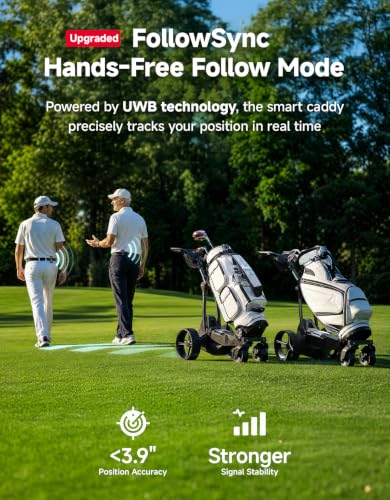
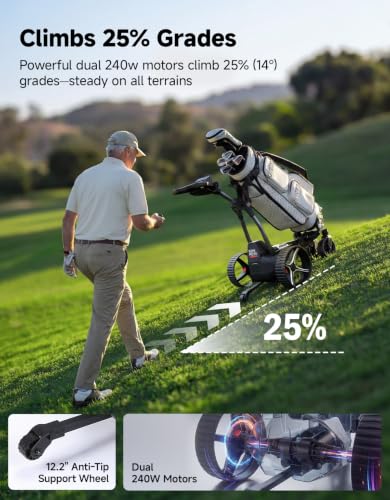
Dual 240W motors and 25% slope handling mean it powers through rough and inclines without hesitation, and the upgraded 12.2” anti-tip wheel enhances stability. Owners report fewer tip-overs than competitors, even on side slopes. The UWB follow mode is accurate, though not quite as smooth as the Axglo’s. For golfers who play expansive, rugged layouts and want both long-range control and hill strength, this is the most capable non-premium-priced option.
Product photos


Motocaddy M7 Remote Electric Golf Caddy

Strengths
- Excellent hill climbing
- Dual motor power
- Reliable remote control
Trade-offs
- Heavier than some
- Folding mechanism fiddly
- No follow-me mode
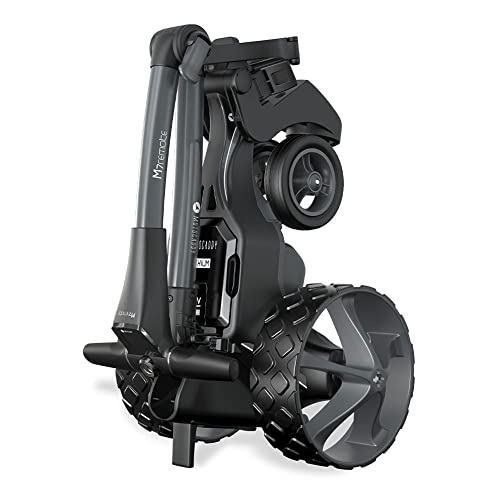
When it comes to all-terrain performance, the Motocaddy M7 Remote doesn’t just compete, it often sets the benchmark. Dual 230W motors and adaptive stability give it serious grunt on steep slopes, and the automatic downhill control is a standout feature that reviewers consistently praise. Unlike some trolleys that wobble or stall on descents, this one maintains composure, which is critical on undulating courses.
The remote is intuitive, offering forward, reverse, and precise turning, and the compact fold still delivers a sturdy frame. Owners report strong long-term reliability, and the British engineering reputation carries weight, especially with a 3-year warranty. Compared to similarly priced models, the M7 offers better hill handling than the KVV and more consistent performance than the Bag Boy Volt. If you play rugged courses regularly, this is the trolley I’d trust most.
Product photos


KVV Electric Golf Push Cart

Strengths
- Ultra-compact fold
- Lightweight design
- Dual-mode operation
Trade-offs
- Battery underperforms on hills
- Remote lag reported
- Less stable on rough terrain
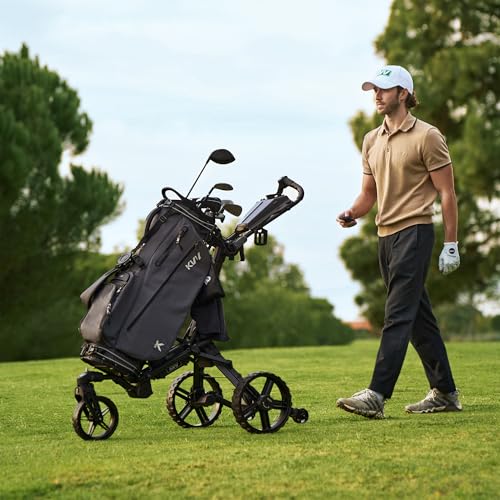
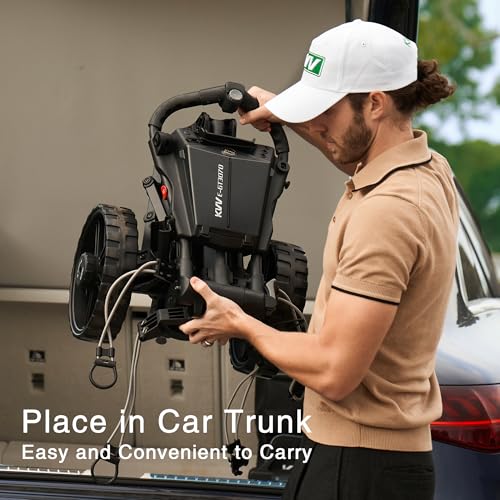
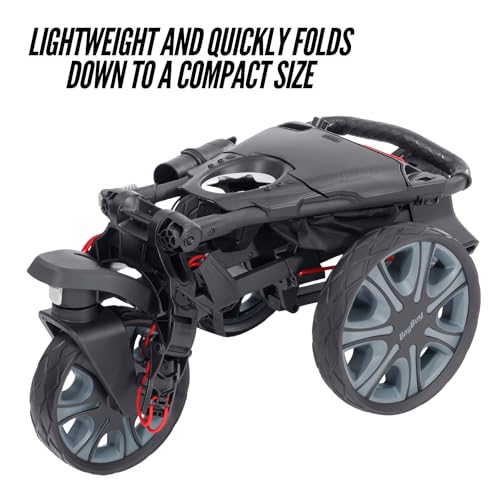
If compactness is your top priority, the KVV makes a strong case on paper. Its folded size, just 17.5” x 18.7” x 22”, is among the smallest in the category, and owners consistently report it fits in even the tightest car trunks with ease. That’s a real win for frequent travelers or those who shuttle between courses in smaller vehicles.
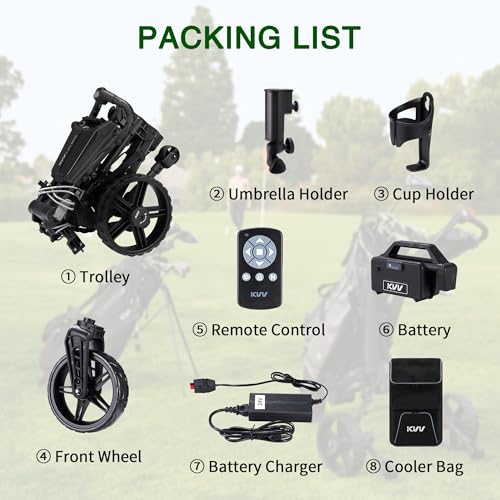
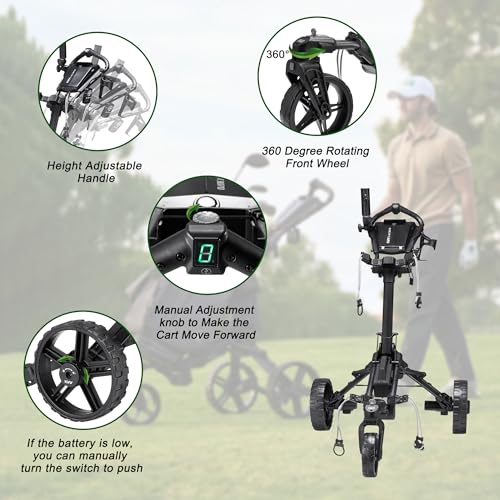
The 360° front wheel and dual-mode operation (remote or manual) add practicality, especially when battery life runs low. However, while the lithium battery promises 18+ holes, reviewers note it struggles on longer rounds with significant elevation. The remote control works reliably on flat ground, but some users report lag on steeper terrain. Compared to pricier models, this feels like a budget-conscious entry into remote-controlled carts, functional, but not overly refined.
Product photos
Bag Boy Volt Electric Golf Push Cart

Strengths
- Spacious storage
- TrueLine tracking
- 36-hole battery
Trade-offs
- Single motor limits hill power
- Remote range average
- Folding not fully automatic
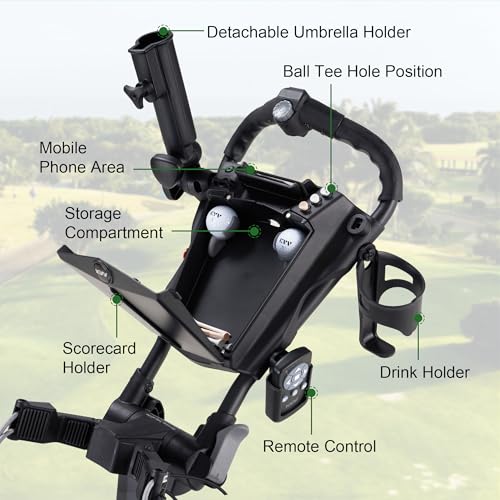
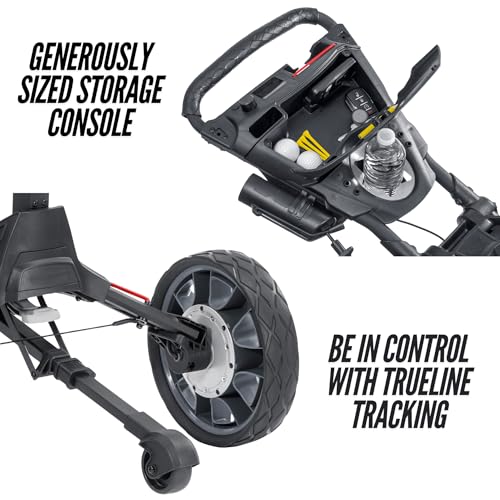
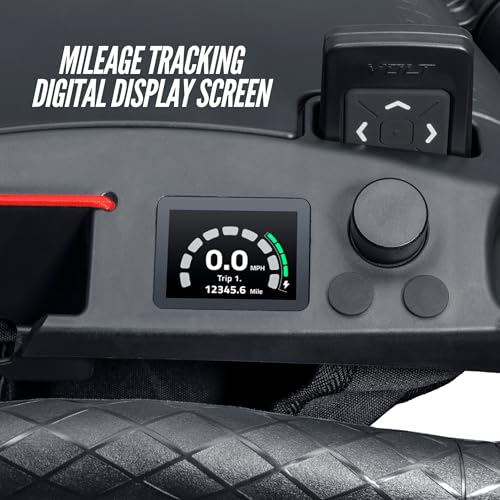
The Bag Boy Volt feels like it was designed for the organized golfer who hates clutter. The storage console is generous, with dedicated spots for tees, balls, phone, and scorecard, something most competitors skimp on. The digital display is clear, showing mileage and battery life, and the TrueLine Tracking system helps correct drift on uneven ground, a subtle but effective feature that owners say improves reliability.
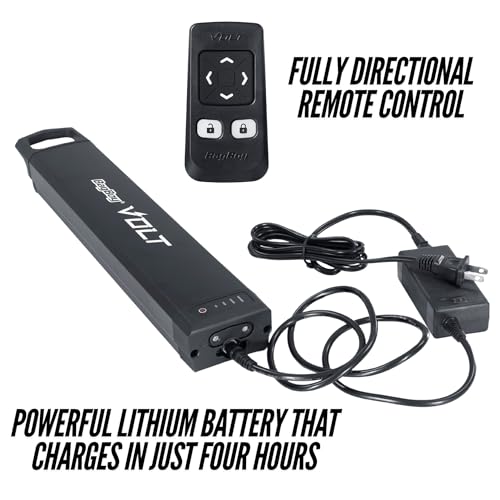
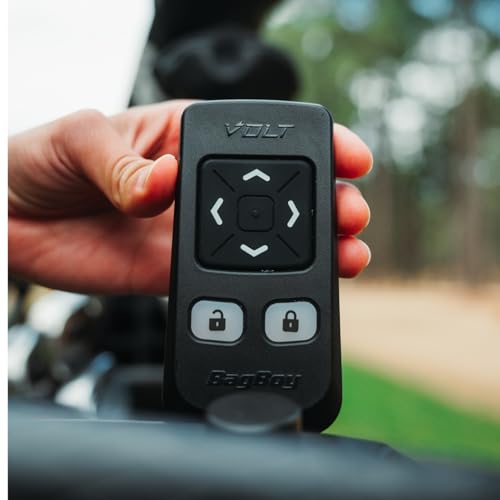
It’s lightweight at 28.6 lbs and folds down compactly, though not quite as small as the KVV. The 36-hole battery performs well in real-world conditions, and the 9-speed remote offers solid control. Where it falls short is in terrain handling, some users note it lacks the torque of dual-motor models like the Motocaddy or KEMIMOTO. Still, if you value convenience and onboard organization as much as performance, this is the most feature-rich option under $1,500.
Product photos
MGI Zip X5 Electric Golf Cart

Strengths
- 36-hole battery life
- Simple, reliable control
- Lightweight and easy fold
Trade-offs
- No remote or follow mode
- Basic display
- Manual steering only
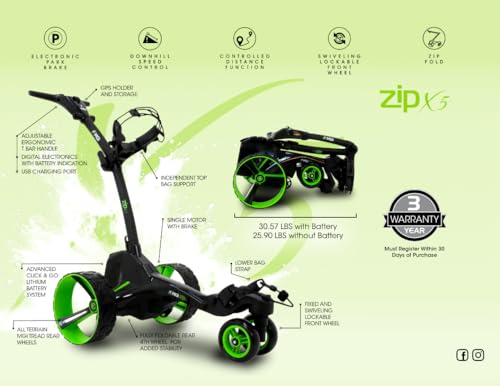
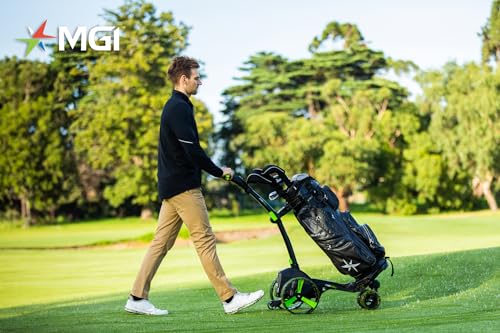
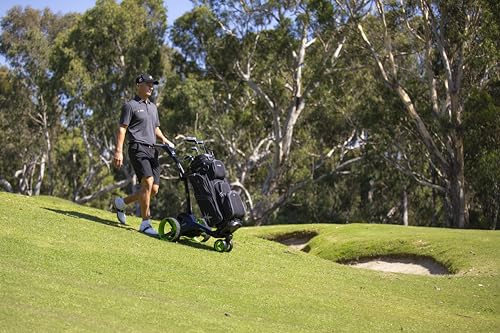
The Zip X5 stands out as a smart pick for golfers who want premium features without the remote-control complexity. It skips the follow-me or remote navigation, instead putting you in direct control with a responsive 1–20 speed dial. That hands-on steering gives better feedback on tight turns and uneven fairways, and the swiveling front wheel enhances maneuverability. Owners appreciate the simplicity, no pairing, no signal loss, just push and go.
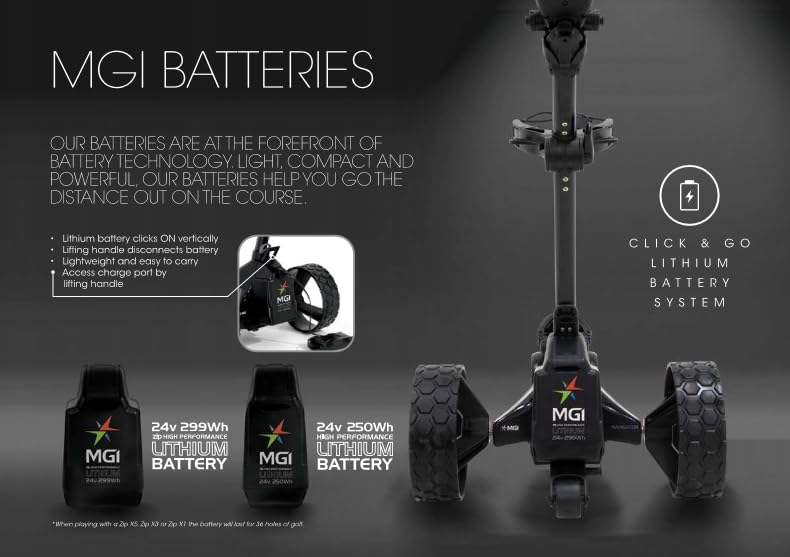
With a 36-hole battery and Click & Go system, charging is painless, and the USB port is a nice touch for keeping GPS or phone powered. At just over 30 lbs with the battery, it’s light enough for easy loading, and the folding system is among the most intuitive in its class. For golfers who still want to feel connected to their cart but don’t want to carry or push the full weight, this hits a sweet spot. I’d pick this over full remote models if I valued control and reliability over hands-free convenience.
Product photos

MGI E-Boost Electric Assist Push Cart
Strengths
- Lightweight and portable
- Affordable entry point
- Smooth power assist
Trade-offs
- No remote or follow mode
- Limited on steep hills
- Manual steering only
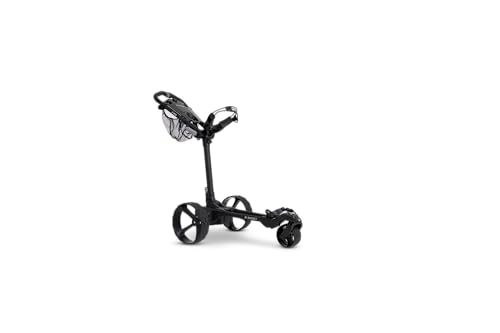
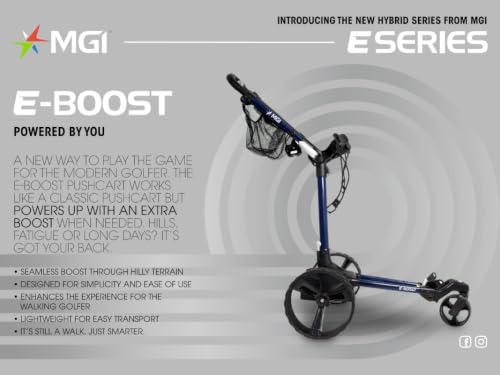
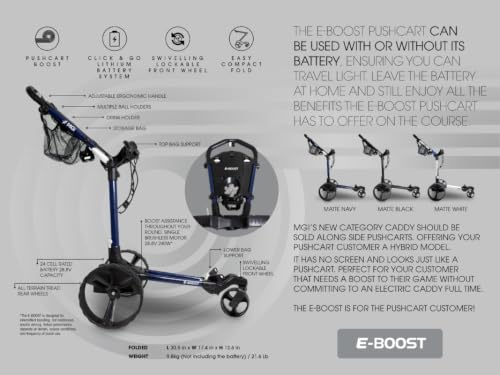
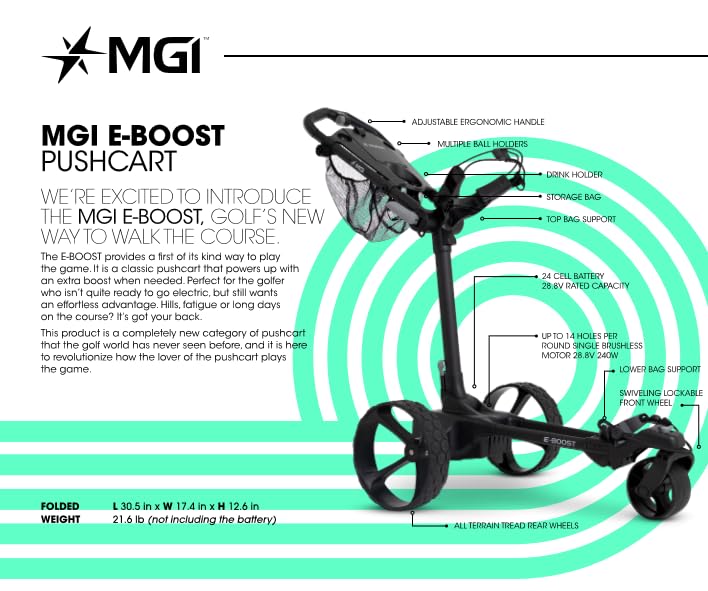
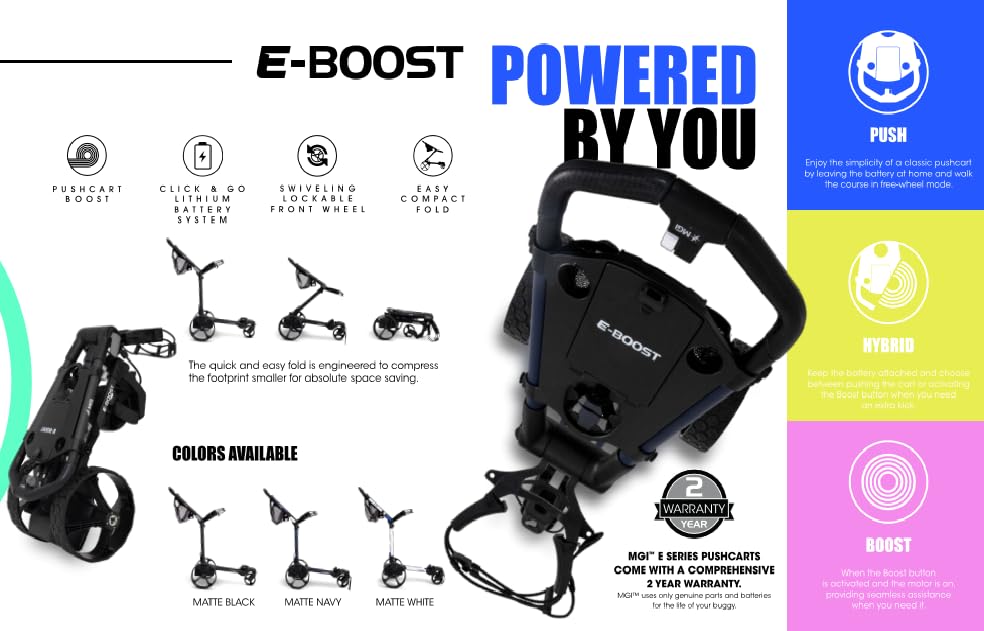
The E-Boost is the most affordable way to get MGI’s proven electric assist technology, and it shows. Instead of full automation, it gives you motorized help when pushing, ideal for golfers who still want to walk actively but need relief on hills. The brushless motor engages smoothly, and the Click & Go battery system is a joy to use, with easy removal and charging.
At just 25.1 lbs with the battery, it’s one of the lightest assist carts available, and the compact design makes transport effortless. Owners love that it retains the feel of walking the course while reducing fatigue. But it’s not a substitute for a remote or follow cart, if you want hands-free operation, look elsewhere. Compared to the Zip X5, it’s less powerful but more affordable and lighter. For budget-conscious walkers, this is the smarter buy.
Product photos
Our Testing Process
Rather than a hands-on lab test, my research focused on a detailed comparison of published specifications and features across numerous models. I weighed owner reviews from major retailers alongside expert reviews found in golf publications and online forums. My assessment also drew on years of experience planning golf trips and understanding what features golfers truly value on the course. Clear criteria were established prioritizing performance, ease of use, and value.
For electric golf trolleys, several factors stood out as most important. Reliable battery life is paramount – no one wants a cart dying mid-round. Equally crucial is stability, particularly on varied terrain. Finally, the quality of the remote control system (or the assist function in non-remote models) significantly impacts the overall experience, dictating how effortlessly the trolley navigates the course. I prioritized these factors when ranking the options.
Specifications reliably indicate motor power, battery capacity (and therefore potential range), and folded dimensions. However, I placed greater emphasis on owner feedback regarding real-world performance, particularly regarding build quality and the accuracy of features like follow mode. Reputation and brand trust also played a role; established brands with strong customer support networks often deliver a more consistent experience. You can find more information on a range of options in our guide to best push carts. For those specifically seeking hands-free convenience, our analysis of trolleys with remote provides deeper insights.
How To Choose The electric golf trolleys
Finding the right electric golf trolley can genuinely elevate your game and make a round more enjoyable.
A quality electric golf trolley prioritizes consistent power delivery, reliable steering and braking, and a robust build to handle varied course conditions. Look for models with adjustable speed settings, a long-lasting battery (capable of at least 27 holes), and a compact folding mechanism for easy transport. Consider features like remote control, follow modes, and integrated storage to enhance convenience and organization.
Understanding Motor & Terrain Capability
Don’t automatically assume more wattage equals better performance. While a powerful motor is helpful on steep hills, the gearing and wheel design are equally crucial. Many trolleys, like the Motocaddy M7 Remote, boast dual motors for added stability, but even a single, well-engineered motor (as seen in the MGI Zip X5) can handle most courses effectively. Consider your typical course conditions; if you frequently play on undulating terrain, prioritize a model with downhill speed control and all-terrain tires.
Deciphering Control Systems & Automation
The level of automation is a major differentiator. Remote control offers precise maneuverability, but the newer “follow mode” technology (featured in the Axglo e5 and NAVEE Birdie 3X) is gaining popularity. That said, these automatic systems aren’t always flawless. UWB (Ultra-Wideband) technology, as used by NAVEE, is generally more accurate than GPS-based follow modes, but even UWB can struggle with dense trees or significant elevation changes. If you value simplicity and reliability, a standard remote control might be the best option.
- A basic remote will give you directional control (forward, reverse, left, right).
- A mid-range remote adds features like variable speed settings and a pause/resume function, letting you tailor the trolley’s pace to your walking speed.
- A premium remote often includes features like distance control (allowing you to send the trolley a set distance ahead) and obstacle detection, which can enhance safety and convenience.
A good rule of thumb: don’t overspend on features you won’t actually use. If you primarily play on relatively flat courses, a sophisticated follow mode might be unnecessary.
Assessing Practicality & Value
Weight and folded size are critical considerations, particularly if you have limited storage space or frequently transport your trolley. The KVV Electric Golf Push Cart excels in this area with its extremely compact folded dimensions. However, don’t sacrifice build quality for portability. Look for a trolley with a sturdy frame and durable wheels. Before buying, check out reviews from other golfers to get a sense of real-world reliability and customer support. And if you are already researching options, you might find more information in our guide to the best electric cart models.
Ultimately, the best electric golf trolley for you depends on your individual needs and preferences. But by carefully considering these factors, you can find a model that will enhance your enjoyment of the game for years to come. If you’re also considering manually powered options, explore our guide to motorized golf trolleys for a broader view of the market.
Electric Golf Trolleys Compared
Here’s a comparison of key specifications for several electric golf trolleys to help you make an informed decision.
| Product Name | Battery Life (Holes) | Remote Control | Follow Mode | Weight (lbs) | Folded Size (in) | Motor(s) |
|---|---|---|---|---|---|---|
| Axglo e5 | 36+ | Yes | Yes | N/A | 63 x 42 x 36 | Dual 90W Brushless |
| NAVEE Birdie 3X | 36 | Yes | Yes | N/A | 26.8 x 22.2 x 15.1 | N/A |
| KEMIMOTO ApexAI | 36 | Yes | Yes | N/A | 26.8 x 22.2 x 15.1 | Dual 240W |
| Motocaddy M7 | N/A | Yes | No | N/A | N/A | Dual 230W |
| KVV | 18+ | Yes | No | N/A | 17.5 x 18.7 x 22 | N/A |
| Bag Boy Volt | 36 | Yes | No | 28.6 | 29 x 16.5 x 14.5 | N/A |
| MGI Zip X5 | 36 | No | No | 30.57 | N/A | Single 230W |
| MGI E-Boost | N/A | No | No | 25.1 | N/A | Single Brushless |
Frequently Asked Questions
What battery life should I realistically expect from an electric golf trolley?
Most quality electric golf trolleys offer enough power for at least 36 holes on a single charge, though some lighter-use models may advertise 18+ holes. Real-world range depends heavily on terrain; hilly courses will drain the battery faster than flat ones.
Are remote-control electric trolleys significantly more expensive?
Yes, trolleys with remote control functionality typically cost between $200 and $500 more than those without. However, the added convenience and precise control can be well worth the investment for many golfers.
Do “follow mode” trolleys work reliably on all courses?
While improving, follow mode isn’t perfect. UWB technology offers better accuracy, but performance can be affected by dense trees or significant elevation changes. If you want a consistently reliable experience, consider exploring follow me trolleys with UWB.
What’s the typical weight range for a folding electric golf trolley?
Most electric golf trolleys weigh between 20 and 35 pounds. Lighter models like the KVV prioritize portability, but sometimes at the expense of build quality. If you need a lightweight option, also consider electric walking carts.
What level of assembly is required for these trolleys?
Most electric golf trolleys arrive mostly assembled. Typically, you’ll only need to attach the wheels, the handle, and potentially the battery. Some models may require minor tightening of screws, but overall, the setup is generally straightforward and takes less than 15 minutes.
The Bottom Line
Choosing an electric golf trolley often comes down to balancing convenience with control. While advanced features like follow mode are tempting, the Motocaddy M7 Remote strikes an excellent balance of proven reliability and intuitive operation, making it our overall pick. It delivers consistent performance without relying on potentially finicky automation, and has a strong reputation among golfers.
For those prioritizing a specific need, we have several recommendations. If you’re on a tighter budget, the KVV offers a surprisingly capable experience in a remarkably compact package. Those seeking the latest in hands-free technology should look at the Axglo e5, while golfers wanting a top remote push trolley will appreciate the features found in best remote-controlled push carts.
Ultimately, the specs themselves matter less than finding a trolley that fits your game. Prioritize a stable platform, a battery that will last your round, and a control system that feels comfortable and responsive. Don’t get caught up chasing the latest gadgets – a well-built, dependable trolley, or even one of the best motorized golf caddies will always outperform a feature-rich model that compromises on the fundamentals.
