
Bobby Jones and the Original Grand Slam That Changed Golf
This post contains affiliate links. As an Amazon Associate, we earn from qualifying purchases.
This post contains affiliate links. As an Amazon Associate, we earn from qualifying purchases.
Bobby Jones and the original Grand Slam refers to his 1930 achievement of winning golf’s four major tournaments, the U.S. Amateur, British Amateur, U.S. Open, and The Open Championship, in a single calendar year. He is the only player to complete a single-season Grand Slam, a feat that redefined the game’s ultimate challenge and cemented his legendary status before he retired at age 28.
That 50-1 bet Jones placed on himself before the season wasn’t just confidence. It was a blueprint. The Grand Slam wasn’t a happy accident; it was a meticulously planned campaign executed over five grueling months across two continents.
What follows is the breakdown of that campaign: the four tournaments that defined it, the logistical edge that made it possible, the immense pressure Jones carried, and why this 1930 record remains the one untouched pinnacle in golf.
Key Takeaways
- Bobby Jones’s 1930 Grand Slam comprised the U.S. Amateur, British Amateur, U.S. Open, and The Open Championship (British Open), the four majors of the pre-Masters era.
- The feat was premeditated; Jones first conceived the idea in 1926 and specifically trained and planned his 1930 schedule around winning all four.
- A critical logistical advantage was his role as playing captain of the U.S. Walker Cup team, which funded his transatlantic travel and allowed him to stay in Britain for the two early Slam events.
- Jones faced immense pressure and tight matches, surviving three 1-up victories in the British Amateur at St. Andrews before dominating the later rounds.
- He retired from competitive golf just weeks after completing the Slam at age 28, his legacy and the term “Grand Slam” forever intertwined.
What Tournaments Made Up the 1930 Grand Slam?
The modern Grand Slam is the Masters, PGA Championship, U.S. Open, and The Open. In 1930, the majors were different. Jones’s target was the “Impregnable Quadrilateral”: the two Open championships that included professionals, and the two national Amateur championships.
The original Grand Slam tournaments were the U.S. Amateur, the British Amateur (The Amateur Championship), the U.S. Open, and The Open Championship (British Open). These were the four premier events before the Masters Tournament was founded.
This distinction matters. Winning the two Opens meant beating the best professionals in the world at their own game. Winning the two Amateurs meant enduring the unpredictable, marathon format of match play, where one bad hole can end your tournament. Jones had to master both formats against both fields. No one has had to clear that specific set of hurdles since.
| Tournament | Format | Location (1930) | Jones’s Margin of Victory |
|---|---|---|---|
| British Amateur | Match Play | St. Andrews, Scotland | 7 & 6 (36-hole final) |
| The Open Championship | Stroke Play | Royal Liverpool, England | 2 strokes |
| U.S. Open | Stroke Play | Interlachen, Minnesota | 2 strokes |
| U.S. Amateur | Match Play | Merion Cricket Club, Pennsylvania | 8 & 7 (36-hole final) |
The table shows the shift in formats. The mental gear change from the precision of stroke play in the Opens to the match-play warfare of the Amateurs, all within weeks, is a layer of difficulty that gets lost in the headline.
The 1930 Campaign: A Five-Month Masterclass
Jones didn’t just show up. His autobiography reveals he first plotted the Grand Slam after his 1926 season, where he won both Opens but lost in the Amateurs. For 1930, he trained differently, playing badminton to keep his weight in check, and entered tune-up events in Georgia.
The schedule was a brutal transatlantic gauntlet: 1. February: Tune-ups in Savannah and Augusta. 2. May 2: Sailed to England on the Mauretania. 3. Late May: Captained the winning U.S. Walker Cup team at Royal St. George’s. 4. May 26-31: British Amateur at St. Andrews. 5. June: The Open Championship at Royal Liverpool. 6. July: U.S. Open at Interlachen. 7. September: U.S. Amateur at Merion.
The **[Walker Cup](https://golfworldtrips.The article at Golf.com/what-is-the-walker-cup/ was what made the trip possible. As playing captain, his travel was covered. This allowed him to extend his stay in Britain to compete in the two early Slam events without the personal financial burden that would have hampered any other amateur. It was the logistical edge that made the entire attempt feasible.
The Crucible at St. Andrews
The British Amateur was the biggest stumble risk. Match play is a capricious format. Jones survived three separate matches that went to the 18th hole, winning each 1-up. The most famous was his fourth-round match against defending champion Cyril Tolley, which he won on the 19th hole. The tension was audible, the click of his cleats on the ancient paths, the silence of the Scottish crowds holding its breath. After escaping those matches, he found his rhythm and routed Roger Wethered 7 & 6 in the 36-hole final.
Where this goes sideways: Assuming the Grand Slam was a stroke-play feat. The match-play Amateurs, where a single choked putt ends everything, were the landmines. Jones navigated them under maximum pressure from the start.
The Pressure and the Payoff
By the time he won The Open at Royal Liverpool, the weight of expectation was a global phenomenon. The New York Times editorial page was watching. He returned to a ticker-tape parade in New York, his second, after 1926, before heading to Minneapolis to win the U.S. Open.
The final act was at Merion for the U.S. Amateur. A crowd of 18,000 packed the fairways for the final. Jones closed out Eugene Homans on the 29th hole of their 36-hole final, winning 8 & 7. The moment his final putt settled, the roar was immediate and deafening. Marines had to form a cordon to prevent him from being mobbed.
I learned through poor results that if you can’t execute a shot calmly on the range, you definitely shouldn’t try it on the course. Jones operated under a magnifying glass for five months, with every shot scrutinized. That he never wavered in the clutch is what separates the achievement from a mere statistical quirk.
Why the 1930 Slam Stands Alone
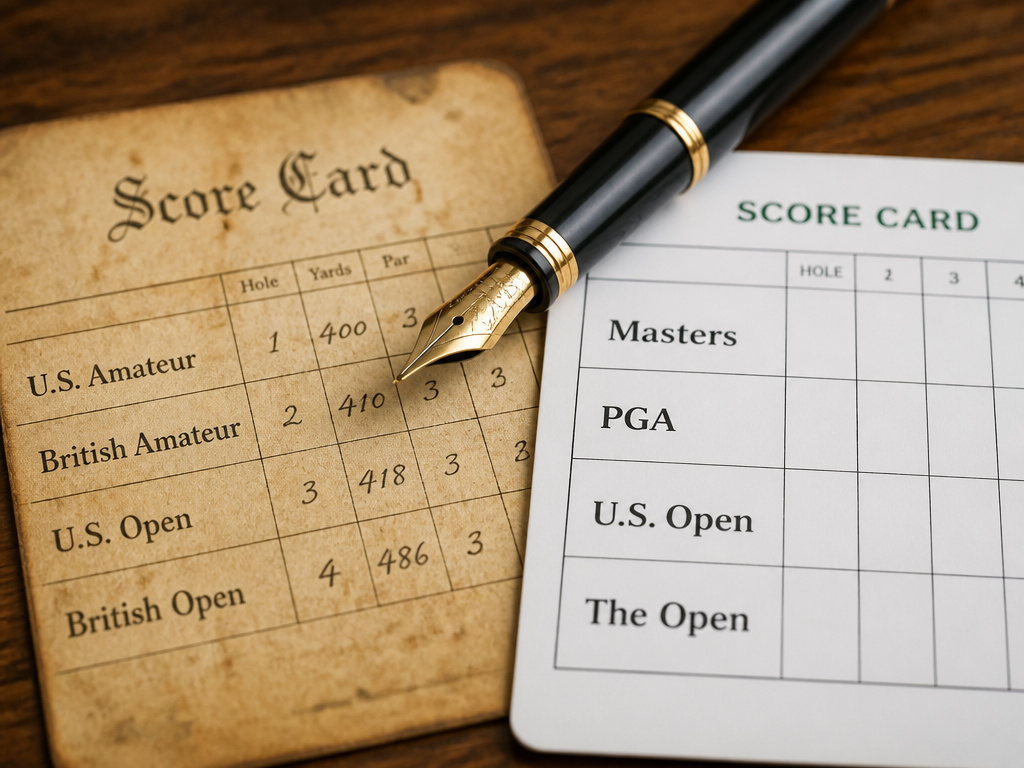
Tiger Woods held all four modern majors concurrently in 2000-2001. Five other men have a career Grand Slam. But Jones’s single-season sweep of his era’s four majors remains unique. The conditions are unrepeatable.
First, the tournament landscape has changed. The PGA Championship and the Masters replaced the amateur championships in the professional major roster. A top player today isn’t entering national amateur events. The window for Jones’s specific feat closed with the dawn of the professional tour.
Second, the depth of field. This isn’t to diminish Jones’s talent, he was beating the best pros of his day, but the global talent pool and year-round competition today make a single-season sweep a taller probabilistic mountain. The Wikipedia entry on golf Grand Slam details how the definition shifted, protecting the singularity of the 1930 record.
| Aspect | 1930 Grand Slam (Jones) | Modern Grand Slam |
|---|---|---|
| Tournaments | U.S./British Amateurs & Opens | Masters, PGA, U.S./British Opens |
| Primary Competition | Mix of top pros & amateurs | Exclusively professional |
| Travel & Logistics | Ocean liner travel, months-long trip | Global air travel, packed yearly schedule |
| Format Challenge | Mixed stroke play & match play | Primarily stroke play (PGA is match play history) |
Finally, Jones walked away. He retired at 28, making the Slam a definitive, closed chapter. There was no “he’ll get another chance.” It was a perfect, contained story. His post-retirement contribution, co-designing Augusta National and founding the Masters, only added to the legend.
The Tools of the Triumph

We talk about mentality and schedule, but Jones did it with equipment that would feel alien today. In the Augusta National clubhouse, a case holds 11 of the hickory-shafted clubs he used in 1930.
The feel of a hickory shaft is fundamentally different from modern steel or graphite. It has more torque and whip. Striking a ball purely with those clubs required a smoother, more rhythmic swing, any hint of a violent, jerky move and the shaft would twist, sending the shot offline. This reality shaped Jones’s legendary tempo. Good golf should feel less complicated the more you understand it, and his equipment demanded a simplicity modern gear can sometimes mask.
He wasn’t pondering amateur golf irons or all-round golf balls. He was using tools that were an extension of a single, repeatable movement. It’s a stark reminder that greatness is about the golfer, not the gear.
The Legacy of the Slam
Jones’s immediate legacy was a second ticker-tape parade and a retirement announcement that stunned the sports world. The New York Times wrote he “nothing common did, or mean.” The term “Grand Slam,” borrowed from bridge by Atlanta sportswriter O.B. Keeler, entered the sporting lexicon forever.
Long-term, his legacy is twofold. First, he set the impossible standard. Every discussion of golf’s ultimate achievement starts with 1930. Second, he used his fame to give back to the game. He co-designed Augusta National and helped found the Masters Tournament, ensuring his influence would shape golf’s future for decades.
His Bobby Jones Wikipedia biography details his post-playing career, but the core of his story is that five-month stretch. The original Grand Slam wasn’t just a winning streak; it was a statement that perfection, however fleeting, was possible. It’s why his World Golf Hall of Fame biography reads like the record of a man who conquered the game’s final frontier.
For students of golf history, understanding this feat provides context for every great career that followed. It’s the benchmark. When you watch golf documentaries or read famous golf quotes, Jones’s shadow is there. His story is the foundation.
Frequently Asked Questions
Has anyone else won a single-season Grand Slam?
No. Bobby Jones is the only golfer to win the four major championships of his era in a single calendar year. Tiger Woods came closest by holding all four modern major titles consecutively across 2000-2001, a feat often called the “Tiger Slam.”
Why did the majors change from Jones’s era?
The rise of professional golf in the 1930s and beyond shifted the focus. The Masters (founded 1934) and the PGA Championship (founded 1916 but grew in stature) became the premier events for professional players, replacing the national amateur championships in the “Grand Slam” definition for pros.
How old was Bobby Jones when he won the Grand Slam?
Jones was 28 years old when he completed the Grand Slam by winning the U.S. Amateur in September 1930. He announced his retirement from competitive golf just weeks later.
Did Bobby Jones ever turn professional?
No, Bobby Jones remained an amateur for his entire competitive career. This is why he did not compete in the PGA Championship and why his major victories are in the Opens (which allowed amateurs) and the Amateurs.
What did Bobby Jones do after retiring?
After retiring, Jones co-founded and co-designed the Augusta National Golf Club, helped establish the Masters Tournament, practiced law, and served in the military during World War II. He occasionally played in the Masters as a ceremonial participant.
Before You Go
One rule most golf history summaries skip: Jones’s Slam was a premeditated operation, not a hot streak. He identified the target four years prior, engineered his schedule and fitness to meet it, and secured the travel means to attempt it. That’s the real lesson, greatness in golf is often a product of design, not just talent.
Everything above assumes a unified goal. For Jones in 1930, every decision fed the single aim of the Grand Slam. For an amateur today, that focus might be breaking 90 or winning a club championship. The scale is different, the principle isn’t. Pick a target, build a plan around it, and understand the obstacles. That’s the blueprint Jones left behind, and it’s far more valuable than any trophy.
