
Golf Club Lie Angle Explained: Why Standard Is a Myth
This post contains affiliate links. As an Amazon Associate, we earn from qualifying purchases.
This post contains affiliate links. As an Amazon Associate, we earn from qualifying purchases.
Golf club lie angle is the angle between the club’s shaft and the ground when the sole rests flat. Get it wrong by one degree, and a 6-iron will miss its target by roughly three yards. That’s nine feet, the difference between a tap-in and a tough two-putt. The industry has no universal standard, so a “standard” 5-iron from one brand can differ by two degrees from another, turning a solid swing into a consistent miss.
That gap between what a club says it is and what it actually measures is where most off-the-rack frustration starts. The ball is struck on the face, not the sole, so the true geometric measurement has to ignore how the club sits and focus on the shaft plane relative to a square face attitude. This is the method used in professional bending machines, and it reveals that mass-produced clubs are rarely perfectly consistent, even within the same set.
What follows is a breakdown of why lie angle matters more than loft for directional control, how to spot if yours is wrong, and the hard limits on adjusting it. We’ll cover the difference between static and dynamic lie, the risks of bending cast versus forged heads, and why you should never apply a blanket adjustment across your entire bag.
Key Takeaways
- A one-degree lie angle error causes a directional miss of about three yards with a mid-iron, due to both initial face angle and induced sidespin.
- There is no true industry standard. Manufacturer specs for a “standard” 5-iron vary from 61.0 to 62.0 degrees, making brand-to-brand comparisons meaningless.
- Dynamic lie angle, the shaft’s angle at impact, is what actually affects ball flight, and it can differ from your static address position due to shaft flex and swing delivery.
- Never assume your entire set needs the same adjustment. A 4-iron and a wedge are delivered differently; each club should be checked and bent individually to a precise number.
- Forged irons can often be bent 3-4 degrees safely; cast irons are more brittle and risk snapping beyond 2 degrees, depending on hosel design.
What Is Golf Club Lie Angle?
Lie angle is the angle formed between the centerline of the shaft and the ground line when the club is in its proper playing position. It’s measured in degrees. A higher number means the shaft is more horizontal, making the club “upright.” A lower number means the shaft is more vertical, making the club “flat.”
Technical Snippet: Proper geometric measurement registers the club’s face in a square and horizontal plane to measure angles relative to the shaft plane. The ideal method aligns the club’s score lines to a known square relationship on the gauge, ensuring accuracy and repeatability independent of sole design. (Mitchell Golf, “A Guide For: Measuring & Adjusting Golf Club Angles,” 2017)
Forget how the sole rests. The real measurement ignores the sole’s curve and focuses on the relationship between the shaft and a perfectly square clubface. This is why a lie board test works, it shows where the sole actually contacts the ground during your swing, revealing your dynamic lie.
If your golf club sets have never been checked, this is the first place to look for a persistent miss. It’s more foundational than tweaking your golf club loft.
Static vs. Dynamic Lie: The Critical Split
Your clubs have two lie angles: static and dynamic.
- Static Lie: This is the built-in angle of the club as it sits on the ground at address. It’s what a fitter measures in a loft-and-lie machine.
- Dynamic Lie: This is the shaft’s angle at the moment of impact. Shaft flex, your posture, and your swing path all change it.
Your dynamic lie is all that matters for ball flight. A club can be perfectly square on the machine but arrive at impact with the toe up or down. This is why hitting off a lie board or using the sharpie-line test is non-negotiable for a real fitting. Static fitting gets you close; dynamic testing gets you right.
Why Lie Angle Matters for Your Ball Flight
Lie angle is a primary governor of your shot’s starting direction. An incorrect angle forces the clubface into a consistent misalignment at impact, which your swing then has to compensate for, or fail to.
For a right-handed golfer: * Too Upright: The toe is up, the face points left. Expect a shot that starts left and hooks further left. * Too Flat: The toe is down, the face points right. Expect a shot that starts right and fades or slices further right.
Where this goes sideways: Hitting the ball fat with a mismatched lie angle. If your lie is too flat and you hit behind the ball, the toe digs first and violently twists the face open. A small push turns into a catastrophic slice. The opposite happens with an upright lie and a fat strike, producing a duck-hook.
The error isn’t small. According to technical analyses, each degree of lie angle error results in about three yards of offline dispersion with a 6-iron. This combines the initial directional error from the faced angle and the sidespin it imparts. For a player fighting a two-degree error, that’s a six-yard miss, enough to consistently find greenside bunkers instead of the putting surface.
This directly ties into the ball flight laws you’re trying to master. A face pointed right of your path at impact creates a slice spin. If your lie angle is systematically pointing the face right, you’re fighting physics with every swing.
The “Standard” Lie Angle Myth
The word “standard” is a trap. In golf manufacturing, it means “average,” not “universal truth.” A 2017 survey of major brands’ #5 irons found stated lie angles of 61.0, 61.5, 61.5, and 62.0 degrees. Lofts for those same clubs varied from 21.5 to 25 degrees.
| Brand (Example #5 Iron) | Published Lie Angle | Published Loft |
|---|---|---|
| Brand A | 61.0° | 21.5° |
| Brand B | 61.5° | 23° |
| Brand C | 61.5° | 24° |
| Brand D | 62.0° | 25° |
Source: Mitchell Golf survey of manufacturer specifications, 2017.
This means a “standard” set from Brand D plays one full degree more upright than a “standard” set from Brand A. If your swing needs 61.5 degrees, one brand fits off the rack, and the other builds in a consistent miss. This is why buying any best complete golf club sets without a basic lie check is a gamble.
Furthermore, manufacturers have production tolerances. It’s common for clubs within the same new set to vary by half a degree or more. The goal of a good fitter isn’t to make them all “2 degrees upright.” It’s to bend each iron to its own specific, precise number relative to a master club.
How to Tell If Your Lie Angle Is Wrong
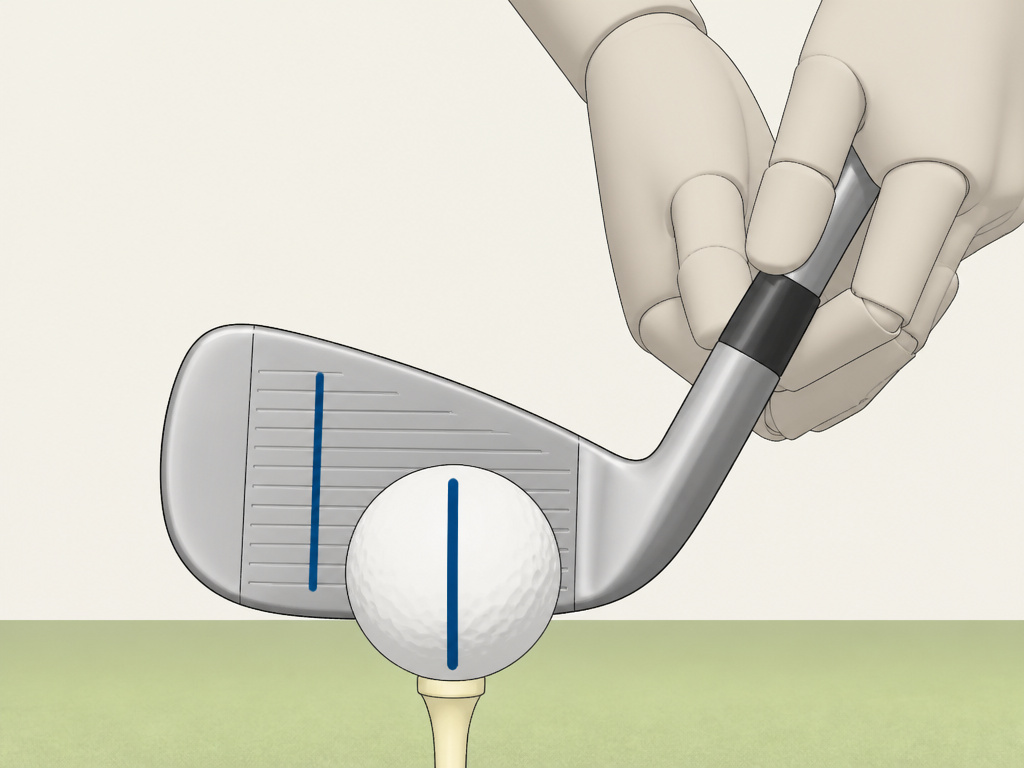
You don’t need a professional fitting to spot the red flags. Two simple DIY tests can point you in the right direction.
1. The Divot Test
Pay attention to the divots your irons leave, especially on clean, struck shots. * A divot that points left of your target (for a righty) suggests the club is too upright (toe up, heel digging first). * A divot that points right of your target suggests the club is too flat (toe digging first). The shape should be rectangular and pointing just left of the target line.
2. The Sharpie Line Test
This is the most accurate home method. 1. Use a dry-erase marker to draw a vertical line on a golf ball. 2. Place the ball on a tee so the line is perfectly vertical facing the clubface. 3. Hit a normal shot. The line will transfer onto the clubface. 4. Examine the line on the face: * If it’s vertical, your lie angle is correct at impact. * If it tilts backward toward the heel, the toe is up (too upright). * If it tilts forward toward the toe, the toe is down (too flat).
If these tests show a consistent pattern, it’s time to visit a professional with a proper loft-and-lie bending machine. This is especially true if you’ve recently invested in new golf club shafts or golf club grips, as those changes can subtly alter your delivery.
Adjusting Lie Angle: What You Can and Can’t Bend
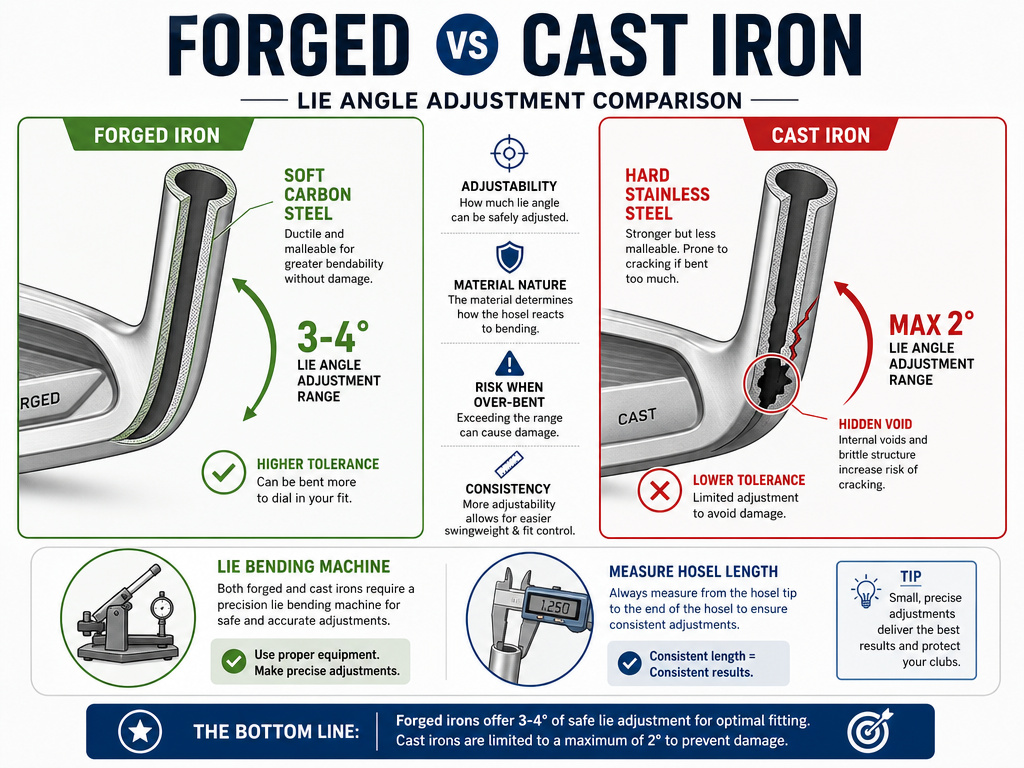
Not every club can be bent, and not every bend is safe. The process requires a specialized machine and an understanding of metallurgy.
The Bending Limits: Forged vs. Cast
The clubhead material dictates everything.
| Club Type | Typical Material | Malleability | Safe Bending Range | Primary Risk |
|---|---|---|---|---|
| Forged Irons | Soft Carbon Steel | High (malleable) | Up to 3-4° or more | Over-bending can weaken hosel; finish may crack. |
| Cast Irons | Hard Stainless Steel | Low (brittle) | Usually 2° maximum | Hosel can snap due to hidden voids or inconsistent wall thickness. |
| Metal Woods/Hybrids | Stainless Steel (must be) | Very Low | Limited, often 1-2° | Requires 1.25″ hosel length; finish is easily damaged. |
Common mistake: Asking a fitter to bend a cast club 4 degrees. The common industry limit of “2 degrees” exists for a reason with cast heads. The Mitchell Golf guide notes that breakage often stems from undetectable manufacturing inconsistencies like voids in the casting or off-center hosel boring. You won’t know until it snaps.
A quality fitter will polish the hosel, use the correct bending bar, and know the limits for your specific model. They can also bend a club back and forth multiple times if needed, a properly bent club doesn’t wear out from adjustment.
Why Blanket Adjustments Are Wrong
Telling a fitter “make my whole set 2 degrees flat” is a mistake. Your swing delivers a 4-iron differently than a pitching wedge. The longer shaft and lower loft of a 4-iron interact with the ground differently. Each club should be checked individually and bent to its own spec to create a proper progression.
This precision is what separates a real fitting from a simple adjustment. It’s also why the specs of men’s golf club sets or senior golf club sets should be verified, even if they’re marketed as “tailored.”
Frequently Asked Questions
Does a tall golfer need upright lie angles?
Not necessarily. While height is a starting point, your dynamic swing posture dictates lie angle. A tall player with a flat, around-the-body swing might need a flatter lie. A shorter player with a very upright swing might need an upright lie. Your wrist-to-floor measurement and actual swing delivery trump height alone.
Can lie angle affect distance?
Indirectly, yes. If the lie angle causes consistent heel or toe strikes, you lose ball speed and center-face contact. A correctly fitted lie angle promotes centered contact, which maximizes distance and improves consistency more than any best golf drivers alone can.
How often should I check my lie angles?
Once a year if you play regularly. Over time, clubs can bend slightly from repeated impact. It’s also a good check if you make a significant swing change, alter your posture, or start seeing a new, persistent ball flight pattern.
Do beginners need to worry about lie angle?
Focus on consistency first. If your swing is different every time, a lie angle fitting won’t solve your dispersion. However, if you are significantly taller or shorter than average, or buying your first beginner golf sets for men, getting clubs that are roughly correct for your physique prevents building compensations from day one.
Can wedges be bent differently than irons?
Yes, and they often should be. Many players prefer their wedges 1 degree flatter than their iron set to encourage a slightly more open face and better turf interaction on partial shots. This is a common tour-level tweak.
The Bottom Line
Lie angle isn’t an advanced fitting metric, it’s a fundamental one. It’s the difference between your clubface arriving square or pre-loaded for a miss. Ignoring it means you’re adding strokes to your score through equipment alone.
Start with the sharpie test. If you see a consistent tilt on the clubface, find a reputable club fitter with a Mitchell or equivalent bending machine. Have them measure each club in your set, not just a 6-iron. Expect to bend them to exact numbers, not relative terms.
The goal is to make your swing the only variable. When your lie angles are correct, a good swing produces a good shot. A bad swing is just a bad swing. That clarity is worth more than any single piece of new equipment.
