
Build a Better Game with These Golf Fitness Training Essentials
This post contains affiliate links. As an Amazon Associate, we earn from qualifying purchases.
This post contains affiliate links. As an Amazon Associate, we earn from qualifying purchases.
Golf fitness training essentials are strength, flexibility, and balance work designed to match the rotational and ground-force demands of the swing. An 8-week, golf-specific program performed 3-4 times weekly can increase clubhead speed by 2.7 mph, ball speed by 5.3 mph, and driving carry distance by 13.8 yards, according to a peer-reviewed study from the University of Kentucky.
That last number comes from motion-capture and force-plate data on recreational players. The difference between a generic gym routine and a targeted plan is about 40 feet off the tee.Your body isn’t just carrying the bag; it’s the engine for every shot. A weak link, tight hips, a sluggish core, poor balance, steals power and invites the nagging injuries that end seasons early.
What follows breaks down the three physical pillars you must address, the exact exercises that transfer to the course, and how to structure a simple 8-week block. We’ll also cover the gear that actually helps, from basic resistance bands to smart golf swing analyzers.
Key Takeaways
- 8 weeks is the minimum effective dose. Peer-reviewed research shows significant gains in speed and distance after two months of consistent, golf-specific training 3-4 times per week.
- Hip mobility drives distance. The modern swing’s “X-factor” relies on separation between your pelvis and torso. Limited hip rotation forces your lower back to over-rotate, cutting power and causing pain.
- Balance training is non-negotiable. The swing is a one-legged move during transition. Poor single-leg stability leaks ground force and causes inconsistent strike patterns.
- Recover like you train. For multi-day tournaments or busy golf trips, a 10-minute post-round routine of stretching and hydration is more impactful than an extra hour on the range.
- Skip generic “core” workouts. Golf requires anti-rotation and rotational strength. Planks are a start, but cable chops and Pallof presses build the specific stability your swing needs.
The Non-Negotiable Physical Pillars
Forget bicep curls and bench press. Golf fitness targets movement patterns, not muscles in isolation. If an exercise doesn’t help you create a faster, more stable coil and uncoil, it’s just gym time.
The research is clear. The University of Kentucky golf study followed trained male golfers through an 8-week program. The results weren’t subtle.
Torso rotational strength and hip abduction strength improved significantly. Upper-torso rotational velocity increased at the acceleration point of the swing. Average club velocity went up. Ball velocity went up. Carry distance went up.
Those changes came from focusing on three areas.
Rotational Strength & Mobility
This is your engine’s horsepower. The swing is a high-speed twist. You need the strength to create that twist against resistance and the mobility to achieve a full backswing without compensation.
- The Why: A larger shoulder-turn relative to your hip-turn (the “X-factor”) stores elastic energy. A lack of thoracic spine or hip mobility forces you to make that turn elsewhere, usually by sliding or over-extending your lower back.
- The Test: Can you rotate your shoulders 90 degrees while keeping your pelvis relatively stable? If not, your lower back is doing the work your hips should handle.
Single-Leg Stability & Balance
The swing is a dance of weight transfer. From the top of your backswing through impact, you’re essentially posting on your lead leg. Wobble here means wasted energy.
- The Why: Power generation starts from the ground. If your lead leg collapses inward (valgus knee), you lose the firm platform needed to push against the earth. That force never reaches the clubhead.
- The Test: Stand on your lead leg for 30 seconds. Does your knee cave in? Does your hip hike? That’s a power leak you feel as a weak slice or thin contact.
Ancillary Strength & Injury Resilience
This is the supporting cast: grip strength, shoulder stability, and lower back endurance. They don’t create speed directly, but they let you apply your power safely, hundreds of times a round.
- The Why: The lead shoulder endures massive forces at the top of the backswing. Weak rotator cuff muscles are a prime candidate for injury. A weak grip loses control at impact, forcing overactive hands.
- ** Test:** Hold a club at arm’s length, parallel to the ground, for 60 seconds. If your forearm burns or the club dips, your endurance is lacking.
What Does “Golf-Specific” Actually Mean?
This is where most weekend plans fail. Golf-specific doesn’t mean doing your swing with a light weight. It means training the body to overcome the physical limitations that block an efficient swing.
The Titleist Performance Institute (TPI) has screened thousands of golfers. They’ve identified common movement deficiencies that directly correlate with swing flaws. A limited hip internal rotation on your lead side, for example, almost guarantees an early extension and a loss of posture through impact. You can take lessons forever, but until you fix the hip, the flaw will return.
Where this goes sideways: Training only in the sagittal plane (forward and back). Golf happens in the transverse (rotational) and frontal (side-to-side) planes. If your workouts are all squats, lunges, and running, you’re neglecting the primary movements of the sport.
A true golf-specific program addresses these limitations with multi-planar exercises. It uses tools that mimic the feel and resistance of the swing. This is why overspeed training with lightweight clubs or swing speed trainers is so effective, it trains your nervous system to move faster, which is a separate adaptation from building stronger muscles.
| General Fitness Exercise | Golf-Specific Translation | Why It’s Better |
|---|---|---|
| Crunches | Cable Woodchops | Trains anti-rotation and rotational power in a standing, athletic position. |
| Machine Leg Press | Single-Leg Romanian Deadlifts | Builds hamstring and glute strength while challenging balance, mimicking the weight shift. |
| Lat Pulldowns | Banded Pull-Aparts | Strengthens the often-overlooked rear deltoids and scapular retractors critical for posture. |
| Static Stretching | Dynamic Hip Circles | Prepares the joint for movement under load rather than just increasing passive range. |
Building Your 8-Week Foundation
You don’t need a gym membership. You need consistency and a few key pieces of equipment. Here’s a blueprint based on the protocols that produced those 13.8-yard gains.
Frequency & Duration: Commit to 3 sessions per week, for 8 weeks. Each session should last 45-60 minutes. This is the dosage from the successful studies. The Bond University research found that one supervised session per week for seven weeks improved musculoskeletal measures but did not improve swing performance. Frequency matters.
The Session Structure:
- Dynamic Warm-Up (10 mins): Leg swings, torso twists, cat-cow stretches, hip circles. The goal is to increase body temperature and lubricate joints.
- Power / Speed Work (10 mins): This is where you use overspeed training principles. Perform 3 sets of 5-8 explosive swings with a training aid like the SuperSpeed Golf system or just your driver. Focus on maximal intent.
- Strength & Mobility Circuit (25 mins): Perform 3 rounds of the following circuit, resting 60 seconds between rounds.
- Cool-Down & Recovery (5 mins): Light stretching for the hips, shoulders, and thoracic spine.
The Essential Circuit:
- Banded Hip Rotations (10 reps per side): Anchor a band at knee height. Facing the anchor, step away to create tension. Keeping your feet planted, rotate your lead hip back and through. This builds active hip internal rotation.
- Single-Arm Bottoms-Up Kettlebell Press (8 reps per side): Hold a light kettlebell upside down. Press it overhead without letting it wobble. This builds incredible shoulder stability and core tension.
- Cable Pallof Press (10 reps per side): Stand sideways to a cable machine at chest height. Hold the handle with both hands at your sternum. Press it straight out, resisting the cable’s pull to rotate you. Hold for 2 seconds, return. This is the ultimate anti-rotation core exercise.
- Single-Leg Glute Bridge (12 reps per leg): Lie on your back, one knee bent, foot flat. Extend the other leg. Drive through the grounded foot to lift your hips. This isolates the lead glute for a powerful impact position.
Worth knowing before you start: If you have any history of back, shoulder, or knee pain, consult a physical therapist. The International Golf Federation therapist guide emphasizes that pre-existing conditions require tailored modifications. Don’t push through sharp pain.
The Gear That Actually Helps
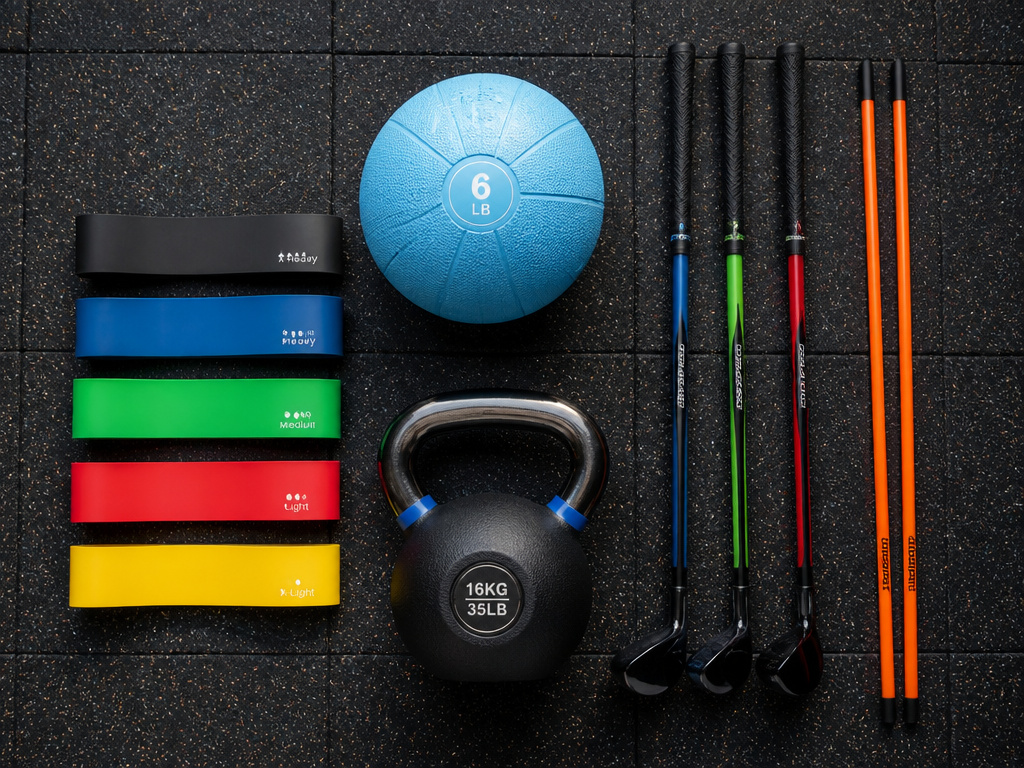 You can spend a fortune. Don’t. These five items deliver 95% of the benefit.
- Resistance Bands: A set of looped and tube bands is the most versatile tool. Use them for warm-ups, rotational exercises, and shoulder prehab. The VersaLoop set is durable and comes with multiple tensions.
- A Light Med Ball (4-6 lbs): For rotational throws and slams. It teaches you to transfer force from the ground up through your core. The Onnit 6 lb. Vinyl med ball is a good size.
- A Kettlebell (16-20 kg for men, 8-12 kg for women): For swings, presses, and carries. It builds full-body, functional strength better than dumbbells. The competition-style kettlebells from Rogue or Kettlebell Kings have a consistent shape.
- A Speed Training System: This is the biggest accelerator for clubhead speed. The SuperSpeed Golf system uses three graduated clubs to train overspeed. The Stack System uses app-based feedback. Both work.
- A Quality Mat: For floor work and med ball slams indoors. A 3/4″ thick rubber horse stall mat from a farm supply store is indestructible and cheap.
This gear, paired with foundational training aids like alignment sticks for feedback, is all you need. Skip the gimmicks. The value is in the consistent use, not the gadget.
Recovery: The Silent Multiplier
 Fitness depends on both the work you do and how well you rebuild afterward. This is doubly true on a golf trip with consecutive rounds.
Post-Round (Within 30 minutes):
- Hydrate: Water plus electrolytes. Golf is a 4-5 hour endurance event.
- Mobilize: Spend 5 minutes on a foam roller for your calves, glutes, and lats. Follow with dynamic stretches, leg swings and torso rotations.
- Refuel: A protein shake or a meal with lean protein and carbs helps repair muscle tissue.
For Multi-Day Events:
- Contrast Therapy: If available, alternate 2 minutes in a hot tub or shower with 1 minute in a cold plunge or cold shower. Repeat 3 times. This reduces inflammation and soreness.
- Active Recovery: A 20-minute walk or light bike ride on an off-day promotes blood flow without adding stress.
- Sleep: This is non-negotiable. Aim for 7-8 hours. Your body releases growth hormone and repairs tissue during deep sleep.
The NCBI golf injury prevention program research underscores that a structured recovery protocol is part of the training load. Ignoring it leads to cumulative fatigue, which shows up as a loss of distance and erratic shots on the final day of your tournament.
Frequently Asked Questions
How soon will I see results from golf fitness training?
You’ll feel movement improvements, easier turns, better balance, within 2-3 weeks. Measurable gains in clubhead speed and distance typically require the full 8-week cycle documented in the studies. Consistency over intensity wins.
Can I do this at home without weights?
Yes, for the foundational phase. Resistance bands, bodyweight exercises, and a speed training system can deliver excellent results. The peer-reviewed golf fitness publication on resistance training notes that cable-based exercises are highly effective, and bands provide similar variable resistance.
I’m over 50. Is this type of training safe?
Absolutely, and it’s critical for longevity. The focus should shift slightly toward mobility, stability, and injury resilience. The work of fitness pioneer Gary Player proved this decades ago. Always prioritize form over load, and consider a session with a TPI-certified trainer to identify your specific limitations.
What’s the #1 mistake golfers make in the gym?
Training for aesthetics over athletics. Building bulk without the corresponding mobility will tighten your swing. Every strength exercise should be paired with a mobility drill for the same movement pattern. For example, follow a set of squats with deep hip capsule stretches.
How does fitness help if I already take lessons?
Lessons provide the software, the swing pattern. Fitness provides the hardware capable of running that software. A coach can tell you to create more hip turn, but if your body physically can’t, you’ll invent a compensation. Fitness removes those physical barriers, letting the lesson actually stick.
Before You Go
Golf fitness focuses on building a body that can execute an athletic motion, repeat it 100 times, and recover in time to do it again tomorrow. The evidence from the journal article on golf strength training and the JSCR golf performance research is unambiguous: a targeted 8-week program works.
Start with the assessment. Identify if it’s your hips, your balance, or your core that’s holding you back. Assemble the basic gear, bands, a med ball, a speed trainer. Block out three sessions a week on your calendar. The gains, in yards, in consistency, and in years of pain-free play, are waiting on the other side of that commitment. Your next drive will thank you.
