
Golf Lessons vs Self Taught: Weighing the Pros, Cons, and Data
This post contains affiliate links. As an Amazon Associate, we earn from qualifying purchases.
This post contains affiliate links. As an Amazon Associate, we earn from qualifying purchases.
Golf lessons produce improvement 2-3 times faster than self-teaching, according to the National Golf Foundation. The trade-off isn’t just money for time; it’s structured feedback against the freedom to experiment on your own schedule. For a complete beginner, skipping lessons risks ingraining swing flaws that take years to unlearn.
That 2-3x speed multiplier is the whole argument. It means fifty hours of undirected range time might get you where fifteen hours of coached practice would. The catch is the “coached” part, you need an instructor who can translate that time into the right changes. A bad fit wastes money and motivation.
What follows is a breakdown of where that speed comes from, when the self-taught path actually works, and how to match your goals, budget, and learning style to the right format. We’ll look at the numbers behind group versus private lessons, the real role of technology, and the one psychological bias that changes how you perceive any instruction you pay for.
Key Takeaways
- Lessons accelerate skill acquisition by providing directed feedback, preventing the deep practice of errors that self-taught golfers often face.
- Complete beginners see nearly identical gains from group and private lessons, making group formats the clear value choice for foundational learning.
- Once your handicap drops below 20, private instruction becomes significantly more effective because your swing flaws become unique.
- Simulator data is useless without expert interpretation; practicing with a launch monitor alone often reinforces existing mistakes.
- A 2024 study found golfers perceive instructors with higher certifications as more skilled, even when teaching identical content, a psychological bias that affects lesson value.
The Core Trade-Off: Speed vs. Cost & Control
The self-taught path offers total control. You practice when you want, work on what interests you, and spend nothing on instruction. This works if you have a keen eye for self-diagnosis and the discipline to seek out quality, structured information. Most golfers don’t. The common failure isn’t a lack of effort; it’s effort spent practicing the wrong thing.
A simulator gives you accurate data on ball flight, but it cannot diagnose the grip pressure or hip slide causing your slice. That interpretation is the coach’s job, and a 2020 study in the Journal of Quantitative Analysis in Sports found golfers improved 38% more over eight weeks with coach-guided feedback plus technology than with the same technology alone.
With lessons, you pay for that diagnosis. You’re buying a trained eye to spot the one fault causing three different misses. The cost is real, anywhere from $30 for a quick tune-up to over $300 an hour for a top-tier coach. But the return is condensed time. Instead of six months of YouTube trial-and-error, you might get a functional swing in six weeks. The financial math shifts when you consider the cost of all those undirected range buckets versus a handful of lessons with a clear practice plan.
| Path | Best For | Biggest Risk |
|---|---|---|
| Self-Taught | Highly disciplined learners, tinkerers, players on a strict budget. | Practicing flaws into muscle memory, leading to a long, expensive unlearning process later. |
| Guided Lessons | Beginners, players stuck at a plateau, anyone valuing efficient time use. | Mismatched instructor fit, or taking lessons faster than you can practice and absorb the changes. |
When Group Lessons Beat Private (And When They Don’t)
The assumption that private lessons are always superior is wrong. For a brand-new golfer, a group setting is often better. The social proof reduces anxiety, everyone is terrible together. The instructor teaches universal fundamentals like grip and posture, which don’t need customization yet. Data from the Grumpy Gopher instructor directory shows beginners improve almost as much in group settings as in private ones, for a fraction of the cost.
Where this goes sideways: Putting a 12-handicapper in a group clinic. Each player needs a different fix, one for early extension, another for face control, a third for tempo. The instructor spends the whole hour context-switching, and nobody gets the focused attention they need.
The threshold is around a 20 handicap. Once your swing has its own personality and your misses become specific, group instruction loses effectiveness. Mid-handicappers in the data improved 78% more with private lessons. Low-handicappers improved a staggering 300% more. Your issues are no longer universal; they’re technical and individual.
The Instructor Credential Trap
A 2024 study published in Frontiers in Psychology revealed a powerful bias. Researchers showed golfers identical lesson videos, but labeled the instructor as a tournament professional, a semi-pro, or an aspiring pro. Participants rated the “more certified” instructor as having higher expertise and performance skills, even though the content was exactly the same. This creates a placebo effect for prestige pricing.
This Frontiers in Psychology study on perception of instructor expertise means you might perceive a $300/hour lesson as better simply because of the instructor’s title. It doesn’t mean the teaching is objectively better for you. A PGA Associate charging $90 an hour might explain concepts in a way that clicks with your brain far better than a Master Professional whose communication style leaves you confused. The credential validates knowledge, but the teaching fit determines your progress.
The Tech Question: Simulators & Data

Launch monitors like TrackMan provide incredible feedback: club path, face angle, spin rate. This is invaluable for making precise adjustments. But the data is just numbers. Knowing your face is 3.2 degrees open is useless if you don’t know how to close it without creating a new problem. Technology-assisted practice without guidance is like having a medical textbook but no doctor to interpret your symptoms.
Indoor simulator lessons are fantastic for diagnosis and mechanical work in a controlled, private environment. They remove weather and self-consciousness. Outdoor range lessons are essential for translating those mechanics to real conditions, dealing with wind, uneven lies, and visualizing actual ball flight. The best approach often combines both: use the simulator for the “what” and “why,” and the range for the “how” under game-like conditions.
Building a Practice Plan That Actually Works
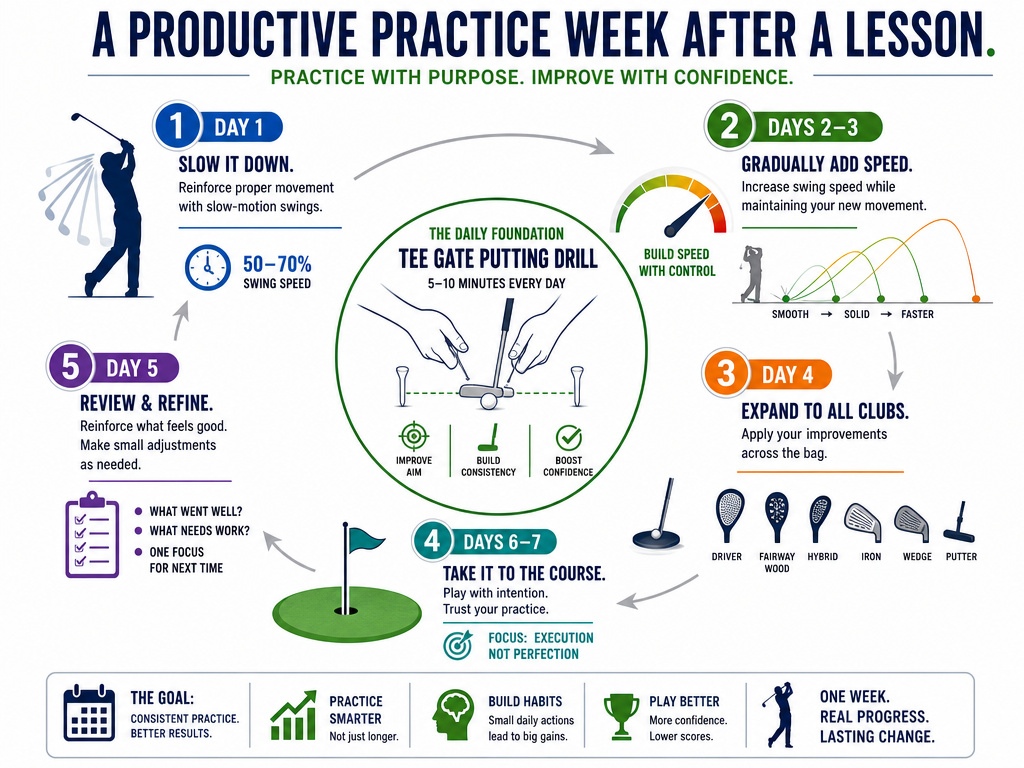
A lesson plants a seed. Practice is the water. The most common waste of money is booking lessons without committing to the work between them. An instructor should give you one or two drills, not a laundry list. Your job is to rep those drills until the feel becomes familiar.
I use the “tee gate” drill for putting path constantly because it gives immediate visual feedback. Set two tees just wider than your putter head on the intended start line. If you hit the tees, your path is off. It’s simple, measurable, and players stick with it. That’s the template: find a drill that connects the lesson’s concept to a clear, repeatable action. Hitting balls mindlessly with no goal builds nothing.
Here’s how to structure a productive practice week after a lesson: 1. Day 1 (Post-Lesson): Perform the assigned drill at half-speed. Focus on the new movement, not ball flight. 2. Day 2-3: Increase speed gradually. Start paying attention to the resulting ball flight. Does it match the intent? 3. Day 4-5: Integrate the change. Hit different clubs with the new feel, and start mixing targets. 4. Day 6-7: Play on the course or in a simulated scenario. The goal is to trust the change under mild pressure.
Without this bridge, the lesson content evaporates by your next session.
Matching Your Goal to the Right Investment
Your commitment level decides everything. If you play four times a year for fun, three lessons to establish basics will make the game more enjoyable. If you want to break 90, you need a series of lessons paired with regular, deliberate practice. If you’re chasing a single-digit handicap, you’re looking at ongoing coaching focused on fine-tuning and course management.
Easy to miss: Equipment that fights your swing. Investing in lessons with poorly fit clubs is like learning to run in the wrong size shoes. A basic club fitting check is a prerequisite, not an upgrade.
For the casual player, a package of mid-tier lessons ($75-$125/hour) offers the best value. For the dedicated amateur, blending lesson types works: a monthly private tune-up, supplemented by structured simulator practice and occasional focused group clinics (like a short-game workshop). This IJARPED journal article on self-directed vs teacher-led learning confirms that structured guidance accelerates achievement in skill-based domains.
Frequently Asked Questions
Are cheap golf lessons worth it?
Yes, with managed expectations. A $30 lesson from a junior pro can provide a single, useful fix, like a grip adjustment that immediately improves ball flight. Don’t expect a complete swing overhaul or a long-term plan. It’s a competent solution for a specific problem or a low-cost trial to see if you like formal instruction.
Can I become a good golfer without lessons?
It’s possible, but it’s the exception, not the rule. It requires extraordinary self-awareness, the ability to accurately interpret video of your own swing, and the discipline to follow a structured plan from reputable sources. Most self-taught good players still seek informal feedback from skilled players, which is a form of instruction.
How many lessons does it take to see improvement?
You should feel a difference after one lesson. You might see measurable improvement on the course after 3-5 lessons, provided you practice correctly between them. Sustainable improvement that lowers your handicap typically requires a series of 6-10 lessons spaced over a season, not crammed into a month.
What’s better: Golftec or a local club pro?
Golftec offers a standardized, technology-heavy, indoor environment with packaged plans. It’s excellent for data-driven learners who want structure. A local club pro offers a personalized, often outdoor experience with more flexibility and potentially better communication fit. The best choice depends on whether you learn better from numbers or feels, and if you value a set program or an a la carte approach.
Do I need my own clubs for lessons?
No, most facilities provide loaner clubs. However, practicing and playing with your own set is ideal. If you’re using rentals, consider investing in a set of game improvement irons for amateur players once you’re committed, as properly fit equipment makes applying lesson changes easier.
The Bottom Line
For most golfers, the answer leans toward lessons. The time saved and the pain of avoiding deeply ingrained bad habits are worth the upfront cost. Start with a group series if you’re a beginner. Move to private instruction once your handicap drops and your needs become specific.
Ignore the prestige badge. Find an instructor whose explanation makes sense to you, whether they charge $50 or $250. Then, match your financial investment with a practice investment. Buy a bucket of balls with a plan, not just a hope. That combination, directed feedback plus disciplined repetition, is what actually moves the needle from frustration to fun.
