
The Ground Under Repair Rule | Spot It, Drop It, Play On
This post contains affiliate links. As an Amazon Associate, we earn from qualifying purchases.
This post contains affiliate links. As an Amazon Associate, we earn from qualifying purchases.
The ground under repair (GUR) rule gives you free relief from areas the course committee has marked as damaged or under construction. Find the nearest spot where you have complete relief, not your best lie, drop within one club-length of that spot, and play on without penalty. This is Rule 16.1, and it covers everything from fresh sod to trenches dug for drainage.
That “nearest point of complete relief” phrase is the whole game. It’s not the nicest lie. It’s the first spot, no closer to the hole, where the GUR condition no longer interferes with your stance or swing. Most weekend players guess this spot and drop two yards closer to the green. That’s a one-stroke penalty for playing from a wrong place.
What follows is how to read the course’s markings, execute a legal drop every time, and know when you’re not allowed relief at all. By the end, you’ll spot GUR from thirty yards out and handle it like a rules official.
Key Takeaways
- Ground under repair (GUR) is any area marked by the committee with white lines, stakes, or notice on the scorecard. You get free relief under Rule 16.1.
- Your drop point is the nearest point of complete relief. Find the closest spot where the GUR no longer affects your stance or swing, then drop within one club-length of that spot.
- If your ball is in GUR but you choose to play it as it lies, you cannot touch or remove any loose impediments within the marked area.
- You cannot take relief from GUR if interference exists only from an abnormal course condition like casual water that has collected within the marked area.
- Always check the local rules sheet. Courses can declare entire areas like native grass or flower beds as GUR through a Local Rule.
What Exactly Is Ground Under Repair (GUR)?
Rule 16.1 in the Rules of Golf defines ground under repair as any part of the course the committee has marked as such. The committee is the group in charge of the competition or the course management for everyday play. They use physical marks and published notices to tell you where play is prohibited.
You’ll see it marked three ways. White painted lines or white stakes are the most common. Sometimes a notice on the scorecard or a local rules sheet declares an area, like “all flower beds are GUR.” In the absence of markings, a hole made by the course staff, like a trench for a new irrigation line, is automatically GUR.
Ground under repair includes all ground inside the marked area, and any grass, bush, tree, or other growing thing rooted in that area. It also includes any material piled for removal and any hole made by the maintenance staff, even if not marked.
The definition is intentionally broad. It covers the obvious, like fresh sod or a dirt pile, and the less obvious, like a shrub planted inside a white-lined bed. If it’s rooted inside the lines, it’s part of the GUR.
Common GUR Scenarios on the Course
- Freshly Sodded Areas: Patches of new grass, often staked off with white lines.
- Drainage or Irrigation Trenches: Long, narrow digs that may or may not be marked.
- Ground Damaged by Vehicles: Ruts from maintenance carts or heavy machinery.
- Piles of Soil or Turf: Material gathered for removal.
- Designated Landscaping: Flower beds, shrubberies, or native areas declared GUR by Local Rule.
The Step-by-Step Relief Procedure
Getting free relief is a mechanical process. Rush it, and you’ll likely drop in a wrong place. Follow these steps in order.
Step 1: Confirm Your Ball is in GUR
Your ball must be inside the marked area or physically in a hole made by maintenance. If it’s on the line, the line itself is out of bounds. The ball is in the GUR. Don’t guess. Walk to the marking and look straight down.
Step 2: Find Your Nearest Point of Complete Relief
This is the critical step almost everyone bungles. You are not looking for a good lie. You are looking for the nearest spot, no closer to the hole, where the GUR condition no longer interferes. – Interference means: The GUR affects your stance or the area of your intended swing. – How to find it: Take the club you would likely use for the shot. Imagine your stance. Find the closest spot where you can stand and swing without the GUR being in the way. Mark that spot with a tee.
Step 3: Measure Your One-Club-Length Relief Area
Using any club except your putter, measure one club-length from the tee marking your nearest point of complete relief. This circle is your relief area. It cannot be any closer to the hole than your nearest point of relief.
Step 4: Drop the Ball Correctly
Stand upright, hold the ball at shoulder height, and let it fall straight down. It must land in and come to rest within your relief area. If it rolls outside this area, you must re-drop. If it rolls out a second time, you then place it on the spot where it first struck the ground on the second drop.
Common mistake: Picking a nice patch of fairway and dropping there. Your nearest point of complete relief might be in light rough, behind a tree, or on a sidehill lie. That’s your spot. Choosing a better one is playing from a wrong place.
The table below shows what happens when you shortcut the procedure.
| Shortcut Taken | Likely Outcome | Rule Violation & Penalty |
|---|---|---|
| Guessing the relief point | Drop is closer to the hole or in a much better lie | Playing from a Wrong Place (General Penalty: 2 strokes in stroke play, loss of hole in match play) |
| Using putter to measure club-length | Relief area is too small | Playing from a Wrong Place |
| Dropping from knee-height | Drop is invalid, must re-drop | No penalty if corrected; penalty if played from that spot |
| Placing the ball instead of dropping | Ball is not in play correctly | Playing from a Wrong Place |
When You CANNOT Take Relief from GUR
Free relief isn’t always available. Three specific situations block it.
1. When Interference is from Another Condition Within the GUR
This is the trickiest exception. If your ball is in GUR, you get relief from the GUR itself. But if your stance would also be in casual water that has pooled inside that same GUR, you do not get additional relief from the casual water. The GUR is the only condition that matters for the drop.
2. When You Choose to Play the Ball as It Lies
You can always play from GUR. No penalty. But you must play it as it lies. You cannot improve your lie, and you cannot remove loose impediments (like leaves or stones) that are inside the marked area. Touching the sand or soil in a prepared area within the GUR is also not allowed.
3. When a Local Rule Restricts Relief
Rarely, a committee might declare an area GUR but deny relief for certain shots, like when the GUR is in a penalty area. Always scan the local rules before you tee off.
GUR vs. Other Free Relief Situations
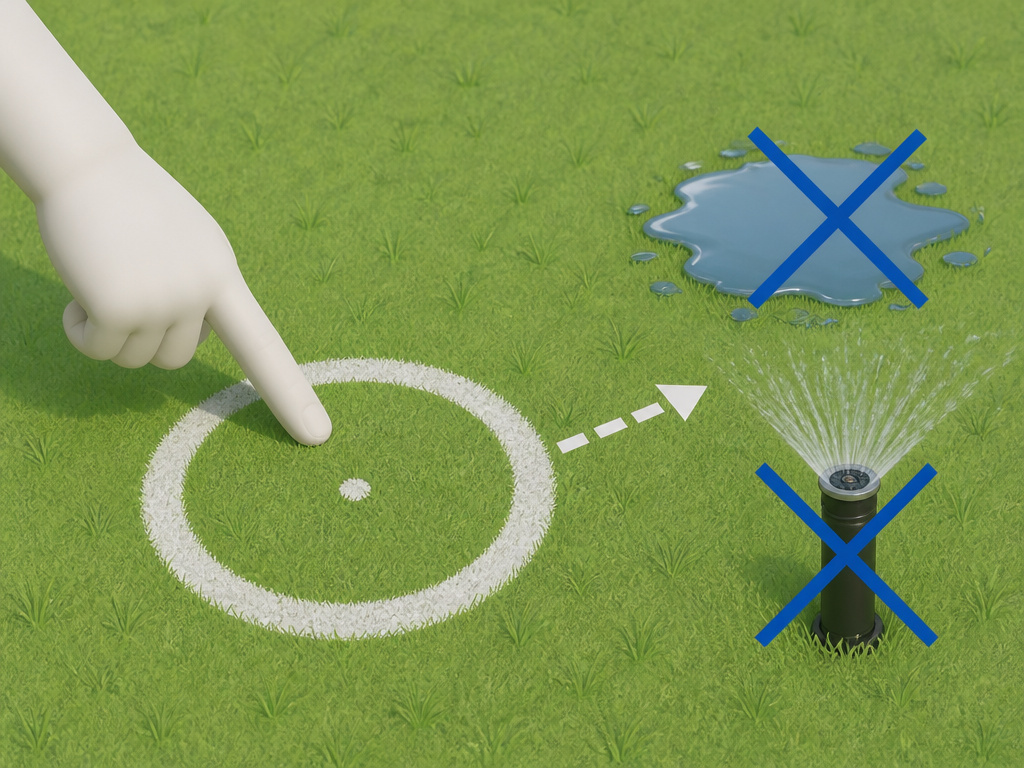
GUR is one of several “abnormal course conditions” that grant free relief. The others are animal holes, temporary water (casual water), and immovable obstructions (like a sprinkler head). The relief procedure is identical: find the nearest point of complete relief and drop within one club-length.
The difference is in the identification. GUR is explicitly marked by the committee. An embedded ball, for example, gives relief under a separate rule (Rule 16.3) and only in the general area, not in sand. Knowing which rule applies keeps you from taking an illegal drop.
| Condition | How to Identify | Key Difference from GUR |
|---|---|---|
| Ground Under Repair (GUR) | White lines/stakes, local rule declaration | Must be marked or declared by the committee. |
| Embedded Ball | Ball is in its own pitch-mark in the general area | Relief only if ball is embedded in its own pitch-mark in closely-mown areas (through the green). No marking needed. |
| Casual Water | Visible standing water before or after taking stance | Temporary condition, not a permanent marked area. |
| Immutable Obstruction | Artificial object like a cart path, sprinkler head | Man-made, not a ground condition. |
How Clubs Use Local Rules for GUR
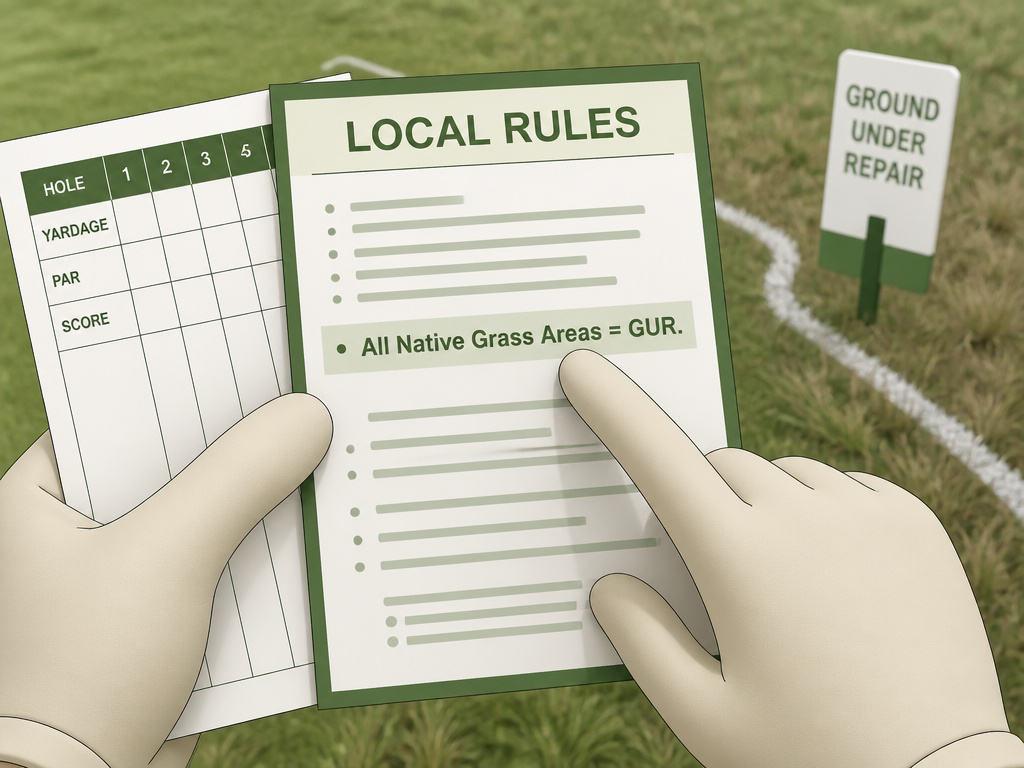
Course committees use the Local Rule provision to manage unusual terrain. This is where the official Rules of Golf grant flexibility. A common Local Rule is to treat all native grass areas or desert scrub as GUR, allowing free relief to keep pace of play up and prevent injury and club damage.
Another typical use is for environmentally sensitive areas. Instead of marking them as penalty areas (red or yellow stakes), which carry a penalty stroke for relief, they are marked as GUR with a mandatory drop zone. This protects the habitat while allowing free relief.
Where this goes sideways: Assuming every unkempt area is GUR. Unless a Local Rule declares it, long grass or bushes are just part of the general area. You play from them or take an unplayable lie penalty.
Always check the scorecard or starter’s sheet for these Local Rules. They are as binding as the white paint on the ground.
The Real-World Impact on Your Round
Knowing the GUR rule does two things. It saves you strokes, and it speeds up play. Hesitation at a marked area burns minutes. A foursome each taking an extra minute to debate a drop adds a hole to your round time.
The rule also teaches you to read the course. You start noticing the white lines before your ball heads toward them. You plan for the mandatory drop zone on the scorecard. This is course management, and it’s how you avoid the big number.
Most importantly, it settles arguments. The rule is unambiguous. If the ball is inside the line, you get relief. Here’s the spot. Drop it. Move on. There’s no committee meeting required.
Frequently Asked Questions
Can I take relief if my ball is not in GUR but my stance is?
Yes. Interference includes your stance. If your ball is outside the marked area but you have to stand inside it to play your shot, you get free relief. Find the nearest point of complete relief for your ball and your stance.
What if my nearest point of complete relief is in a penalty area or out of bounds?
Tough luck. Your nearest point of complete relief must be in the general area, the fairway, or the rough. If the only spot that gives you complete relief is in a bunker, a penalty area, or out of bounds, you cannot take free relief under this rule. Your options are to play the ball as it lies or take penalty relief under another rule.
Does GUR include trees or bushes inside the marked area?
Yes. If a tree, bush, or any growing thing is rooted inside the area marked as GUR, it is considered part of the ground under repair. You get relief from it as part of the GUR condition.
What’s the penalty for taking relief from an area that isn’t actually GUR?
If you take free relief from an area you mistakenly believe is GUR, and you play a ball from that wrong place, you get the general penalty (two strokes in stroke play, loss of hole in match play) for playing from a wrong place. If you realize the mistake before playing the ball, you can correct it without penalty.
Can I use the GUR rule to get relief from a divot hole?
No. A divot hole is not ground under repair unless the committee has specifically marked it as such. A divot hole in the fairway is simply a bad break. You must play the ball as it lies or declare it unplayable and take a penalty stroke.
Before You Go
The ground under repair rule is a gift from the rulebook. It’s free relief from places the course doesn’t want you to play from. Use it, but use it correctly. Find that nearest point of complete relief, not the nearest nice patch of grass, and drop within a club-length.
Stash a copy of the local rules in your bag. Know where the mandatory drop zones are. And when you see those white lines, don’t overthink it. Spot, drop, and play on. That’s how you keep a card clean and a round moving.
