
The Unplayable Lie Rule: Options, Penalties, and Strategy
This post contains affiliate links. As an Amazon Associate, we earn from qualifying purchases.
This post contains affiliate links. As an Amazon Associate, we earn from qualifying purchases.
The unplayable lie rule (Rule 19) lets you declare your ball unplayable anywhere on the course except in a penalty area, take a one-stroke penalty, and choose one of three relief options: stroke-and-distance (replay from previous spot), back-on-line relief (drop anywhere behind the ball on a line to the hole), or lateral relief (drop within two club-lengths, no nearer the hole). In a bunker, a fourth option exists: back-on-line relief outside the sand for two total penalty strokes.
That “except in a penalty area” clause is where rounds get wrecked. A ball in red or yellow stakes lives under a different law. Rule 17 for penalty areas, and trying to use the unplayable rule there is a rules breach that compounds the trouble. The unplayable rule is for damage control on a found ball you simply cannot or will not play from its spot.
What follows is the breakdown of when to pull the trigger and which of the three (or four) escape routes actually gets you back in play. We’ll cover the measurement specifics, the bunker math that changes the penalty, and the one drop scenario that offers no guarantees.
Key Takeaways
- You are the sole judge of an unplayable lie, but the rule never applies if your ball is inside a marked penalty area.
- Lateral relief (two club-lengths) is the most common choice, but back-on-line relief offers unlimited distance backwards if you need a clean swing.
- Declaring an unplayable ball in a bunker and taking relief outside the sand costs two penalty strokes, not one.
- If your dropped ball is still unplayable, you may declare it unplayable again, but that’s another penalty stroke each time.
- Always announce your intention to take unplayable relief before you touch or move your ball.
When Is a Ball Actually Unplayable?
The rule is brutally simple: you decide. There is no official definition of a bush so thick or a lie so buried that it automatically qualifies. If you look at your ball nestled against a tree root, under a thorny bush, or perched on a rock, and you decide that attempting a stroke is unreasonable or risky, you can call it. Your playing partners cannot overrule you.
This is different from other bad lies that have their own rules. An embedded ball in the general area often gets free relief. A ball in a penalty area must use the penalty area relief options. The unplayable lie rule is your tool for a ball that is found, in bounds, and not in a hazard, but is otherwise a nightmare.
Common mistake: Trying to use the unplayable ball rule when your ball is in a penalty area. This is a breach. If your ball is inside red or yellow stakes or lines, your only relief options are under penalty area rules.
The trigger is usually physical impossibility or extreme risk. Swinging into a tree root could break your club or your wrist. A ball wedged deep in a bush might not move at all. The rule exists for damage control, accepting a one-stroke penalty to avoid a potential triple or quadruple bogey from hacking away.
What Are Your Three Unplayable Lie Options?
Once you declare your ball unplayable, you have three choices, each costing one penalty stroke. You must know the spot of your original ball to use options two or three.
Option 1: Stroke-and-Distance Relief
This is the nuclear option. You go back to the spot where you played your last stroke and play again from there, adding a penalty stroke. It’s the same penalty as a lost ball or hitting out of bounds. Use this when the other two options leave you in equally bad trouble, like deep in a forest where two club-lengths is still deep in the forest.
Option 2: Back-on-Line Relief
Imagine a straight line running from the hole through the spot of your unplayable ball. You can drop a ball anywhere on that line behind the original spot. There is no limit to how far back you go. The relief area is then one club-length in any direction from where the dropped ball first touches the ground, but it cannot be nearer the hole than the original ball’s spot.
Option 3: Lateral Relief
This is the most frequently used option. You drop a ball within two club-lengths of the spot of the original ball, no closer to the hole. It’s a quick escape from tree roots or bushes where a small move is all you need.
| Relief Option | Penalty | Procedure | Best For |
|---|---|---|---|
| Stroke-and-Distance | 1 stroke | Replay from previous shot’s spot. | When the area is so bad that any drop nearby is still unplayable. |
| Back-on-Line | 1 stroke | Drop anywhere on line from hole through ball, going backwards. Unlimited distance. | When you need a clean lie and are willing to give up significant yardage. |
| Lateral Relief | 1 stroke | Drop within two club-lengths of the original spot, no closer to the hole. | Escaping immediate trouble (roots, bushes) with minimal distance loss. |
Back-on-line relief gives you an unlimited retreat. If your ball is under a shrub, you can drop 50 yards back down the fairway on that line, as long as you find a spot within the general area. That one-club-length relief area is measured from where the ball first hits the ground.
A critical nuance involves a ball that is not on the ground. If your ball is stuck in a tree, the reference point for lateral relief is the spot on the ground directly below it. You don’t get to drop where it would land if it fell.
The Special Case: Unplayable Ball in a Bunker
Sand adds a layer of complexity. The standard three options are available, but with a key restriction for options two and three: if you take back-on-line or lateral relief, you must drop the ball inside the bunker. This often fails to solve the problem if your ball is buried under a high lip.
That’s why Rule 19.3 provides a fourth, more expensive escape hatch.
The Bunker Escape Option:
For a total of two penalty strokes, you may take back-on-the-line relief outside the bunker. You still use the line from the hole through the ball’s spot, drop outside the sand, and your relief area is one club-length from where it lands.
| Situation | Option | Drop Location | Total Penalty |
|---|---|---|---|
| Unplayable in Bunker | Normal Relief (Options 1-3) | In Bunker (for Options 2 & 3) | 1 stroke |
| Unplayable in Bunker | Extra Relief (Option 4) | Outside Bunker (Back-on-Line) | 2 strokes |
This two-stroke option was added in the 2019 rules modernization. Before that, if you couldn’t play from somewhere in the bunker, your only way out was stroke-and-distance. It’s a costly but sometimes necessary trade to avoid multiple failed attempts from the sand.
Where the Unplayable Lie Rule Does NOT Apply
This is the most important boundary. The unplayable ball rule is not a universal get-out-of-jail card.
1. In a Penalty Area
This is non-negotiable. If your ball is in a penalty area (marked by red or yellow stakes or lines), you cannot declare it unplayable under Rule 19. Your relief options are strictly governed by Rule 17 and the penalty area rules. Confusing these two rules is a common and costly error.
2. For an Embedded Ball
If your ball is embedded in its own pitch mark in the general area (fairway, rough), you are likely entitled to free relief under Rule 16.3. There’s no penalty. Don’t pay a stroke when you don’t have to. Always check for an embedded ball before declaring it unplayable.
3. For a Lost Ball or Out of Bounds Ball
If you can’t find your ball within three minutes, it’s lost, and you must use the lost ball rule (stroke-and-distance). If it crossed a boundary, it’s out of bounds. These are not unplayable lies; they are different situations with their own procedures, often involving a provisional ball.
How to Execute the Drop Correctly
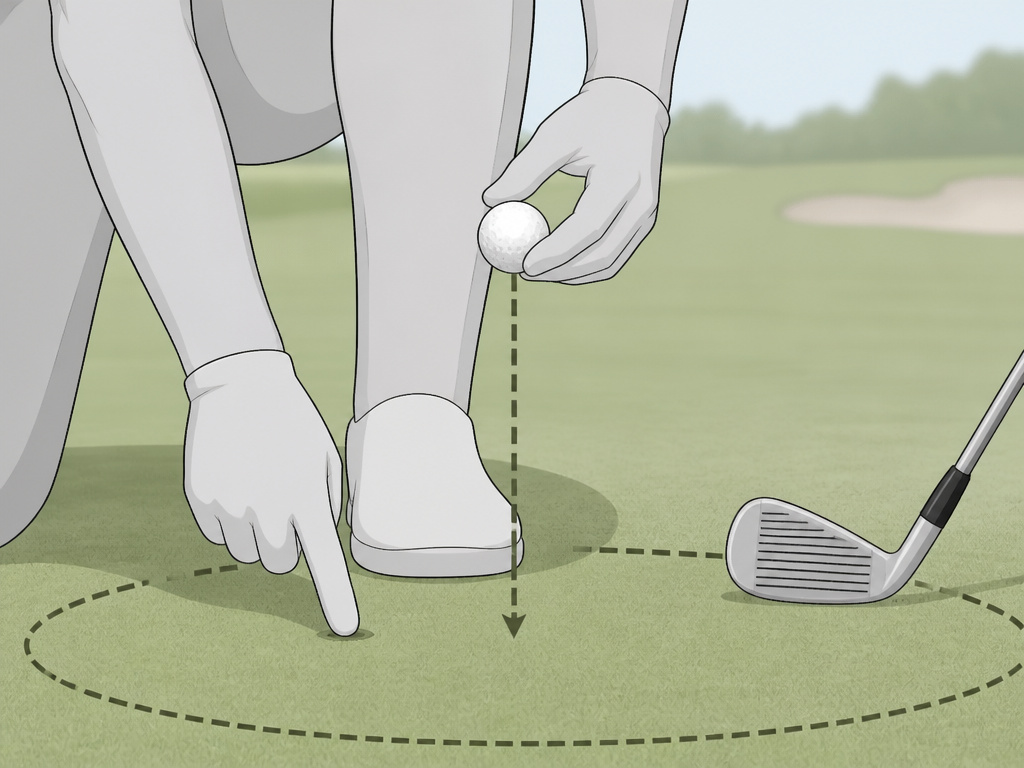
Taking relief is a specific procedure. Getting it wrong can lead to playing from a wrong place and a general penalty.
- Announce Your Intent. Clearly state to your marker or fellow competitors that you are taking unplayable ball relief and which option you are using.
- Identify the Correct Reference Point. This is the spot of the original ball for lateral relief, or a point on the back-on-line for that option.
- Measure Your Relief Area. Use a club to measure your one or two club-lengths from the reference point (or where the ball first struck the ground for back-on-line).
- Drop from Knee Height. Stand upright, hold the ball at the height of your knee, and let it fall straight down without spinning or throwing it.
- Ensure It Comes to Rest in the Relief Area. The ball must stay within the measured relief area. If it rolls outside, you must re-drop. If it happens again, you then place it where it first struck the ground.
Where this goes sideways: Not announcing your intention before lifting the ball. If you touch or move your ball without declaring it unplayable first, you incur a one-stroke penalty under Rule 9.4, and you still have to replace it or take unplayable relief on top of that.
Unplayable Lie vs. Other Rules: A Quick Guide
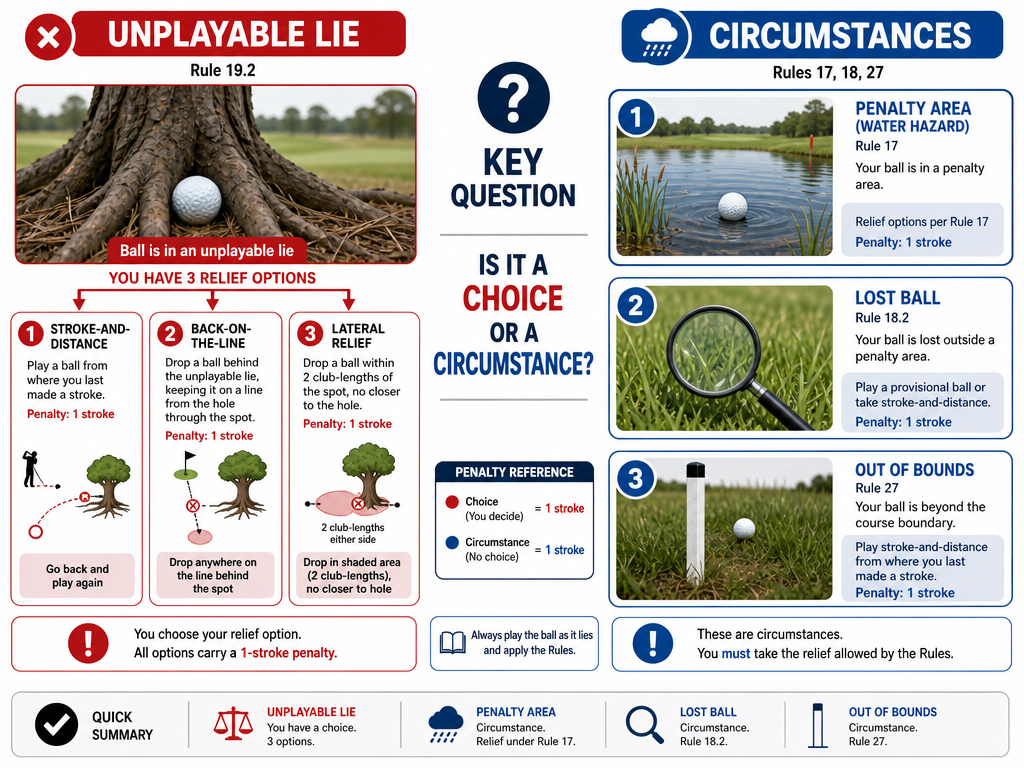
It’s easy to mix up the rules when you’re frustrated. Use this table to diagnose your situation before you act.
| Your Situation | Governing Rule | Key Question |
|---|---|---|
| Ball is against a tree root in the rough. | Rule 19 (Unplayable Ball) | Can I (or do I want to) play this shot? |
| Ball is in a red-staked creek. | Rule 17 (Penalty Area) | Is my ball inside the marked hazard? |
| Ball is buried in its own pitch mark in the fairway. | Rule 16.3 (Embedded Ball) | Is the ball embedded in the general area? |
| Ball cannot be found after a 3-minute search. | Rule 18 (Lost Ball) | Did I find my original ball? |
| Ball is beyond the white stakes. | Rule 18 (Out of Bounds) | Did my ball cross the boundary line? |
The cleanest differentiator: an unplayable lie is a choice you make about a ball you can see and identify. A lost ball or a ball in a penalty area is a circumstance dictated by the course or your search.
Frequently Asked Questions
Can I declare a ball unplayable in a penalty area?
No. The unplayable ball rule (Rule 19) explicitly does not apply when your ball is in a penalty area. You must use the relief options under Rule 17, which also cost one penalty stroke but have different dropping procedures.
What if my drop under unplayable relief is also unplayable?
You may declare that new ball unplayable as well. This incurs an additional penalty stroke. You can choose any of the three relief options again from the new spot. There is no guarantee of a playable lie after a drop.
Can I clean my ball when I take unplayable relief?
Yes. Whenever you lift your ball to take relief under a rule, including Rule 19, you are allowed to clean it.
Does “two club-lengths” mean two of my longest clubs?
No. You may use any club in your bag to measure the relief area. Most players use their driver for consistency, but the rule does not specify which club.
What if my ball is unplayable on the putting green?
The same three options under Rule 19 apply, with the same one-stroke penalty. However, it is exceptionally rare to need this, as you can usually mark, lift, and clean your ball on the green without penalty.
The Bottom Line
The unplayable lie rule is golf’s controlled demolition charge. It accepts a small, known penalty, one stroke, to avoid a catastrophic collapse. Your key decision points are always location-based. In the general area, weigh lateral relief against a longer walk back on the line. In the bunker, decide if one stroke in the sand is better than two strokes for freedom.
Remember the hard limits. The rule never touches a ball in a penalty area, and it treats a bunker as a special prison with a higher cost for parole. Use it as the strategic tool it is, not as a last resort after three failed hacks. That’s how you turn a potential “other” into a bogey or double, and keep your round alive.
