
Health Benefits of Walking 18 Holes | What the Data Shows
This post contains affiliate links. As an Amazon Associate, we earn from qualifying purchases.
This post contains affiliate links. As an Amazon Associate, we earn from qualifying purchases.
Walking 18 holes of golf delivers low-impact, moderate-intensity exercise, covering roughly 6–8 kilometers and burning 800–1,100 calories for an average adult, while also providing proven cognitive and cardiovascular benefits like improved cholesterol ratios and executive function.
The calorie burn and step count are the headline, but the mechanism is what makes it stick. Golf walking is a start-stop interval session spread over four hours, with a pattern of walking, stopping, setting up, swinging, and repeating. That pattern keeps the heart rate in a moderate zone longer than a brisk walk of the same distance, and it loads the muscles differently than a flat treadmill session.
What follows: the exact numbers from peer-reviewed studies on steps, calories, and body composition; a breakdown of the cognitive and cardiovascular perks you won’t get from a cart; and the practical gear choices that make walking sustainable, not a punishment.
Key Takeaways
- Walking a typical 18-hole course meets or exceeds the CDC’s recommended 10,000 daily steps, often hitting over 13,000 steps.
- Studies show regular golf walking can improve your HDL (“good”) cholesterol ratio and reduce waist circumference, independent of diet changes.
- For players with knee osteoarthritis, walking the course does not significantly increase knee pain compared to riding, making it a viable joint-friendly exercise.
- Investing in proper footwear like dedicated walking golf shoes and using a push cart are the two biggest factors in making 18-hole walks enjoyable and repeatable.
- The social and cognitive engagement of playing a round while walking provides mental health benefits that pure cardio does not.
How Many Calories Do You Burn Walking 18 Holes?
You’re looking at a range. For an average adult, walking 18 holes while carrying your bag burns between 800 and 1,100 calories. Using a push cart drops that to about 700–900 calories. Riding in a cart cuts the total nearly in half, to roughly 450–600 calories.
The number swings with your weight, the course’s hilliness, and how fast you play. But the studies are consistent on the scale.
A 2022 study in the European Journal of Sport Science directly compared walking versus riding. The walkers averaged 880 ± 279 kilocalories expended over the round. The riders came in at 456 ± 155 kilocalories. That’s a difference you can feel by the 14th hole.
The “how” matters more than the total. Golf walking is interval training in disguise. You walk at a moderate pace for 100–300 yards, then stop completely to assess your shot, select a club, and execute your swing. Your heart rate spikes with the swing effort, especially on an uphill approach, then recovers as you walk to your ball.
That stop-start pattern is why the calorie burn stays high. It prevents your body from settling into an efficient, steady-state rhythm. It also explains why you can be more physically drained after a walking round than after a jog of the same distance. You’ve used more muscle groups, with more bursts of power.
If you skip the push cart and carry your bag, add about 150–200 calories to those estimates. The extra load turns your walk into a weighted exercise. That’s why so many caddies have notable core and leg strength, they’re essentially doing a four-hour weighted carry workout several times a week. For most recreational players, though, a lightweight golf bag on a push cart is the smart compromise between workout and sustainability.
Step Count and Distance: Exceeding the Daily Goal
Here’s the simplest metric: walking 18 holes of golf provides over 130% of the recommended 10,000 daily steps. The research is blunt. One study published in Medicine & Science in Sports & Exercise found golfers accumulated 13,145 ± 1,736 steps per round. Even using a golf cart still logged an impressive 6,280 ± 1,428 steps, nearly two-thirds of the daily goal.
The course yardage on the scorecard is a lie. Well, an underestimate. Studies that tracked golfers with GPS found the actual distance walked averages about 1.25 times the published playing distance. A 6,500-yard course becomes an 8,125-yard walk, or roughly 4.6 miles. You cover extra ground walking to and from tees, searching for balls in the rough, and navigating between greens and the next tee box.
| Activity | Average Steps | Approx. Distance | % of 10K Goal |
|---|---|---|---|
| Walking 18 (Carry) | 13,000 – 15,000 | 4.5 – 6 miles | 130% – 150% |
| Walking 18 (Push Cart) | 12,000 – 14,000 | 4.0 – 5.5 miles | 120% – 140% |
| Riding 18 (Cart) | 6,000 – 7,500 | 2.0 – 3.0 miles | 60% – 75% |
| CDC Daily Rec. | 10,000 | ~5 miles | 100% |
This table isn’t just trivia. It shows that a cart round still provides legitimate, moderate activity. But the step gap between walking and riding is massive, almost a full day’s recommended activity in the difference. That’s the essential core of the health argument.
Your feet will know the truth by the 15th hole if you’re in the wrong shoes. The wrong pair, too stiff, poor arch support, no cushion, will have your heels burning and your toes numb. The right pair, like a dedicated set of best walking golf shoes, feels broken in from the first tee and distributes the pressure evenly. That’s the difference between walking once as a novelty and making it your standard routine.
The Cardiovascular and Body Composition Payoff
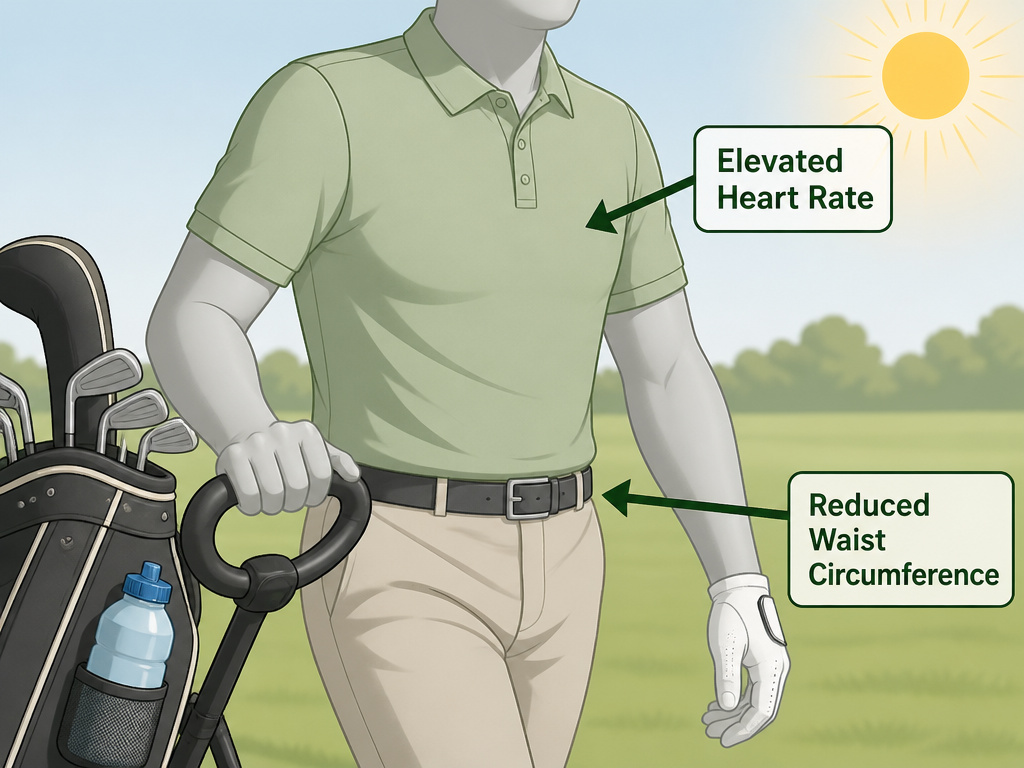
The heart and waistline benefits are where the long-term studies get interesting. It’s not just about burning calories today; it’s about improving your health markers over a season.
Take HDL cholesterol, the “good” kind that helps clear your arteries. A 20-week controlled trial published in the American Journal of Medicine followed sedentary men who took up golf walking 2–3 times a week. The golf group showed significantly greater increases in HDL levels and in the ratio of HDL to total cholesterol compared to the control group. That’s a direct, measurable reduction in cardiovascular risk from an activity that doesn’t feel like grinding gym work.
The same study recorded body composition changes. After 20 weeks, the walking golfers lost an average of 1.4 kg (3.1 lbs) and reduced their waist circumference by 2.2 cm (0.87 inches). These weren’t people on strict diets. They were just adding regular, purposeful walking to their week.
Where this goes sideways: Assuming walking is “light” exercise. Your core temperature and heart rate stay elevated across a 4-hour walking round in a way they simply don’t in a cart. One study found core temperature was significantly higher at the 6th, 12th, and 18th holes when walking, and heart rate increased across the round instead of decreasing.
The cardiovascular demand is real and sustained. Proper hydration is your essential performance fuel. I’ve watched players fade on the back nine because they treated water as an afterthought.They’d start strong, then their concentration and swing stability would unravel as they got dehydrated. You need to sip water constantly, not just when you feel thirsty.
For older players or those managing joint concerns, the data contains a crucial insight. A clinical study on osteoarthritis looked specifically at golfers with knee OA. It found that walking the course led to 2481 more steps and higher perceived exertion, but, and this is key, no significant difference in knee pain compared to using a cart. The joints can handle the load if the surrounding muscles are engaged. Using a push cart removes the carrying strain, making it an excellent entry point for maintaining joint health.
Mental and Cognitive Benefits Beyond the Physical

This is the part most fitness trackers miss. Walking a golf course is a continuous, low-grade cognitive workout wrapped in a physical one.
Executive function gets a boost. A randomised cross-over study with healthy older golfers measured performance on the Trail-Making Test (TMT), a common assessment of processing speed and task-switching. After an 18-hole walking round, participants shaved an average of 4.4 seconds off their TMT A-test time. Other walking exercises improved it too, but golf provided the unique combination of navigation, strategy, and social interaction.
I learned this by watching students who only practiced on the range. Their swings were technically sound, but they’d crumble on the course under decision fatigue. The player who walks and plays regularly develops a kind of mental endurance. They’re used to planning the next shot while recovering from the last one, all while keeping pace. That’s a skill you can’t buy.
The social component is medicine. Golf is one of the few activities where extended, conversational walking is built into the game. That social connection reduces stress and loneliness, both of which are independent risk factors for heart disease. You’re not just walking; you’re engaging in a shared, focused challenge with friends. It turns exercise into play, which is why people stick with it for decades when they quit gym memberships after six months.
There’s also the simple sensory benefit of being outdoors for four hours, the sun, the grass, the quiet focus between shots. It’s a form of moving meditation that combats the fragmented attention of modern life. Your brain gets a chance to unwind in a way it never does during a high-intensity spin class.
Walking vs. Riding: A Real-World Comparison
Let’s commit. For the average player seeking health benefits, walking with a push cart is the clear winner. Riding a cart is better than not playing, but it’s a fraction of the workout.
The difference isn’t subtle. We’ve covered the step and calorie gaps. But the physiological experience is starkly different. When you walk, your body stays in an active, calorie-burning mode for the entire round. Your metabolism doesn’t get to shut off between shots. When you ride, you’re essentially taking a seated break every few minutes, completely resetting your heart rate and cooling your muscles.
Common mistake: Thinking a golf cart saves energy for your swing. It actually does the opposite. Sitting for long periods between shots lets your muscles cool and stiffen. When you stand up to hit, you’re starting from a cold state every time, which can hurt consistency and power. Walking keeps your body warm and loose, ready for each shot.
The cart has its place. In extreme heat, on a brutally hilly course, or for players with serious mobility issues, it’s a tool that keeps the game accessible. And for a beginner overwhelmed by the skill of golf, removing the physical exertion can help focus on learning. But if your goal is to use golf as legitimate exercise, the cart is a compromise that costs you most of the benefit.
Your equipment choice directly supports your decision. If you’re going to walk, look for a push cart with a parking brake and a lightweight aluminum frame.com/best-golf-push-carts/) to save your back and shoulders. Pair it with a lightweight stand bag and specialized golf socks to manage moisture and friction. This isn’t about luxury; it’s about reducing the barriers that make you reach for the cart key next time.
Practical Gear for Sustainable Walking
Good intentions fail on the 12th hole when your feet hurt and your back is sore. The right gear removes the friction.
Start from the ground up. Your shoes are the most important piece of equipment, more than your driver. A walking shoe like a Hoka or a Brooks has ample cushioning, a flexible sole for natural foot strike, and a wide toe box to prevent pinching. Traditional leather golf shoes often prioritize lateral stability for the swing at the expense of walking comfort. Modern spikeless models from brands like FootJoy, Adidas, and Ecco are designed for this dual purpose. Don’t just buy golf shoes; buy shoes for walking 18 holes.
Next, get a push cart. Carrying a bag is a fantastic workout, but it’s also a surefire way to create muscle fatigue that degrades your swing by the end of the round. A three- or four-wheel push cart lets you save that energy for your game. The best ones have smooth-rolling wheels, a brake you can engage with your foot, and a compartment for your water bottle and snacks. For those who want the ultimate ease, electric golf carts do the pushing for you, preserving the walking motion without the effort.
Don’t forget the small stuff. Moisture-wicking golf socks prevent blisters. A lightweight, well-balanced bag makes a world of difference compared to a heavy, unbalanced tour bag. And a large insulated water bottle, at least 32 ounces, is non-negotiable. Fill it at the start and commit to finishing it by the turn.
This is about spending money on the right things. A comfortable, supported walk makes you more likely to do it again next weekend, turning a single health benefit into a lasting habit.
Frequently Asked Questions
Is walking 18 holes of golf good exercise?
Yes, it’s considered moderate-intensity exercise. It typically exceeds 10,000 steps, burns 800+ calories, and keeps your heart rate elevated for 3–4 hours in a start-stop pattern that engages multiple muscle groups. Studies confirm it improves cardiovascular markers like HDL cholesterol and reduces waist circumference.
How many miles is walking 18 holes?
You walk significantly farther than the course yardage. While a course may be 6,500 yards (3.7 miles) long, golfers actually walk about 1.25 times that distance due to pathing between holes and searching for balls. Expect to walk between 4.5 and 6 miles during a full 18-hole round.
Can walking golf help with weight loss?
Yes, as part of a balanced lifestyle. Walking 18 holes 2-3 times a week creates a meaningful calorie deficit, around 2,400–3,300 calories weekly. Combined with sensible nutrition, this can support steady weight loss. Research shows regular golf walkers can lose weight and reduce abdominal fat even without drastic diet changes.
Is it better to walk or use a cart for health?
Walking is significantly better for measurable health outcomes. Riding a cart cuts your step count by more than half and reduces calorie burn by nearly 50%. While a cart round is still activity, it lacks the sustained cardiovascular and metabolic load that defines the health benefits of a walking round.
What if I have bad knees or arthritis?
Consult your doctor first. However, a study in the Journal of Osteoarthritis and Cartilage found that for golfers with knee osteoarthritis, walking the course did not significantly increase knee pain compared to riding. Using a push cart to eliminate carrying is strongly recommended to reduce joint strain while preserving the walking benefit.
Before You Go
The evidence is clear, but the choice is personal. Walking 18 holes is one of the most complete forms of moderate exercise available, it trains your heart, muscles, and mind over a long, enjoyable duration. Riding a cart still gets you outside and swinging, but you’re leaving the majority of the health benefit in the parking lot.
My stance is practical. If you can walk, you should. Start with a push cart and proper shoes. If a full 18 feels like too much, walk the front nine and ride the back. The goal isn’t purity; it’s consistent, repeatable activity that keeps you playing for years.
The threshold for action is simple. Your next round, leave the cart key in your bag. Bring water. Wear your most supportive shoes for walking. See how you feel at the end. The data says you’ll have taken over 10,000 steps, burned the equivalent of a large meal, and given your brain a four-hour vacation from the noise.
