
Golf Ball Compression Explained: Match to Swing Speed for Distance
This post contains affiliate links. As an Amazon Associate, we earn from qualifying purchases.
Golf ball compression is a measure of how much a ball deforms under a fixed load, rated on a scale from roughly 30 (very soft) to 110+ (very firm). The right compression rating for you is dictated by your driver swing speed: under 85 mph matches with low compression (30-70), 85-100 mph with mid compression (65-90), and over 100 mph with high compression (90-115). Matching compression to your swing ensures efficient energy transfer, which directly influences distance, feel, and control.
That scale from 30 to 110 isn’t just a feel score. It’s a physical measurement of force. The number tells you how much energy from your swing is used to squash the ball versus how much is returned as ball speed. Get this match wrong, and you’re leaving yards on the table or fighting for control you can’t access.
What follows is a breakdown of the physics, the real-world data from independent testing, and the specific adjustments you need to make for conditions like cold weather. By the end, you’ll be able to look past marketing claims and pick a ball based on the specs that actually matter for your game.
Key Takeaways
- Compression is a force measurement, not a feel rating. It quantifies the load needed to deform a ball a specific distance. A higher number means a firmer ball.
- Swing speed is the primary driver for compression choice. Low swing speeds cannot activate high-compression cores, resulting in lost distance. High swing speeds over-compress soft balls, also losing efficiency.
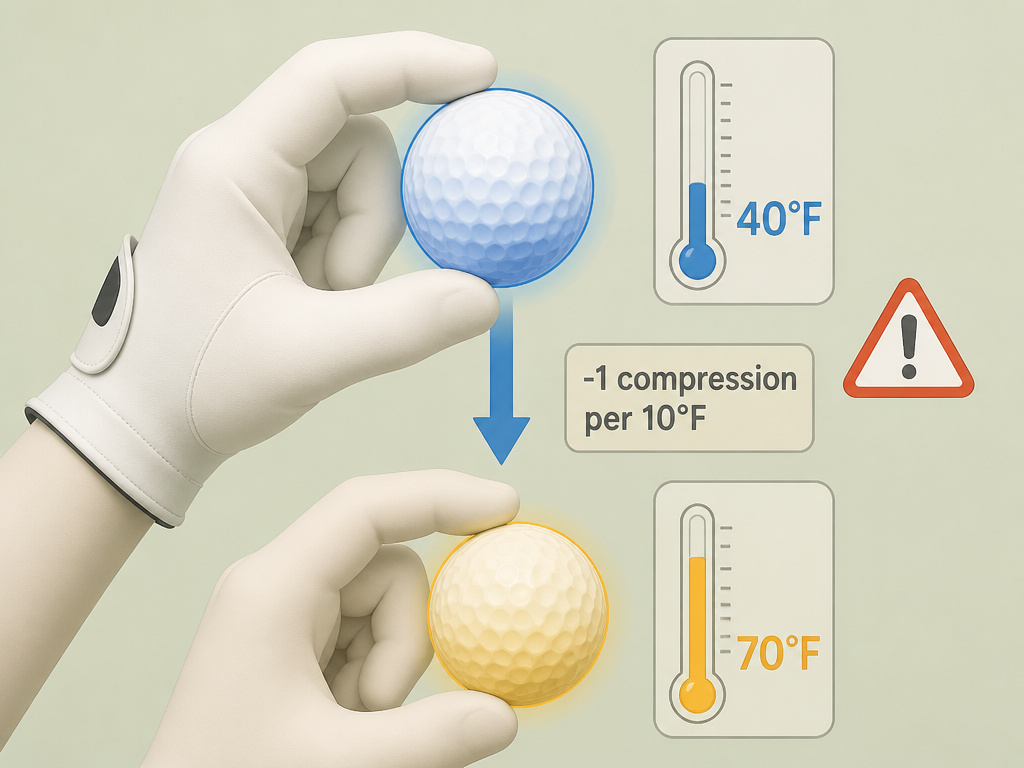
- Cold weather effectively increases compression. A ball rated 90 at 70°F can play like a 100+ compression ball at 40°F. Drop one compression tier in winter or store balls indoors.
- Manufacturer-stated compressions are often core-only measurements and are not directly comparable across brands. Independent tests like MyGolfSpy’s Ball Lab use a single gauge for true comparisons.
- Cover material (urethane vs. Ionomer) dictates short-game feel and spin more than the core’s compression number. A low-compression urethane ball can feel softer on chips than a high-compression ionomer ball.
How Compression Actually Works (The Physics)
Forget “soft” or “hard.” Compression is an engineering spec. The standard test involves placing a golf ball in a device like a Rimac Compression Tester and applying a fixed load, often 200 pounds, to see how much the ball deflects. The resulting measurement in millimeters is converted to the 30-110 scale.
The method described in patent WO2017165479A1 involves measuring the time-varying force as a ball returns from a deformed state, calculating a modulus that is proportional to its compression value. This dynamic approach aims for greater accuracy than a simple static load.
The core’s rubber compound is the main factor. A low-compression core uses a softer, less dense rubber that deforms easily. A high-compression core uses a firmer, more resilient compound. When you strike the ball, the core compresses against the clubface like a spring. Your swing speed provides the energy to load that spring. If the spring is too stiff for your speed, it doesn’t fully compress, and energy is wasted. If it’s too soft, it collapses completely and doesn’t rebound efficiently.
This is why the old advice of “swing speed matches compression” holds up. It’s a simple way to approximate the energy transfer equation. The construction of the ball’s other layers, mantles and cover, adds complexity to the feel and spin, but the core compression sets the baseline for distance potential.
The Swing Speed Match Game: Finding Your Tier
Your average driver swing speed is the single most useful number for narrowing your compression range. While launch monitor data is ideal, you can estimate based on carry distance. A 200-yard carry typically corresponds to a swing speed in the mid-80s (mph).
| Driver Swing Speed | Compression Range | Primary Goal | Example Balls |
|---|---|---|---|
| Under 85 mph | 30 – 70 | Maximize energy transfer for slow swings; increase launch. | Callaway Supersoft (38), Wilson DUO Soft+ (40), Srixon Soft Feel (60) |
| 85 – 100 mph | 65 – 90 | Balance distance with control; optimize spin separation. | Srixon Q-Star Tour (72), Titleist Tour Speed (80), TaylorMade TP5 (85) |
| Over 100 mph | 90 – 115 | Control excessive spin; harness high swing energy. | Titleist Pro V1 (92), TaylorMade TP5x (97), Vice Pro Plus (90) |
This table is a starting point, not a final answer. Within each tier, you must then consider your golf ball construction, specifically the cover material, which dictates short-game performance. A player with a 92 mph swing could be equally fit by a Titleist Tour Speed (80 compression, ionomer cover) for durability and straight flight or a Srixon Q-Star Tour (72 compression, urethane cover) for more greenside spin. Your preference around the green decides it.
Where this goes sideways: Choosing a ball purely for its tour pedigree. The average male amateur swings around 85-90 mph, which sits in the mid-compression zone. Playing a Titleist Pro V1 (compression 92) at that speed means you’re not fully loading the core, sacrificing 5-10 yards off the tee compared to a properly fitted mid-compression ball.
Low, Mid, or High? Breaking Down the Feel and Performance
Each compression tier delivers a distinct on-course experience. It’s not just about distance; it’s about how the ball interacts with every club in your bag.
Low Compression (30-70): The Energy Activators
- Feel: Noticeably soft off all clubs. Putting feels almost muted.
- Driver/Irons: Designed to compress fully at slower speeds. They often produce higher launch angles for extra carry.
- Short Game: Typically feature ionomer covers (like Surlyn) for durability. This means less grip on wedge grooves and lower spin on chips and pitches.
- Best For: Beginners, seniors, and any player with a driver speed under 85 mph who prioritizes maximizing distance.
Mid Compression (65-90): The Performance Bridge
- Feel: A blend. Firm enough for feedback, soft enough for comfort. This is where most urethane vs Surlyn cover decisions become critical for feel.
- Driver/Irons: Excellent spin separation. Lower spin off the driver for roll, higher spin off irons for stopping power.
- Short Game: Urethane-covered models here, like the Q-Star Tour, offer tour-level spin control. Ionomer models focus on straight flight and value.
- Best For: The vast majority of club golfers. If you’re between an 8 and 18 handicap, start your search here.
High Compression (85-115): The Player’s Ball
- Feel: Firm and crisp. Better players interpret this as “responsive” feedback.
- Driver/Irons: Requires high swing speed to compress. Returns maximum energy, often with lower driver spin for a penetrating flight.
- Short Game: Almost exclusively urethane covers. Provides the highest level of spin control for shaping shots and holding firm greens.
- Best For: Low handicappers, scratch players, and anyone with a verified driver speed over 100 mph.
The takeaway? Your guide to golf ball selection must start with compression tier, then filter by cover material based on your short-game needs. Don’t shop by brand first.
The Hidden Factors: What Changes the Number
Compression isn’t a fixed sticker on the box. Three external factors alter how a ball actually performs in your hands.
1. The Measurement Gauge Problem
There is no universal industry standard. One manufacturer’s “90” could be another’s “87” due to different testing equipment. This is why resources like MyGolfSpy’s Ball Lab are invaluable, they test every ball on the same calibrated machine, providing comparable data. When a brand states a compression, ask: is that for the core alone or the whole ball? Core-only numbers are useless for cross-brand comparison.
2. The Cold-Weather Compression Shift
This is the most overlooked practical factor. Golf ball cores are rubber, and rubber stiffens in the cold. The physics are simple.
A ball loses roughly 1 compression point per 10°F (5.5°C) drop in temperature. A 90-compression ball at 40°F plays like a 95+ compression ball. At freezing, it feels like a rock.
The consequence is a direct loss of distance and a harsh feel. If you play in temperatures below 50°F, you have two choices: consciously drop down one compression tier (e.g., from a 90 to a 70), or store your golf balls at room temperature and keep only one sleeve in your pocket during the round.
3. Compression Differential (The Spin Secret)
In multi-layer balls, the relationship between layers matters as much as the overall rating. The compression differential, the difference in firmness between the soft core and the firmer mantle layer, is a key driver of spin. A larger differential helps create the “spin separation” that better players seek: low spin off the driver, high spin off the wedges. This is why two balls with the same overall compression can produce different spin profiles.
Debunking Common Compression Myths
Let’s clear the fog around the most repeated, and often incorrect, pieces of advice.
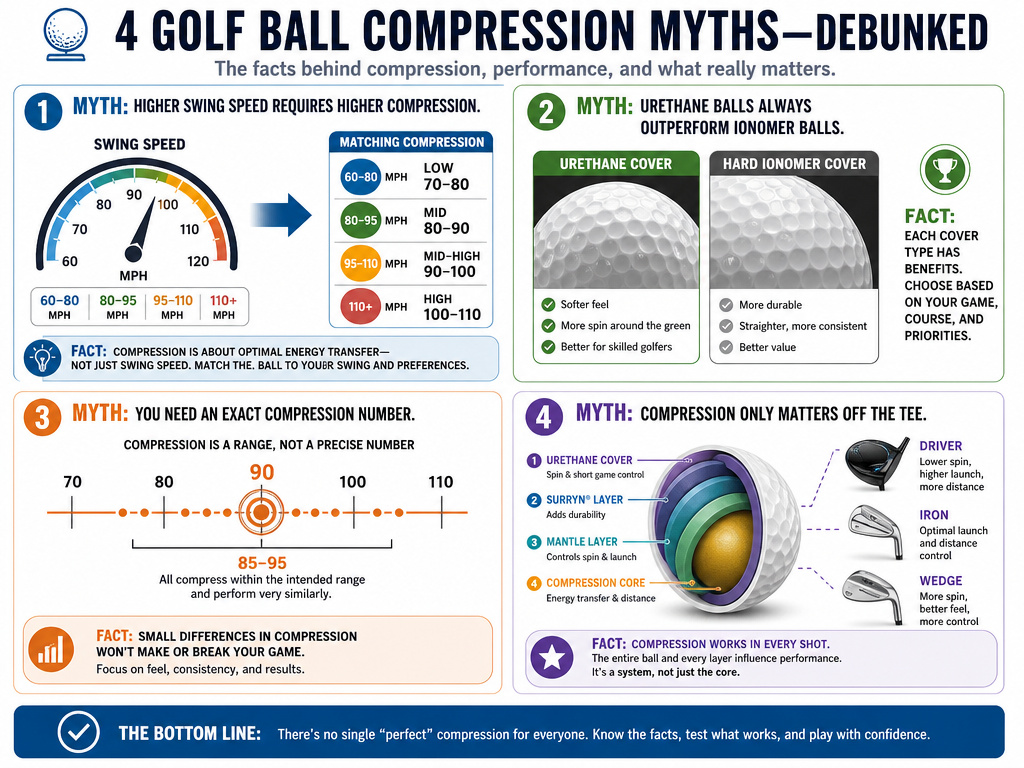
Myth 1: “Lower compression always means more distance.”
Truth: Only if your swing speed is too slow to compress a firmer ball efficiently. For a high-speed player, a too-soft ball over-compresses, acting like a wet sponge and sapping ball speed. Robot testing confirms maximum distance occurs when swing speed and compression are matched.
Myth 2: “Compression determines short-game spin.”
Truth: Cover material is the dominant factor for greenside spin. A low compression golf ball with a urethane cover (like some direct-to-consumer models) will generate more spin on a 30-yard pitch than a high compression golf ball with a rock-hard ionomer cover. Your wedge grooves grip the cover, not the core.
Myth 3: “The compression rating on the box is a precise guarantee.”
Truth: It’s a target. Manufacturing tolerances exist. The TaylorMade TP5 (2026) earned a high quality score, but its tested compression still ranged from 86.5 to 95.5 across a sample. Consistency is a separate quality you should look for in independent test data.
Myth 4: “You need to change balls for every club.”
Truth: Modern multi-layer construction is designed so one ball optimizes performance across the set. The core influences driver speed, the mantle layers influence iron spin, and the cover influences wedge spin. Switching balls mid-round introduces more variables than it solves.
How to Test and Choose Your Right Ball
You don’t need a $5,000 compression tester. Use this field-test protocol.
- Know Your Speed: Use a launch monitor at a local fitter or retailer. If that’s not possible, use your average driver carry distance as a proxy.
- Start With Your Tier: Based on your speed, buy a sleeve each of a low, mid, and high-compression ball from the chart above. Stick to one cover type (e.g., all urethane) to isolate the compression variable.
- Test on the Course: Play the same hole twice with different balls. Note the driver feel and total distance. Pay close attention to the 50-yard wedge shot. Which ball checks up more predictably?
- Listen for Feedback: A properly compressed driver shot has a solid, medium-pitched “crack.” A too-soft ball sounds dull and dead. A too-firm ball feels and sounds harsh, like you didn’t catch it clean.
- Check the Data: If you have access to a monitor, look at ball speed and smash factor. The right ball will give you your highest consistent smash factor (ideally near 1.50).
Your goal isn’t to find a “magic” ball. It’s to find the ball whose engineering matches your swing’s physics. When you get it right, the game feels easier.
Frequently Asked Questions
What compression is a Titleist Pro V1?
Independent testing from MyGolfSpy’s Ball Lab measures the Titleist Pro V1 at approximately 92 compression. The Pro V1x measures firmer, around 102 compression. Titleist does not publish official numbers, so third-party data is the most reliable source.
Can a high handicapper use a high-compression ball?
They can, but they shouldn’t. A high handicapper typically lacks the swing speed to compress a tour-level ball fully. This results in less distance off the tee and no access to the high-spin benefits around the green. A mid compression golf ball is almost always a better, more cost-effective fit.
Does compression affect ball flight?
Indirectly. The core compression influences spin, which affects trajectory. However, the golf ball dimples and their aerodynamic design are the primary architects of ball flight. A high-compression ball can be designed for a high or low trajectory based on its dimple pattern.
How does temperature affect my golf ball choice?
Significantly. In cold weather (below 50°F), plan to use a ball one full compression tier softer than your gamer. If you play a 90-compression ball in summer, switch to a 70-80 compression ball in winter. Storing balls indoors overnight is a simple hack that preserves their intended feel.
Is a softer ball better for putting?
Feel is subjective. Some players prefer the soft, muted feedback of a low-compression ball on the greens. Others prefer the firmer, more responsive “click” of a high-compression ball. The actual roll is influenced more by the ball’s roundness and your putting stroke than by its core compression.
How important is compression for irons?
Crucial for feel and distance consistency. The goal with an iron is to compress the golf ball against the turf. A ball that matches your swing speed will feel solid and produce a predictable ball flight. The wrong compression can lead to a vague feel, distance gaps, and a lack of stopping power on the greens.
Before You Go
Stop playing a ball because a pro uses it or your friend likes it. Compression is the first filter in a logical selection process. Find your swing speed tier. Then decide between a urethane cover for spin control or an ionomer cover for durability and straight flight. Finally, account for the season, drop that compression when the temperature drops.
For the majority of golfers, that path leads directly to the mid-compression shelf. Balls like the Srixon Q-Star Tour or the Titleist Tour Speed offer the engineering that matches amateur swing speeds, often at a better price than the tour models. Grab a sleeve, test it against your current gamer, and let the results, not the marketing, make the final decision.
