
How Are Golf Courses Built? A Guide to the Planning & Construction
This post contains affiliate links. As an Amazon Associate, we earn from qualifying purchases.
This post contains affiliate links. As an Amazon Associate, we earn from qualifying purchases.
Building a golf course requires matching three things: enough usable land (150-175 acres for 18 holes), a verified market demand, and a sequenced construction process that layers 4 inches of gravel, 2 inches of choker sand, and 12 inches of root zone mix under every green. The entire journey from land search to opening day typically spans three to five years.
That 12-inch root zone is the whole game. Its job is to hold water and air in perfect balance so bentgrass roots can push down 14 inches and survive a summer drought. Get the mix wrong, too much clay, not enough sand, and the green drowns after a heavy rain or bakes hard by July.
What follows is a walk through the specs, the timelines, and the single biggest decision that shapes everything else: hiring the right golf course architect. By the end, you’ll know why a desert course costs millions more in irrigation than a parkland layout, and what the “grow-in” year really means for the first tee shot.
Key Takeaways
- Secure the architect first. A qualified golf course architect conducts the initial feasibility study and leads the entire project team; hiring them late is the most expensive shortcut.
- Land dictates design. The ideal 150-175 acre site has natural drainage and minimal trees to reduce earthmoving costs by up to 30%; heavily wooded or flat land balloons the budget.
- Greens are built in layers. A USGA specification green is a engineered system: 4″ of gravel for drainage, 2″ of 1-2mm choker sand, and 12″ of blended root zone mix for the turf.
- Water needs vary wildly. An 18-hole course in the Northeast might use 25,000 gallons a day; a similar course in a desert climate can require over 1,000,000 gallons daily for irrigation.
- The grow-in is not optional. After grass is planted, a 6-12 month establishment period is critical for root development; opening too early ruins the playing surfaces for years.
Why Your First Hire Isn’t a Bulldozer Driver
It’s the golf course architect. This is about conducting the feasibility study that answers the only question that matters: should this project even exist?
The architect examines the physical site, topography, soil, drainage, water sources, and the market. Is there demand for another public course in this area, or would a private club model work? They blend this with your vision to create a masterplan. This document shows the potential routing, the location of the clubhouse and maintenance facilities, and the preliminary budget. Skipping this step is how you end up with a beautiful course that nobody plays, or a budget that doubles by the third earthmoving invoice.
A golf course architect’s role is akin to a symphony conductor, blending disciplines like agronomy, civil engineering, and landscape architecture into a cost-effective project, as outlined in the official ASGCA golf course development Q&A.
Their early analysis also flags the common limitations that kill projects: environmental protections on wetlands, zoning restrictions, or a lack of accessible water rights. Getting this right first saves years of headache later.
The 7-Stage Construction Process (Step-by-Step)
Once the masterplan is approved and permits are secured, the physical build begins. This sequence is required. Jumping ahead to seed before the drainage is in guarantees a swamp.
1. Clearing and Earthmoving
This is the noisy, dramatic phase. Heavy machinery like feller bunchers remove trees where necessary, preserving specimen trees as design features. The goal is to create the course’s “base shape”, the rough contours of fairways, tees, and green complexes. The ideal site requires minimal earthmoving; moving dirt is the single largest construction expense. Every cubic yard of soil shifted to create a dramatic hill is money that won’t be spent on better irrigation or sand in the bunkers.
2. Installing Drainage and Irrigation
Water must go somewhere. A network of drain pipes is installed at a minimum 1% slope, with surface drainage graded between 2-3% to shed rainfall quickly. This system is the skeleton of the course. Then, the irrigation infrastructure goes in. This involves a pumping station, miles of PVC pipe, and a computerized control system. The water source is decided here: a well, a municipal line, or recycled water.This decision alone can define the course’s operating budget for decades.
3. Building Greens, Tees, and Bunkers
This is precision work. For a USGA specification green, contractors excavate a hole and build it back up in engineered layers.
| Layer | Thickness | Material & Purpose |
|---|---|---|
| Gravel | 4 inches | Crushed stone (3/8″ to 1/2″). Provides subsurface drainage. |
| Choker Sand | 2 inches | Fine sand (1-2mm particle size). Prevents root zone mix from washing into gravel. |
| Root Zone Mix | 12 inches | A blended soil (typically 80-90% sand, 10-20% peat/soil). Supports turfgrass root growth and holds moisture. |
Tees are built similarly, though often with a simpler soil profile. Bunkers are excavated, lined with a fabric or plastic barrier to prevent contamination, and filled with 4-6 inches of specialty bunker sand.
4. Fine Shaping and Final Grading
With the major features in place, smaller dozers and skilled operators carve the final contours. This is where the artistry meets engineering. The shapes must look natural, direct surface water as planned, and provide the intended playing strategy. The ground is rolled and compacted to prevent settling.
5. Grassing the Course
Grass selection is climate-driven. Bentgrass is standard for northern greens, while Bermudagrass dominates in the south. Seed is applied via hydroseeding (a slurry sprayed on slopes) or broadcast seeding. For immediate play, sod is used on tees, greens, and sometimes fairways. It’s more expensive but establishes faster.
6. The Grow-In Period
The course is now “built,” but it’s not ready. The grow-in or establishment period lasts 6 to 12 months. The grass needs constant watering, mowing, fertilization, and protection from disease. This is not maintenance; it’s critical development. Opening the course before roots are mature causes thin turf, weed invasion, and compacted soil. It’s a year of investment with no revenue, which is why it’s often under-budgeted.
7. Final Touches and Opening
The architect returns to mark mowing lines for greens, fairways, and rough, defining the precise playing corridors. Sand is added to bunkers, signage is installed, and the maintenance team establishes its long-term routines. Then, and only then, does the first foursome tee off.
Greens, Bunkers, and Irrigation: The Technical Core
These three elements consume most of the construction budget and dictate daily maintenance for the life of the course.
Greens are the engine. The USGA specification is the gold standard, but it’s not the only way. A native push-up green, built simply from existing topsoil, can work if the native soil drains exceptionally well and the site has good air movement. It’s a cheaper, faster option for low-budget projects, but it’s far riskier. Most architects and builders follow the layered spec because it’s a predictable, engineered system.
Bunkers are high-maintenance hazards. Modern construction uses a liner (like a porous geotextile) between the native soil and the sand. This prevents rocks and soil from contaminating the sand and improves drainage. Without it, a bunker turns into a muddy pit after one storm. The sand depth matters, too. Under 4 inches, a club will easily hit the liner or hardpan below, damaging equipment and providing no penalty for a poor shot.
Irrigation is the circulatory system. A modern system is controlled by a central computer that can water individual sprinkler heads based on sun exposure, wind, and soil type. The pumps are its heart. Pumps in parallel increase water flow; pumps in series increase pressure. Choosing the right setup depends on the water source elevation and the course’s peak demand. A system designed for 25,000 gallons a day will fail catastrophically in Arizona.
Where this goes sideways: Using the wrong grass species for the climate. Planting cool-season bentgrass on a southern course with limited water guarantees a brown, diseased green by August, requiring a full resod in year two.
How Long Does It Really Take? The Realistic Timeline
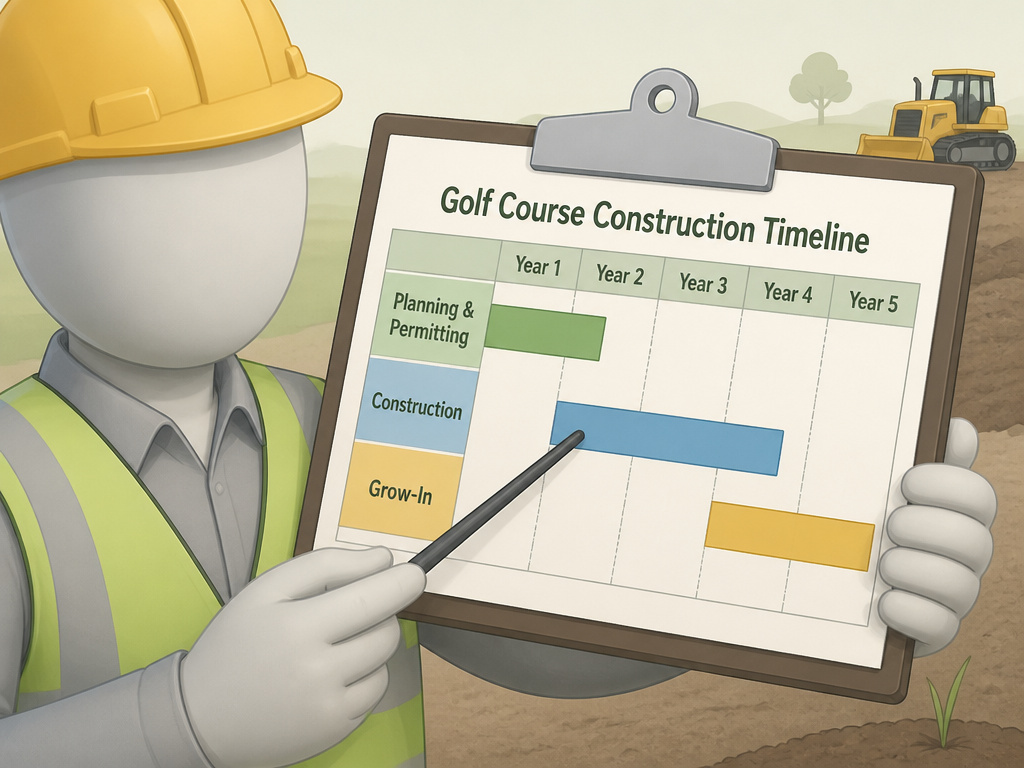
Forget the quick builds you see on reality TV. A regulation 18-hole course is a three- to five-year project from the start of planning to the first round.
The timeline breaks into three big chunks:
- Planning & Permitting (6-18 months): Feasibility, masterplan, environmental assessments, and securing local government approvals. This phase is all paperwork and meetings. It’s also where most projects get delayed.
- Construction (1-2 years): The physical work outlined in the 7-stage process above. Weather is the biggest variable here; a rainy season can add months.
- Grow-In (6-12 months): The non-negotiable period for the grass to establish. Rushing this sacrifices long-term quality for short-term revenue.
Here’s how those years typically allocate the work:
| Phase | Typical Duration | Key Activities |
|---|---|---|
| Land Acquisition & Planning | 6-18 months | Site selection, feasibility studies, hiring architect, masterplan, permitting. |
| Heavy Construction | 12-18 months | Clearing, earthmoving, drainage, irrigation, feature construction. |
| Grassing & Grow-In | 6-12 months | Seeding/sodding, fertilization, irrigation, mowing, pest control. |
| Final Prep & Opening | 1-2 months | Mowing line definition, bunker sand placement, staff training. |
A client once asked me if they could open in two years total. I told them they could, but they’d be replacing half the greens in year three. Good golf should feel less complicated the more you understand it, and that includes respecting the grass’s natural timeline.
The Major Challenges (And How to Solve Them)
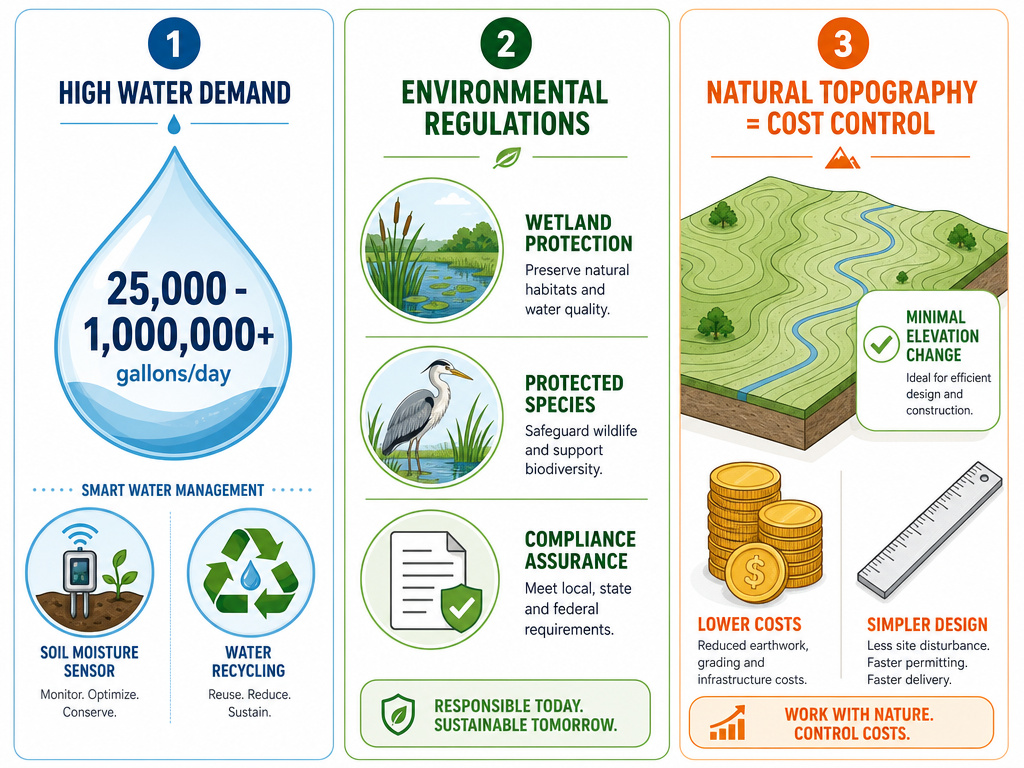
Three hurdles trip up more projects than any bad design.
1. Water. This is the existential challenge. An 18-hole course in the Northeast might use 25,000 gallons a day. In the desert Southwest, that number can exceed 1,000,000 gallons. The solution isn’t just finding water; it’s using it efficiently. Modern systems with soil moisture sensors and weather tracking can cut usage by 20-30%. Using effluent (recycled) water for irrigation is a common, responsible practice in water-scarce regions, as promoted in guides on environmental golf course development.
2. Environmental Regulations. You will encounter them. Wetlands, protected species, and stormwater management rules are strict. The fix is to hire an environmental consultant early and integrate their work with the masterplan. Often, you can turn a constraint into a feature, designing a wetland as a natural hazard that also treats runoff.
3. The Budget. Costs always run over. The single best cost-control measure is choosing a site with good natural topography. Every cubic yard of dirt you don’t have to move is money in the bank for better materials. Adhering to local standards, like those found in a municipal golf facility development resource, can prevent costly rework during inspections.
I favor straightforward, practical routines, not chasing the latest tip, and that applies to construction too. The most sustainable, affordable courses are often those that work with the land they have, not the land they wish they had.
Frequently Asked Questions
What is the minimum amount of land needed for an 18-hole golf course?
You need at least 150 acres of usable land for a standard 18-hole course, including space for the clubhouse, parking, and maintenance facilities. A compact “executive” course of par-3 and short par-4 holes can fit on 75-100 acres. Championship courses often use 175-200 acres.
How much does it cost to build a golf course?
Construction costs vary immensely by region, land costs, and design complexity. A basic public course can range significantly, while a high-end private or resort course costs multiples more. The largest expenses are earthmoving, irrigation systems, and clubhouse construction.
What’s the difference between a USGA green and a push-up green?
USGA green is built from the ground up with specified gravel, sand, and root zone layers for guaranteed drainage. A push-up green** is formed from the existing native topsoil. USGA greens are more consistent and perform better in wet climates; push-up greens are cheaper and can work in arid regions with well-draining soil.
Who is involved in building a golf course?
The core team is led by the golf course architect. They coordinate the civil engineer, irrigation designer, environmental consultant, golf course builder, and the golf course superintendent who will maintain it. It’s a collaborative process from start to finish.
Can you build a course on bad land, like a landfill?
Yes, but it’s complex and expensive. Former landfills, mines, or other disturbed lands can be reclaimed for golf. The challenges involve stabilizing the ground, managing methane gas, and importing all topsoil. It’s a specialist project that requires extensive engineering and environmental oversight, principles covered in state environmental best management practices.
The Bottom Line
Building a golf course is a marathon, not a sprint. It’s a layered process where the decisions you make in year one, the architect, the land, the water source, echo for the next fifty years of maintenance and play.
The most successful projects understand that the three-year timeline isn’t a suggestion. That 12-month grow-in is the period where the root zone mix you carefully specified actually grows roots deep enough to handle a summer drought. Rushing it is the one mistake you can’t fix with money later.
So if you’re looking at a parcel of land with a dream, start with the right question. Don’t ask “Can we build a course here?” Ask instead, “Can we build a course here that will still be great, and solvent, in thirty years?” The difference between those two questions is what separates a flashy project from a lasting one.
