
Advanced Turf Management and Irrigation Solutions for Golf
This post contains affiliate links. As an Amazon Associate, we earn from qualifying purchases.
This post contains affiliate links. As an Amazon Associate, we earn from qualifying purchases.
Turf management and irrigation on golf courses now runs on three things: localized evapotranspiration (ET) data, soil moisture sensors, and deficit scheduling. The goal is to replace water based on what the turf actually uses, not a fixed calendar. Since 2005, U.S. Courses have cut applied water per acre by about 15% nationally by adopting these practices, according to the GCSAA Environmental Profile.
That 15% drop represents a shift from a reactive ‘green at any cost’ mindset to a predictive system where water is a precision input. The old method, watering every other day because that’s what the schedule says, wastes water in open areas and drowns roots in shaded zones.Modern management treats each sprinkler head as its own climate zone.
What follows is a breakdown of the three pillars, the tools that make them work, and the specific products proven in university trials to keep turf alive on less water. You’ll see where the industry consensus is solid and where your local microclimate dictates the rules.
Key Takeaways
- U.S. Golf courses used 31% less total water in 2024 versus 2005, with about 15% less water applied per irrigated acre, driven by efficiency gains.
- Soil moisture sensors and ET data move irrigation from a calendar to a plant-need schedule, but sensor placement is everything, a bad spot gives a bad reading for the whole zone.
- Wetting agents like Aquatrols Revolution and experimental products like ACA 1935 are proven to maintain turf quality under severe deficit irrigation (as low as 40% ET replacement) in UC Riverside trials.
- Deficit irrigation, applying less than 100% of estimated water use, creates soil storage capacity for rain and trains turf roots to seek deeper moisture. Uniformity audits are essential; an irrigation system with 45% uniformity (common in older systems) must run nearly twice as long to water the driest spot, wasting everything in between.
The Three Pillars of Modern Turf Irrigation
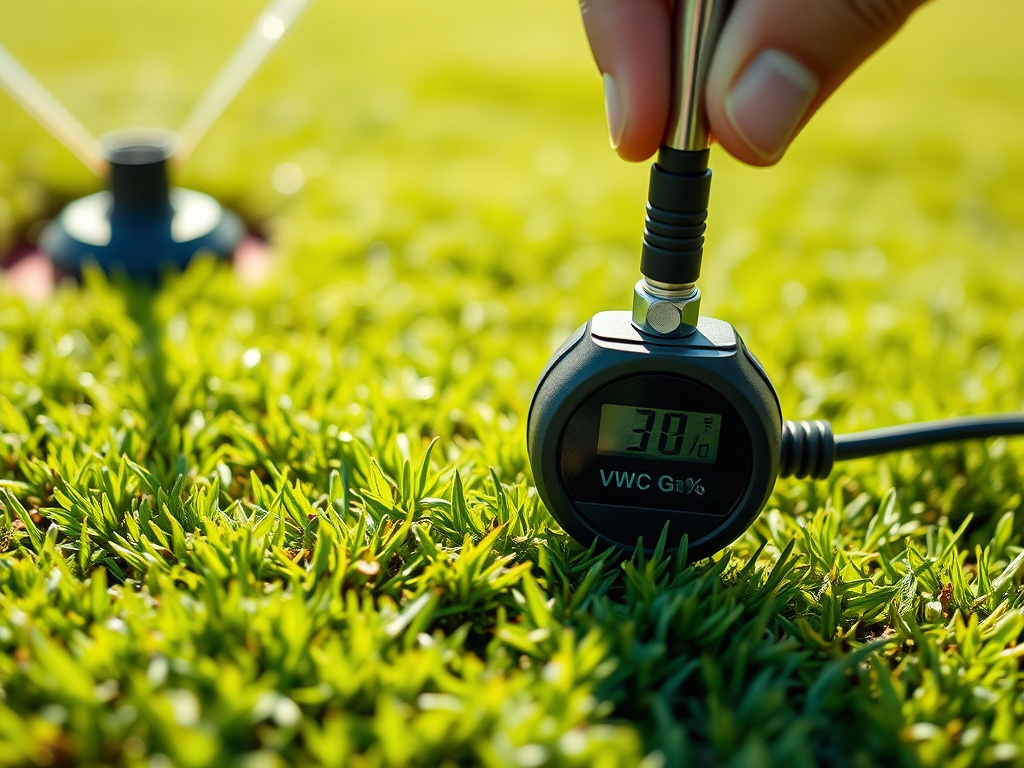
Forget the single silver bullet. Effective water management is a stool built on three legs: measurement, chemistry, and strategy. Pull one out and the whole system wobbles. This isn’t about buying the most expensive sensor; it’s about linking data to a deliberate plan.
The first leg is measurement. You can’t manage what you don’t measure. That means knowing both how much water your pumps push and how much stays in the rootzone where the plant can use it.
Technical Snippet: Evapotranspiration (ET) is the combined water loss from soil evaporation and plant transpiration. Golf course irrigation scheduling uses reference ET (ETo) data, often from an on-site weather station, adjusted by a crop coefficient (Kc) for the specific turfgrass. The goal is to replace a percentage of this calculated water loss, not to refill the soil to field capacity every time.
The second leg is chemistry. Soil isn’t just dirt; it’s a complex matrix where water interacts with organic matter, thatch, and hydrophobic compounds. Wetting agents change the physics of that interaction, helping water penetrate evenly and stay available.
The third leg is strategy. This is where your management philosophy hits the ground. It’s the decision to water at 70% of ET instead of 100%, accepting slightly firmer conditions to build drought resilience. It’s the commitment to audit your irrigation system’s uniformity every other year, because a broken head is a leak in your budget.
Sensor vs. Feel: The Data Revolution
The old-school method had its merits. You walk the course at dawn, probe a green with a soil knife, and feel for moisture. It builds intuition. But intuition scales poorly across 100 acres and doesn’t provide a number you can track over time.
Soil moisture sensors give you that number, volumetric water content (VWC) as a percentage. The revolution isn’t the gadget itself; it’s what you do with the data. The trick is installing them in a representative location, not just a convenient one. A sensor placed in a low spot or a heavily shaded collar will tell you the whole green is wet when the center is bone dry.
I learned this the hard way on a course with persistent dry spots on several greens. We had sensors, but the readings never matched the visual stress. The problem was placement. We’d put them in standard “good” locations, but tree growth over five years had turned those areas into permanent shade, completely altering the soil’s drying cycle. The data was accurate for that spot, and useless for the rest of the putting surface. We moved them to more neutral, sun-exposed areas and finally saw readings that correlated with actual turf need.
The USGA Green Section Record details these spatial challenges, noting that soil moisture can vary wildly within a single green. One sensor per zone is a starting point, not a finish line.
Wetting Agents: The Force Multiplier
Think of a wetting agent as a detergent for your soil. It reduces the surface tension of water, allowing it to spread evenly through the soil profile instead of beading up and running off, or creating isolated wet and dry pockets. This is especially critical in sandy soils and in areas with thatch buildup, which can become hydrophobic.
University research provides the proof, not just the promise. A UC Riverside research report on Bermudagrass under deficit irrigation found that the wetting agent Aquatrols Revolution had the greatest positive effect on turf quality under severe stress (40% ET replacement). Experimental products ACA 1935 and ACA 5000 also significantly improved both turf quality and soil VWC.
| Wetting Agent (from UC Riverside Trials) | Key Finding | Best For |
|---|---|---|
| Aquatrols Revolution | Greatest quality improvement under severe deficit irrigation (40% ET). | Courses facing mandatory water restrictions. |
| ACA 1935 / ACA 5000 | Improved soil VWC and turf quality in deficit trials. | Sandy soils, high-thatch areas needing moisture retention. |
| TriCure AD | Effective at both full and half label rates, offering cost savings. | Large-area applications like fairways where product cost is a major factor. |
The bottom line from the science: on deficit irrigation, a wetting agent is essential for keeping the turf from going over the edge. The Cornell University BMP guide lists them as a core best management practice for a reason.
Deficit Scheduling & The Art of “Less”
Deficit irrigation is a deliberate strategy of applying less water than the turf could potentially use. You’re not trying to create drought stress, but rather to maintain a slight moisture deficit. This does two powerful things.
First, it creates air-filled pore space in the soil, storage capacity for the next rain event. If your soil is already saturated, rainfall just runs off. Second, it encourages deeper root growth as the plant seeks water further down in the profile. Shallow, frequent watering does the opposite.
Where this goes sideways: Applying deficit irrigation uniformly across the course. A shaded approach that stays damp all day needs far less water than a sun-baked fairway knoll. Deficit rates must be zone-specific.
Your golf course management strategy must account for these microclimates. The economic pressure is real, as detailed in analyses of golf course economics, but the agronomic payoff is firmer, healthier playing surfaces that waste less water.
The Non-Negotiable System Audit
All the smart scheduling in the world is wasted if your irrigation system can’t deliver water evenly. Uniformity is the foundation. An audit tells you two critical things: your Distribution Uniformity (DU) and your actual precipitation rates.
| Uniformity Rating (DU) | What It Means | Consequence |
|---|---|---|
| Excellent (75%+) | Water is applied very evenly across the zone. | Can confidently use deficit scheduling. |
| Good (65-74%) | Moderate variation. Some over/under-watering. | Requires longer run times to cover dry spots. |
| Fair (55-64%) | Significant variation, common in older systems. | Must run 30-50% longer, wasting water. |
| Poor (<55%) | Very uneven application. | System needs repair or redesign before any water-saving plan can work. |
A study of five Florida courses found average uniformities ranging from 45% to 63%. A system at 45% DU must run almost twice as long to get enough water to the driest areas, simultaneously overwatering everything else. That’s why the first capital investment in any water conservation plan should be an audit and critical repairs. The Alabama Department of Environment BMPs emphasize pump station and system maintenance as a core component of environmental stewardship.
Regional Realities & The Superintendent’s Role
A plan that works in Arizona will drown a course in Oregon. Your local climate dictates the rules of the game.
In the arid Southwest, water is expensive and often restricted. Every percentage of efficiency translates directly to savings and regulatory compliance. Deficit irrigation and wetting agents are survival tools. In colder northern climates, the annual challenge is winterization, blowing out systems to prevent freeze damage, and a shorter, more intense irrigation season.
In humid, transitional zones, the battle is against persistent moisture and disease. The goal here is often to remove water from the profile through drainage and air movement, not to add it. This is where understanding how to play golf in the rain intersects with agronomy; the superintendent and the player both need to know how the course behaves when wet.
The golf course superintendent is the integrator who balances these regional pressures with daily playability. They use resources like the peer-reviewed irrigation study on national water use trends to advocate for infrastructure upgrades, and they implement the sustainability practices that define modern sustainable maintenance.
Frequently Asked Questions
What is the single biggest water-waster on most golf courses?
An irrigation system with poor distribution uniformity. If your system’s DU is below 60%, you are overwatering some areas by 50% or more just to get enough water to the driest spots. Fixing broken heads, correcting nozzle pressures, and leveling sprinklers should always come before tweaking controller schedules.
How often should soil moisture sensors be calibrated?
At minimum, calibrate them seasonally, once at the start of the peak irrigation season and once in the fall. Check them after any major cultural practice like aerification or topdressing, as the changed soil surface can affect readings. More important than frequent calibration is verifying the sensor’s reading matches a physical check (like a soil probe) in its specific location.
Can you use deficit irrigation on greens, or is it only for fairways?
You can and should use it on greens, but with greater precision. The deficit percentage will be much smaller (e.g., 90% of ET instead of 70% on fairways). The priority is maintaining consistent moisture to prevent stress-induced disease or root die-off. Green surfaces often have their own dedicated irrigation zones precisely for this kind of fine-tuning.
Are wetting agents safe for the environment?
Modern, EPA-registered wetting agents used according to label directions are considered safe. Many are biodegradable. The environmental benefit comes from their primary function: reducing overall water use. Using less water from ponds or aquifers is a net positive for the local watershed, which is a key part of any golf course sustainability practices.
How does course design affect irrigation needs?
Dramatically. A wide-open links-style course has uniform wind and sun exposure, making scheduling simpler. A heavily wooded parkland course creates dozens of microclimates with varying sun, wind, and root competition from trees, requiring a complex zone map. This is why irrigation design is a critical phase in golf course construction.
The Bottom Line
Modern turf irrigation focuses on having the most control over the water you use. The three-part framework, measure with sensors, enhance with chemistry, and strategize with deficit scheduling, is what cut national water use per acre by 15%.
Start with an irrigation audit. You can’t fix what you don’t know is broken. Then, pick one wetting agent proven in university trials, like Revolution or TriCure AD, and apply it to your most stressed fairways. Finally, look at your controller. Find one zone, maybe a sunny, open fairway, and reduce its runtime by 10%. Watch it for a week. The turf will tell you if it’s enough.
That’s the shift. From a calendar in the office to a conversation with the course itself. The data guides, the tools help, but the decision to water less today for a more resilient course tomorrow is still a human one. Make that call once, and the savings, and the better playing surfaces, compound for seasons to come.
