
How to Become a PGA Professional: Pathways & Requirements
This post contains affiliate links. As an Amazon Associate, we earn from qualifying purchases.
To become a PGA Professional, you choose between two official pathways: the self-paced PGA Associate Program, which requires full-time employment at a golf facility, or the 4.5-year PGA Golf Management University Program at one of 16 schools. Both require passing a background check, completing the PGA Professional Golf Management (PGM) curriculum, including five-day seminars in Frisco, Texas, and passing the 36-hole Playing Ability Test (PAT) within 15 shots of the course rating. The PAT is not an entrance test but must be passed before registering for the final Level 3 coursework.
The distinction between those two routes, self-paced with a job versus a structured college degree with internships, is the single biggest decision you’ll make. One builds your career resume alongside your education; the other immerses you in golf business theory before sending you out for 16 months of internships. Your choice dictates your daily life for the next half-decade.
What follows is a breakdown of both paths, the exact PAT math you need to pass, the three career tracks you’ll specialize in, and the one eligibility trap that catches more applicants than a buried bunker lie.
Key Takeaways
- The PGA’s Playing Ability Test (PAT) isn’t an entrance exam; you must pass it before your final Level 3, and a passed score is valid for eight years from the date you shot it.
- The University Program is a 4.5–5 year college degree with built-in internships, while the Associate Program is self-paced and requires you to already be working full-time at a golf course.
- After Level 1, you must choose one of three career paths: Golf Operations, Teaching & Coaching, or Executive Management, your coursework and seminars diverge from there.
- You can satisfy the PAT requirement by shooting one 18-hole score within five strokes of the target during any attempt in the eight years before registration, not just a full 36-hole pass.
- Nearly 60% of golf facilities employ a PGA member, making the certification a direct ticket to management roles beyond just giving lessons.
The Two Main Pathways to Membership
You have a fork in the road right at the start. On one side is the go-at-your-own-pace Associate Program. On the other is the traditional college experience of the University Program. They lead to the same “, PGA” title, but they are built for different lives.
The PGA Associate Program is for the person already in the industry or ready to jump in. It’s self-paced, which sounds flexible until you realize it requires full-time employment at a golf facility from day one. You’re not just studying turfgrass management, you’re managing the cart fleet on a Saturday morning while fitting in coursework. The timeline is yours to control, but your progress is measured against an “Acceptable Progress” clock that starts ticking the moment you register. This is the path for the doer who learns by applying concepts directly to a real pro shop, restaurant, or lesson tee.
The PGA’s official PGA Professional Golf Management curriculum outlines the three-level structure for both pathways, each level blending online manuals, portfolio projects, and intensive five-day seminars.
The PGA Golf Management University Program is a 4.5 to 5-year commitment at one of 16 universities across the country. You earn a bachelor’s degree in something like business administration or hospitality while completing the same PGM coursework as the Associate track. The killer feature is the 16 months of required internships, which scatter you across different facilities and roles. You graduate with a degree, the PGM completion, and a resume that’s already several pages long. It’s a structured, immersive bootcamp for the golf business, but it requires the time and financial commitment of a college degree.
I’ve watched students from both paths succeed. The University grad often has a broader network from those internships. The Associate who’s been working at a muny for four years has deeper operational scars, and usually a better handle on payroll software. One isn’t better; they’re tools for different situations.
The Playing Ability Test (PAT) Is Your Skill Threshold
Let’s be clear about this. The PAT is where talented players who can’t manage pressure watch their PGA dream stall. It’s not a test of tour-level skill; it’s a test of competent, repeatable golf under scrutiny. The math is precise: shoot a 36-hole score within 15 strokes of the 36-hole course rating. If the course rating is 72, your target is 159 (72 x 2 = 144, + 15). You do this in one day, walking, under the same rules as any tournament.
Common mistake: Thinking you need to pass the PAT before you start the PGM program. You don’t. You can, and most do, register and begin coursework first. But you must pass it before you can register for Level 3, the final stage before membership.
The PAT’s eight-year validity window is your friend, not a constraint. If you passed a PAT eight years and one day ago, it’s expired. If you passed it yesterday, you have eight years to progress through the PGM program’s “Acceptable Progress” timeline. This rule exists because life happens, injuries, career shifts, family. It gives you a runway.
Here’s the part nobody mentions: you have a second, quieter way to satisfy the requirement. If you attempt the PAT at least once within eight years prior to registration, you can use a single 18-hole score that comes within five strokes of the 18-hole target. So if the target for 18 holes is 79 (72 + 7, because 15/2 = 7.5, rounded), shooting an 84 or better in one of your rounds counts. It’s a safety valve for the player who crumbles in the afternoon round but can post a solid morning number.
| PAT Requirement | Standard 36-Hole Method | Alternative 18-Hole Method |
|---|---|---|
| When to Complete | Before registering for Level 3 | At least one attempt within 8 years prior to PGM registration |
| Target Score | 36-hole course rating + 15 strokes | 18-hole course rating + 5 strokes (for one round) |
| Validity Period | 8 years from the date passed | 8 years from the date of the qualifying round |
| Typical Format | Two consecutive rounds in one day | Any 18-hole round during an official PAT event |
Strip it back. The PAT says, “Can you play to a consistent, mid-handicap level?” If you’re spending 90% of your practice time trying to add 20 yards to your drive instead of learning to get up and down from a buried lie, you’re preparing for the wrong test.
Breaking Down the PGM Program Levels
Once you’re registered, whether as an Associate or a University student, you’re climbing the same three-level ladder. Each level is a blend of book learning, hands-on projects, and that all-important seminar in Frisco. The grind is real, but it’s structured.
Qualifying Level is your onboarding. You’ll pass a background check, complete four online courses (intro to the PGA, the Constitution, Rules of Golf, Career Enhancement), and verify your eligible employment if you’re an Associate. It’s administrative, but it’s the foundation. Skip the pre-work for these courses and you’ll show up to your first seminar behind everyone else.
Level 1 is where the real work begins. You’ll complete course manuals on Facility Management and Teaching & Coaching, attend the seminars (three days on management, two on teaching), and build a portfolio linking the theory to your job. At the end of this level, you choose your career path: Golf Operations, Teaching & Coaching, or Executive Management. This choice isn’t a minor elective; it dictates the focus of every piece of coursework and every seminar for Levels 2 and 3.
I once believed that more technical knowledge was always better, until I saw it cause paralysis for several assistant pros trying to please every department. The path system forces you to specialize early, which is frustrating but ultimately career-saving.
Level 2 and Level 3 deepen your specialization. If you picked Teaching & Coaching, your Level 2 seminar is a full five days on advanced instruction methodology. Your portfolio becomes more intricate, requiring you to design a full player development program or analyze swing data. The final hurdle in Level 3 is a proctored knowledge test, multiple-choice and true/false questions drawn from every domain you’ve studied. It’s open book in spirit only; the questions are built for application, not rote recall.
The five-day seminars in Frisco (or virtually) are where the cohort bonds. You’re in a classroom from 8 to 5, then dissecting the day’s topics over dinner. The fatigue is physical, sitting, discussing, workshopping, but the connections you make are the start of your professional network. You’ll meet your future boss, your future business partner, or the person who bails you out with a vendor contact next year.
Work Experience: The Non-Negotiable Ingredient
!PGA professional candidate clocking in for required work experience at golf facilityjpg) The PGA doesn’t certify theorists. They certify professionals who can run a facility, grow the game, and turn a profit. That’s why work experience isn’t just recommended; it’s mandated and meticulously tracked.
For Associates, this is straightforward: you must be employed full-time in an eligible position at a golf facility when you register and throughout your progression. The PGA has a list of approved job classifications. If you’re a bartender in the clubhouse, that might not count. If you’re an assistant pro running leagues and fittings, it does. Your portfolio projects are literally your job duties, documented and refined.
For University Program students, the requirement is met through those 16 months of internships. These aren’t fetch-coffee gigs; you’ll do rotations in golf shop operations, tournament direction, food and beverage, and instruction. The goal is exposure. You might discover you hate tournament logistics but love teaching seniors. That discovery is the point.
The system has a built-in trap, though. If you compete in amateur tournaments as an Associate, you forfeit the work experience credits for that period. The PGA views that as time not spent developing as a professional. It’s a rule that forces a choice: are you an aspiring club professional or an amateur competitor? You can’t fully be both on the PGA’s clock.
Costs, Timelines, and the Business Reality
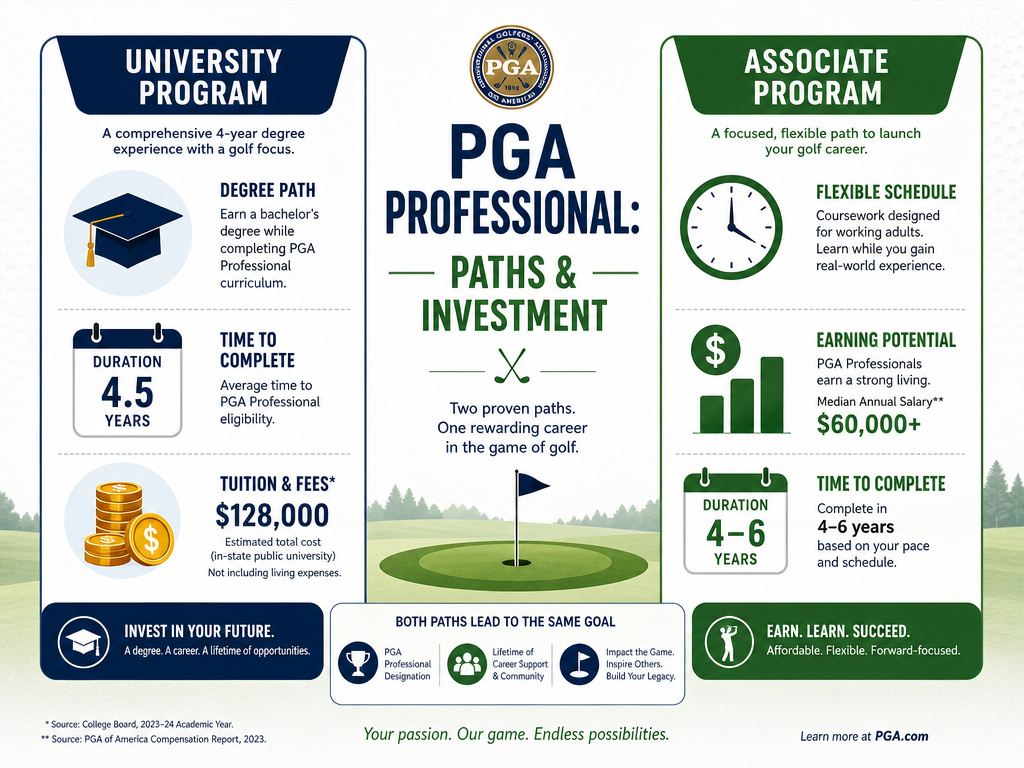 Let’s talk about the investment. The University Program means college tuition, room, board, and fees for 4.5 years. The Associate Program has lower direct education costs but assumes you’re living on an assistant pro’s salary, which, early on, is modest. You’re trading tuition dollars for years of earned income and resume lines.
The timeline difference is stark. An Associate, grinding through levels while working 50-hour weeks, might take four to six years. A University student is on a set, 4.5-year academic track. One feels like a marathon where you carry weights; the other feels like a guided tour with scheduled rest stops.
Where this goes sideways: Underestimating the time commitment for the self-paced Associate path. “Self-paced” doesn’t mean “whenever.” The “Acceptable Progress” policy requires you to complete each level within a certain timeframe. Life gets busy, a level expires, and you’re-registering and paying again.
Is it worth it? Look at the numbers. Nearly 18,000 golf facilities exist, and about 60% employ a PGA member. Over 18,000 active PGA Members hold jobs as head professionals, directors of golf, general managers, and elite instructors. The certification is a union card for the golf industry. It won’t guarantee you a job at Augusta National, but it will get your resume past the first filter at almost any public course or resort.
The future of the career isn’t just giving lessons. It’s in specialization: becoming the go-to junior golf developer, the clubfitting expert who partners with a major brand, or the manager who understands agronomy budgets. The benefits of professional club fitting is a skill set that turns a teaching pro into a revenue center. The PGM program, especially the Executive Management track, is built to teach you that.
Frequently Asked Questions
Can you become a PGA Pro without a college degree?
Yes. The PGA Associate Program requires no degree, only a high school diploma or equivalent. The University Program includes a degree, but it is not a requirement for membership if you complete the Associate path.
How hard is the PGA Playing Ability Test?
The PAT is designed to be passed by a skilled amateur golfer. The target is a 36-hole score within 15 shots of the course rating, typically requiring two rounds in the 70s or low 80s on a course of average difficulty. The pressure of a one-day test is often the biggest hurdle.
What’s the difference between the PGA of America and the PGA Tour?
The PGA of America is a membership organization of club and teaching professionals focused on growing the game and managing facilities. The PGA Tour is a separate entity that organizes professional tournaments for playing professionals like Rory McIlroy and Scottie Scheffler. The PGA Tour structure is built around competition, while the PGA of America’s structure is built around education and career development.
How long does it take to become a PGA Teaching Professional?
The timeline depends on your path. After completing the PGM program and passing the PAT, you must gain the required work experience in instruction. A focused candidate in the Teaching & Coaching career path could achieve this in 4-6 years through the Associate Program or upon graduation from the 4.5-year University Program.
Can you make a good living as a PGA Professional?
Earnings vary widely based on role, location, and facility. Head professionals at private clubs or directors of golf at large resorts can earn six figures with bonuses. Assistant pros and teaching professionals starting out will earn less, often combining salary with lesson revenue. The career offers stability within the golf industry rather than the volatile earnings of a touring pro on the Korn Ferry Tour pathway.
Before You Go
The path to “, PGA” is a trade apprenticeship wrapped in a modern education. It rewards the person who shows up, for the 6 AM cart set-up, the late-night inventory count, and the fifth rewrite of a portfolio project.
Register, tackle the Qualifying Level, and use your workplace as your lab. If you’re coming out of high school with a passion for the business side of golf, the University Program is a structured, debt-heavy but network-rich launchpad.
One final, non-negotiable rule from the official PAT regulations PDF: your playing skill must be current. A PAT score expires after eight years. Don’t let a career dream stall because you thought an old score would last forever. Your first move, before any registration, should be to check the PAT schedule and get a current number on the board.
The certification is a license to operate in the world of golf. It says you’ve been tested on the rules, the swing, the balance sheet, and your own ability to break 80 on a long day. That’s a credential no one can ever take from you.
